A stack of 50,000 chips can feel enormous. In a poker tournament, however, the number printed on the chips tells you almost nothing by itself. If the big blind is 500, you have 100 big blinds. If it is 2,000, the same stack is only 25 big blinds. Your decisions should change completely.
The useful question is not “How many chips do I have?” It is “How many big blinds do I have?”
The one calculation to make every level
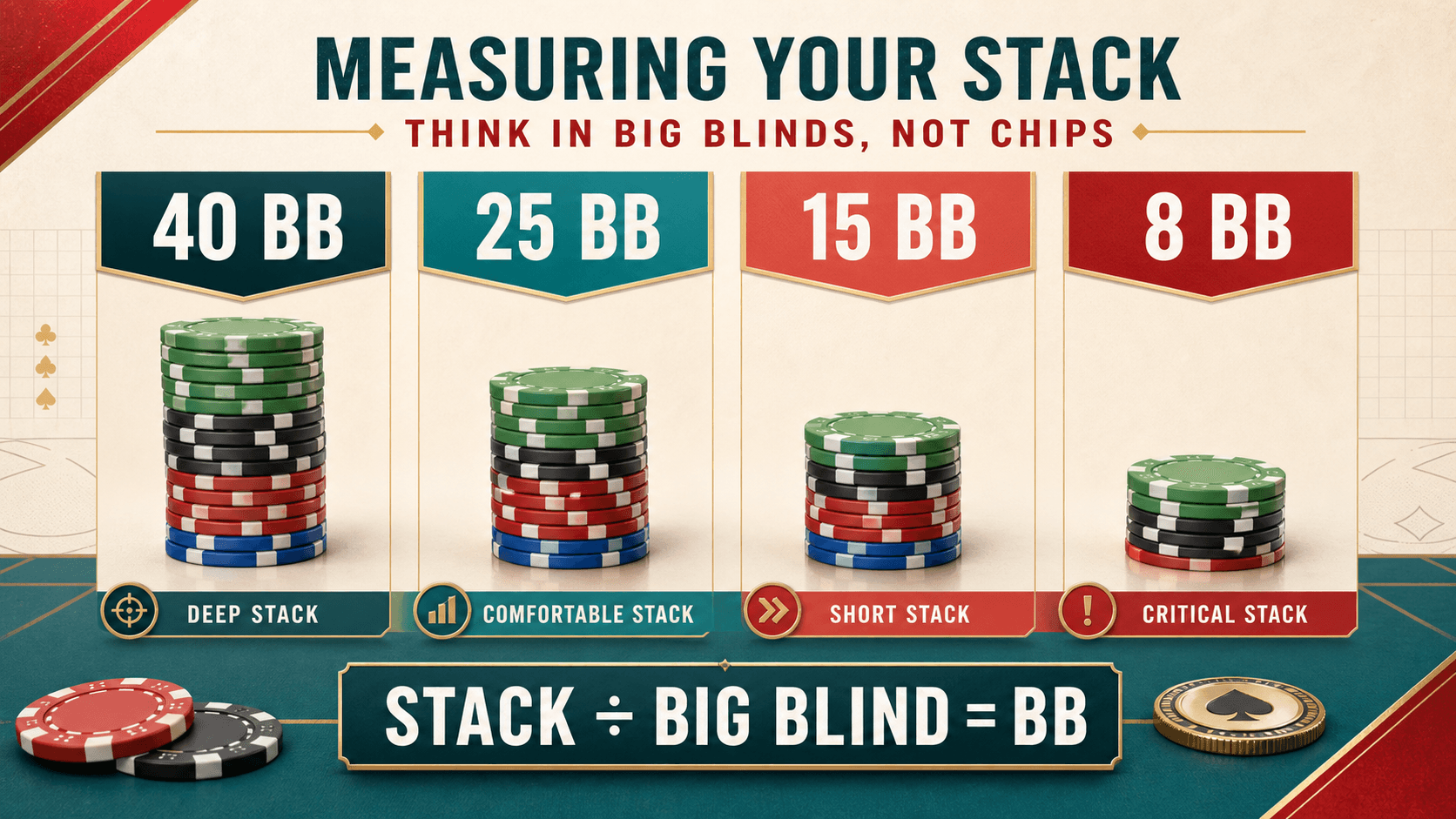
Divide your stack by the current big blind.
50,000 chips at 1,000/2,000 blinds = 25 big blinds.
You do not need a calculator for perfect precision. Round to a number you can use quickly: 40 BB, 25 BB, 15 BB or 8 BB. Recalculate when the blinds increase, after a large pot, and before entering a new hand that may commit a meaningful part of your stack.
Four stack zones that change your options
40 BB or more — deep: You have room to open, call in position, three-bet without automatically committing your whole stack, and play later streets. This does not mean every speculative hand is profitable; position and opponent quality still matter.
Around 25 BB — comfortable but compressed: You can still raise-fold, but loose calls become expensive. Three-bet pots create a low stack-to-pot ratio quickly. Plan before entering: will you continue against a re-raise, or are you spending chips without a clear next step?
Around 15 BB — short: Open sizes should stay small, and many calls become worse than either shoving or folding. Your fold equity matters. Limping or calling simply to “see a flop” can consume too much of the stack.
Around 8 BB — critical: The blinds and ante are taking a meaningful share of your stack. Waiting only for premium pairs can leave you with too little fold equity. Decisions become highly dependent on position, action before you, payout pressure and the ranges of players behind.
These are planning zones, not automatic commands. A 15 BB button decision is different from a 15 BB under-the-gun decision.
The big blind ante makes waiting more expensive
Many modern live tournaments use a big blind ante. The player in the big blind posts both the blind and the table’s ante for that hand. Poker TDA’s current recommended procedures support the big-blind-ante format and recommend calculating the blind first when a short stack cannot cover both.
At an eight-handed table, one full orbit commonly costs about 2.5 big blinds: 0.5 BB as the small blind, 1 BB as the big blind, and 1 BB as the big blind ante.
That means a 20 BB stack has roughly eight orbit-costs before considering future blind increases. It does not mean you have eight comfortable orbits to wait. The structure will usually move, tables may become shorter, and your ability to make opponents fold shrinks as your stack falls.
A 20-second routine before every important hand
- Check the big blind and confirm whether a big blind ante is in play.
- Divide your stack by the big blind and round to the nearest useful number.
- Note the effective stack: the smaller stack between you and the opponent who can continue.
- Look at the next blind increase and how many hands remain in the level.
- Decide whether your hand is a raise-fold, raise-call, shove or fold before you put chips in.
The effective stack is crucial. You may have 40 BB, but if every player behind has 12 BB, their stacks determine the maximum you can win from them and the pressure their all-in decisions create.
Example: the same 48,000-chip stack
At 400/800, 48,000 is 60 BB. You can use position, smaller pots and post-flop skill.
At 1,000/2,000, it is 24 BB. Calls and three-bets consume a much larger percentage of your stack.
At 2,000/4,000, it is 12 BB. A standard open followed by a fold may cost a large part of your remaining leverage. Shove-or-fold and raise-call planning becomes much more important.
The chips did not change. The strategic value did.
Common mistakes DIP sees
- Celebrating a chip count without comparing it with the blinds.
- Calling a raise because the amount “looks small” in pesos or chips.
- Using a cash-game mindset when the blinds and ante keep rising.
- Counting only your own stack instead of the effective stack.
- Waiting for a perfect hand until your shove no longer pressures anyone.
- Treating stack-zone guidelines as rigid charts without considering position, opponents and payouts.
DIP’s view
Big-blind thinking is one of the fastest upgrades a new tournament player can make. It turns an intimidating pile of chips into a decision framework. Start with four checkpoints—40, 25, 15 and 8 BB—then add position, opponent tendencies and payout pressure as your experience grows.
A chart can suggest a baseline, but live poker is not played in a vacuum. Confirm the event’s house rules and structure, watch who is calling too widely, and avoid committing chips without knowing what you will do against a raise.
Information verified: August 29, 2026. Rule references were checked against the Poker Tournament Directors Association’s 2024 rules and the official 2026 WSOP tournament materials. House rules and individual tournament structures may differ.
Responsible play notice: Poker involves financial risk. Set a spending limit before you play, never chase losses, and treat any buy-in as money you can afford to lose.