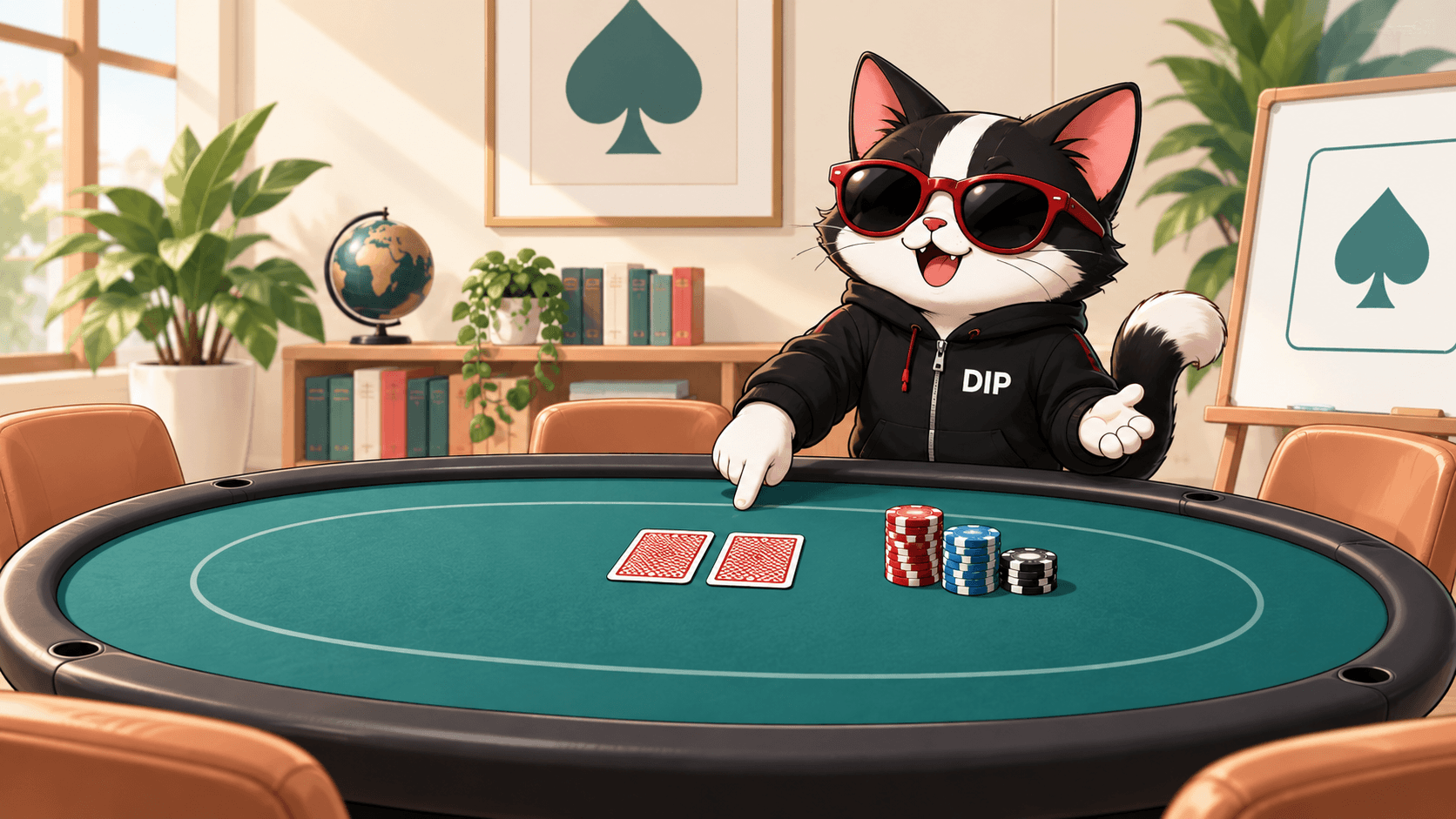
A pile beside your cards and a pile in the middle do different jobs. Today we will follow the chips, one action at a time. You do not need to know a betting strategy. You only need to ask: which chips can I still bet, and which have already been wagered?
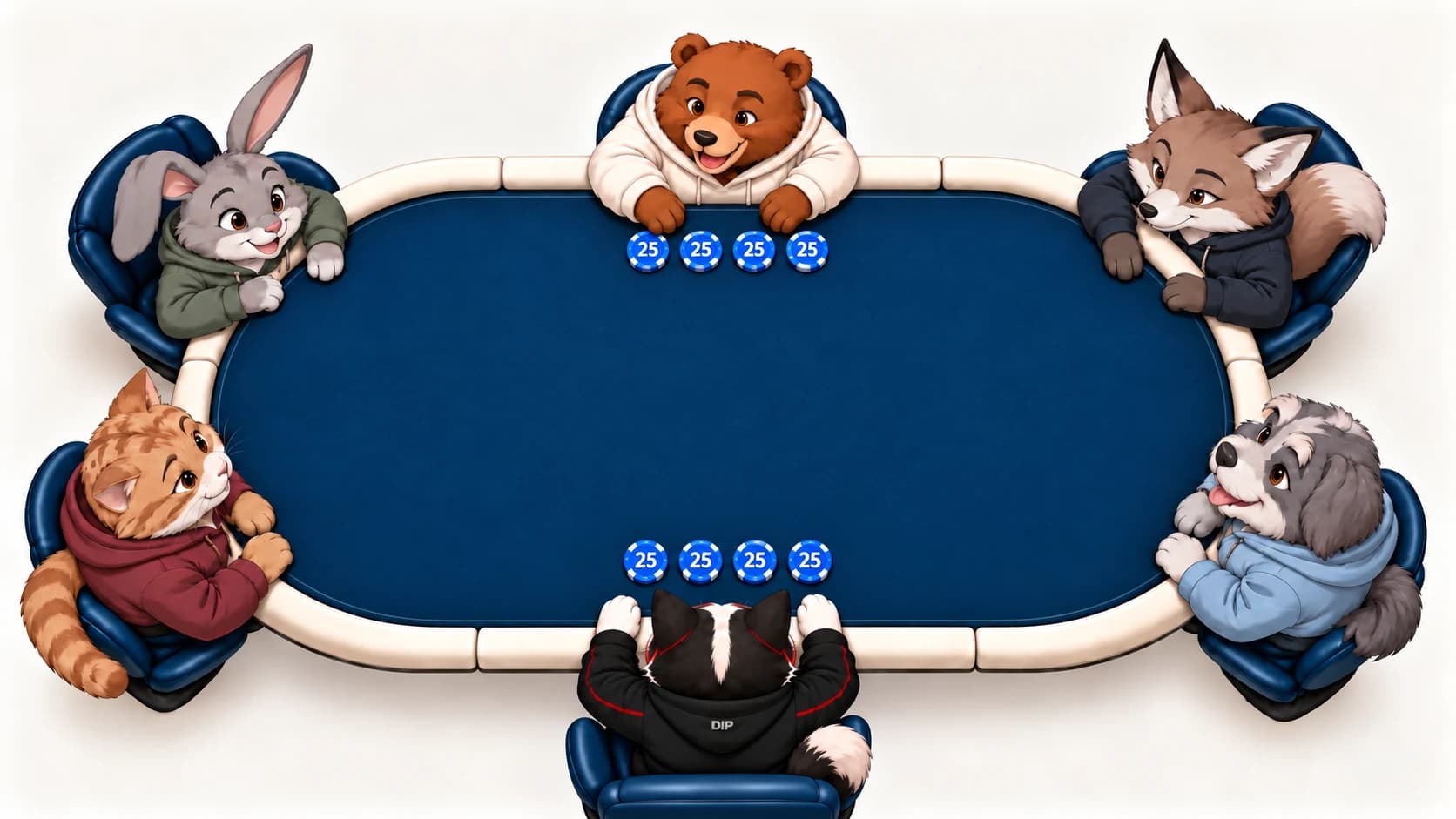
Everything here uses free practice units, not money. DIP Cat is you, at the bottom of the table. Bear is your only opponent, at the top. The other four friends are watching. They are not playing this hand, have not posted blinds and have not contributed any chips.
What you will learn
- Identify your remaining stack separately from the pot.
- Count chip value rather than just the number of discs.
- Follow a raise, a bet and a call without counting a payment twice.
- Turn a chip amount into big blinds, written BB.
First, what is a chip worth?
A chip is a small marker representing a value. That printed value is its denomination. In this classroom, purple means 1 practice unit, gold means 5 and blue means 25. These colours are our teaching convention, not a universal casino rule. In a real room, read the value or ask the dealer.
Look at each row in the picture. Five purple chips are worth 5. Three gold chips are worth 15. Two blue chips are worth 50. There are ten physical chips, but their combined value is 70 units.
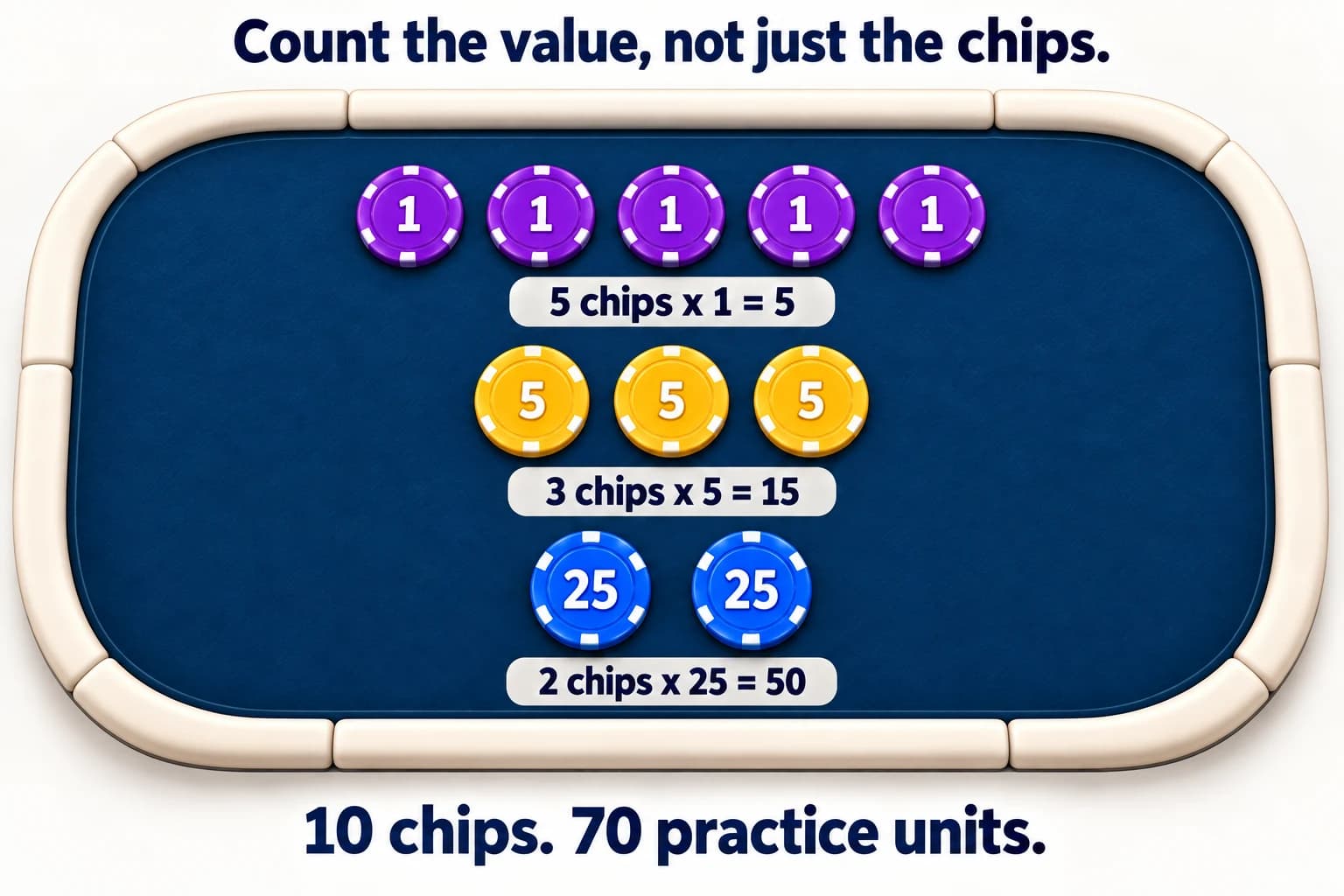
Changing one blue 25 into five gold 5s does not give you more value. It only gives you more pieces. This is useful when you need to pay a small amount. In the pictures that follow, some chips are exchanged for smaller denominations between actions. Those exchanges never change either player's total.
Three places to look
Your remaining stack is the chip value you still have available to wager. In our table pictures, it sits to the right of your cards, near your seat. Bear's remaining stack sits near Bear's seat at the top right. These are two different players' stacks.
A current wager is the separate group you have pushed forward for this betting round. Those chips have already left your remaining stack, even if the dealer has not gathered them yet. Being close to your cards does not make them available to bet again.
The collected pot is the group already gathered away from both players' personal stacks. After the flop, it appears on the left side of the felt. It is not a literal bowl. It is simply the chips being contested.
Our TOTAL POT includes the collected pot AND both players' current wagers. We count each chip once. Later, gathering those wagers into one pile changes their location, not the total pot.
Our two-player practice hand
Both players begin with 100 units. The small blind is 1 and the big blind is 2. There is no ante, rake or other deduction, and nobody adds or removes chips. Therefore your remaining stack + Bear's remaining stack + total pot must always equal 200.
You have the dealer button and post the small blind. Bear posts the big blind. With exactly two players, this is called heads-up: you act first before the flop and Bear acts first after the flop. This is the two-player exception introduced in Lesson 4, not its six-player action order.
Before the hand starts, each player has four blue 25-unit chips: 4 x 25 = 100. Nothing has been wagered. No cards have been dealt.
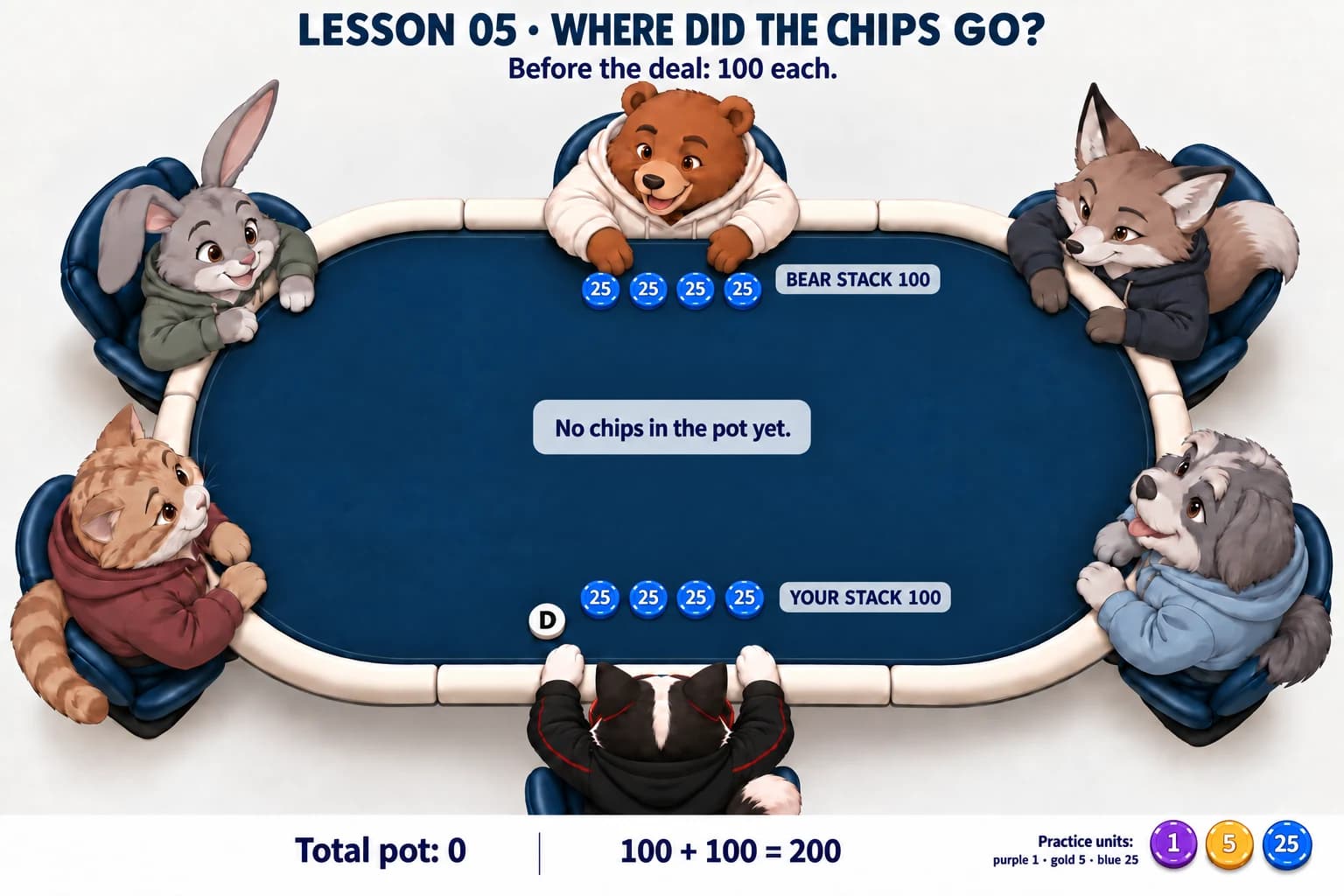
The blinds: your 1 and Bear's 2
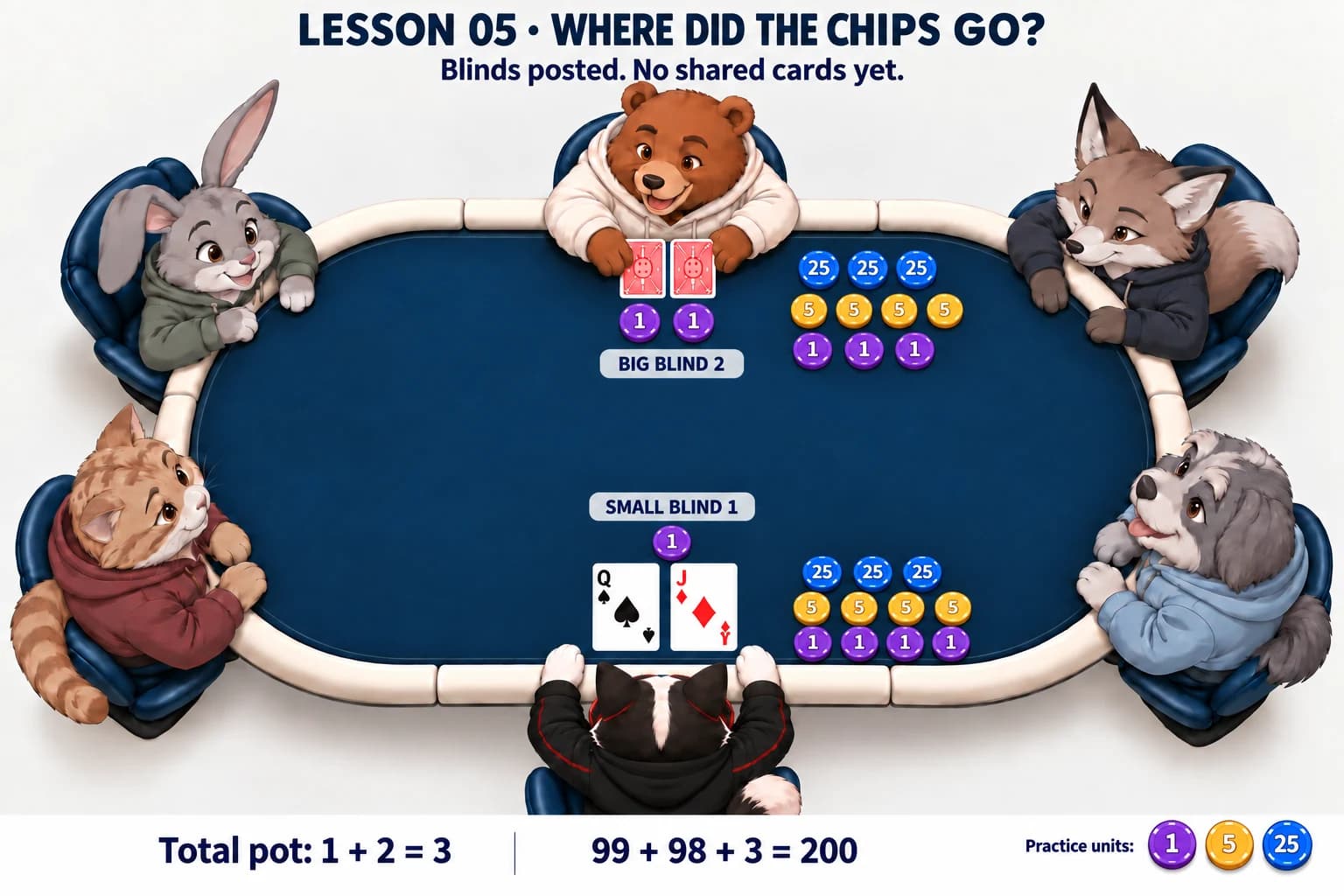
You post 1, leaving 99 in your stack. Bear posts 2, leaving 98. These required wagers start the pot before the ordinary preflop decisions. Total pot: 1 + 2 = 3.
You receive Q♠ J♦ as your two private cards. Bear receives two private cards, shown face down. The centre has no shared cards yet, so this is preflop. We keep the same hand throughout. The card ranks are not what we are practising today.
You raise TO 4: add only 3
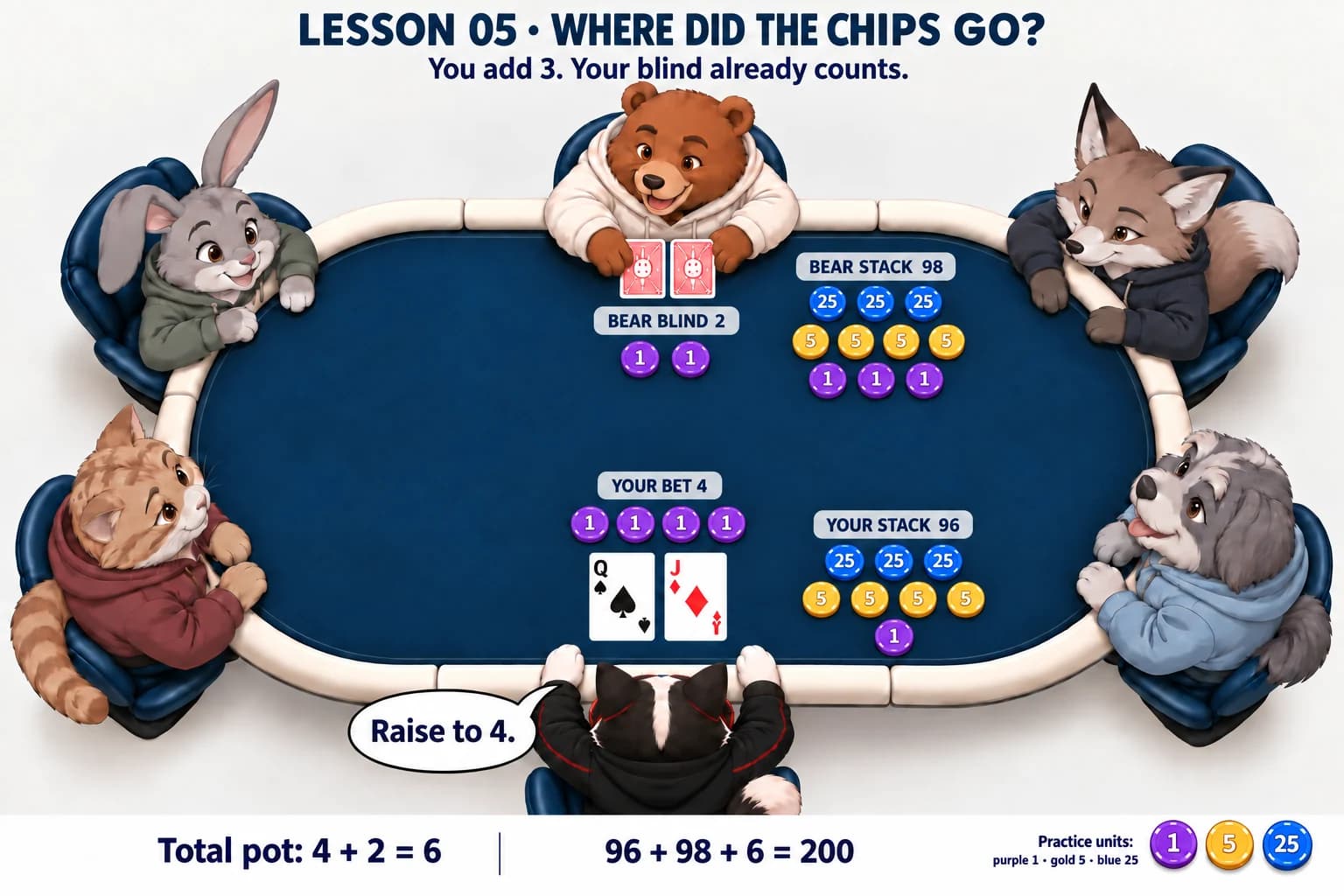
You act first. Raising TO 4 means your entire contribution on this betting round becomes 4. The 1-unit small blind you already posted counts towards that amount. You do not pay a fresh 4 on top of it.
- Already posted: 1.
- Extra chips needed: 4 - 1 = 3.
- Your remaining stack: 99 - 3 = 96.
- Total pot right now: your 4 + Bear's 2 = 6.
Bear calls: add only 2
Now it is Bear's turn. Bear already posted 2 and needs a total of 4 to match you. Bear adds 2, not 4, leaving 96. Both players have contributed 4. The dealer can gather those contributions into a single pot of 8.
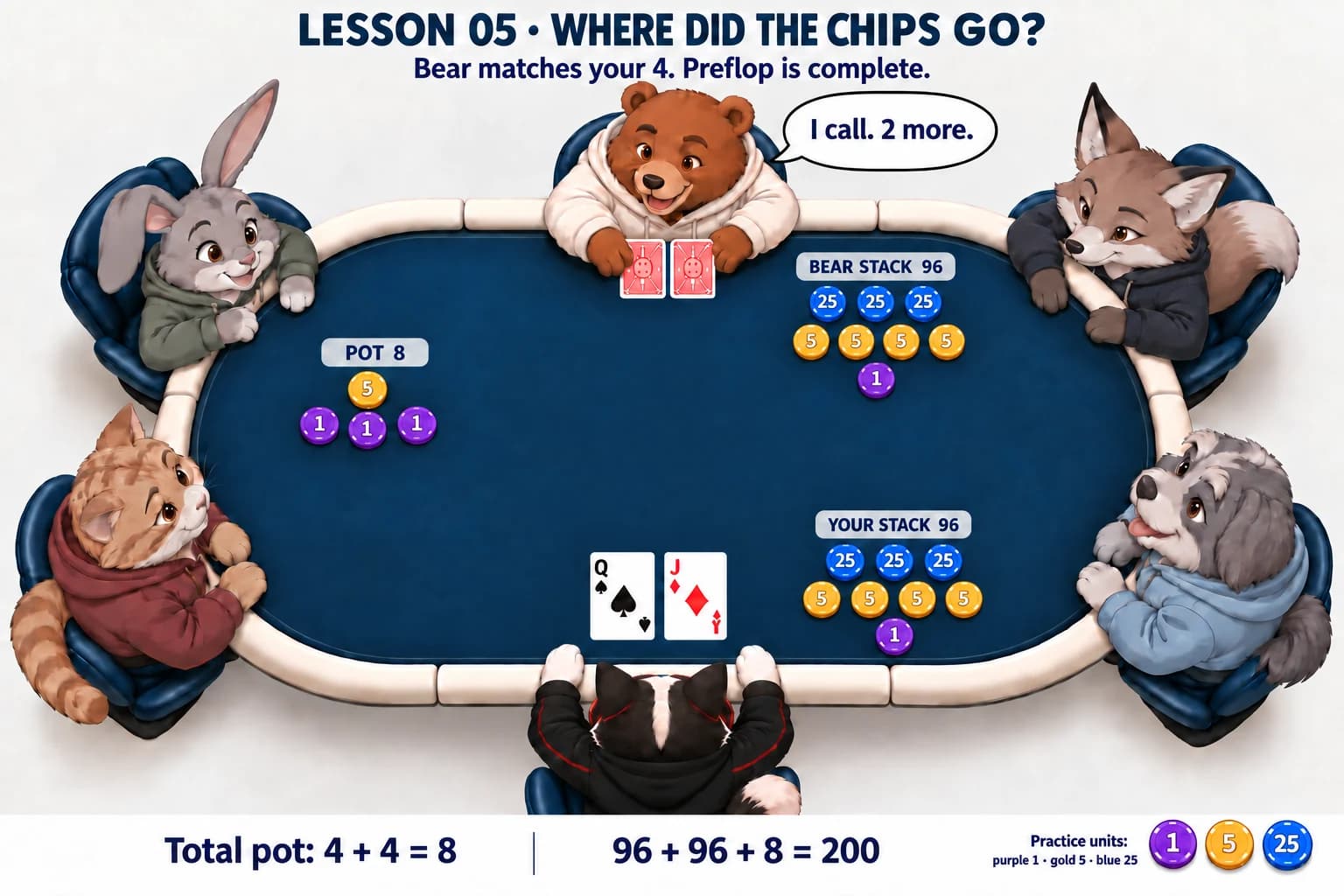
Notice that your stack stayed 96 while Bear called. It was not your turn to pay. Also, gathering the chips did not increase the pot: they were already counted while sitting in front of the players.
The flop appears, and Bear checks
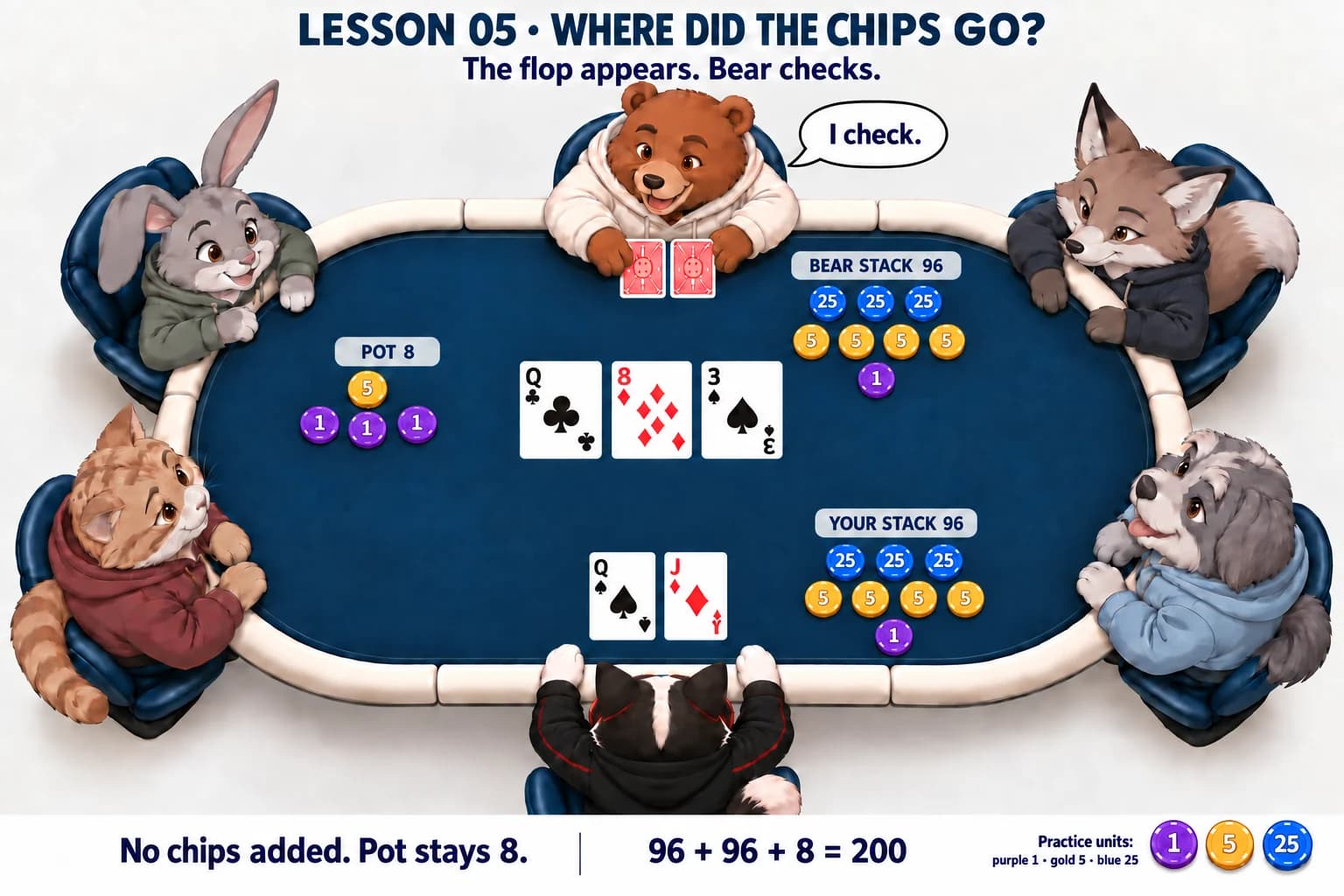
The dealer places three shared cards in the middle: Q♣ 8♦ 3♠. This is the flop. Your private cards remain Q♠ J♦. Bear's private cards remain hidden. Only two players are in the hand; the friends at the other seats are still just watching.
Bear acts first on this round and checks. Nobody has bet on the flop yet, so checking continues the hand without adding chips. Both stacks remain 96 and the pot remains 8.
You bet 4: keep the old pot separate
You now bet 4. Your remaining stack falls from 96 to 92. The four purple chips in front of you are your new wager, separate from the old collected pot of 8. Bear still has 96 and has not called yet.
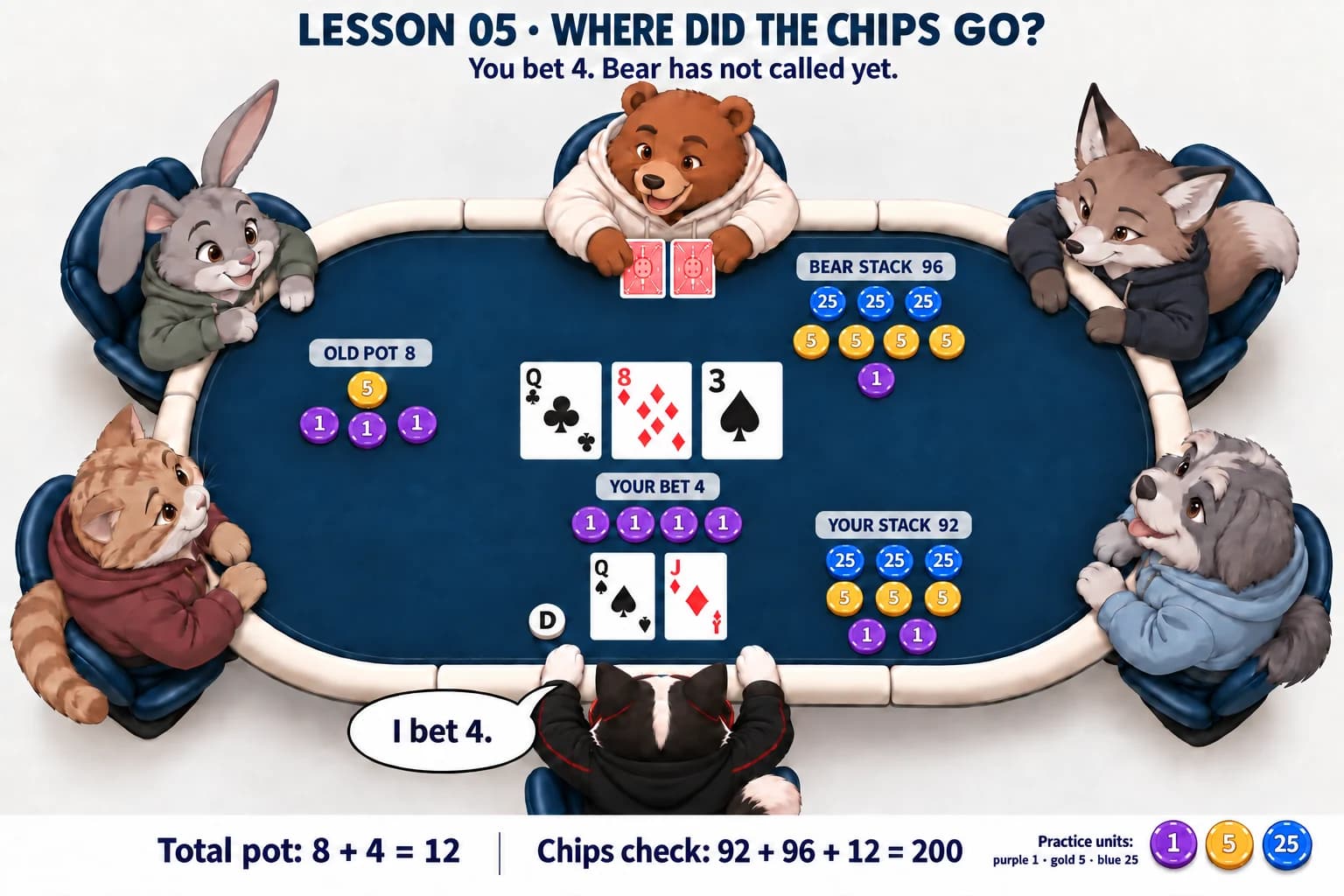
Point to the three different places: your remaining stack, your four wagered chips and the old pot. The wager is already part of the total pot of 12. Do not add it a second time just because it is not in the collected pile yet.
Bear calls 4: one new payment
Bear matches your flop bet by putting in 4. Bear's stack drops from 96 to 92. Your stack stays 92. The old pot is still 8, your wager is 4 and Bear's new wager is 4. Total pot: 8 + 4 + 4 = 16.
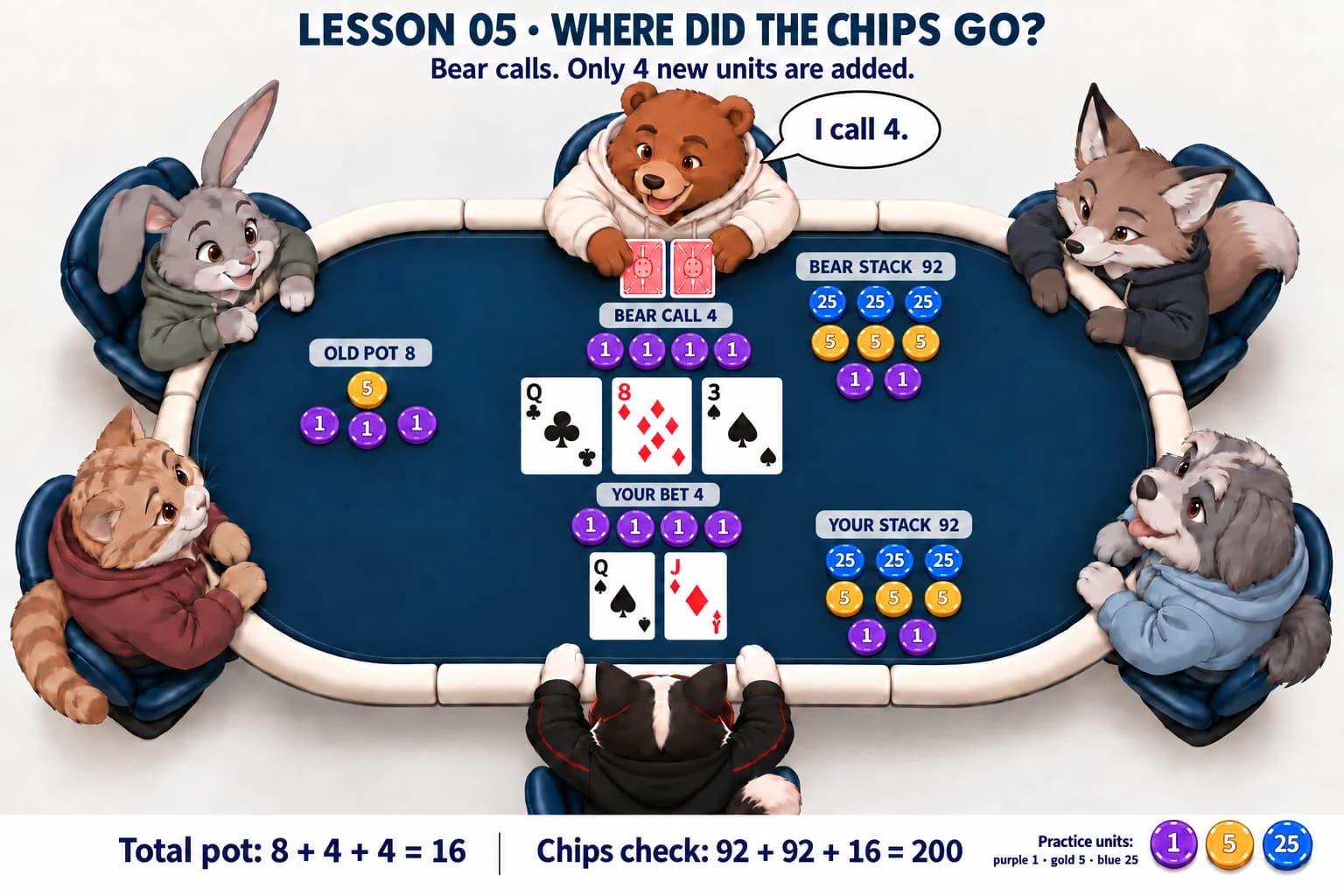
The dealer can now gather both four-unit wagers beside the old pot. The total stays 16. Both remaining stacks are 92, and 92 + 92 + 16 = 200. The betting round is complete, but the hand is not over. We stop before the turn. No winner has been decided, and the pot is not yours just because you bet or hold a pair of queens.
Try the sequence with free chips or counters. After each action, count both remaining stacks and the total pot. If the answer is not 200, check for a payment you counted twice or a chip you forgot to move.
What does BB mean?
BB stands for big blind. It can describe the player in that seat. In an amount such as 50 BB, it is a measuring unit: one BB equals the current big-blind amount.
In this hand, one BB is 2 practice units. Divide a chip value by 2 to express it in BB:
- Starting stack: 100 / 2 = 50 BB.
- Remaining stack after the flop call: 92 / 2 = 46 BB.
- Total pot after the call: 16 / 2 = 8 BB.
46 BB does not mean 46 plastic chips. It describes value. Different combinations of 1-, 5- and 25-unit chips can represent the same total.
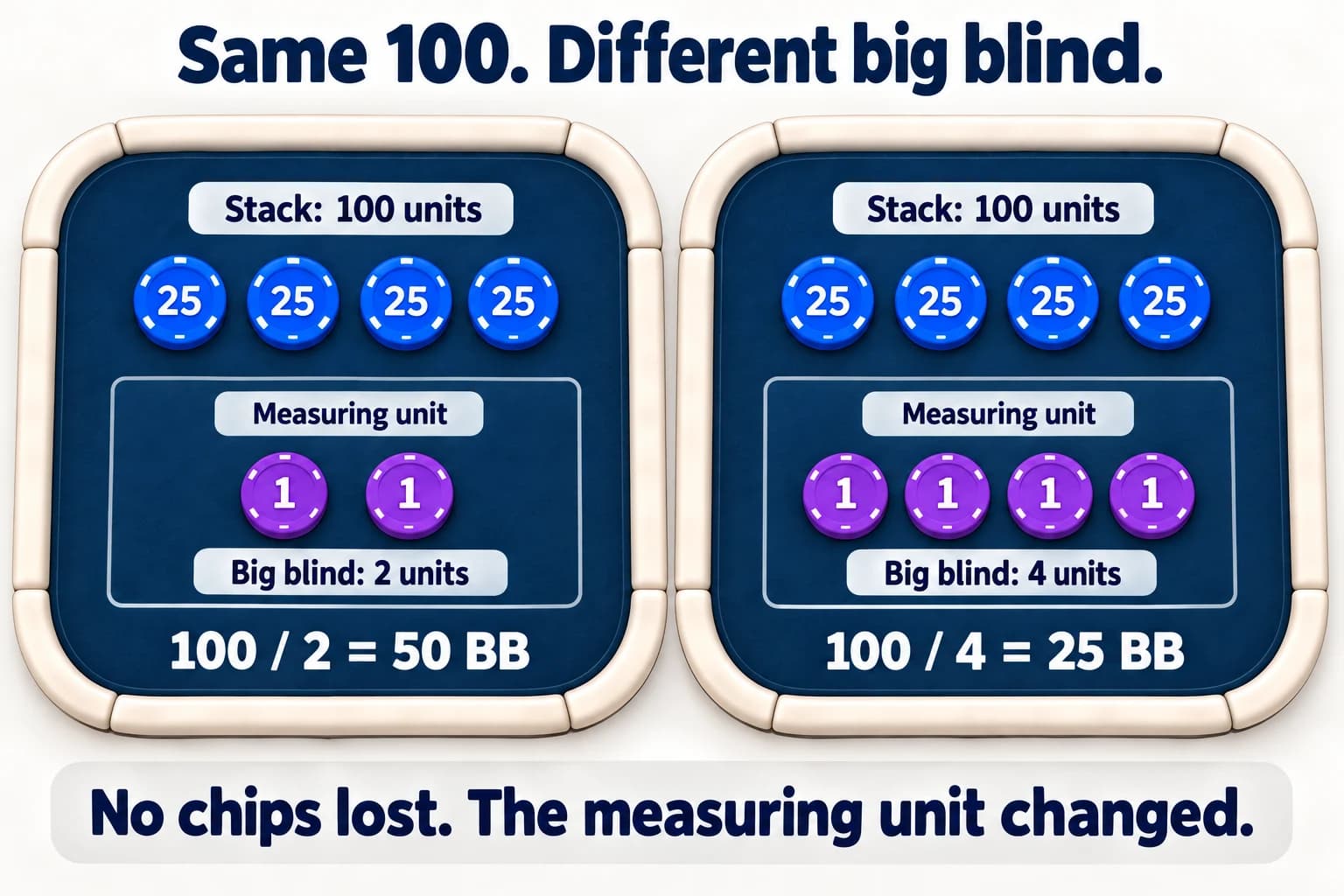
If a later tournament level changes the big blind from 2 to 4, an unchanged 100-unit stack becomes 100 / 4 = 25 BB. You did not lose half your chips. The measuring unit doubled. Always use the current big blind.
An ante is a separate required contribution. It can add to the pot, but it does not change what one BB means. We left antes out of this practice hand to learn one calculation at a time.
A short note about effective stacks
For a two-player decision, the smaller remaining stack limits how much more the two players can match against each other. If you have 92 and Bear has 60, the effective remaining stack is 60. Your actual stack is still 92. The unmatched extra 32 cannot be won by that opponent in this hand. We will cover all-ins and side pots separately.
Mini glossary
- Denomination: the value printed on a chip.
- Remaining stack: chip value still available at a player's seat to wager.
- Current wager: chips already committed on this betting round, even before the dealer gathers them.
- Total pot: all chips being contested, including current wagers.
- Blind: a required starting wager.
- BB as a unit: one current big-blind amount.
- Heads-up: exactly two players competing.
- Effective remaining stack: the smaller of two opponents' remaining stacks for the decision.
- Ante: a required contribution separate from the blinds.
DIP's takeaway
Point first, calculate second. Find your remaining stack, find the wagers already made, then count the total pot once. For BB, divide by the current big blind. Those habits make betting instructions much easier to follow.
This is a chip-accounting exercise, not a recommendation to raise or bet queen-jack in every situation. Next comes choosing starting hands. Earlier published lessons are in the Strategy & News library.
Reviewed September 18, 2026. The teaching examples, calculations and illustrations are original DIP material. The hand preserves 200 practice units at every stage. The four observers never contribute chips.
Responsible play: Learn with free practice chips. Real-money play carries financial risk. Follow local eligibility rules, set affordable limits, never borrow or chase losses, and take a break whenever needed.