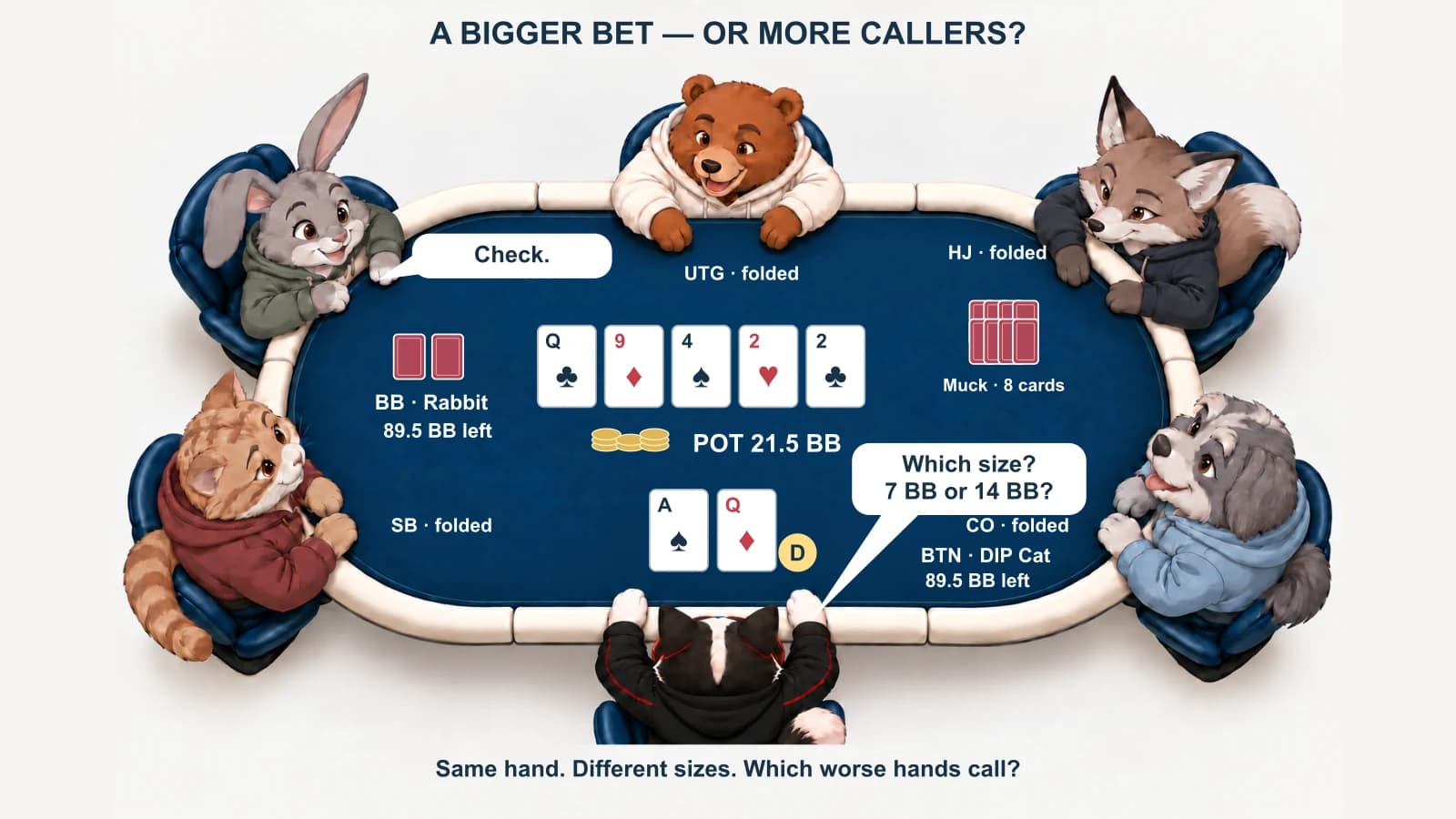
The river is safe enough to value-bet, but that does not tell you how big to bet. A larger bet collects more from each caller. A smaller bet can collect from more callers. The useful question is which effect dominates against this opponent.
This worked example compares two sizes against an explicitly assumed range. It is a sensitivity test, not a solver result or a claim about how every live player behaves.
The hand, including the money already in
Six-handed cash practice hand, 100 BB effective starting stacks, no ante or rake. UTG, HJ and CO fold. Hero on BTN opens to 2.5 BB with A♠ Q♦. SB folds its 0.5 BB and BB calls. Two players see the flop; the pot is 5.5 BB.
On Q♣ 9♦ 4♠, BB checks, Hero bets 2 BB and BB calls. Pot: 9.5 BB. On the 2♥ turn, BB checks, Hero bets 6 BB and BB calls. Pot: 21.5 BB. Both players have 89.5 BB left.
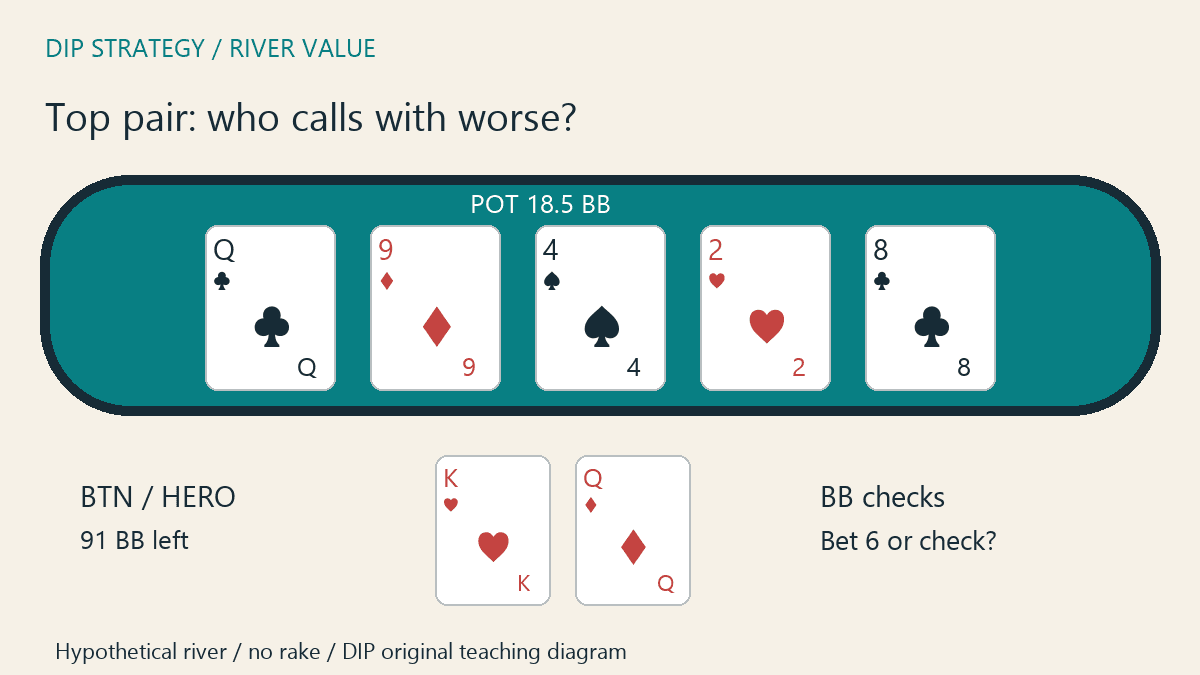
The river is 2♣. BB checks. Hero has queens and deuces with an ace kicker. Compare checking back, betting 7 BB (about one-third pot), and betting 14 BB (about two-thirds pot).
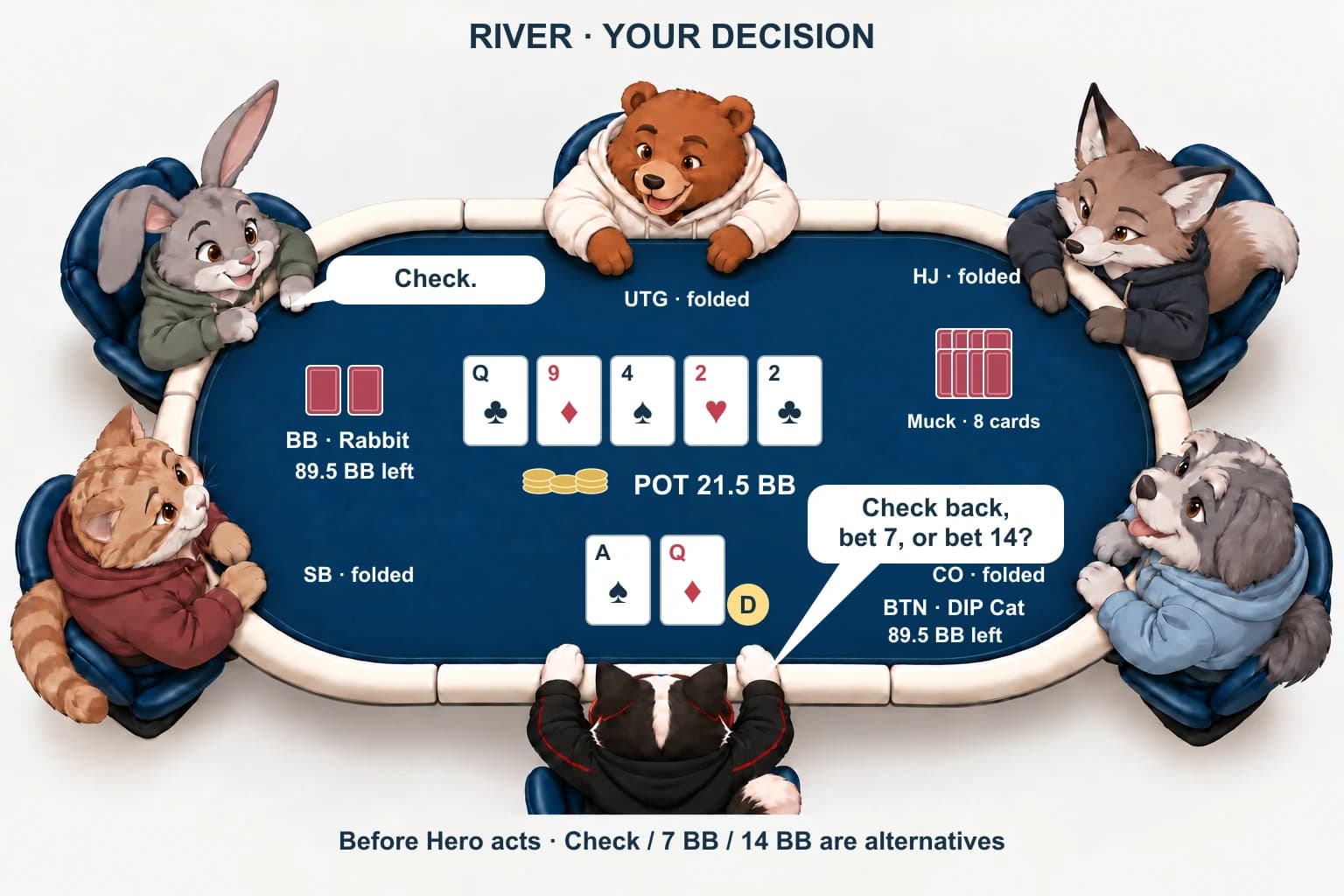
These are alternative bets, not two bets made in succession. No opponent bet is outstanding and calling is not an available response to a check.
Build a testable calling range
Suppose our working model for BB after checking is:
- KQ, QJ and QT: eight combinations of each, 24 total. Two queens remain and each side-card rank has four available cards.
- JJ and TT: six combinations each, 12 total.
- 99 and 44: three combinations each, six total. One card of each rank is on the board.
That is 42 equally weighted combinations: 36 lose to Hero, while six full houses beat Hero. Hero's queen and the board's queen remove half the ordinary queen-x combinations. Do not count 16 combinations for each queen-x hand here.
This is deliberately a restricted teaching range. It omits missed draws, weaker pairs, other boats and unusual traps. We are not asserting that every listed combination takes the earlier call-call line with equal frequency. If your opponent rarely reaches the river with QT offsuit or TT, reduce their weight before trusting the result.
For the first comparison, assume BB calls 7 BB with all 42 combinations, but calls 14 BB only with KQ, QJ, 99 and 44: 16 worse hands and six better hands. All other hands fold to 14. Assume no raises in this initial model.
Compare extra value, not just the size of the pot you receive
Checking wins the existing pot against the 36 worse combinations and loses against the six boats. Check-back expected value is 36/42 × 21.5 = 18.43 BB from this decision point. Earlier investments are already committed, not costs to subtract again.
Against a worse hand that calls, your bet earns an extra bet-sized amount compared with checking. Against a better hand that calls, your bet loses that amount. When a worse hand folds, you win the same existing pot as checking would have won in this model.
- Bet 7: (36 × 7 − 6 × 7) / 42 = **5.00 BB extra** over checking.
- Bet 14: (16 × 14 − 6 × 14) / 42 = **3.33 BB extra** over checking.
Total decision-point expected values are therefore 23.43 BB for the small bet, 21.76 BB for the large bet, and 18.43 BB for checking. These are averages under the assumptions, not guaranteed profit per hand or a return on the entire session.
The small bet wins this comparison by 1.67 BB. The bigger bet does make more when KQ or QJ calls, but it loses calls from too many other worse hands and pays more when behind.
Where the preferred size changes
Keep the six better combinations calling both sizes. Let W be the number of worse combinations that call 14 BB. To match the small bet's extra value:
14 × (W − 6) = 7 × (36 − 6).
That gives W = 21. The large bet ties if 21 worse combinations call and does better if more than 21 call. Fractional weights are fine: real ranges need not behave as an all-or-nothing list of whole combinations.
If all 24 queen-x combinations call 14, its extra value becomes (24 − 6) × 14 / 42 = 6 BB, beating the small bet's 5. The correct lesson is not “always bet small.” It is “your sizing decision depends on which worse hands continue.”
What about raises, missed draws and rake?
If only the six boats raise and Hero always folds, Hero still loses the chosen bet against them, so this particular calculation is unchanged. If worse hands bluff-raise, folding now gives up a pot Hero would otherwise win; the simple model breaks. Do not treat the no-raise assumption as permission to call every raise with an ace kicker.
Missed draws that fold both sizes do not automatically create value for a larger bet. A check-back already beats them. If some bluff-raise or occasionally call, their response must be included explicitly.
Actual cash games can deduct rake. Our example excludes it so the sizing mechanism stays visible. Recalculate with the room's applicable deductions when they materially differ between outcomes; do not silently apply this no-rake result to every live pot.
A practical way to use the comparison
Before betting, name two or three worse hands you genuinely expect to call. Then ask whether those same hands call your bigger size. Use observed behaviour, not the hope that someone cannot fold a pair.
A smaller bet is attractive when it keeps a broad set of worse hands in and the risk of a bluff-raise is low. A larger bet is attractive when enough worse hands are insensitive to size. Checking becomes more attractive when the apparent calling range is mostly better hands or your estimates are too optimistic.
Avoid three mistakes: counting blocked cards, treating every possible combination as equally likely without saying so, and comparing “chips won when called” while ignoring how often each size gets called.
DIP's conclusion
Do not choose a river size simply because your hand feels strong. Start with the opponent's plausible range, identify the worse calls retained or lost by each size, and test the threshold where your preference changes. Here, 7 BB beats 14 under one transparent assumption set; a modest change in queen-x calls reverses that answer.
Practise with play chips or written examples. If you play for money, follow local eligibility rules, set limits and never treat a positive model calculation as guaranteed income.