A tournament can reach a strange moment when winning 20,000 chips feels less valuable than losing 20,000 chips feels costly.
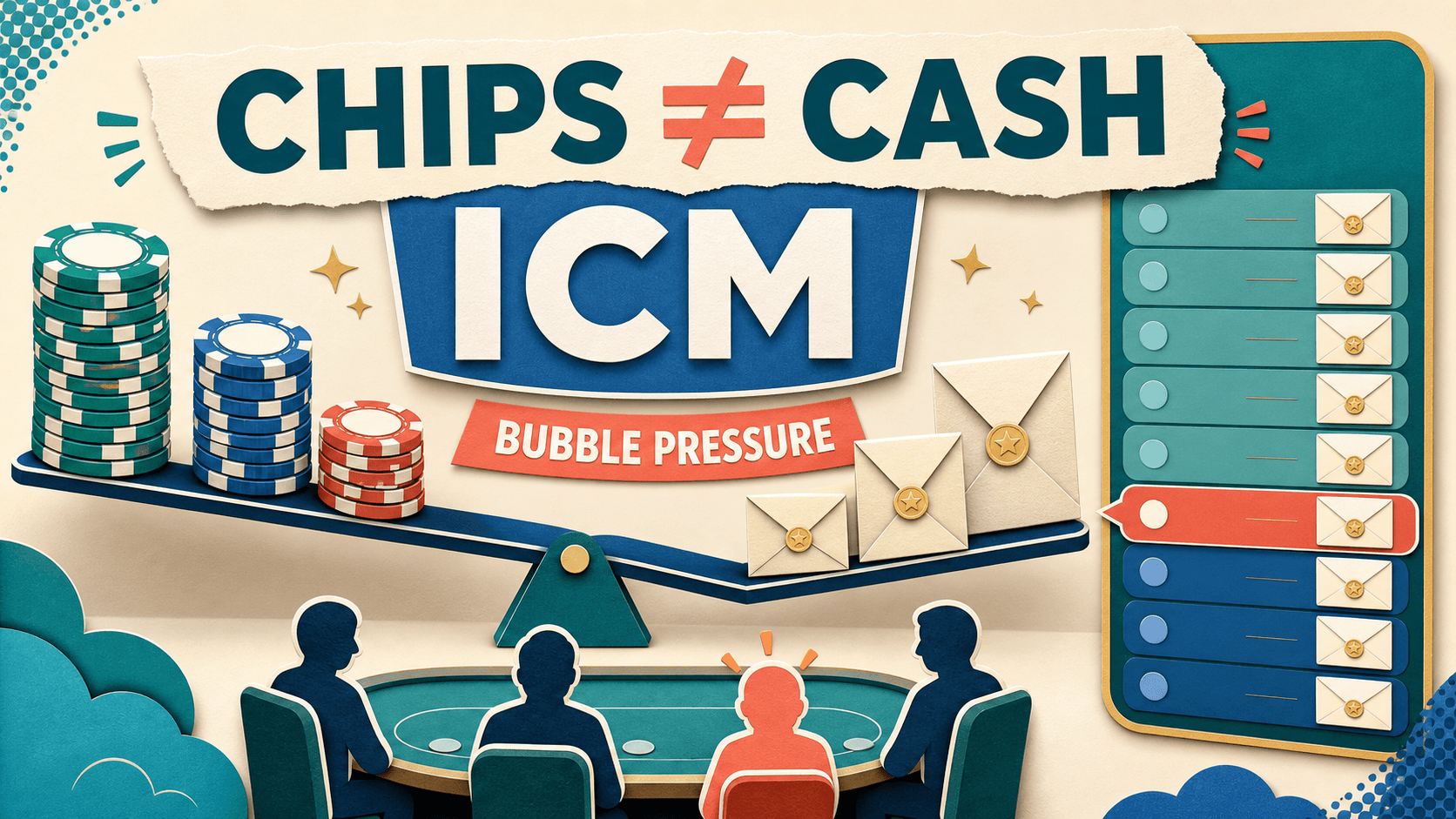
That is not fear talking. It is the basic idea behind the Independent Chip Model, usually shortened to ICM.
ICM estimates the share of the prize pool represented by each stack, using the remaining stacks and payout structure. It does not know who is the best player, who has position, or what cards will come next. Its job is narrower: translating tournament chips into prize equity.
Why chips stop behaving like cash
In a cash game, doubling your stack doubles its cash value. In a tournament, winning every chip does not win every peso in the prize pool because other finishing positions are also paid.
That creates diminishing value. The first chips that keep you alive are extremely important. Additional chips still help, but their prize value does not rise one-for-one.
This is why a play that wins chips on average can still be unattractive near a major payout threshold. The upside improves your chance of a higher finish; the downside can erase every chance of receiving a prize.
Where ICM pressure becomes visible
You do not need to treat every early hand like a final-table decision. ICM exists throughout a tournament, but it becomes practically important when the payout consequences change sharply.
Watch for three situations:
- The direct money bubble, when one or a few eliminations separate zero from a cash.
- The final table and large pay jumps, when waiting for another player to bust can materially change your result.
- A satellite ticket bubble, where every qualifying player receives the same prize.
Satellite bubbles can be the most extreme. Once your stack is likely to secure a ticket, extra chips may add almost no prize value while elimination still costs the entire ticket.
The question is not only “How strong is my hand?”
Imagine nine players remain, eight are paid, and two players at other tables have fewer than three big blinds. You hold a medium stack that can survive several orbits. A bigger stack moves all-in.
A normal chip calculation asks whether calling wins enough chips over time. An ICM-aware decision also asks:
- Do I risk elimination while shorter stacks are likely to bust?
- How much does winning improve my likely payout?
- How much prize equity disappears when I lose?
- Does the opponent cover my stack?
- Would moving all-in myself have created fold equity that a call cannot?
This does not automatically make every call a fold. It explains why the required hand strength can be much higher than it would be in a cash game or early tournament level.
Stack size changes your job
Big stack
A big stack can pressure opponents who are trying to survive. The best targets are often medium stacks that have much to lose and cannot comfortably call. Avoid casually doubling another big stack when losing would surrender your leverage.
Medium stack
The medium stack often feels the strongest pressure. It can reach the money without taking a marginal all-in, but one bad confrontation can turn a healthy position into zero. Covered calls deserve special caution.
Short stack
“ICM means wait” is dangerous advice for the shortest stack. If the blinds will consume you before someone else is likely to bust, you may need to act while you still have fold equity. Compare yourself with the other short stacks, not with an imaginary average stack.
Calling and shoving are not the same decision
When you call an all-in, the hand usually must win at showdown. When you shove, the opponent can fold and surrender the pot.
That difference matters under ICM pressure. It is possible for an aggressive move to be reasonable while calling the same range would be too costly.
Do not turn that principle into a blind command to shove. Position, stack coverage, payout structure and opponent ranges still matter. Serious review requires an ICM calculator rather than a universal chart.
A live-table ICM checklist
Before committing a large part of your stack near a payout threshold:
- Count the players remaining and the places paid.
- Read the next two or three pay jumps.
- Compare your stack with the shortest stacks still alive.
- Identify which opponents cover you.
- Separate a call from a shove; only one has fold equity.
- Ask what you gain by winning and what disappears if you bust.
- Mark the hand for later software review instead of inventing exact ICM numbers at the table.
The DIP view
ICM is most useful as a warning light. It tells you when ordinary chip intuition may be incomplete.
The wrong lesson is “always play scared on the bubble.” The better lesson is “price elimination correctly.” Big stacks can attack, medium stacks must protect valuable survival equity, and desperate short stacks cannot wait forever.
Information verified: September 1, 2026. Concept reference: PokerStars Learn, ICM and Its Impact on Tournaments. The examples and practical checklist are DIP editorial analysis; exact decisions depend on all stack sizes, payouts and ranges.
Responsible play notice: Poker involves financial risk. Tournament strategy cannot guarantee a return. Set time and spending limits, never chase losses, and never play with money needed for living expenses.