A continuation bet does not need to be large to be profitable. On dry flops, the expensive bluff can look more convincing while quietly demanding far more folds than the smaller bet. The right question is not “Which size looks strongest?” It is “Which size buys enough folds from the range in front of me?”
The hand
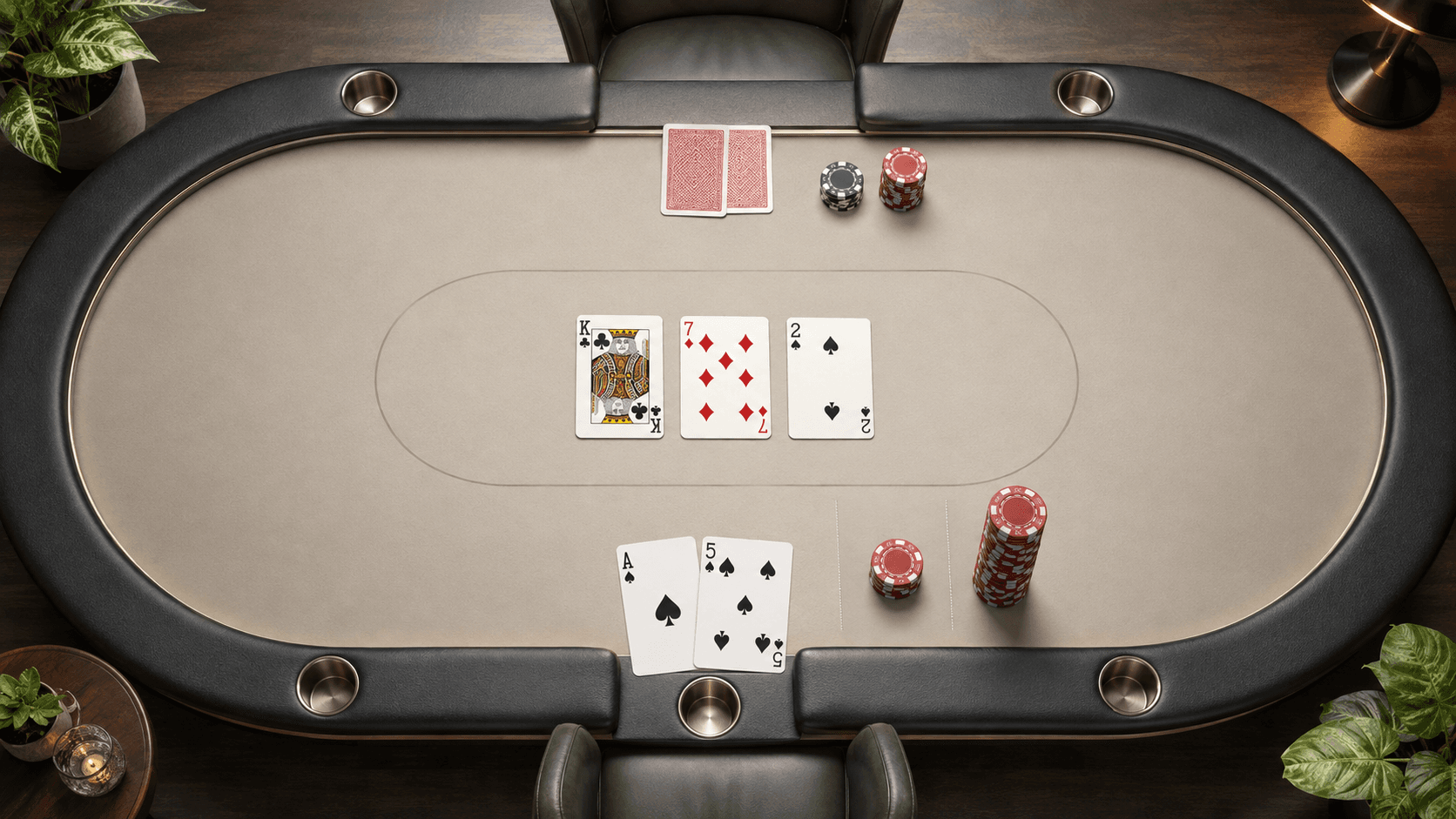
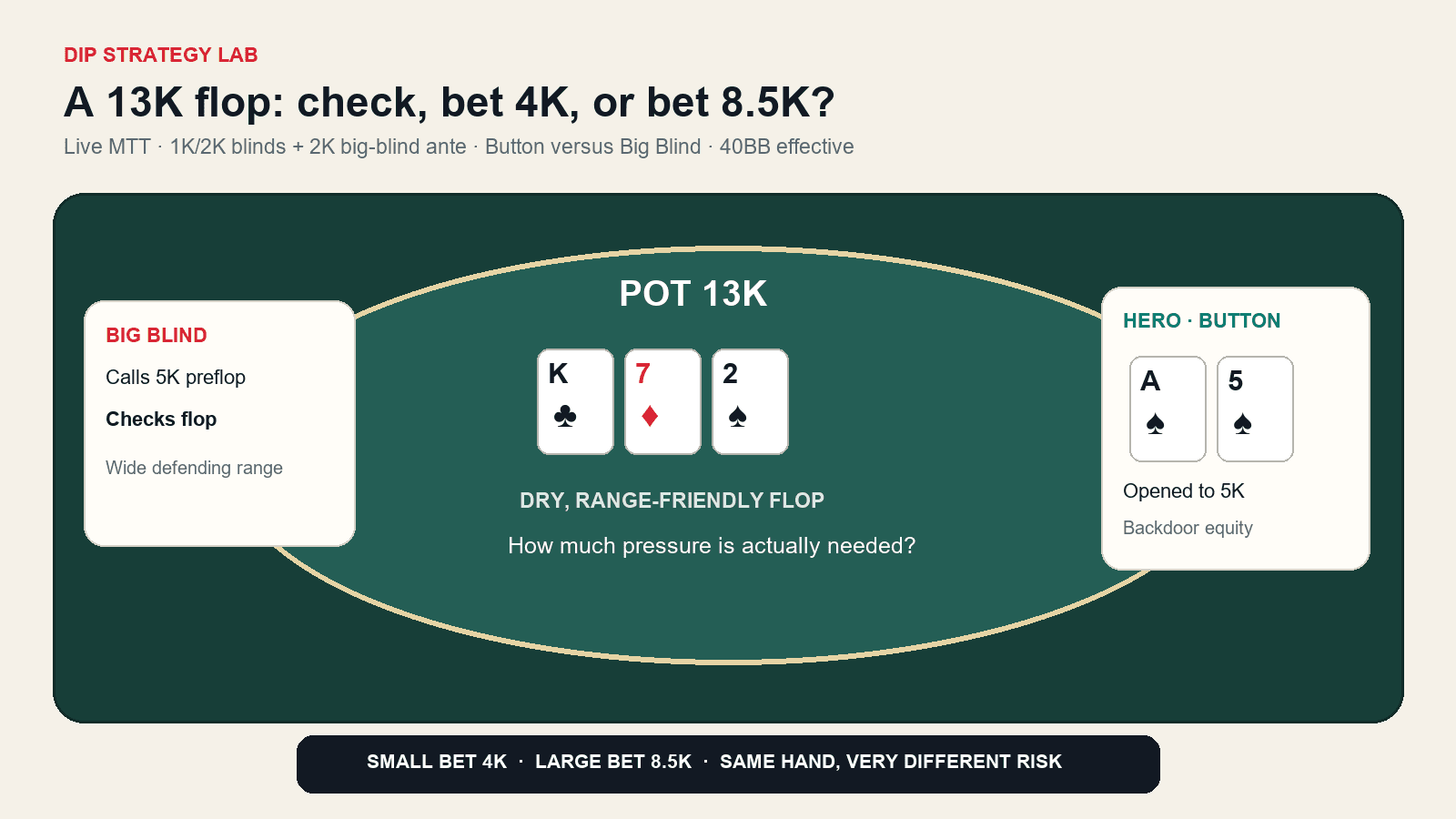
This is a six-handed live tournament at 1,000/2,000 with a 2,000 big-blind ante. Folds reach Hero on the button with 80,000, or 40 big blinds. Hero opens A♠ 5♠ to 5,000. The small blind folds. The big blind, also starting the hand with 80,000, calls.
The flop is K♣ 7♦ 2♠. The big blind checks. The pot is 13,000.
Hero has ace-high, a backdoor nut-flush draw, and several useful turn cards—but no made hand. The options are check, bet 4,000, or bet roughly 8,500.
Why this flop favors a small size
The button begins with a strong, wide opening range. The big blind defends many hands because of the price, including suited cards, connected cards, weak aces, and broadways. On K♣ 7♦ 2♠, both players can have sets and two pair, but Hero retains many strong kings, overpairs, and high-card combinations.
The board is also static. There are few immediate draws, and many turn cards do not radically change which player has the strongest range. Hero can therefore bet a large portion of the range for a small size without claiming that every hand is extremely strong.
A 4,000 bet is about 31% of the pot. It pressures hands such as QJ, JT, T9, 98, and weak ace-high holdings at a low price. It also lets Hero use the same size with value hands such as KQ, KJ, and pocket aces.
Calculate the pure-bluff threshold
For a bluff that has zero equity when called, the break-even fold rate is:
Bet ÷ (pot + bet)
With a 4,000 bet into 13,000:
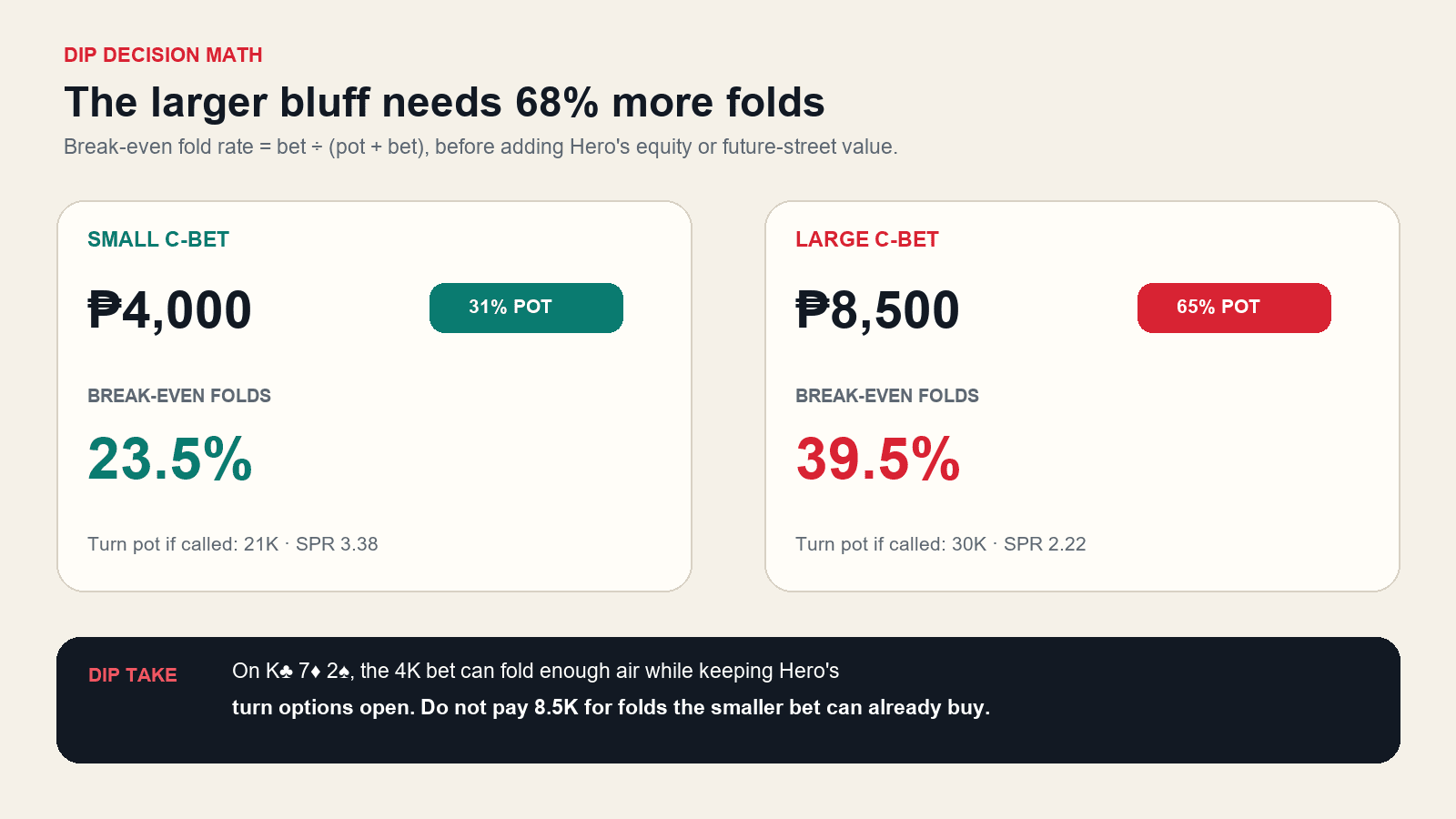
4,000 ÷ (13,000 + 4,000) = 23.5%
The big blind needs to fold only a little more than one time in four for the immediate bluff to break even.
With an 8,500 bet:
8,500 ÷ (13,000 + 8,500) = 39.5%
Now Hero needs almost two folds in five. The larger bet risks 112.5% more chips, but its required fold rate rises from 23.5% to 39.5%—about 68% more folds relative to the smaller threshold.
The formula is a floor, not the whole decision
A♠ 5♠ is not a zero-equity bluff. A spade on the turn creates the nut-flush draw. A four makes a wheel immediately. A three creates a gutshot, and an ace or five can improve Hero to a pair.
That extra equity makes the real small bet slightly better than the pure-bluff calculation suggests. But the backdoors do not justify betting automatically. When called, Hero still reaches many turns with ace-high and must decide whether to continue.
The big blind’s response range matters more than the raw formula. If this opponent folds every unpaired hand, 4,000 may already be highly profitable. If the opponent defends almost any pair and floats ace-high, checking becomes more attractive.
What happens to the turn SPR
Bet sizing changes the next decision before the turn card even arrives.
If Hero bets 4,000 and the big blind calls, the pot becomes 21,000. Both players have 71,000 behind, giving an SPR of about 3.38.
If Hero bets 8,500 and gets called, the pot becomes 30,000. Both have 66,500 behind, so the SPR falls to about 2.22.
The large bet therefore commits more of the stack to a pot where Hero often still has ace-high. It makes future pressure expensive and reduces the room to react when the big blind check-raises or continues strongly.
A small bet preserves optionality. Hero can barrel favorable turns, check back neutral ones, and avoid turning every bluff into a three-street commitment.
Build the turn plan before betting
A good flop bet already knows which turns continue the story.
Strong barrel or value-improvement cards include:
- Any spade, which gives Hero the nut-flush draw.
- A four, which completes A-2-3-4-5.
- A three, which creates a gutshot to the wheel.
- An ace, which improves Hero to top pair and may still receive calls from sevens or stubborn floats.
- Some queens, jacks, and tens, which favor Hero’s broadway-heavy button range and can pressure weak pairs.
Many low blanks are reasonable checks. Hero has already bought folds from the weakest hands; forcing a second barrel into a range now weighted toward kings, sevens, pairs, and stubborn ace-high holdings can burn chips.
The plan also changes against a check-raise. With only backdoor equity, A♠5♠ usually folds to a meaningful raise. The small bet loses 4,000; the large bet loses 8,500 before Hero reaches the same conclusion.
Compare the three options
Check is completely legitimate. It protects Hero’s checking range, realizes some ace-high showdown value, and avoids being raised. Against a player who rarely folds the flop or attacks small bets aggressively, checking may be best.
Bet 4,000 is the default in this exact setup. It needs only 23.5% immediate folds, uses a size Hero can repeat with many value hands, and preserves turn flexibility.
Bet 8,500 can make sense with a more polarized range on dynamic boards, or against an opponent who overfolds specifically to larger bets. On this dry K-7-2 rainbow texture, it often pays extra for folds that 4,000 could already produce.
Common mistakes
- Choosing a big size because a bluff feels emotionally safer when it looks strong.
- Looking only at the current fold rate and forgetting how the size changes the turn SPR.
- Betting every range-advantage flop without checking how the specific opponent defends.
- Barreling every turn after the small bet instead of using the optionality the size created.
- Treating backdoor equity as if it were a made draw.
- Using one size with bluffs and another obvious size with value.
The sizing decision must fit the entire range, not just Hero’s two cards.
DIP’s take
Bet 4,000. The board is dry, Hero has the range advantage, and the smaller size needs very few folds to work. A♠5♠ also has enough backdoor potential to continue on selected turns.
The important lesson is broader than this hand: do not spend 8,500 to purchase a fold that 4,000 can already buy. Calculate the threshold, consider the opponent’s continuing range, and look one street ahead before placing the chips.
Poker involves financial risk. Sound bet sizing reduces unnecessary losses; it does not guarantee profit. Play only with a fixed entertainment budget, never chase losses, and use properly licensed venues.