A draw can look powerful and still be a fold.
The mistake is usually not the arithmetic. Most players can count nine flush cards and eight straight cards, remove two overlaps, and arrive at 15 outs. The mistake is assuming every one of those cards wins against every hand that bets.
This hand shows why a turn decision must be built in the right order: price first, then range, then clean outs.
The Hand
- Format: live multi-table tournament
- Blinds: 1,000/2,000 with a 2,000 big-blind ante
- Players in the hand: two after the flop
- Effective stack at the start: 80,000, or 40 big blinds
- Villain: cutoff
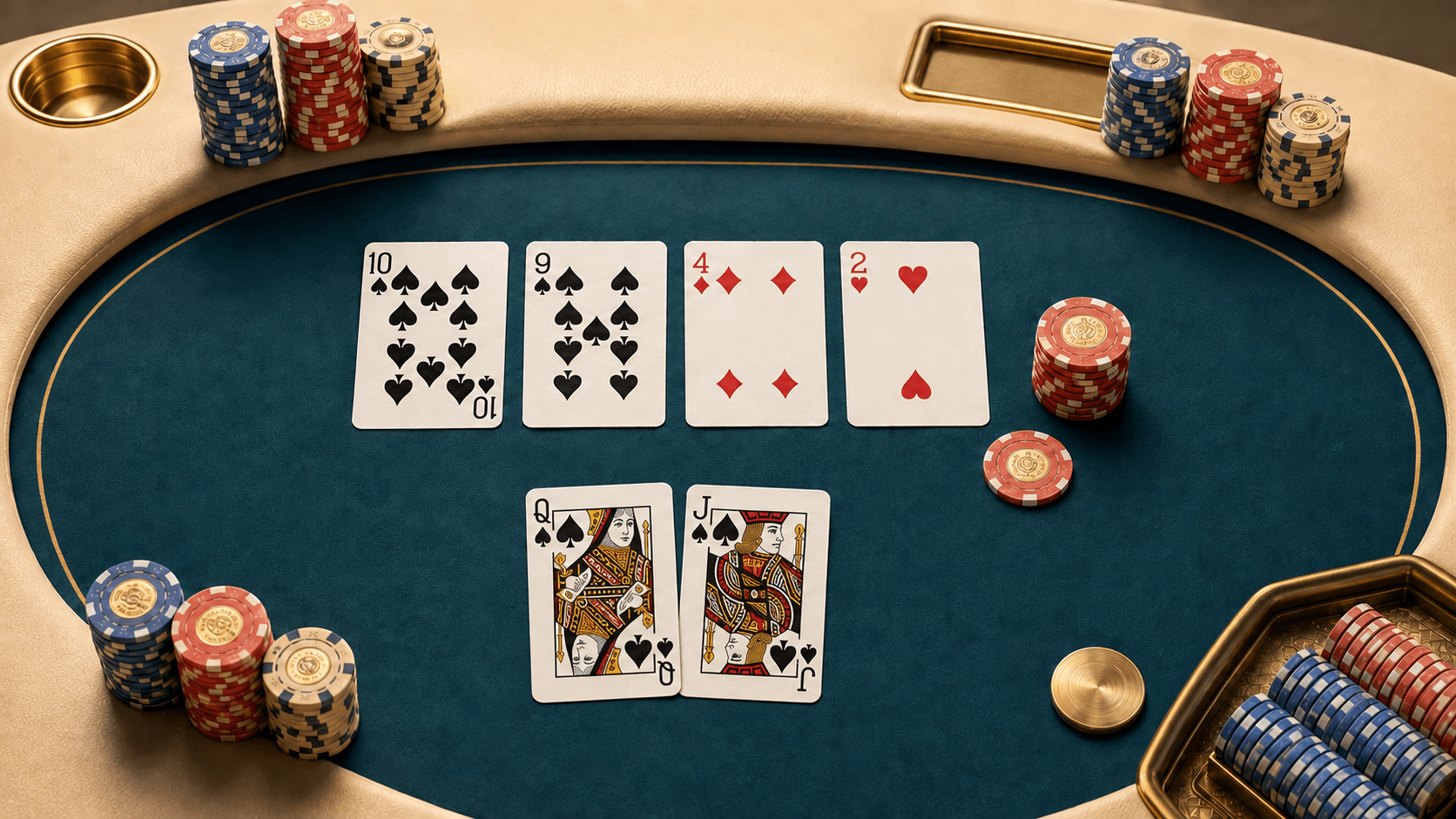
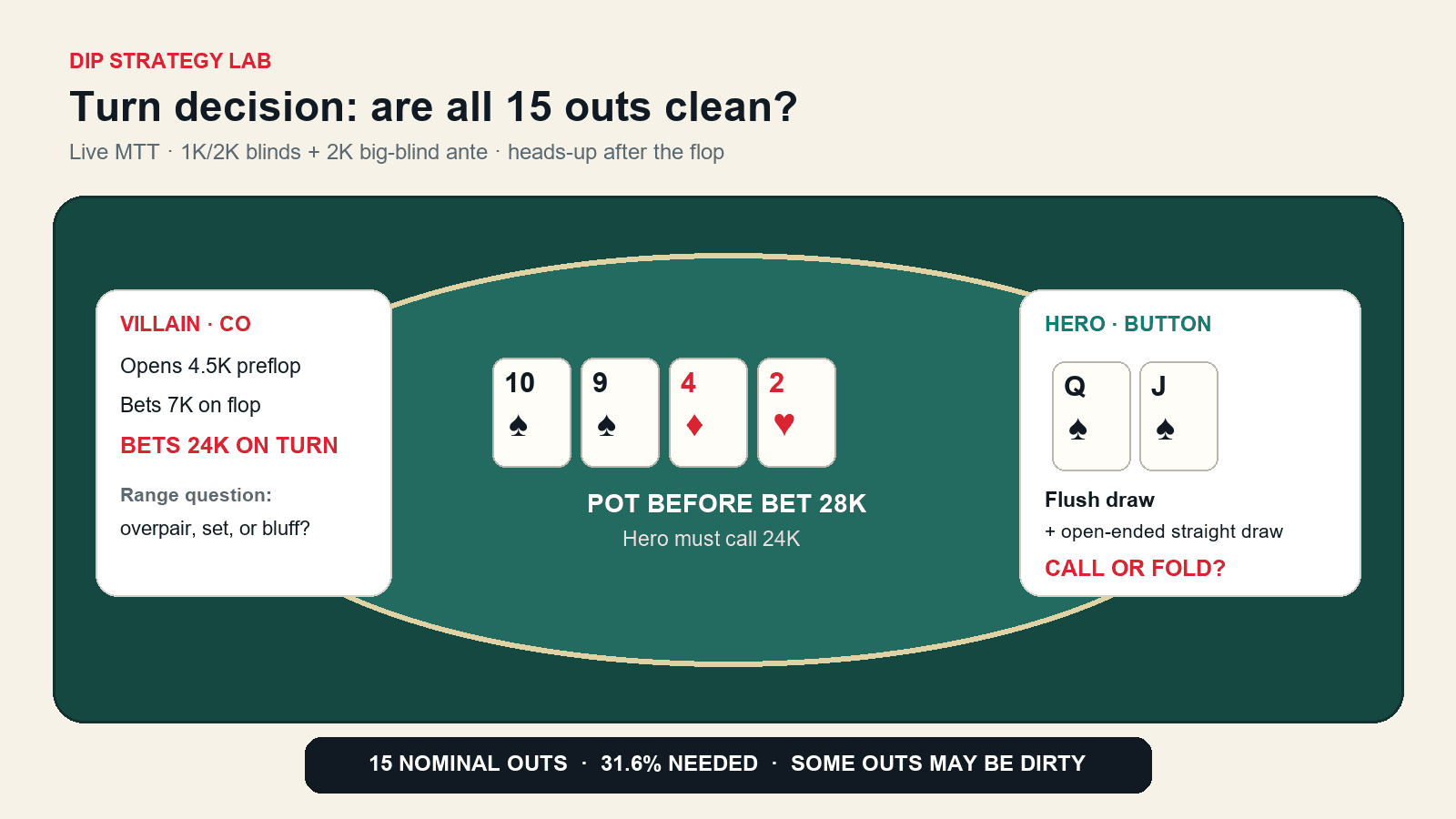
- Hero: button with Q♠ J♠
The cutoff opens to 4,500. Hero calls on the button. The blinds fold.
The pot is 14,000.
The flop is T♠ 9♠ 4♦.
Villain bets 7,000. Hero calls.
The pot is now 28,000. Both players have 68,500 behind. The turn SPR is about 2.45.
The turn is 2♥.
Villain bets 24,000 into 28,000. Hero must decide whether to call with a queen-high flush draw and an open-ended straight draw.
Step 1: Calculate the Price Before Telling a Story
If Hero calls 24,000, the final pot for this street will be:
- 28,000 already in the pot
- 24,000 bet by Villain
- 24,000 call by Hero
- 76,000 total
Required equity is call divided by the final pot:
24,000 ÷ 76,000 = 31.6%
That is the break-even point before considering future river action. Hero needs to win more than 31.6% of the time for an immediate call to make money.
This number does not change because Villain looks nervous, because the tournament is important, or because Hero has a beautiful draw. The price is fixed. What changes is Hero’s equity against Villain’s actual betting range.
Step 2: Count the Nominal Outs Correctly
Q♠ J♠ on T♠ 9♠ 4♦ 2♥ can improve in two obvious ways.
Flush cards
There are nine unseen spades.
Straight cards
Any king or any eight completes a straight. That appears to add eight cards, but K♠ and 8♠ were already counted among the flush cards.
The total is therefore:
9 spades + 3 non-spade kings + 3 non-spade eights = 15 nominal outs
With one card to come and 44 unseen cards after assigning Villain a specific two-card holding, 15 clean outs would produce about 34.1% equity.
That clears the 31.6% requirement—but only if every out is clean.
Step 3: Discount Outs Against Sets
Suppose Villain has an overpair without a spade. A river king, eight, or spade gives Hero a hand that beats one pair. In that clean case, the 15-out estimate is reasonable.
Now suppose Villain has a set.
A river 4♠ or 2♠ completes Hero’s flush, but it also pairs the board. A set becomes a full house or quads, so those two apparent flush outs do not win.
Hero is left with 13 clean outs:
13 ÷ 44 = 29.5%
That is below the 31.6% break-even threshold.
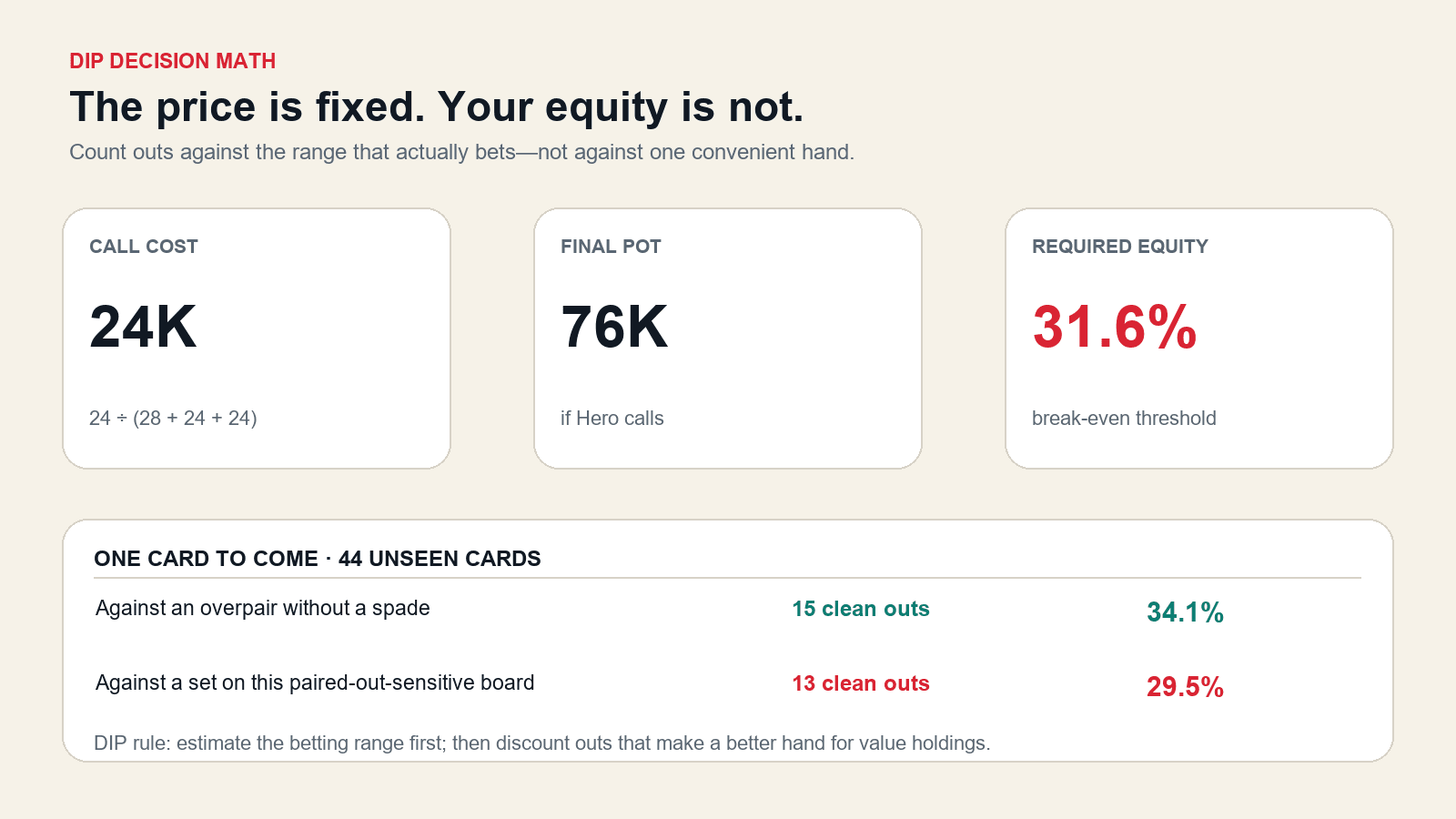
This is the central lesson: outs belong to a matchup, not to a hand in isolation.
Step 4: Build a Range, Not a Single Hand
A good decision cannot stop at “Villain could have aces” or “Villain could have a set.” The bet comes from a range.
Reasonable value candidates may include:
- AA, KK or QQ without a spade
- TT, 99 or 44
- Occasionally T9 suited
- A strong made hand protecting against many river cards
Possible bluffs and semi-bluffs may include:
- A♠Kx or A♠Qx-type hands when available
- KQ without a made hand
- Some ace-high spade holdings
- Player-specific over-aggression
Hero’s exact blockers matter. Q♠ J♠ removes several natural queen- and jack-high spade combinations from Villain’s range. But Hero does not hold A♠ or K♠, so Villain can still have higher flush draws such as A♠Kx or K♠8♠. Those hands can block apparent outs and dominate Hero on a spade river. The blockers also reduce some missed-draw bluffs Villain could otherwise hold.
Against a range weighted toward overpairs and semi-bluffs, calling becomes more attractive. Against a tight live player whose large turn bet is mostly sets and two pair, the clean-out discount can push the hand below the required price.
A Useful Range Threshold
Consider a simplified value-only range made of overpairs without a spade and sets.
- Equity against an overpair: about 34.1%
- Equity against a set: about 29.5%
- Required equity: 31.6%
If roughly 45% or more of that simplified range is overpairs, the weighted draw equity reaches the break-even area. If sets dominate the range, Hero falls short.
Real ranges are not this clean. Two pair, blocked spade hands, bluffs and future river decisions all change the result. The threshold is still useful because it shows how narrow the margin is. This is not a “draw too strong to fold.” It is a close range decision.
What the SPR Adds
Before the turn bet, the effective stack is 68,500 and the pot is 28,000. The SPR is about 2.45.
After Hero calls, 44,500 remains and the river pot is 76,000. The river SPR is only about 0.59.
That low river SPR has two consequences:
- When Hero improves, Villain may still pay a meaningful river bet with strong one-pair hands or sets on safe rivers.
- When Hero misses, Villain can apply maximum pressure with a relatively small remaining stack.
Do not automatically add optimistic implied odds. A visible flush card may shut down action, and a river that pairs the board can improve Villain more than Hero. Treat future value as a bonus supported by the opponent—not as permission to ignore the turn price.
Call, Fold or Raise?
Call
Calling is strongest when Villain can bet overpairs, two pair and semi-bluffs at this size. Position helps because Hero sees Villain’s river action before making the final decision.
Fold
Folding is correct when the player pool or specific opponent is heavily weighted toward sets and rarely fires large turn bluffs. Saving 24,000 preserves more than 22 big blinds, which remains a playable tournament stack.
Raise all-in
A shove risks 68,500 total into a range that may already be committed. It can be attractive only if Villain has enough bet-fold hands. Against a value-heavy live range, the raise often removes Hero’s positional advantage and gets called by the hands against which some outs are dirty.
Without a strong read that Villain can fold one-pair hands, calling or folding is usually cleaner than turning the draw into a high-variance shove.
Common Mistakes
- Adding nine flush outs and eight straight outs without removing overlap
- Treating paired-board flush cards as automatic winners against sets
- Using the rule of four on the turn when only one card remains
- Comparing draw percentage with the bet size instead of the final-pot price
- Counting outs before estimating Villain’s betting range
- Inventing implied odds against a player who may stop paying on obvious rivers
- Shoving because the draw “looks too big to fold”
The DIP Take
Start with 31.6%, not with 15 outs.
Against a balanced or aggressive opponent, Q♠ J♠ has enough equity to continue at least some of the time. Against a straightforward live player whose 24,000 turn bet is concentrated around sets, the two dirty spade outs matter and folding can be disciplined rather than weak.
The most useful habit is simple:
1. Calculate the price. 2. Name the range that takes this line. 3. Count clean outs against that range. 4. Use stack depth and position only after the first three steps.
A combo draw is not a permission slip. It is a set of conditional chances.
Responsible play notice: Poker involves financial risk. Use strategy study to improve decisions, not to justify playing above an affordable limit.