A river overbet forces a different kind of decision. Your hand may look strong in absolute terms, but the bet size asks a mathematical question: can this bluff-catcher win often enough against a polarized range?
This example is deliberately built from a common live-tournament line. The objective is not to memorize “call” or “fold.” It is to learn how to combine pot odds, range construction, blockers and a realistic read on live bluffing frequency.
The live hand
- Six-handed live tournament
- Blinds: 1,000/2,000 with a 2,000 big-blind ante
- Villain: cutoff, 80,000 chips
- Hero: big blind, 78,000 chips
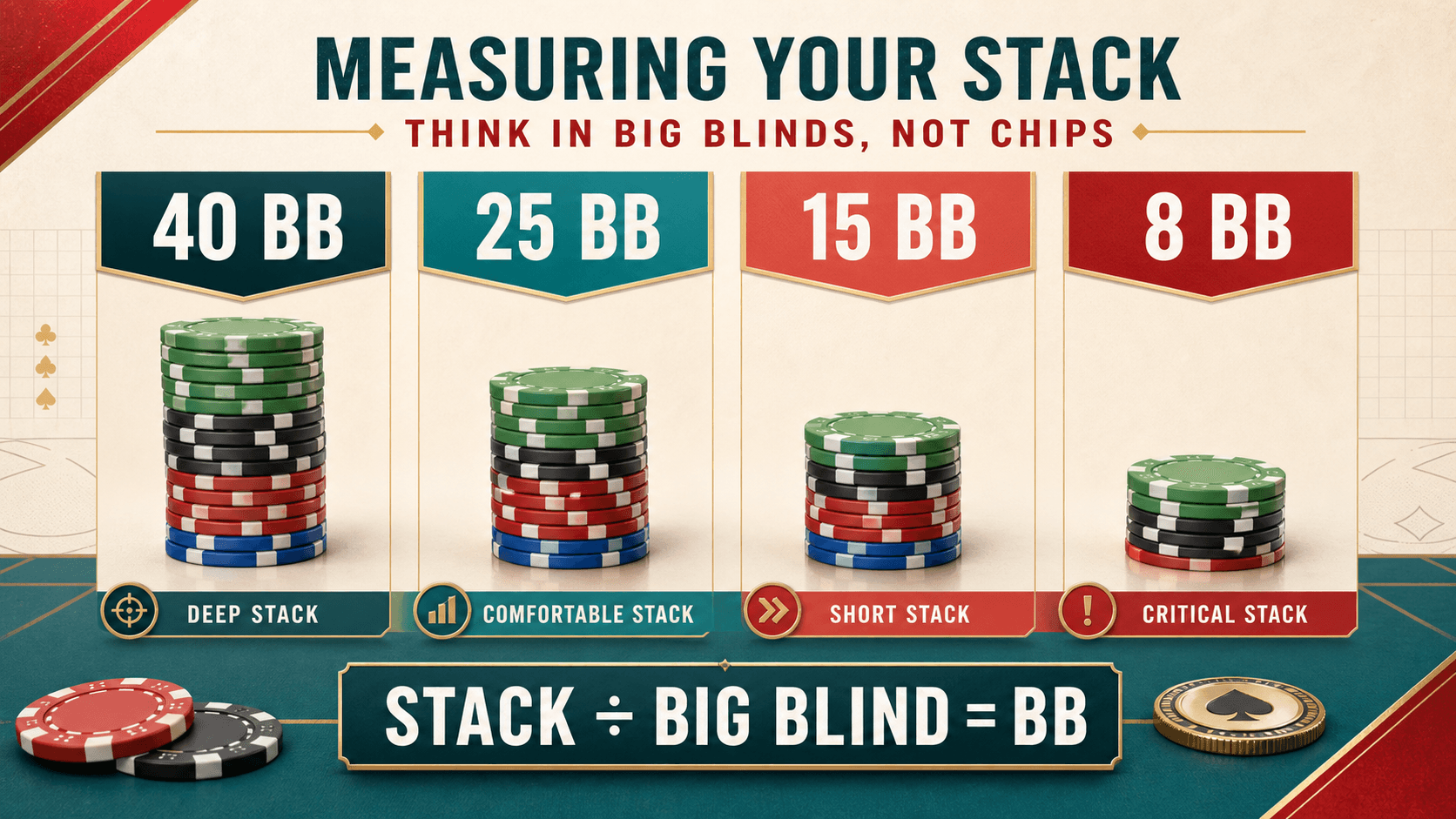
- Effective stack before the hand: 39 big blinds
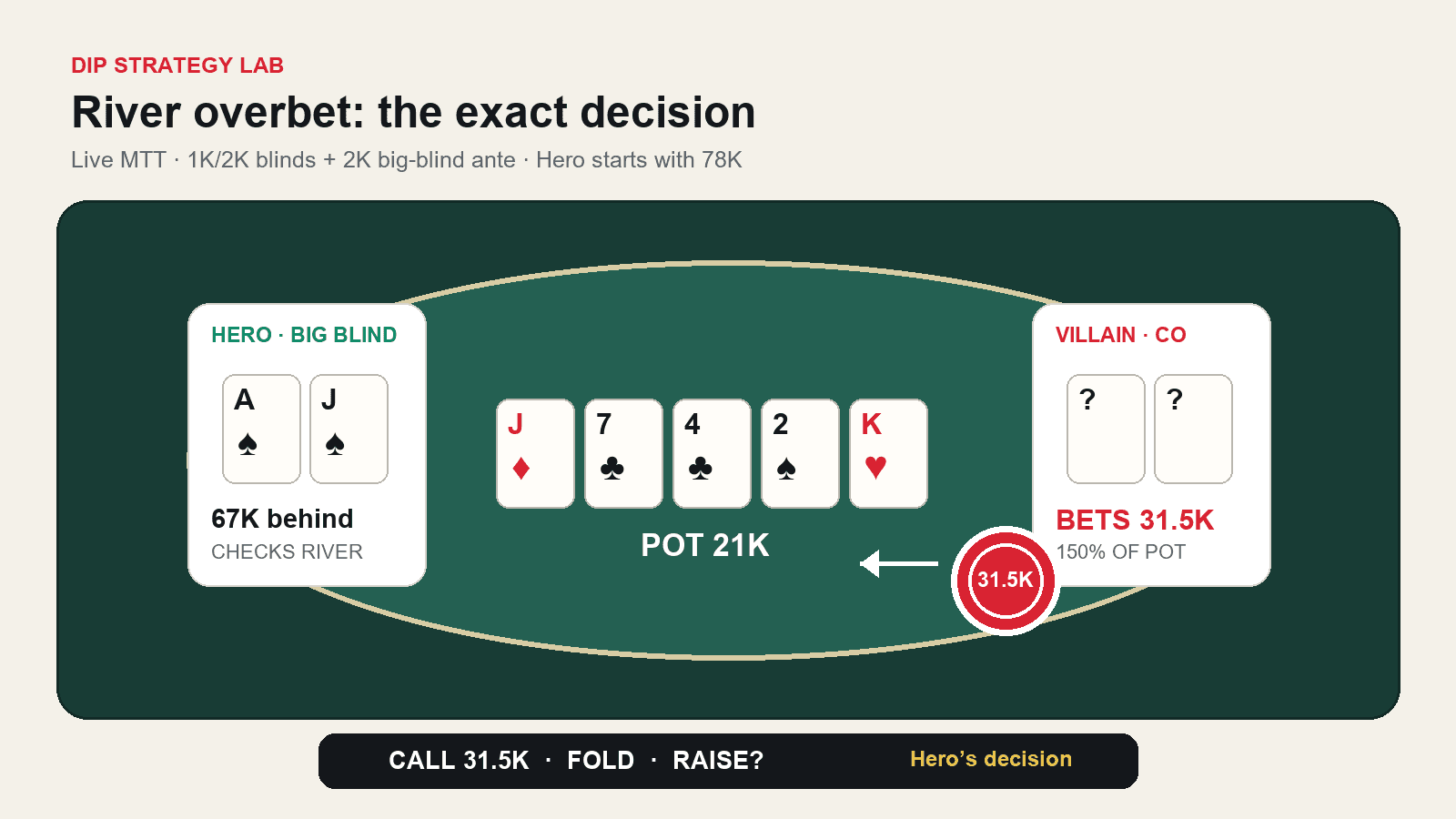
- Hero holds A♠ J♠
The cutoff opens to 5,000. The small blind folds and Hero calls 3,000 more. Including the small blind and big-blind ante, the pot is 13,000.
The flop is J♦ 7♣ 4♣. Hero checks. Villain bets 4,000 and Hero calls. The pot is now 21,000, with Hero holding 67,000 behind. The turn is 2♠ and both players check.
The river is K♥. Hero checks. Villain bets 31,500—exactly 150% of the pot. Hero has second pair with top kicker and must decide whether to call, fold or turn the hand into a raise.
First calculate the price
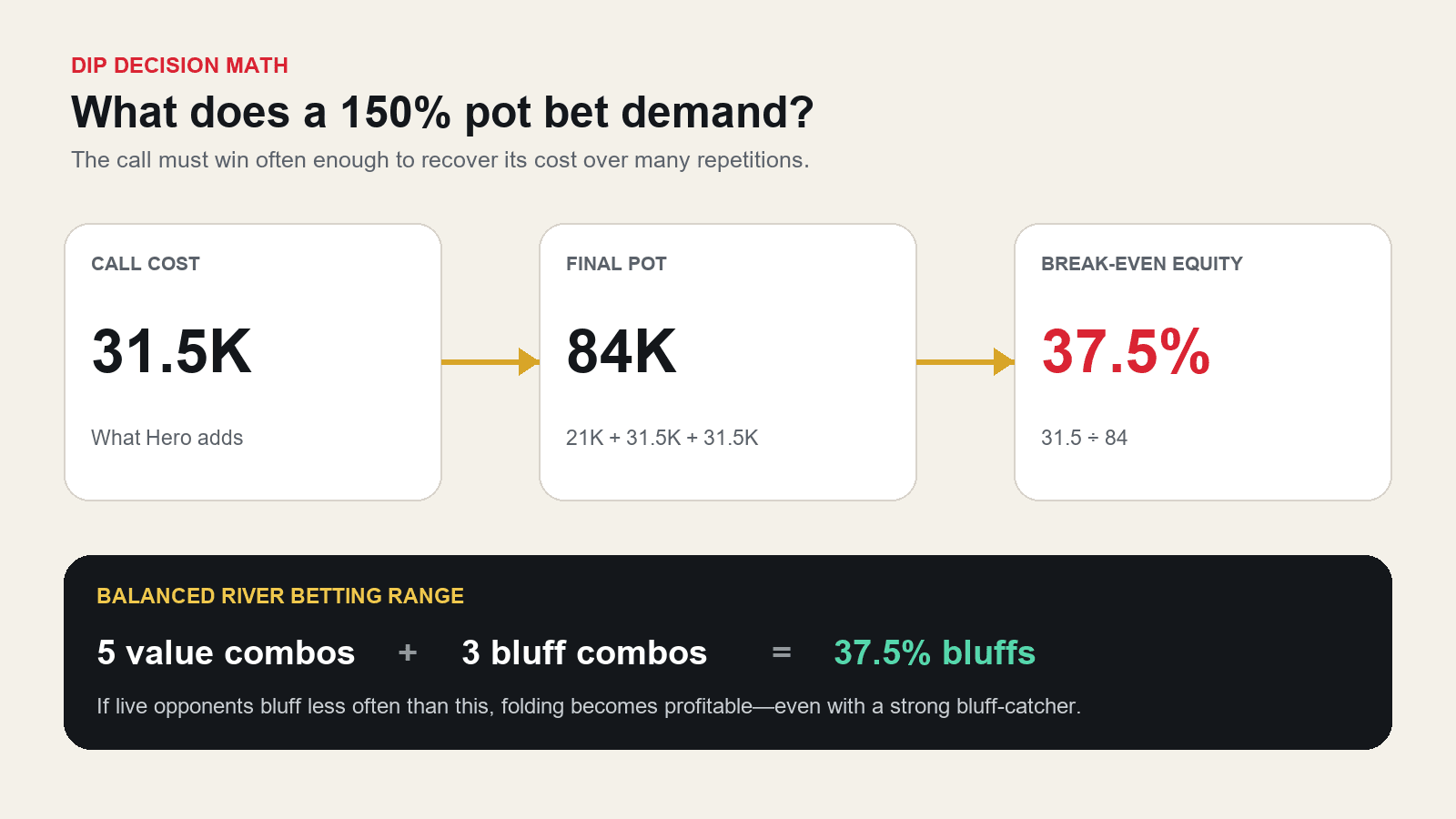
Hero must call 31,500. If Hero calls, the final pot will be:
21,000 existing pot + 31,500 Villain bet + 31,500 Hero call = 84,000.
Required equity is call cost divided by the final pot:
31,500 ÷ 84,000 = 37.5%.
Hero therefore needs to win at least 37.5% of the time for a call to break even before considering future information or tournament-specific factors.
Another useful expression is the bluff-to-value ratio. If Villain has five value combinations, a perfectly balanced 150% pot range needs three bluff combinations. Three bluffs out of eight total bets is 37.5%.
The minimum defence frequency against a 150% pot bet is 40% of Hero’s range: 21,000 ÷ 52,500. That does not mean this particular A♠J♠ must call 40% of the time. It means a theoretically protected checking range cannot simply fold everything except two pair or better. Hand selection still depends on blockers and the opponent.
What value hands make sense?
Villain’s line is polarized. A medium-strength hand normally has little reason to risk 31,500 to win 21,000.
Credible value candidates include:
- KJ for rivered two pair
- KK for a rivered set
- JJ, 77 or 44 when a set used a small flop bet and checked the turn
- Occasionally AA played for an unusually large river value bet
Not every opponent arrives with all of these hands in the same frequency. Some players bet sets again on the turn. Others check KJ on the flop. Range work is not a list of every possible hand; it is an estimate of which combinations realistically follow this exact path.
Where can the bluffs come from?
The flop contains two clubs and several straight backdoors. Hands such as A♣Q♣, A♣10♣, Q♣10♣, 10♣9♣, 9♣8♣ and 6♣5♣ can bet the flop, take a free turn and miss the river. Some unpaired Q10, 109 or 98 combinations may also decide that the king is a strong card to represent.
Hero’s A♠J♠ contains no club. That matters because Hero does not block Villain’s missed club draws. In a bluff-catching decision, allowing the opponent to hold more natural bluffs is useful.
The ace of spades is not purely helpful. It can remove a few ace-high hands that might otherwise bluff. Blockers are never magic; they adjust the combination count after the betting line has already defined the range.
The SPR tells us why the bet is serious
The flop begins with approximately 71,000 effective behind and a 13,000 pot, an SPR of about 5.5. After the flop bet and call, the turn SPR is approximately 3.2.
This is not a shallow all-in pot where top pair is automatically committed. Villain still has room to apply extreme river pressure. Hero’s remaining stack is large enough that a wrong call costs more than fifteen big blinds.
Compare the three options
Calling is correct only when Villain’s betting range contains at least 37.5% bluffs. Against a genuinely aggressive opponent who finds missed-club bluffs, A♠J♠ is one of Hero’s better one-pair bluff-catchers.
Folding is the default against many low- and mid-stakes live opponents. Large river overbets are often underbluffed. If Villain reaches the river with only 30% bluffs, the call loses about 6,300 chips in expectation:
30% × 52,500 − 70% × 31,500 = −6,300.
If Villain is bluffing 45% of the time, the same call earns about 6,300 chips in expectation.
Raising is usually the weakest option. A raise makes missed draws fold—the hands Hero already beats—while stronger value hands continue. Without a specific exploit, A♠J♠ has too much showdown value to convert into a bluff and too little value to raise for calls from worse.
A practical live checklist
Before calling, ask:
- Does this player use overbets with bluffs, or only with very strong hands?
- Which missed draws can reach the river after the turn checks through?
- Does my hand block value or unblock natural bluffs?
- Has Villain shown a willingness to risk a meaningful part of the stack without showdown value?
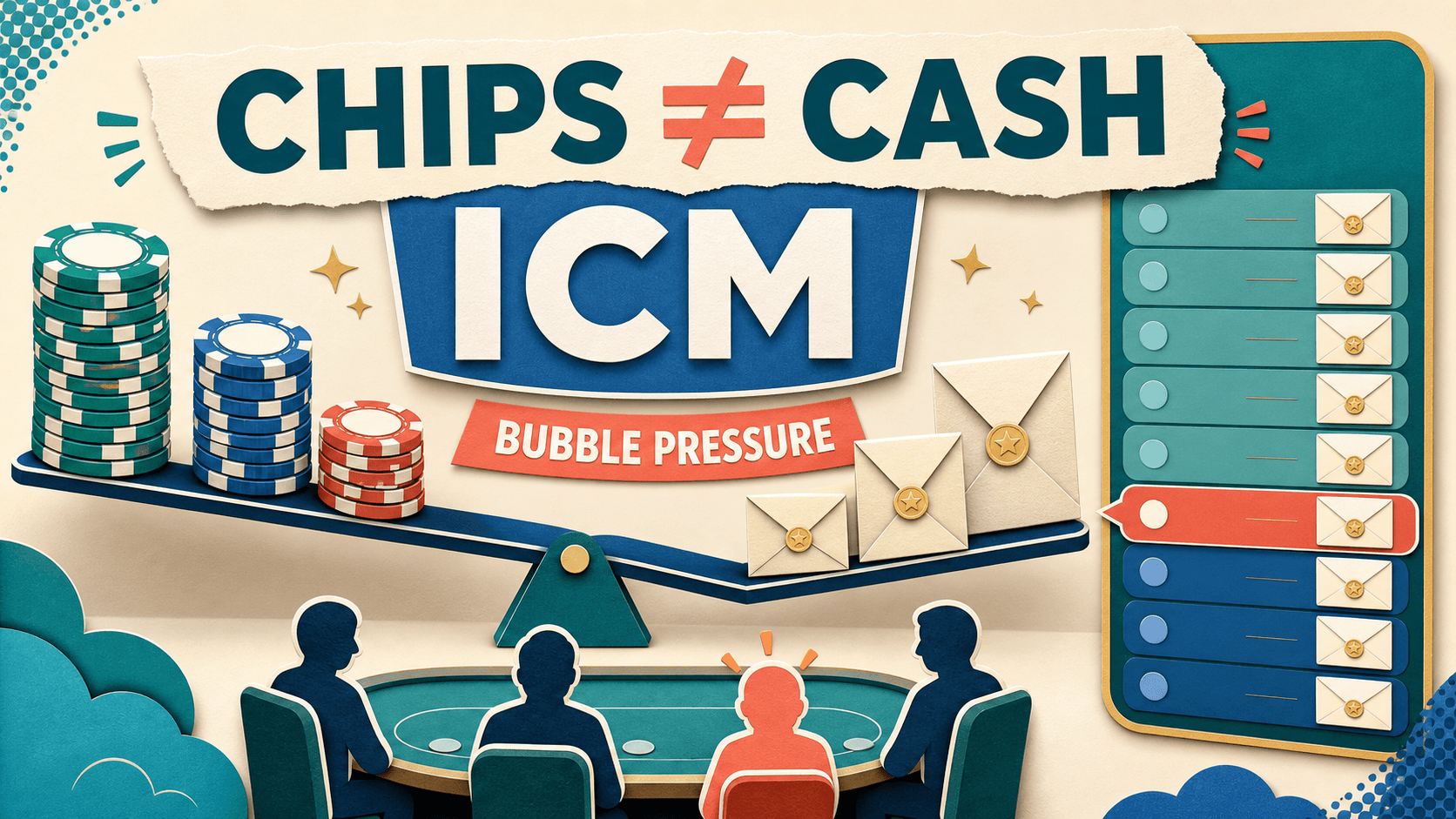
- Is there ICM pressure that makes losing 15.75 big blinds more costly than chip EV alone suggests?
Near a satellite bubble or a final-table pay jump, ICM can push a marginal chip-EV call toward a fold. Far from meaningful pay jumps, chip EV is the cleaner starting point.
The common mistake
Players often call because “top pair was good on the flop” or fold because “the king is scary.” Both reactions ignore the actual price.
The disciplined process is:
- Calculate the required equity
- Build the value side of Villain’s range
- Identify credible missed draws
- Check your blockers
- Adjust for the opponent and ICM
DIP’s view
In an unknown live field, DIP would fold A♠J♠ to this 150% river overbet. The price requires 37.5% equity, and many opponents do not find enough bluffs at this size.
Against a proven aggressive player, the hand becomes an attractive call because it unblocks missed clubs and sits high in Hero’s one-pair range. The important skill is not bravery. It is knowing exactly how much bluffing the call requires—and refusing to invent bluffs that the opponent is unlikely to choose.
Poker involves financial risk. Use tournament money you can afford to lose, set limits before playing, and do not chase losses.