A small pocket pair looks cheap and harmless. That is exactly why many live players leak chips with it. They remember that a set arrives roughly once every eight flops, see a call that feels affordable, and forget to ask the only question that matters: will the rare win be large enough to pay for all the misses?
The number every player should know
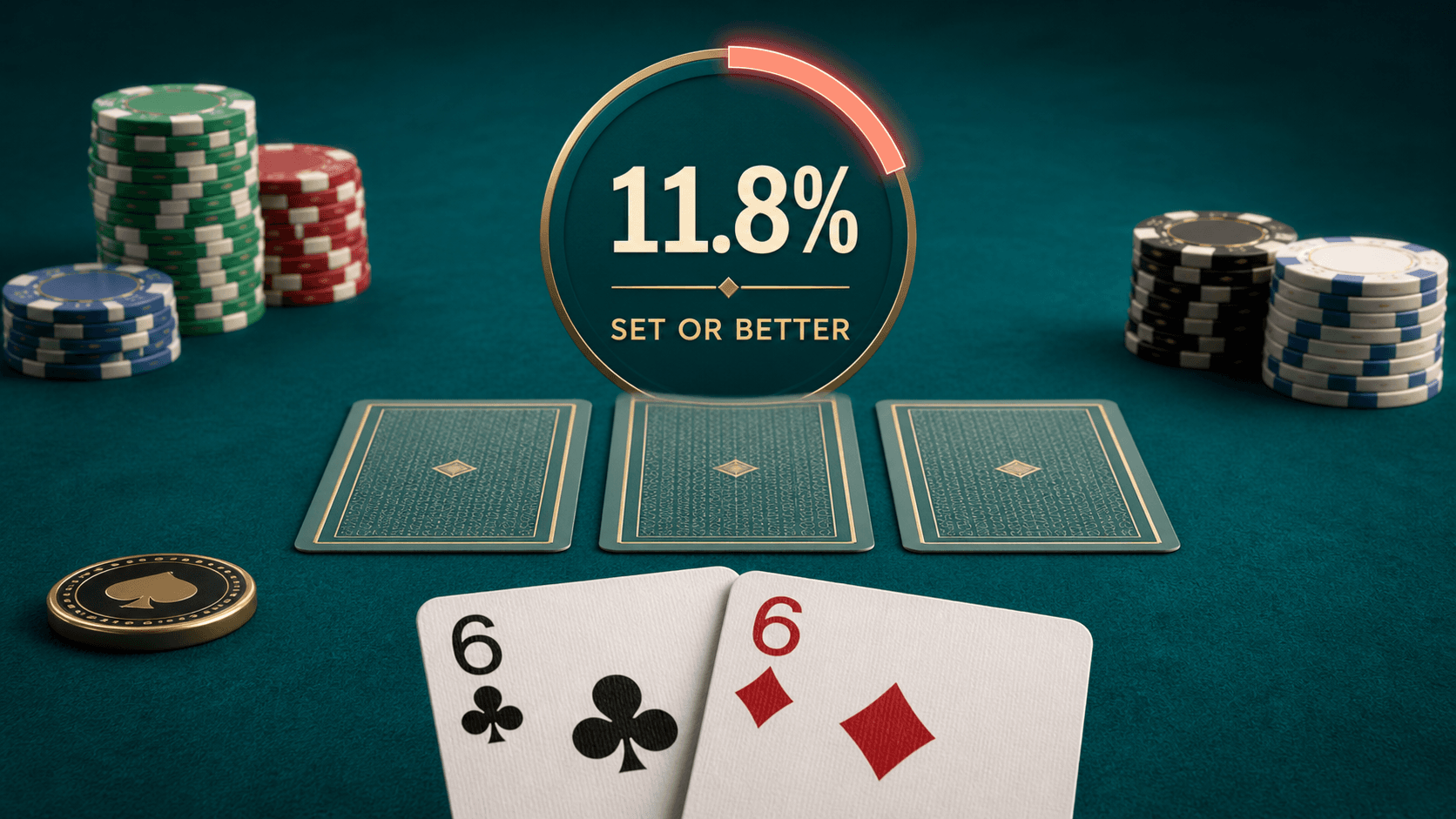
After you are dealt a pocket pair, 50 cards remain unseen. There are 19,600 possible three-card flops. Of those, 2,304 give you at least three of a kind: a set, a full house, or quads.
That is 11.76%, rounded to 11.8%. Put another way, you will miss about 88.2% of flops. The odds against improving to a set or better are approximately 7.5-to-1.
Those numbers describe frequency. They do not prove that a call is profitable.
Why an “8-to-1” shortcut is too optimistic
Imagine you must call 2,500 chips. If you hit, you do not automatically win 20,000. Sometimes the raiser has ace-king and gives up on a low flop. Sometimes an overcard kills the action. Sometimes a player behind squeezes and you fold before seeing the flop. Occasionally you make a set and still lose to a straight, flush, larger set, full house, or quads.
That is why direct pot odds are rarely enough for pure set mining. You need implied odds: the realistic extra chips you expect to win after the flop. “Realistic” is the important word. The opponent’s remaining stack is not money already promised to you.
Five filters before you call
- Effective stack: Compare the amount you must call with the smaller remaining stack between you and the opponent. Ten times the call is a bare checkpoint, not a guarantee. Many difficult spots need 12 to 15 times the call—or more.
- Opponent’s range: A tight early-position raiser is more likely to hold an overpair that can pay a set. A wide late-position opener often misses the flop and escapes cheaply.
- Position: Acting last helps you control the pot when you miss and extract value when you hit. Out of position, the same pair is harder to realize profitably.
- Players behind: Every active player left to act can squeeze, isolate, or create a multiway pot. Multiway action can increase the reward, but it also raises the chance of stronger draws and set-over-set trouble.
- Tournament pressure: Near a bubble or major pay jump, losing a medium stack may cost more tournament equity than the chip calculation suggests. ICM can turn a marginal chip call into an unnecessary risk.
A practical live example
You have 50 big blinds and pocket sixes on the button. A tight player opens to 2.5 big blinds from early position and also has 50 big blinds. Calling costs 2.5 big blinds, leaving an effective stack of 47.5 big blinds behind—19 times the call.
That is a much better set-mining environment than facing a 20-big-blind stack, because there is enough money behind and the opener can hold premium pairs. It is still not automatic. If aggressive players remain in the blinds, if the opener folds too easily postflop, or if tournament pressure is severe, folding may remain the cleaner choice.
Now change only one detail: the opener has 14 big blinds. After raising, there is not enough stack left to compensate for all the times you miss. The cards are identical, but the investment is worse.
When small pairs have value beyond a set
“Set mine or fold” is a useful beginner simplification, but stronger players also consider whether the pair can win at showdown, bluff on favorable boards, or become a profitable three-bet. Those options depend on ranges, position, and skill after the flop.
If your plan is purely to hit a set, be honest about it. Do not justify a weak call by imagining advanced postflop moves you are unlikely to make.
DIP Take
Treat set mining like a business investment, not a lottery ticket. The 11.8% hit rate is only the admission price. Effective stacks, position, opponent type, and tournament pressure determine whether the ticket is worth buying.
Before calling, say the plan in one sentence: “I am risking this amount because this opponent can realistically pay at least this much when I hit.” If you cannot finish that sentence convincingly, folding is usually the disciplined play.
Information verified: September 2, 2026. Probability checked by combinatorial calculation and compared with established poker strategy references.
Responsible play notice: Poker involves financial risk and short-term variance. Use money you can afford to lose, set time and spending limits, and never chase losses.