You bet for value. Your opponent raises. That does not mean the original bet was wrong, and it does not mean you must defend it by calling. The new price needs a new decision.
One hand, with the pot kept honest
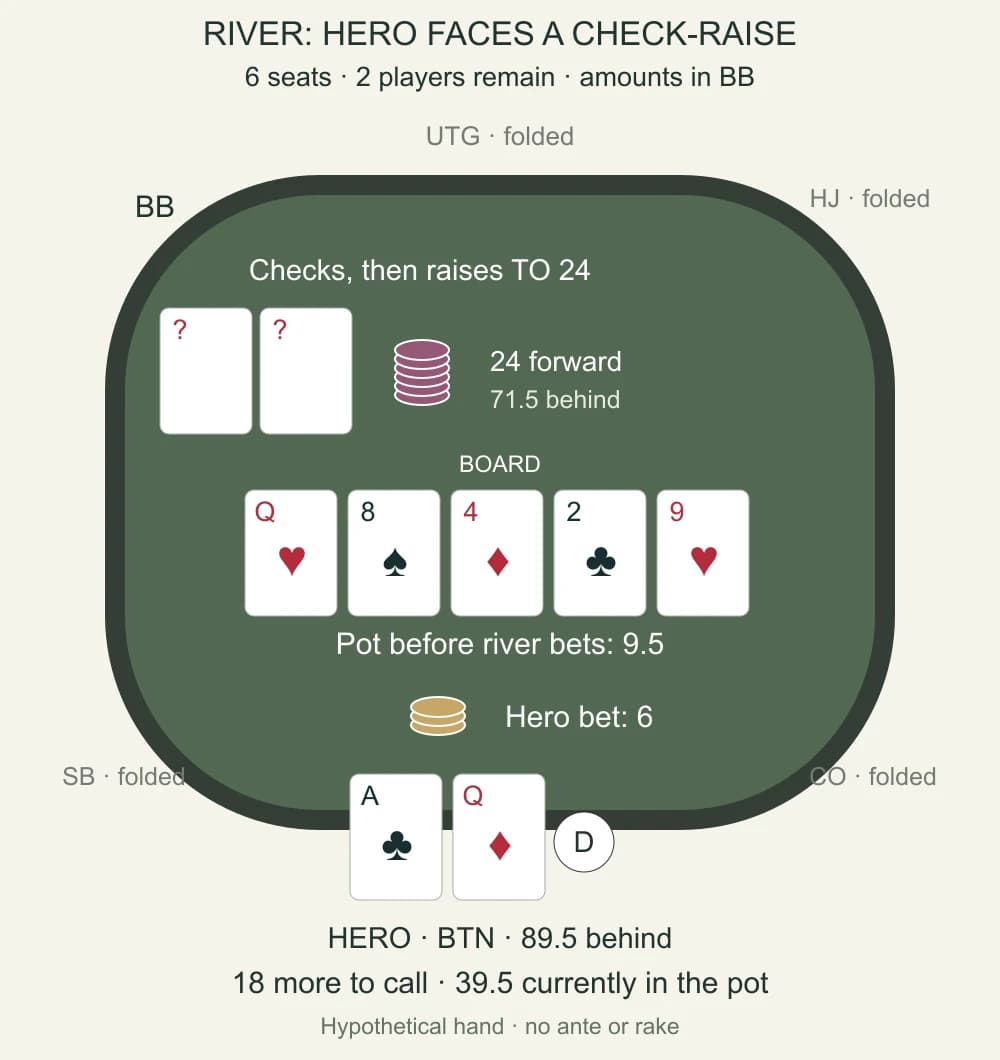
This is a six-seat cash-game example with 100 BB effective starting stacks, no ante and no rake. Hero is on the button with ace of clubs and queen of diamonds. Everyone before Hero folds. Hero opens to 2.5 BB, the small blind folds and the big blind calls. Two players see the flop. The pot is 5.5 BB, including the folded small blind's 0.5 BB.
The flop is queen of hearts, eight of spades and four of diamonds. The big blind checks. Hero bets 2 BB and gets called: pot 9.5 BB.
The turn is two of clubs. Both players check. The river is nine of hearts. The board is now Qh-8s-4d-2c-9h, with no possible flush. Both players have 95.5 BB behind.
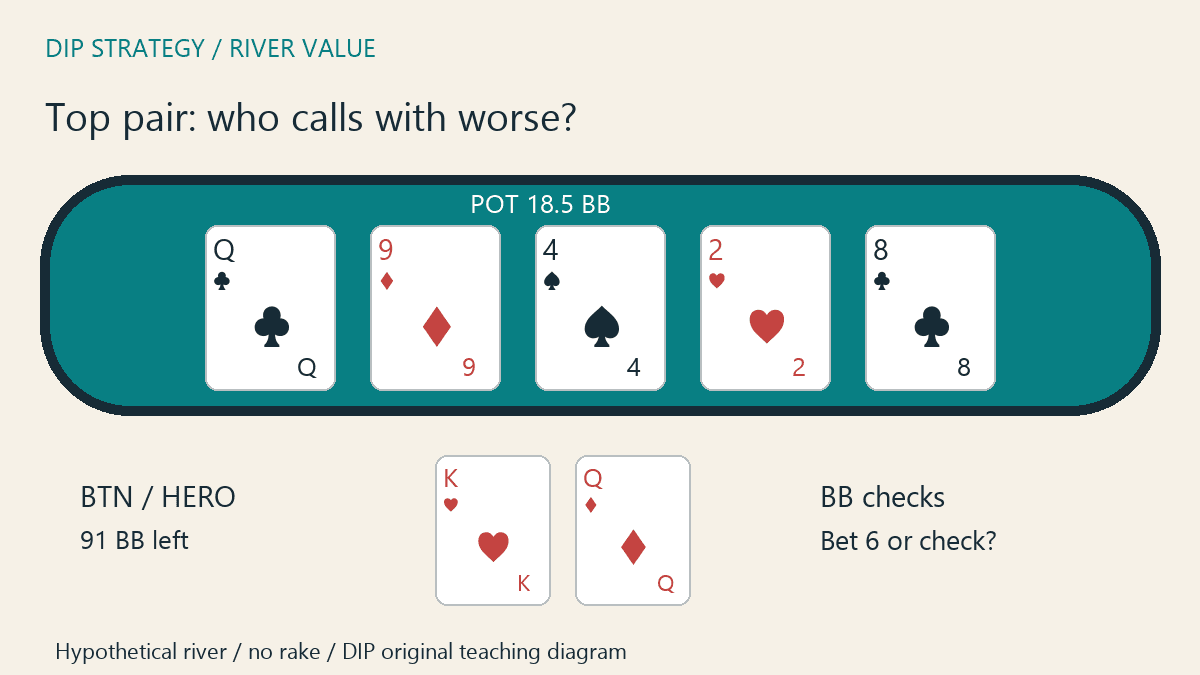
The big blind checks. Hero bets 6 BB with top pair, ace kicker. The opponent raises TO 24 BB, putting 24 BB forward on this river. Hero has already bet 6, so calling costs another 18 BB.
The pot is offering a price, not proof of a bluff
Before Hero decides, the pot is 9.5 + 6 + 24 = 39.5 BB. Calling 18 would make the final pot 57.5 BB.
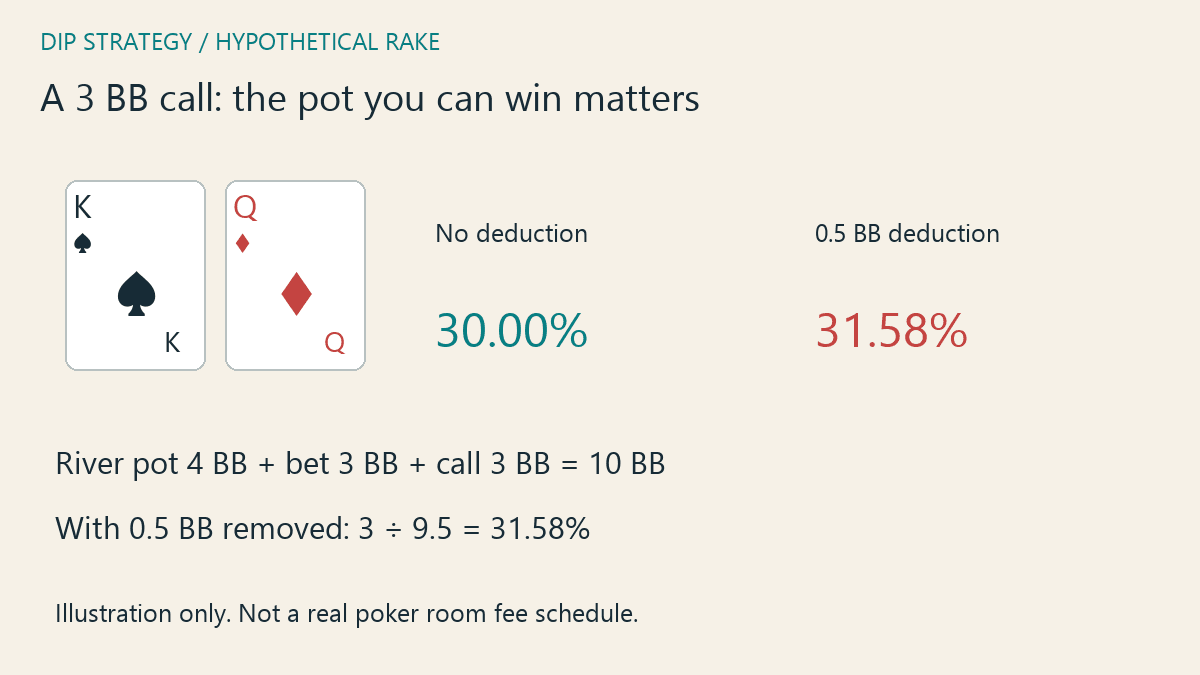
The break-even winning frequency is 18 / 57.5 = 31.30%. That threshold assumes no rake and no ties. It does not tell us that the opponent actually bluffs 31.30% of the time.
Hero's previous 6 BB is already committed. For this decision, folding has an incremental value of zero. It is not free to call merely because the original bet was intended for value.
Try a deliberately simple range model
Suppose, for analysis only, the opponent raises every combination of 88, 44, 99 and JTs for value, and no other value hands. Each set has three combinations because one card of its rank is on the board. JTs has four suited combinations and makes an eight-to-queen straight. That is 3 + 3 + 3 + 4 = 13 value combinations. Hero loses against all 13.
Now suppose the only bluffs are missed 76s and 65s. There are four combinations of each, so eight candidate bluffs. These are possible bluff candidates, not a claim about how real opponents play this line. Hero beats all eight at showdown.
If all eight bluff combinations take this exact line as often as each value combination, Hero wins 8 / 21 = 38.10% and calling has positive model value:
(8 / 21 x 39.5) - (13 / 21 x 18) = +3.90 BB.
But if each candidate bluffs only half the time, there are four weighted bluff combinations against 13 value combinations. Hero wins 4 / 17 = 23.53%, and the model call loses:
(4 / 17 x 39.5) - (13 / 17 x 18) = -4.47 BB.
Counting possible hands is not enough. We need to consider how frequently they actually reach the river and raise.
Where is the tipping point?
Let B be weighted bluff combinations. A break-even call requires 39.5B = 18 x 13, so B = 5.92. With whole equally weighted combinations, six bluffs barely make the call positive: +0.16 BB. Five bluffs make it negative: -2.03 BB.
These are not universal thresholds for top pair. They apply to this size and this assumed 13-combination value range. Adding more value hands, discounting preflop calls or changing river frequencies changes the result. Rake can also erase a small margin.
Call, fold or raise again?
Calling makes sense only if your evidence supports enough bluffs or weaker made hands raising. Folding is reasonable when that evidence is missing and this opponent rarely raises without a strong hand. Raising again risks more money: missed draws may fold while stronger hands continue. Do not turn top pair into a larger bluff simply because calling feels uncomfortable.
The earlier 6 BB value bet must be assessed against hands that could call with worse, separately from the response to a raise. This example is not a solver-approved claim that betting is always better than checking.
DIP's conclusion
When a value bet is raised, stop defending your earlier decision. Recalculate the additional call, list plausible value hands, then ask which bluffs really take the whole line. A cheap-looking price cannot manufacture missing bluffs.
Practise with free chips. Real-money play carries financial risk. Use affordable limits, never borrow or chase losses, and stop when play is no longer comfortable.