You raise with pocket jacks, flop the best possible hand, bet, and get raised. Calling feels clever. Raising feels obvious. Neither feeling is a plan.
The useful question is what happens to the remaining stacks on the next two streets. A slow-play can preserve bluffs, but it can also let the cards or the opponent close your value window.
The hand: top set facing a raise
This is a hypothetical six-seat cash-game example measured in big blinds (BB), with 100 BB effective stacks and no ante or rake. Real rake changes the final returns. We are studying chip value, not tournament payout pressure.
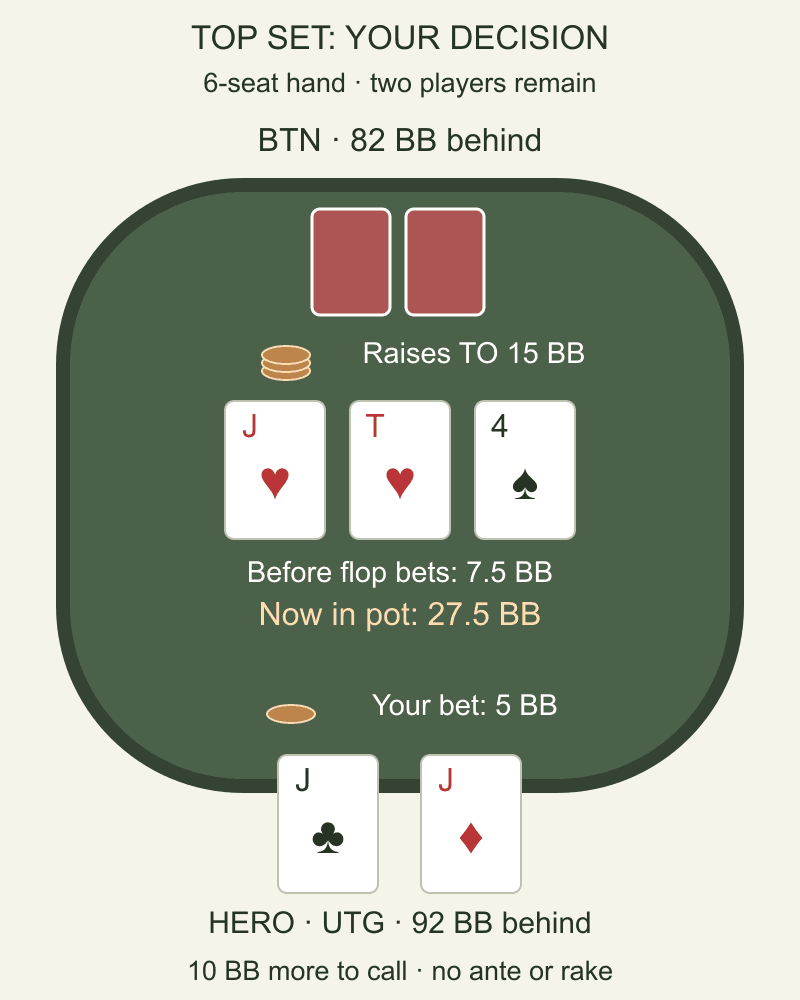
- Hero is UTG with J♣ J♦ and opens to 3 BB.
- HJ and CO fold. BTN calls 3 BB. Both blinds fold.
- The pot is 7.5 BB: 3 + 3 + the folded blinds' 1.5.
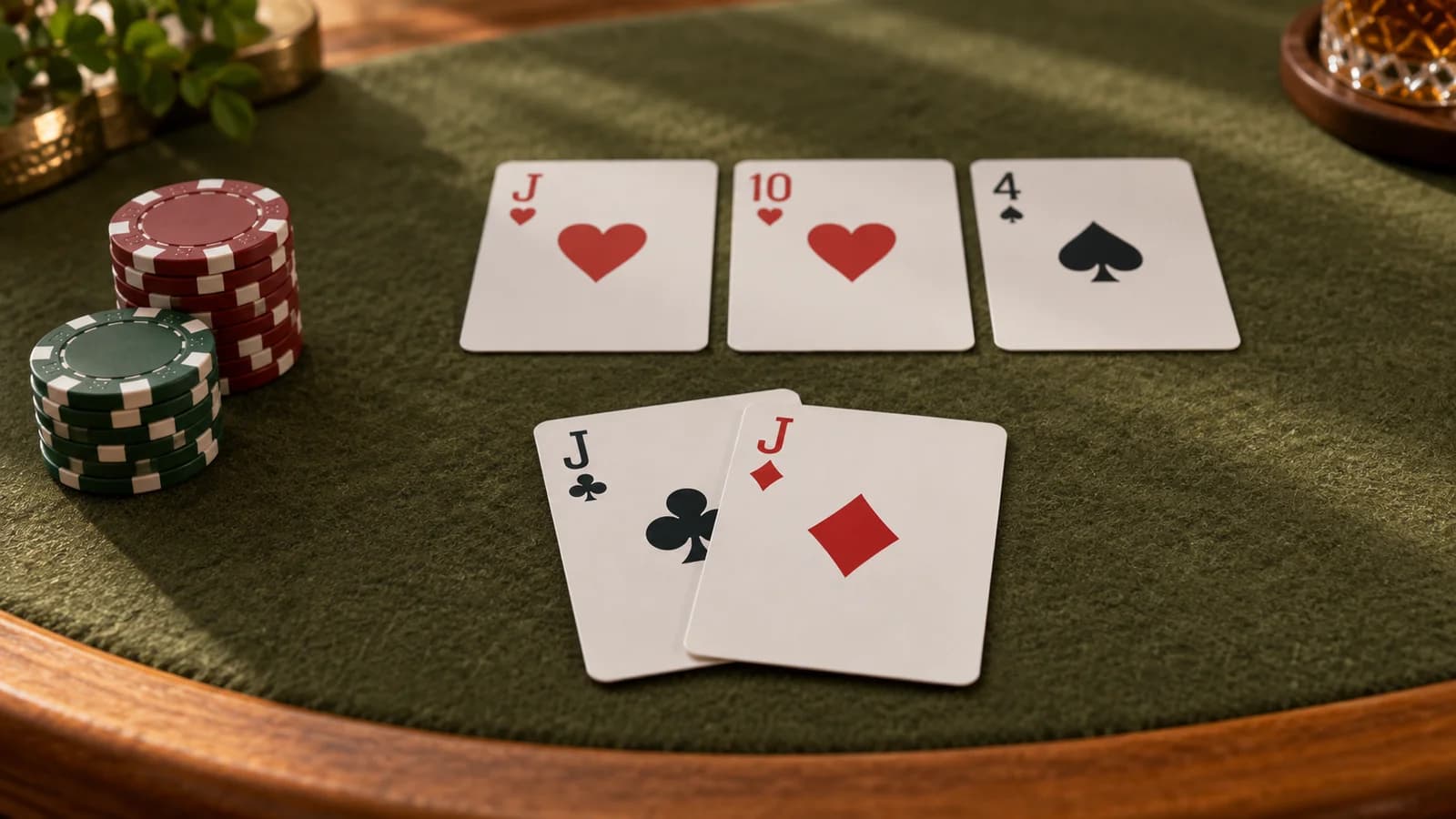
- The flop is J♥ T♥ 4♠. Two players remain.
- Hero bets 5 BB. BTN raises to 15 BB, not by 15.
- There is now 27.5 BB in the middle. Hero has 92 BB behind; BTN has 82 BB behind.
Hero has three jacks, or top set. On this flop no straight or flush is complete, so it is currently the strongest possible hand. That does not mean it cannot lose by the river.
First count what a call actually creates
Calling adds 10 BB. The resulting pot is 37.5 BB and both players have 82 BB left.
The immediate price is 10 / 37.5 = 26.7%. That is only a simplified equity benchmark if there were no further betting and all equity were realised. It is not a reason to fold top set, nor does it tell us whether calling earns more than raising.
The turn stack-to-pot ratio is 82 / 37.5 = 2.19. Stacks can still go in over two streets without absurd bets. For example, on a suitable turn, a 25 BB bet and call make the pot 87.5 BB. Each player then has 57 BB, leaving a river shove of about 65% of the pot.
That sequence assumes someone bets and the opponent calls. Because Hero is out of position, calling the flop does not guarantee BTN will continue betting. Checking the turn may produce a check-back; leading the turn is a separate strategic choice, not a free continuation of the trap.
What a raise to 40 BB changes
Hero has already put in 5 BB on this flop. Raising to 40 BB means adding 35 BB now. The pot becomes 62.5 BB before BTN responds.
BTN has already invested 15 BB, so calling costs another 25 BB. If called, the pot is 87.5 BB and both players have 57 BB behind. The turn SPR is 57 / 87.5 = 0.65.
One more substantial bet can now put the remaining effective stack in. The raise brings value forward, while worse made hands and strong draws can still be interested. But if it folds out all the hands that would have bluffed again, it also has a cost.
These are alternative branches, not consecutive actions. Do not add the call-line pot to the raise-line pot.
Which hands continue, and which disappear?
Build a plausible opponent model rather than declaring every raise a draw.
- Lower sets: TT and 44 have three combinations each before weighting how often BTN calls preflop and raises this flop.
- Two pair: JTs is reduced to just J♠ T♠ by Hero's cards and the board. Do not count the usual four suited combinations.
- Strong heart draws can include A♥ Q♥, K♥ Q♥ or Q♥ 9♥. These examples are not an exhaustive range and do not all take the same preflop or flop action.
- Other raises might include straight draws, weaker heart draws or bluffs, depending on the player. Their frequency is an assumption, not information revealed by the raise itself.
Against a player who raises strong draws and then calls another raise too freely, building the pot has a clear value purpose. Against a player who attacks small bets widely but folds those bluffs to resistance, calling can retain hands a raise would lose.
Neither description licenses exact equity claims without explicit range weights. Six lower-set combinations do not mean six equally likely combinations in every opponent's strategy.
The turn is part of the flop decision
A 2♣ is a relatively quiet turn. A heart can complete a flush, while some connected cards can complete straights. Even a card that does not beat Hero can frighten worse hands into checking or folding.
Conversely, a board-pairing turn can give Hero a full house or quads. Evaluate the actual card and betting action, not a rule that every scary card demands a fold or every set demands an all-in.
This is why “charge the draw” is incomplete advice. We are choosing a size that worse hands can continue against and a future pot size we can use. Making every draw fold immediately is not the objective when those calls would be profitable for us.
Three mistakes to avoid
- Treating “raise to 40” as 40 new chips after already betting 5. That overstates the pot and understates the stack.
- Slow-playing automatically because the hand is strong, without asking whether BTN will keep betting or whether many turns reduce action.
- Raising solely to feel safe. Top set can still lose; the decision is about value against a range, not eliminating uncertainty.
DIP's take
Our practical default in this specific example is to lean toward a value reraise against opponents who continue too often with lower sets, two pair and substantial draws. Calling remains a credible adjustment against a bluff-heavy raiser who will keep firing.
The key is not that one size is universally optimal. Count the chips, estimate what continues, and plan the next street before choosing the clever-looking option.
Use play chips to work through the two branches. If you play for money, set limits in advance and never increase stakes to recover losses.