A call can look profitable on paper and still lose a little after the pot is reduced. That does not mean every close call should be folded. It means the price calculation must use the money you can actually receive.
This is a deliberately small example. We are not describing a particular Philippine poker room or claiming a current fee schedule. The deduction below is hypothetical, so the arithmetic can be checked without relying on a venue's changing terms.
One hand, one final decision
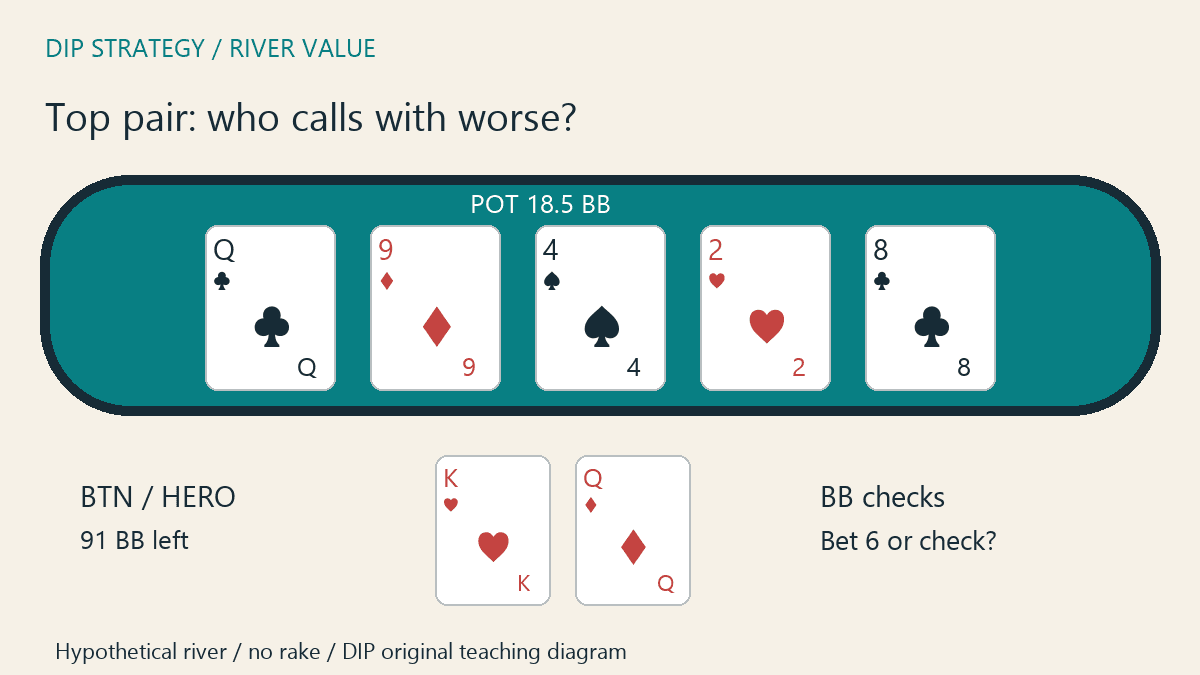
Consider heads-up no-limit cash poker with blinds of 0.5BB and 1BB. Both players start with 100BB. Hero is on the button/small blind with K♠ Q♦. Hero completes to 1BB, the big blind raises to 2BB, and Hero calls the extra 1BB. Each has contributed 2BB, the gross pot is 4BB and each retains 98BB. This is a constructed accounting example, not a recommended opening strategy.
The flop is K♥ 9♣ 7♦. Both check. The turn is 2♠. Both check again. The river is 2♥. The big blind bets 3BB into the 4BB pot. Hero now chooses between folding, calling 3BB or raising. This article isolates the call-versus-fold calculation; a raise needs a separate model of which hands continue.
There is 7BB in front of Hero before the call. If Hero calls, the gross final pot becomes 10BB. No more betting remains. Hero's K♠ Q♦ makes two pair, kings and twos, with a queen kicker. It does not automatically beat an opponent who bet after two checked streets.
Start with the no-deduction benchmark
Treat folding now as an incremental result of zero. The 2BB Hero invested earlier is already committed and is not part of today's new decision.
If Hero wins after calling, the net result from this decision is +7BB: receive 10BB after paying 3BB. If Hero loses, it is −3BB. With no ties, and win probability q:
Call EV = q × 7 − (1 − q) × 3 = 10q − 3.
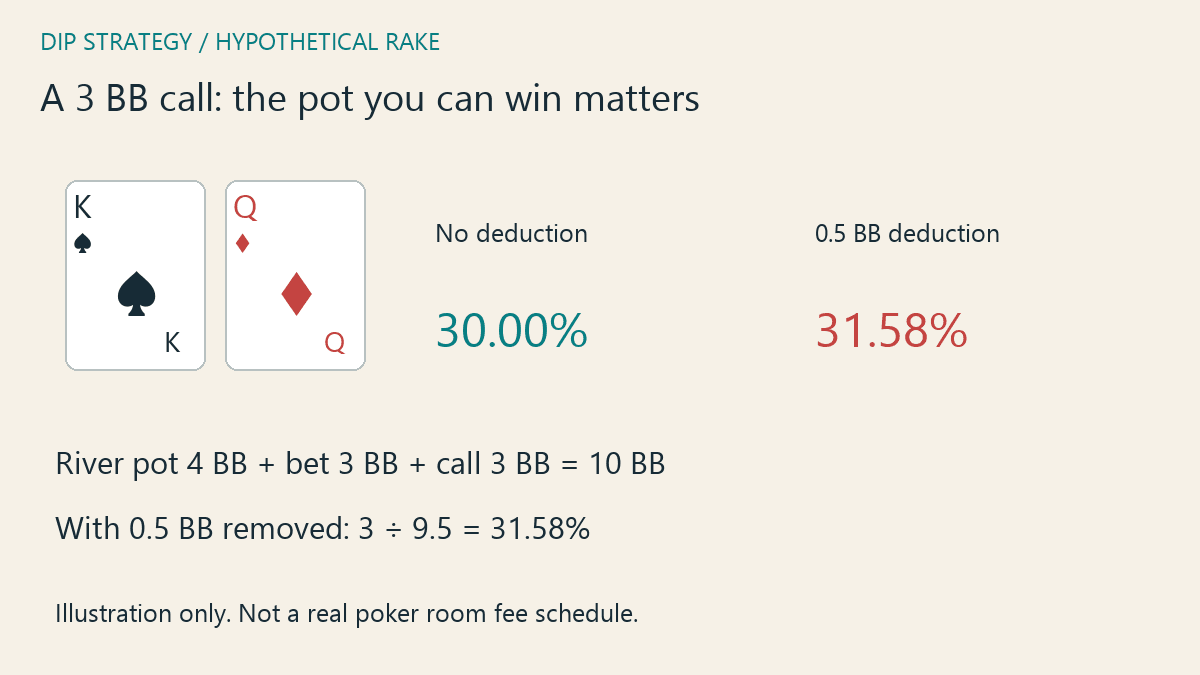
Set that equal to zero: q = 3 ÷ 10 = 30%. That is the familiar pot-odds threshold, but it assumes the full pot is returned to a player.
Now remove a hypothetical 0.5BB
Suppose the total deduction at settlement is 0.5BB. The winner receives 9.5BB rather than 10BB. Our 4BB starting pot was gross, before any deduction; we are not removing a fee twice.
Hero's winning result becomes +6.5BB after the new call. The losing result remains −3BB. Therefore:
Call EV = q × 6.5 − (1 − q) × 3 = 9.5q − 3.
Required win probability = 3 ÷ 9.5 = 31.58%.
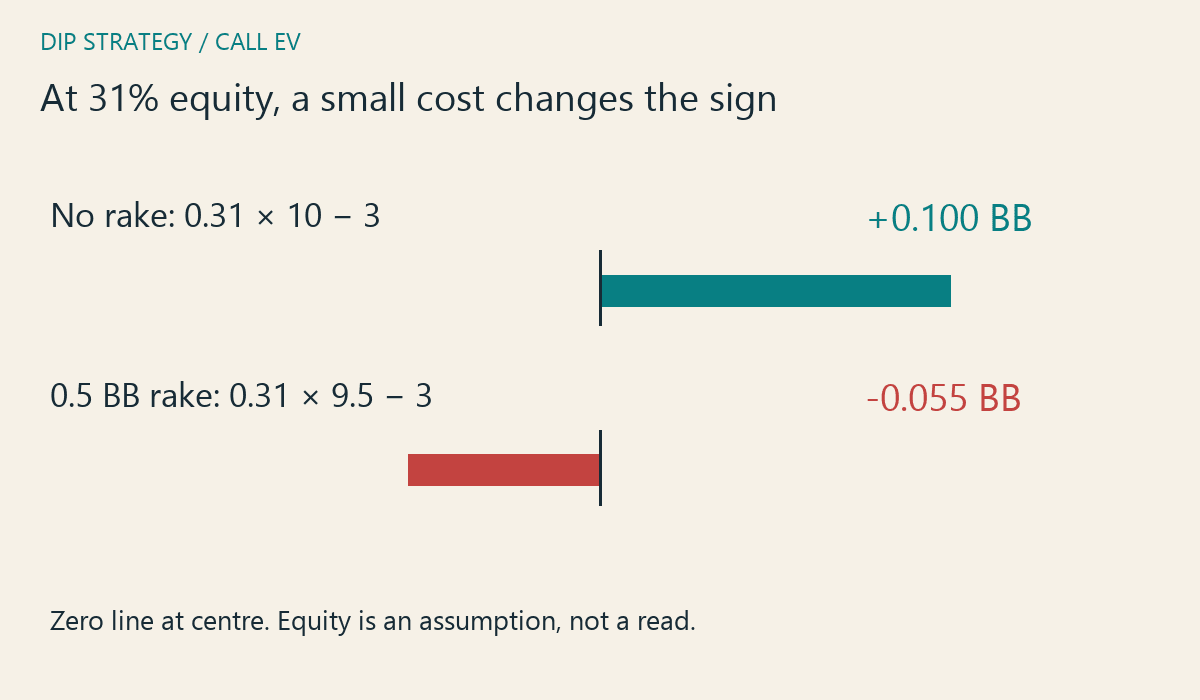
At an assumed 31% chance of winning, the no-deduction call earns 0.31 × 10 − 3 = +0.10BB. With the deduction it earns 0.31 × 9.5 − 3 = −0.055BB. These are long-run mathematical averages under the assumptions, not amounts that one individual hand pays.
The calculation is precise; your range estimate is not
The 31% is a sensitivity test, not a claim that KQ has exactly that equity. Imagine a weighted opponent model with 31% hands Hero beats and 69% stronger hands, with ties excluded. Plausible losing hands for Hero include AK and full houses; plausible wins include missed draws turned into bluffs. Their actual frequencies require evidence. Two checks do not supply those frequencies by themselves.
If the true win rate were 35%, the same fee-adjusted EV would be 0.35 × 9.5 − 3 = +0.325BB. If it were 25%, EV would be −0.625BB. A small error in the opponent model can matter much more than the decimal places in the fee calculation.
Where ties exist, use expected share of the distributable pot rather than just the frequency of outright wins. Our simplified formula deliberately removes that extra complication.
Before applying this to a real game
- Confirm whether the displayed pot is gross or already net of deductions. Do not subtract the same fee again.
- Check how the venue calculates its deduction, including any cap or other drop. A percentage, a capped charge and a time charge are not interchangeable.
- Use only costs affected by the decision when comparing alternatives. A prepaid session charge is not another charge on this particular call.
- Do not transfer this river formula unchanged to the flop. Future bets can prevent you from realizing your full equity.
DIP's take
Know the structure before you sit down, but do not turn a barely negative toy calculation into a confident fold against every opponent. Use fees to sharpen the price, and use credible hand-reading to estimate what that price buys. If both are uncertain, admit the uncertainty instead of inventing a razor-thin edge.
All numbers, diagrams and the hand above are original DIP examples, checked September 13, 2026. No actual venue rate is asserted.
Play only where legally permitted. Set a loss limit before playing and never use essential living expenses as a poker bankroll.