A river value bet is not justified by the sentence “I have top pair.” It needs a second sentence: “These worse hands can call.” If your opponent only continues with hands that beat you, betting has turned a useful showdown hand into an unnecessary payment.
This hand lab isolates that decision. It is an original, hypothetical example, not a solver output or a claim about how all Manila players behave.
The hand, including every chip
Six-max cash game, 100BB effective stacks, blinds 0.5/1BB, no ante. Rake is ignored to keep the comparison transparent. BB means big blind, not a peso amount.
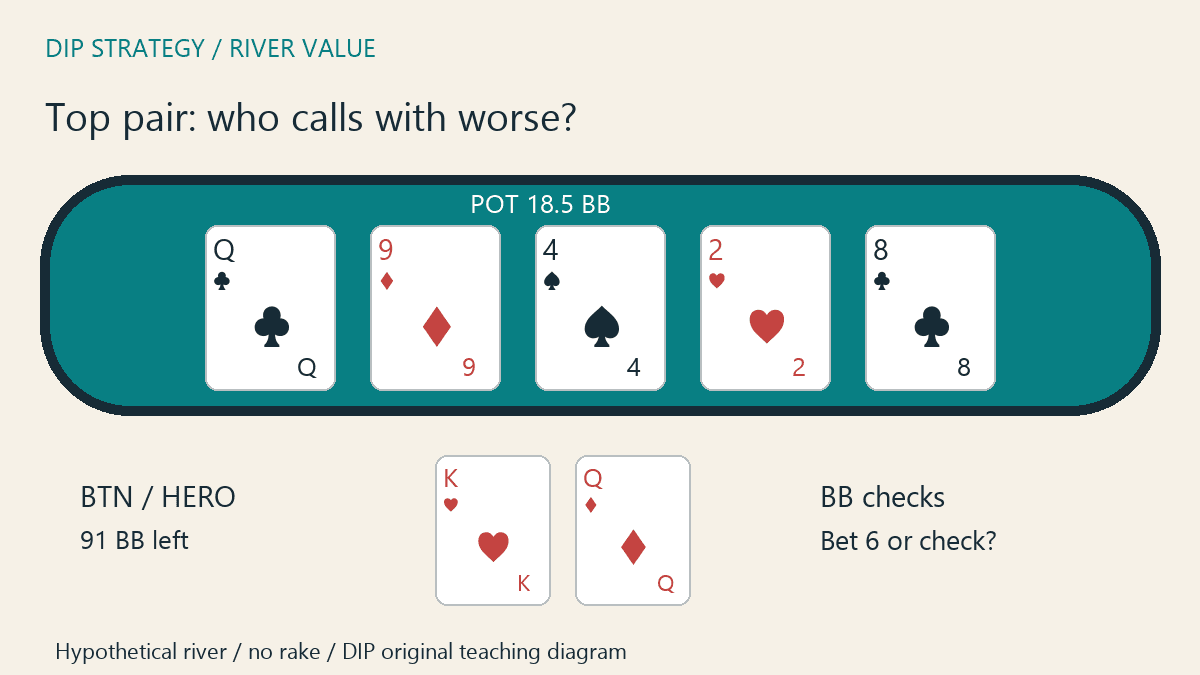
Hero holds K♥ Q♦ on the button. Everyone before Hero folds. Hero opens to 2.5BB, the small blind folds and the big blind calls the extra 1.5BB. Two players reach the flop. The pot is 2.5 + 2.5 + 0.5 = 5.5BB.
- Flop Q♣ 9♦ 4♠: BB checks, Hero bets 3BB, BB calls. Pot: 11.5BB.
- Turn 2♥: BB checks, Hero bets 3.5BB, BB calls. Pot: 18.5BB.
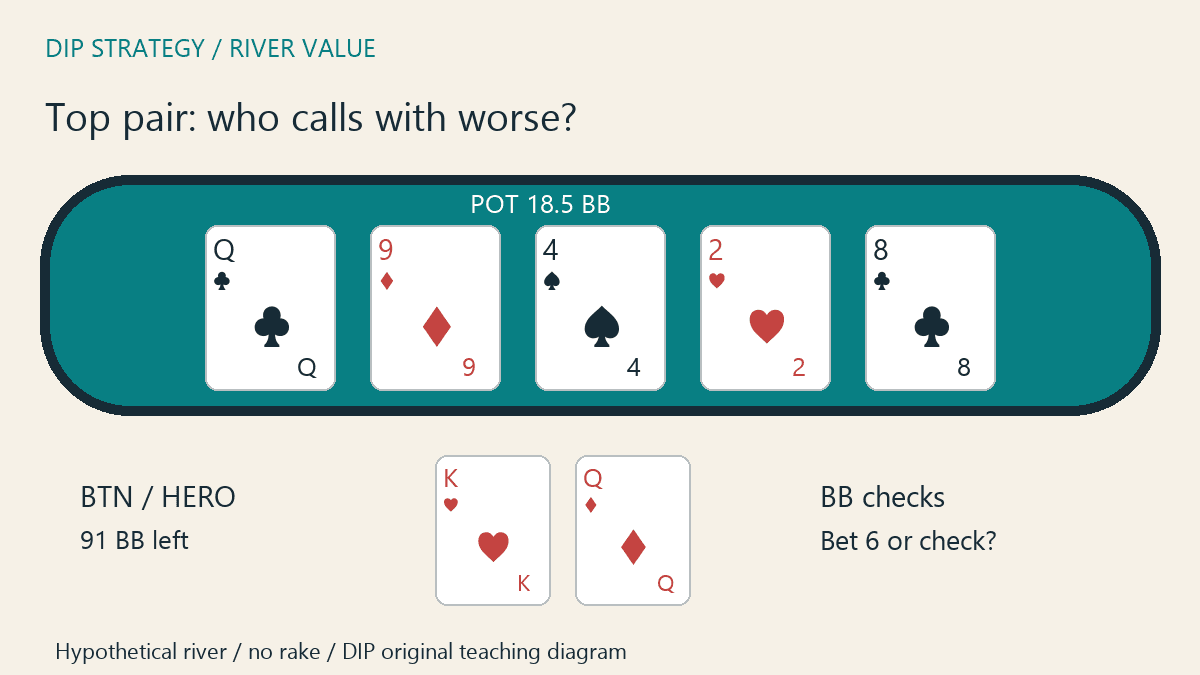
- River 8♣: BB checks. Both players have 91BB remaining. Hero chooses between checking back and betting 6BB.
The small turn sizing is an assumption of this example, not a recommendation to use it universally. River SPR is 91 / 18.5 = 4.92. There is still room for a large raise; this is not an automatic stack-off spot.
First identify the hands that changed
The river is not completely harmless. J-T now makes a queen-high straight: 8-9-T-J-Q. A player with 8-8 has improved to a set. Q-8 and 9-8 can make two pair. Those hands should not vanish from a range simply because the opponent checked.
Potential worse calls include Q-J and Q-T. A-Q beats Hero. Sets, two pair and J-T also beat Hero. K-Q can tie. The question is not whether these hands exist in the deck, but how often this opponent reaches the river with them and chooses each response.
Hero’s Q♦ removes some queen combinations. Hero’s K♥ can remove some K-high missed hands. Card removal does not by itself prove that a value bet is good.
A deliberately small range model
Start with 40 equally weighted teaching cases. This is a sensitivity test, not a reconstructed population range. Assume no raises, no ties and no better hands folding.
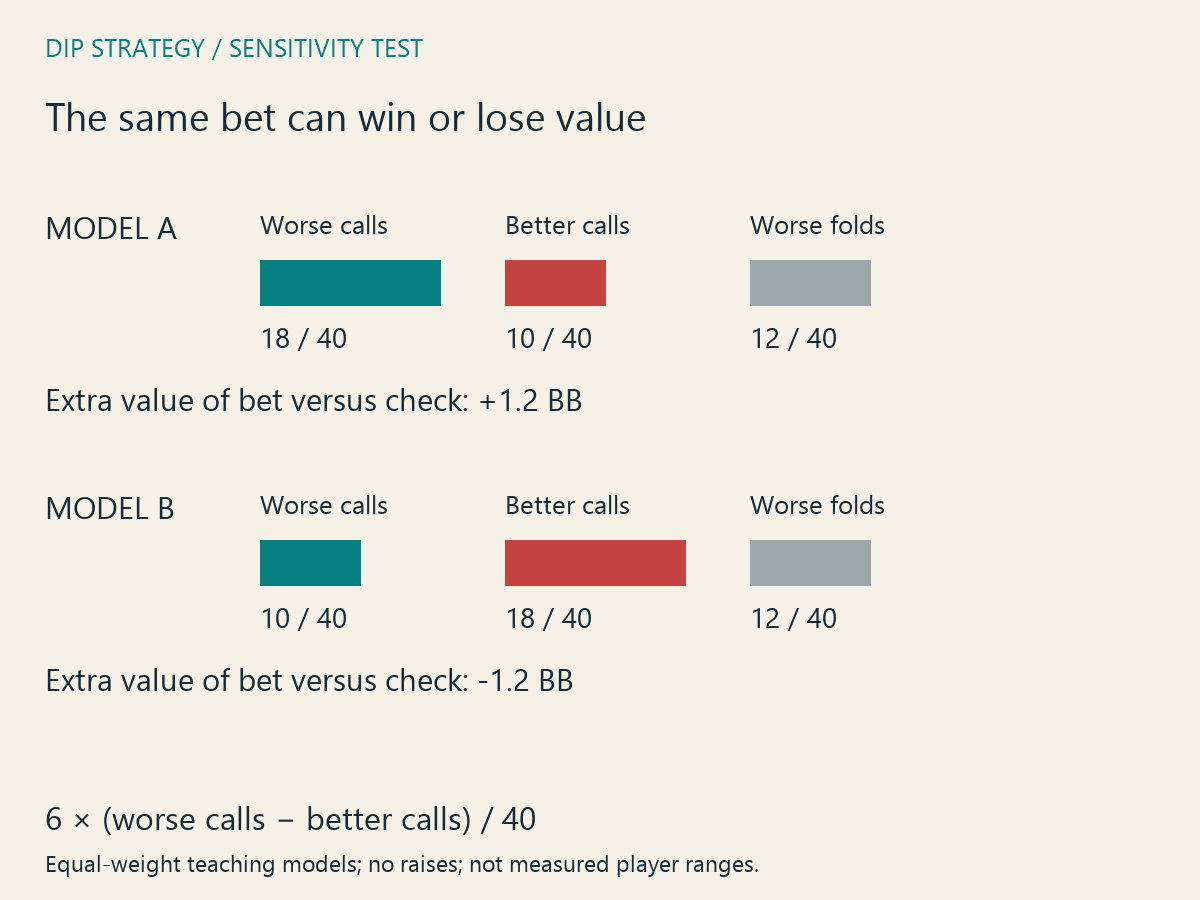
Model A contains 18 worse calls, 10 better calls and 12 worse folds. One legal illustration for the 18 worse combinations is Q-J (8), Q-T (8), Q♥7♥ and Q♠7♠ (2). A-Q supplies eight better combinations; Q♥9♥ and Q♠9♠ supply two more. A-J suited, A-T suited and J-7 suited can supply twelve unpaired folds.
This restricted illustration deliberately omits other credible hands such as sets and J-T. It is not permission to ignore them in play. Model B represents a more value-heavy opponent by shifting eight cases from worse calls to better calls: 10 worse calls, 18 better calls and 12 worse folds. Those are weighted cases, not a claim that every alternative combination is equally likely.
Compare betting with the free showdown
When a worse hand calls 6BB, betting earns 6BB more than checking. When a better hand calls, it loses an extra 6BB. When a worse hand folds, Hero wins the same existing pot that checking would have won. The fold is not additional value over the check-back baseline.
- Model A: 6 × (18 − 10) / 40 = +1.2BB versus checking.
- Model B: 6 × (10 − 18) / 40 = −1.2BB versus checking.
You can verify this by including the existing pot. Model A checking wins 18.5BB in 30 of 40 cases: 13.875BB expected return from this decision. Betting gives (18 × 24.5 − 10 × 6 + 12 × 18.5) / 40 = 15.075BB. Difference: 1.2BB. Earlier contributions are already sunk; do not subtract them again from only one option.
Among calls in this simplified model, Hero needs to win more than half for the bet to add value. That is a comparison with checking, not the pot-odds threshold for calling someone else’s bet.
Why a bigger bet is not automatically better
Doubling the size does not preserve the calling range. Q-T may call 6BB and fold to 12BB, while A-Q and straights continue. A smaller bet may keep worse queens involved, but it may also invite a raise. A player who calls many weak pairs supports a different sizing decision from one who is selective on the river.
Before betting, decide how a raise changes the analysis. The two models stop being valid as soon as check-raises enter. Against a player whose river raises are strongly value-heavy, bet-fold can be reasonable; against someone who attacks small bets with bluffs, that same plan may be exploited. Without evidence, checking back is a legitimate way to realise showdown value.
Common mistakes
- Counting every hand you beat as a worse call, even if it folds.
- Calling the 8♣ a blank and missing J-T’s completed straight.
- Applying the opponent’s preflop range unchanged after two calls.
- Quoting +1.2BB as a solved answer rather than a result of assumptions.
- Betting without a response plan, then calling a raise because chips are already invested.
DIP’s conclusion
We would not prescribe a bet from the cards alone. Against credible worse-queen calls, a small value bet is a candidate. Against a tight river calling range, take the showdown. Write down three actual worse hands you expect to call before reaching for chips. If you cannot name them honestly, “top pair” is not enough.
Verification: September 11, 2026. Pot totals, card availability and both expected-value models were checked directly by DIP. No solver or measured player dataset is claimed.
Responsible play: This is an educational example, not a promise of profit. Practise without money, set affordable limits if eligible to play, and never borrow to continue.