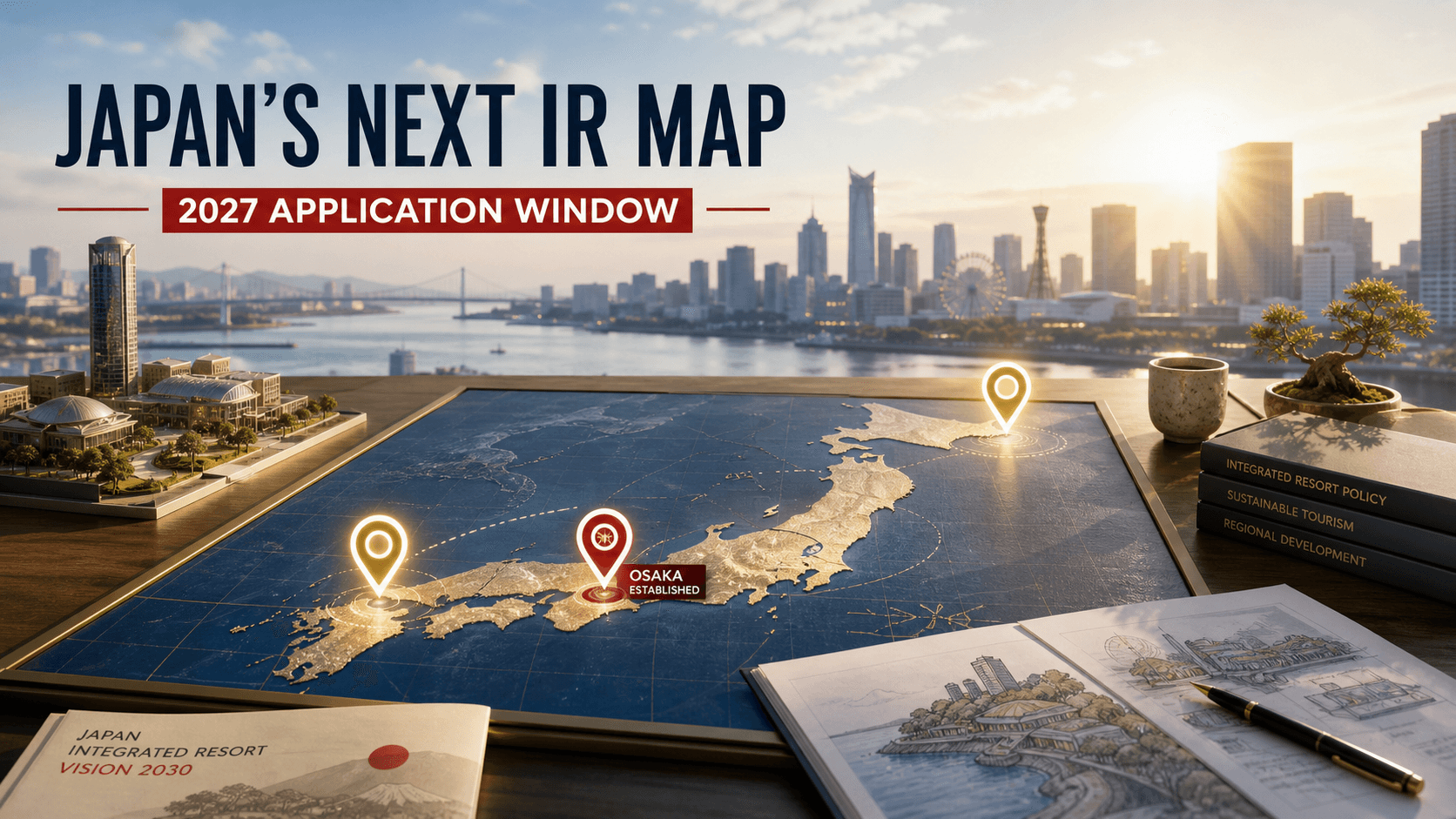
Japan already has one approved integrated-resort project: Osaka’s Yumeshima development, currently targeted for a 2030 opening. But the national framework allows up to three certified IR regions. A new government timetable means the remaining two slots could return to the national agenda in 2027.
That does not mean two new casinos have been chosen. It means eligible local governments may once again prepare regional development plans with private-sector partners and ask the national government for certification.
The official 2027 window
Japan’s Tourism Agency announced that applications for new IR area-development plans will be accepted from May 6 to November 5, 2027. The decision adds a new six-month application period under the Integrated Resort Implementation Act.
Only one region—Osaka/Yumeshima—has been certified so far. Because the law permits a maximum of three, up to two additional regions remain possible.
Possible is not the same as automatic. A local government must first decide to proceed, select and coordinate with an operator, build a detailed regional plan, complete local approvals, and submit the package. The national government then evaluates the application before deciding whether to certify it.
What an “IR” means in Japan
The Japanese model is designed as more than a casino floor. An approved project is expected to combine accommodation, convention and exhibition space, entertainment, tourism facilities, and transport or regional-development planning.
The casino component is also subject to a specific regulatory framework, including controls aimed at responsible gambling and entry management. Any future applicant will need to explain both the economic promise and the safeguards.
For readers, this distinction matters. A headline saying “Japan may add two casinos” misses the larger—and slower—process. The real competition is to prove that a full destination can create international tourism demand while managing social risk.
Osaka is the benchmark, not a template
Osaka remains the only certified project and therefore the clearest reference point. MGM Resorts said in its July 2026 financial update that MGM Osaka remained on track for a 2030 opening.
Future applicants would not simply copy Osaka. Different regions have different airports, convention markets, tourism identities, infrastructure needs, local politics, and public concerns. A plan that works on Yumeshima may not make sense elsewhere.
No additional region should be treated as selected until an official local decision, application, and national certification are documented.
Why the 2027 window matters across Asia
A second or third Japanese IR could reshape competition for convention visitors and premium leisure travel across Macau, Singapore, South Korea, and the Philippines. The impact would depend on location, scale, operator, transport access, and opening date.
For the Philippines, the most useful question is not whether Japan will “take” casino customers. It is whether Asian integrated resorts will become more differentiated. Manila can compete through connectivity, hospitality, poker schedules, entertainment, and price—but only if information and visitor experience remain clear and reliable.
Poker should also be discussed carefully. An integrated resort may include gaming without becoming a major live-poker destination. Tournament poker requires dedicated space, experienced operations, a calendar, partnerships, and sustained player demand. None of those should be assumed from an IR announcement alone.
What to watch next
- Which local governments publicly confirm serious interest before the 2027 application period.
- Which operating partners are selected and how financing is structured.
- Whether local assemblies and residents support the proposed plan.
- How each proposal addresses transport, tourism, convention demand, and responsible-gambling controls.
- Whether the national government certifies one, two, or no additional regions after evaluation.
DIP Take
The important story is not a race to name the next Japanese casino city. It is the reopening of a formal policy pathway.
DIP will treat rumored locations as rumors and official applications as applications—not approvals. The strongest future coverage will compare what each proposed destination actually offers, how it protects players and residents, and whether its timeline is financially credible.
Information verified: September 2, 2026. Application dates and certification framework checked against Japan Tourism Agency materials; Osaka progress checked against Osaka Prefecture and MGM Resorts disclosures.
Responsible play notice: Casino and poker travel should be budgeted as entertainment, not income. Confirm local rules, use licensed venues, set spending limits, and never chase losses.