You know that each player receives two private cards. You have seen the three-card flop, the one-card turn and the one-card river. Now look away from the cards for a moment. A small marker on the table tells you something just as important: where the action starts.
Today is about finding your turn, not memorizing a chart of hands to play. You can practise everything here with counters and a deck, without money.
What you will learn
- Find the button and the two blind positions.
- Follow the first betting round in the correct order.
- Explain why that order changes when the flop appears.
- Notice the difference between acting before and after another player.
The button is a marker, not an extra bet
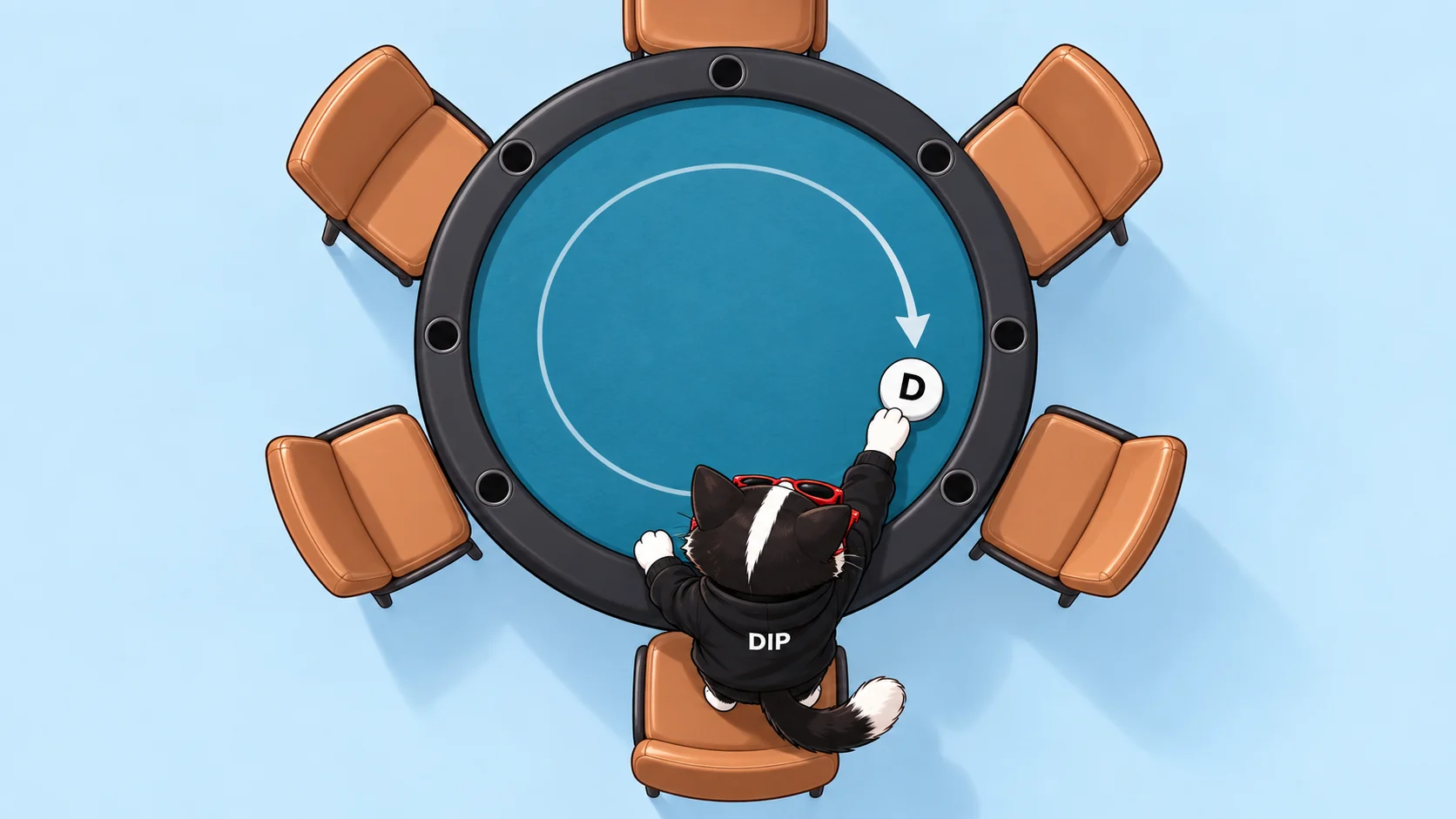
The dealer button is usually a small disc, often marked D or DEALER. Our drawings label it BTN. It identifies the dealer position for the hand. In a casino, a staff dealer can deal every hand while the button still moves around the players. Holding the button does not mean you must physically deal the cards.
Do not confuse this marker with a chip you can bet. It tells the table where the hand's positions begin. Position means your place in the action order, relative to that marker and the players still involved.
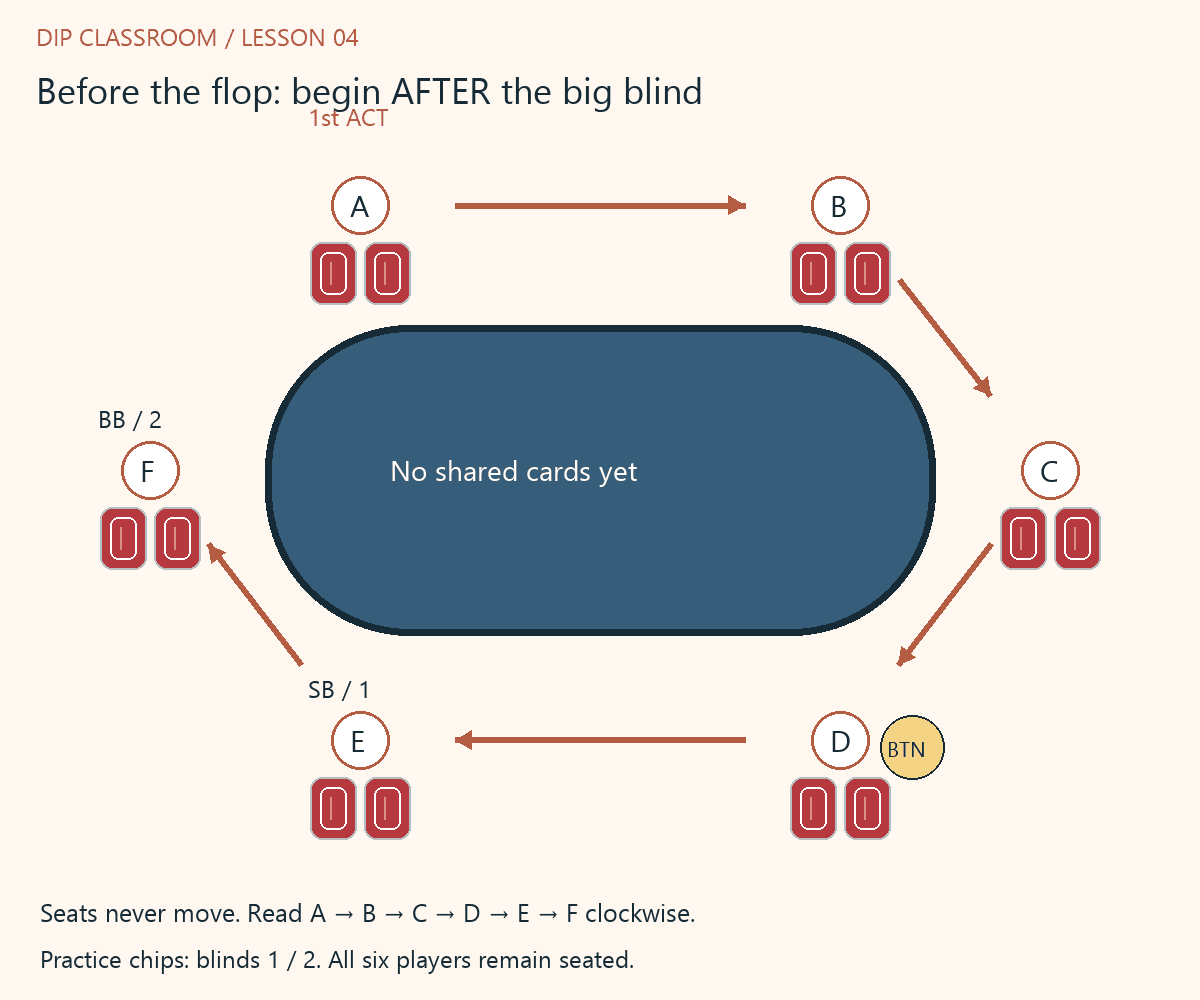
The drawings use six seats, A through F, so you do not have to learn six people's names. Read clockwise: A, B, C, D, E, F, and back to A. Each seat has two red-backed private cards. They stay face down because other players cannot see them. An empty table centre means the flop has not been dealt yet.
Step 1: find D, then E, then F
In this hand, seat D has the button. The next seat clockwise, E, is the small blind (SB). The following seat, F, is the big blind (BB). The blinds are compulsory starting contributions, placed before the ordinary preflop action. They give the hand an initial pot.
Our practice game uses a small blind of 1 chip and a big blind of 2 chips. The pot is the shared pile players are competing for. A stack is the pile still belonging to one player. One practice chip is one unit here; it is not a currency or a casino denomination.
Everyone starts with 100 chips. After posting, E has 99 left and F has 98 left. A, B, C and D still have 100 each. The pot contains 1 + 2 = 3. Nothing has disappeared: 597 in stacks plus 3 in the pot still equals the original 600 chips.
Step 2: preflop starts after the big blind
Preflop is the stage before any shared cards appear. The first player to act is A, immediately clockwise from the big blind F. The first pass follows A → B → C → D → E → F.
For this exercise, nobody raises and nobody folds. We are using a simple sequence to learn order, not suggesting that everyone should usually call.
- A calls 2. Pot: 5. A has 98 left.
- B calls 2. Pot: 7. B has 98 left.
- C calls 2. Pot: 9. C has 98 left.
- D calls 2. Pot: 11. D has 98 left.
- E adds only 1 more. E already posted 1, so E now has 2 invested and 98 left. Pot: 12.
- F checks. F already posted the required 2 and faces no increase. No extra chip is needed to continue in this example.
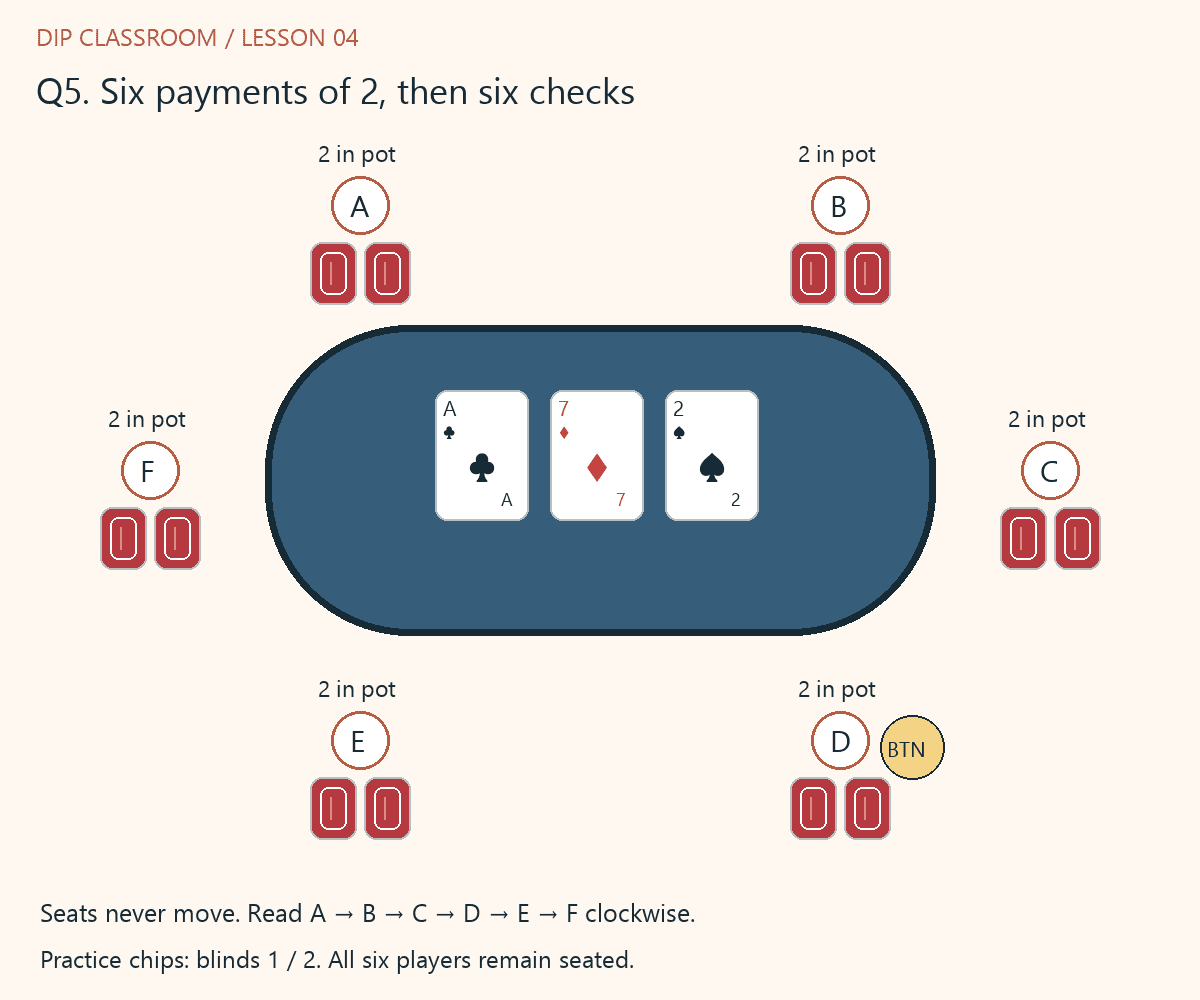
Now all six players have 2 in the pot and 98 in their own stacks. Six contributions of 2 make 12. That is a useful double-check.
F could have raised instead of checking. Posting the blind does not use up that option. Had F raised, the other players would need another opportunity to respond. Action does not stop just because each person has spoken once; the outstanding wager must be dealt with.
Step 3: the flop changes the starting point
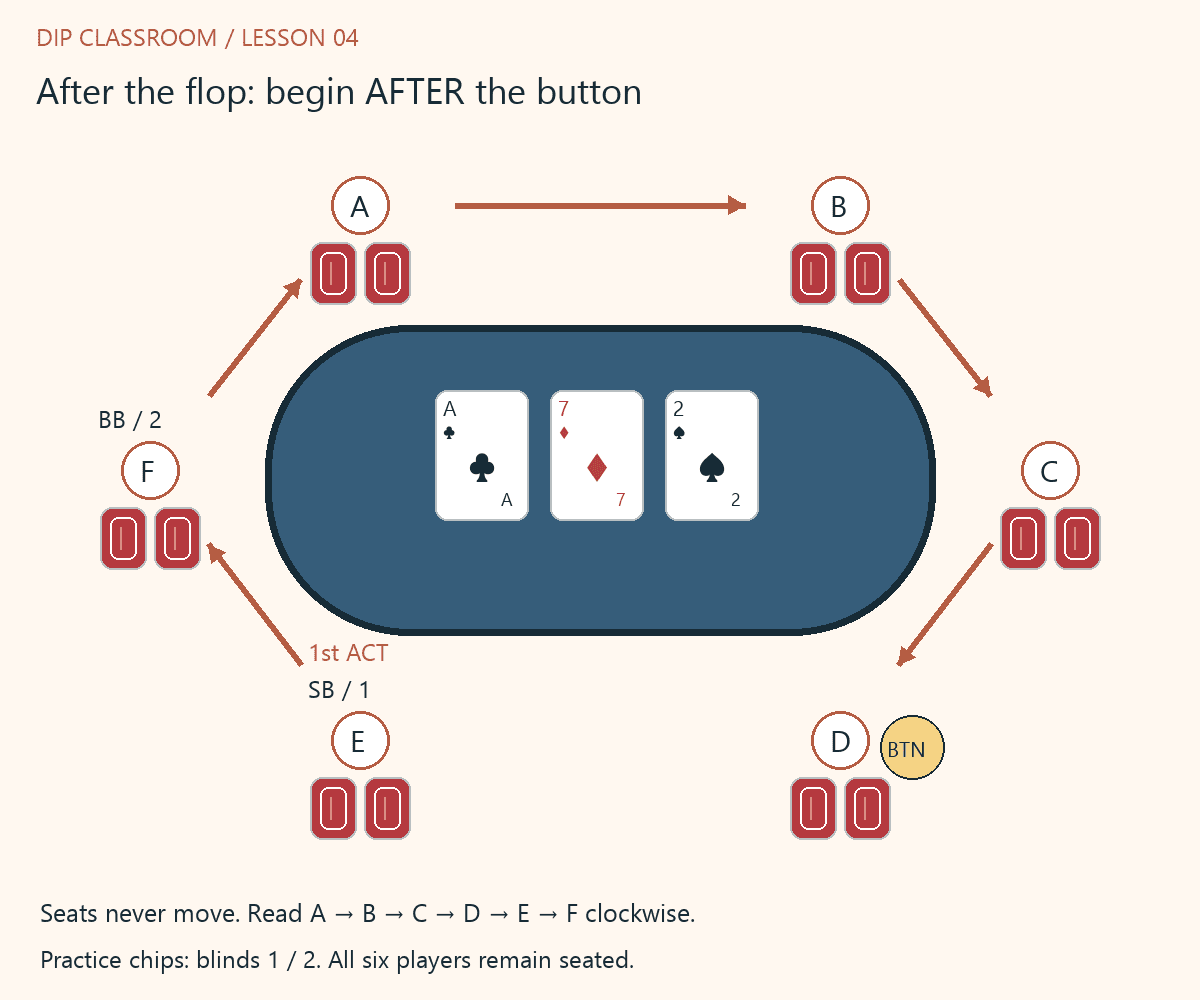
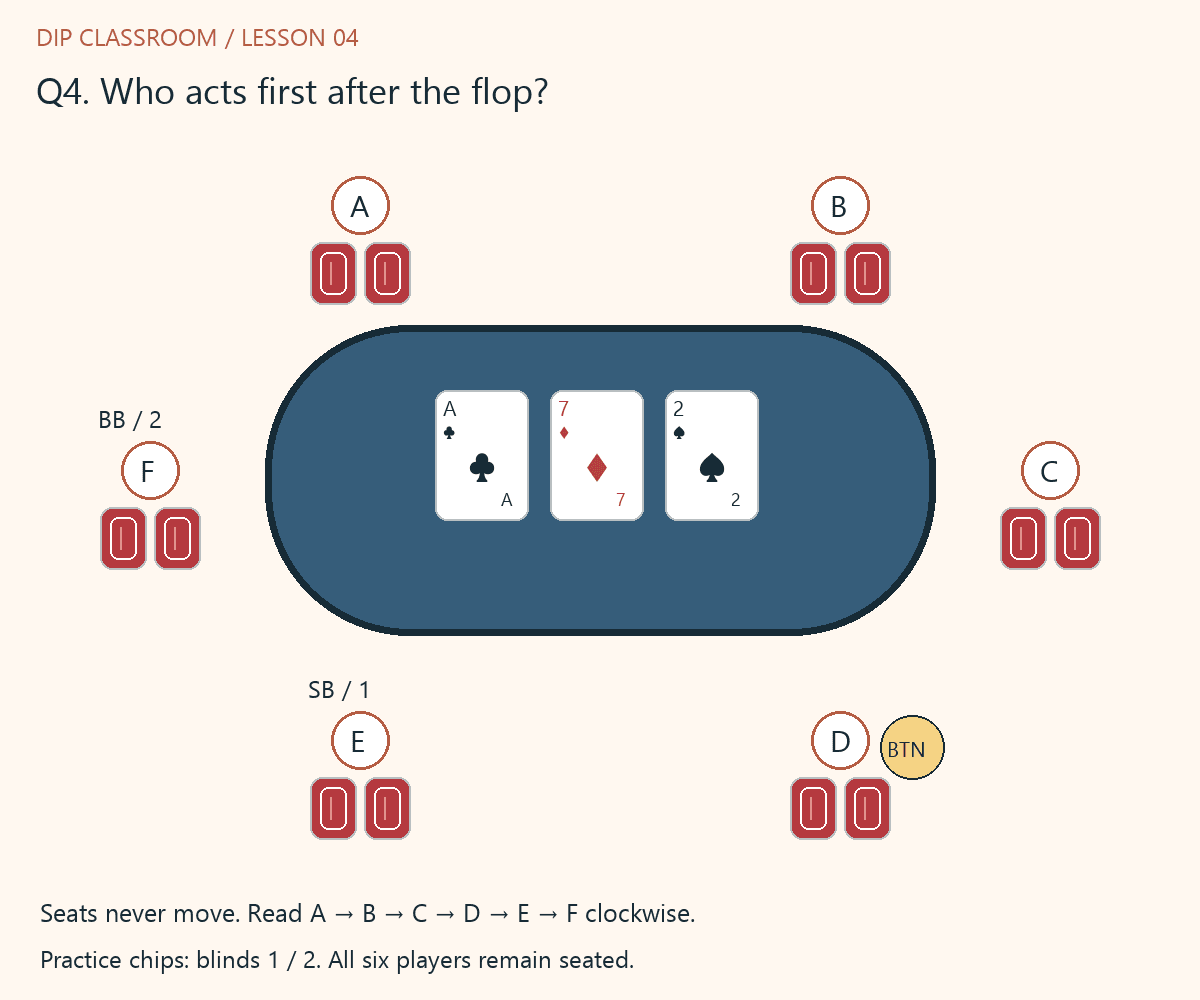
The dealer now places A♣ 7♦ 2♠ together in the centre. Those are three shared cards. Every remaining player can use them with their own two private cards. The private cards, seats and button stay where they were.
After the flop, action begins with the first remaining player clockwise from the button. Because all six still have live hands, that is E, not A. The order is E → F → A → B → C → D. D, the button, now acts last.
Let everyone check for this exercise. No one adds chips, so the pot stays 12 and everyone still has 98. The turn and river use the same starting-point rule, skipping anyone who has folded. If E had folded earlier, F would be the first remaining player clockwise from D and would start the flop action.
A fold removes a player from this hand's future decisions. It does not physically move the seats, and it does not make their earlier contributions theirs again.
Why acting later helps
Imagine you are D on the button. Before making your flop decision, you have watched five other players act. You might see five checks, a bet followed by calls, or a bet followed by folds. That is information the first player did not have.
It is still incomplete information. A check can conceal a strong hand. A bet can be a bluff. Acting later lets you react to observed actions; it does not let you see private cards or prove how strong they are.
When people say you are “in position” against someone after the flop, they mean you act after that person. “Out of position” means you act before them. A middle seat can act after one opponent but before another, so the phrase depends on whom you are comparing.
For now, simply notice who is waiting behind you. We will study which starting hands to choose in later lessons.
Step 4: the next hand moves the marker
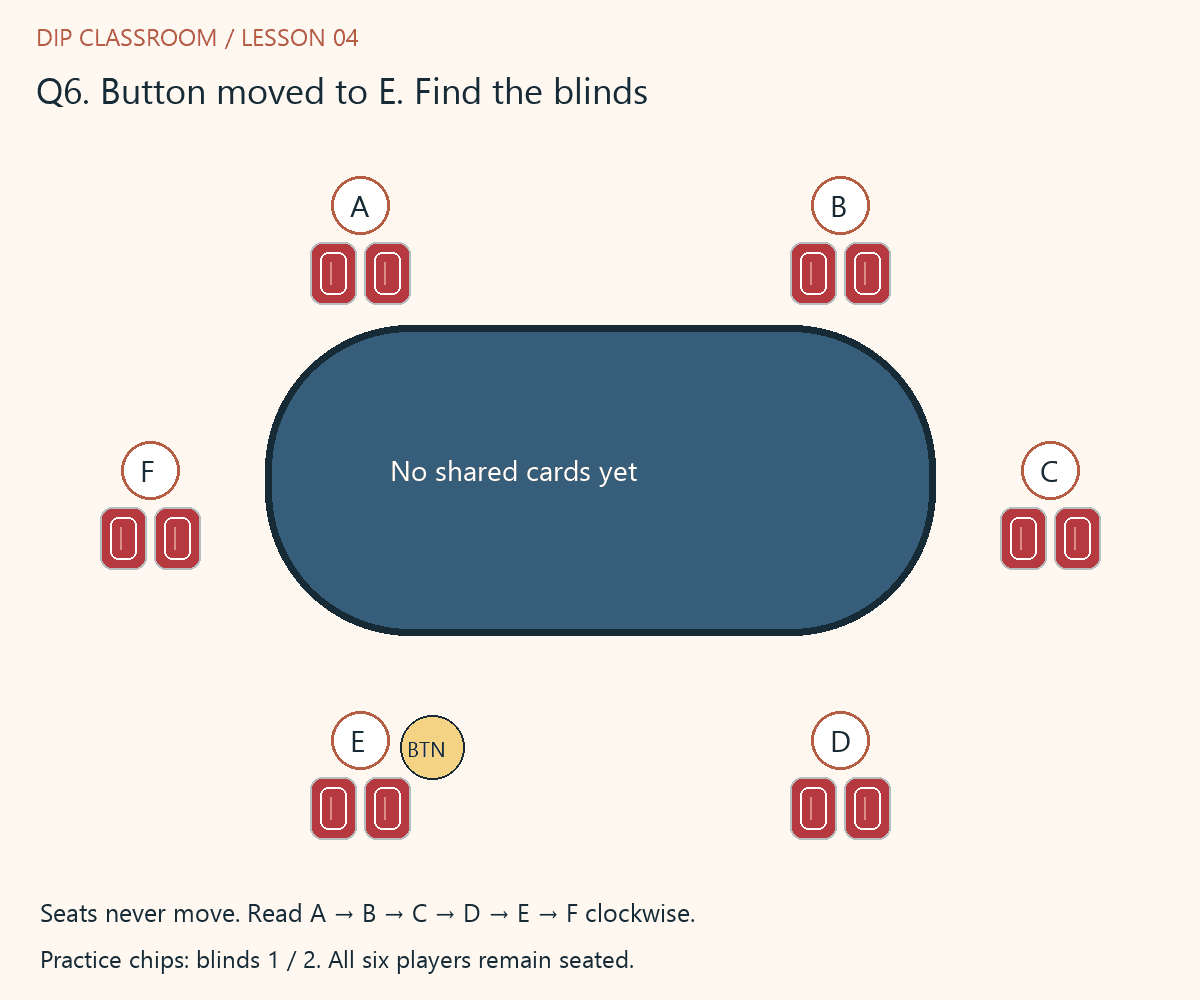
In our steady six-player table, with no one leaving or joining, the next hand moves the button one seat clockwise, from D to E. F becomes the small blind and A becomes the big blind. Nobody swaps chairs. Their roles change because the marker moved.
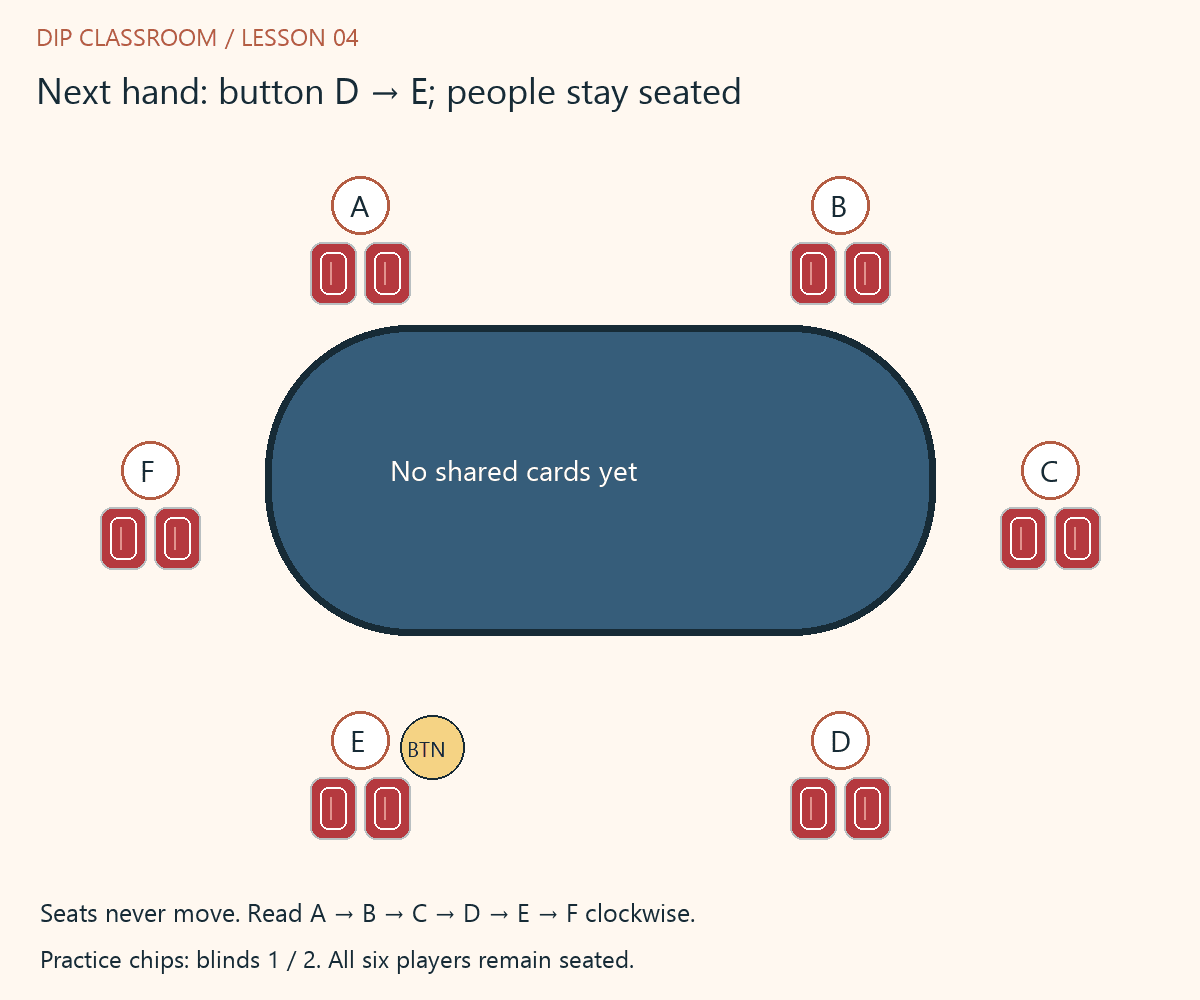
Real tournaments can have special button procedures when seats become empty. Follow the dealer rather than trying to move the marker yourself. Our picture deliberately keeps all six seats occupied.
One exception to keep in mind: only two players
When just two players are playing, the button also posts the small blind. That player acts first before the flop and last after the flop. The other player is the big blind. Do not use the six-player A-through-F sequence for a two-player table.
You do not need to memorize a new diagram today. Remember the warning: two players is a special case, and the dealer can confirm whose turn it is.
Practise with the cards in front of you
Each question is a separate exercise. Everything you need is repeated beside its diagram. Choose your answer first, then open Show answer to see the explanation. You do not need to scroll back to an earlier example.
Question 1: Find the two blinds
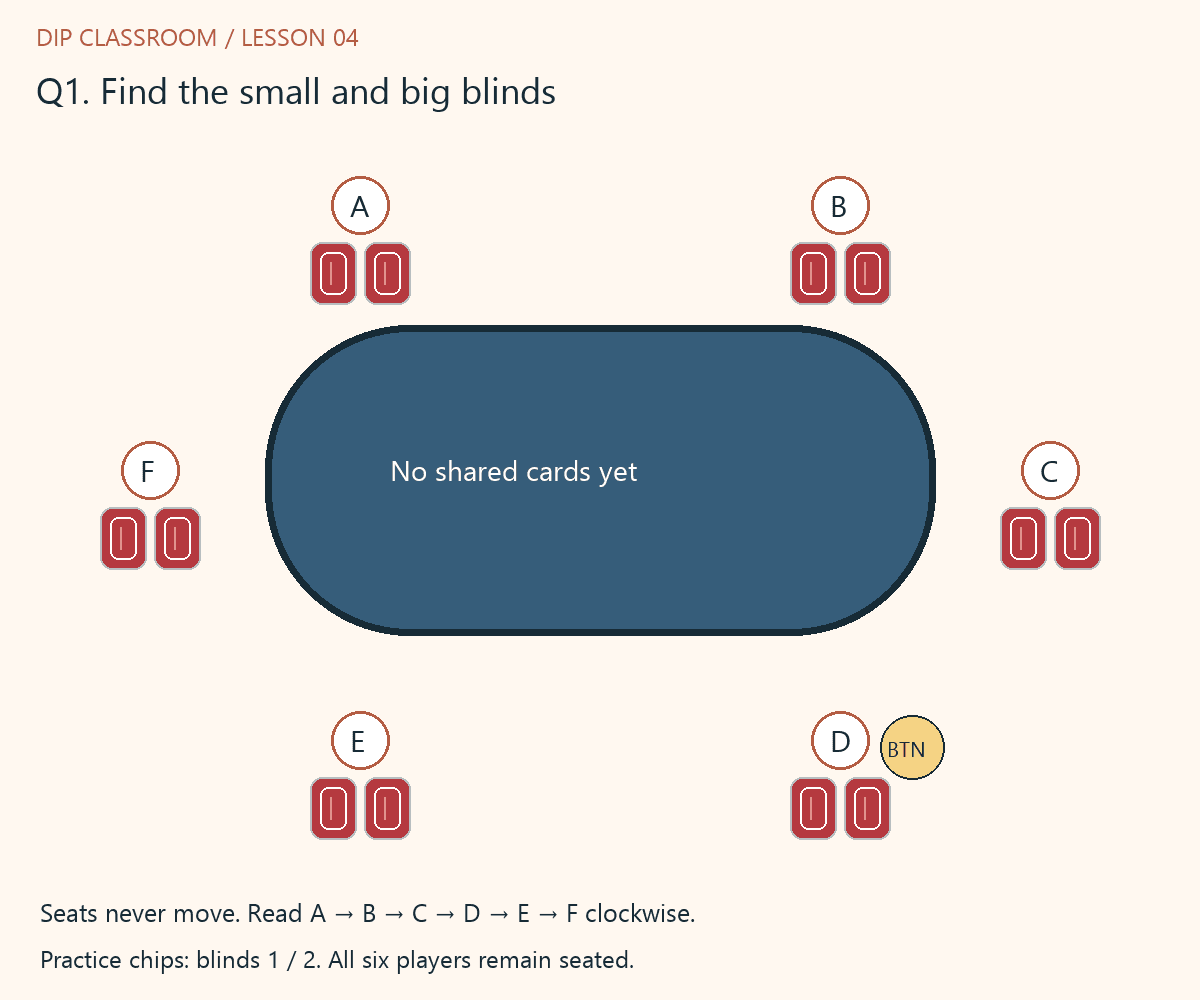
Use the six seats in the picture: A → B → C → D → E → F clockwise. D has the dealer button. Blinds are 1 and 2. Everyone remains seated. Which seat posts the small blind, and which posts the big blind?
Show answer 1Hide answer 1
E posts the small blind of 1; F posts the big blind of 2. Start at D’s button and move clockwise one seat, then one more.
Question 2: Count what you already posted
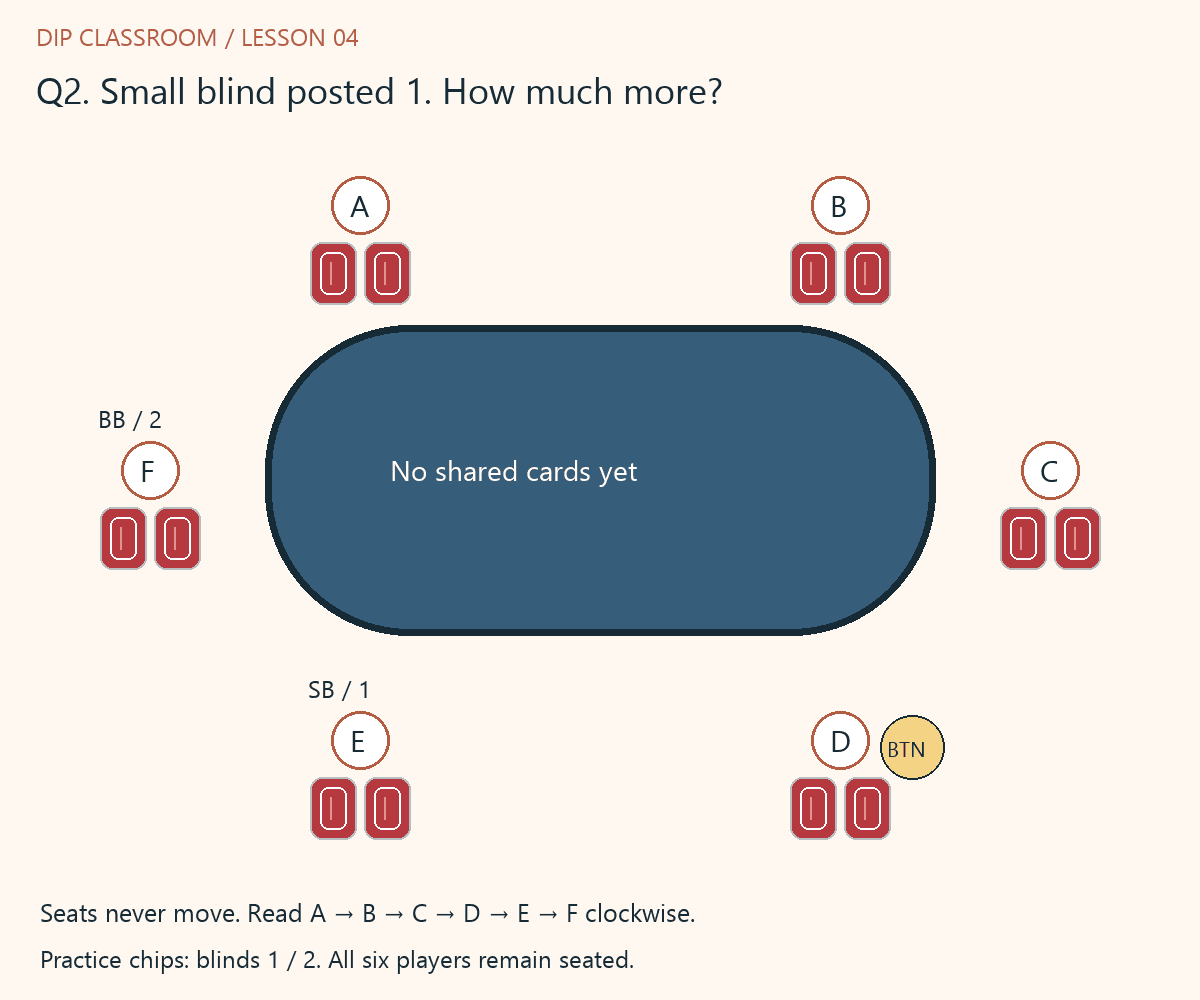
The six-seat table has D on the button, E as small blind and F as big blind. Blinds are 1 and 2. Nobody raises; when action reaches E, E has already put in 1. How many MORE chips does E add for a total call of 2?
Show answer 2Hide answer 2
One more chip. The original small blind counts: 1 already posted + 1 more = 2 total. Adding another 2 would make 3, not a simple call of 2.
Question 3: First before the flop
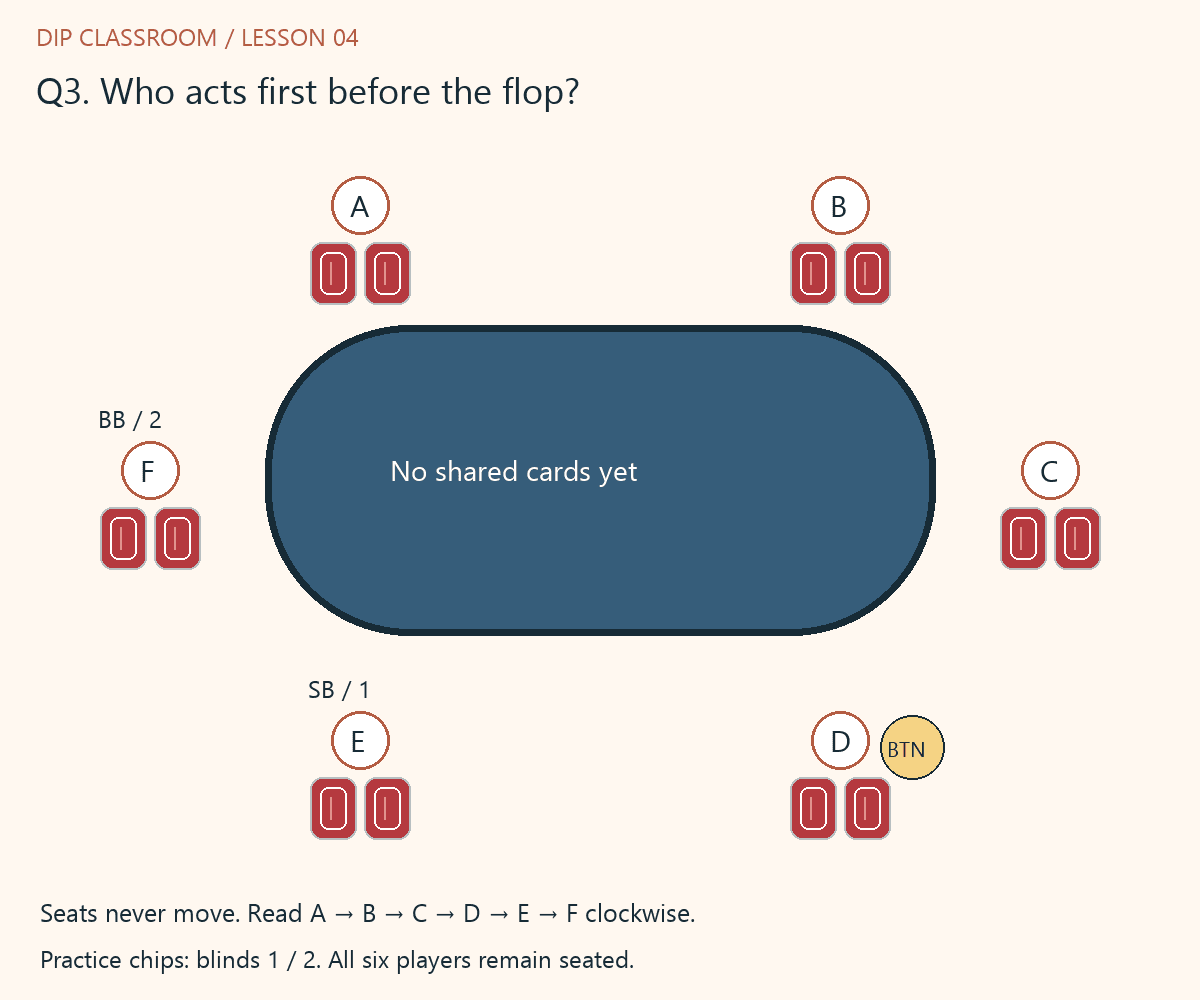
There are six active players and no community cards yet. D has the button, E has posted the small blind and F has posted the big blind. Using the pictured clockwise seat order, which seat gets the first preflop decision?
Show answer 3Hide answer 3
A, the next active seat clockwise from F’s big blind. The full initial sequence is A → B → C → D → E → F. The button does not act first here.
Question 4: First after the flop
All six players remain when A♣ 7♦ 2♠ appears. D still has the button, E is the small-blind seat and F is the big-blind seat. Nobody has acted on the flop yet. Which seat acts first now, and which acts last in this initial pass?
Show answer 4Hide answer 4
E acts first and D acts last. After the flop start at the first active seat clockwise from the button: E → F → A → B → C → D. This differs from the preflop order.
Question 5: Six contributions, then checks
All six players have put 2 chips each into the pot before the flop, with no ante or rake. The three shared cards are A♣ 7♦ 2♠ and every player checks. Count the six contributions; nobody adds chips on the flop. How many chips are in the pot after those checks?
Show answer 5Hide answer 5
12: six players × 2 chips each. Checking adds zero, so the pot stays 12. A bet or call would change the amount; a check does not.
Question 6: The button moves, not the people
The previous hand had D on the button. For a new hand with the same six people and no empty seats, the button moves clockwise to E, as shown. Do players swap chairs? Which seats now have the small and big blinds?
Show answer 6Hide answer 6
Nobody swaps chairs. With E now on the button, F is the new small blind and A is the new big blind. Their roles change; the people stay in their seats.
Mini glossary
- Button / BTN: the marker identifying the dealer position for this hand.
- Small blind / SB: the first compulsory blind contribution clockwise from the button in our six-player example.
- Big blind / BB: the next blind contribution, two practice chips here.
- Clockwise: around the table in the same direction as a clock's hands.
- Live hand: cards still eligible to compete, rather than folded cards.
- Position: where you act relative to other players.
- Check: continue without adding chips when you face no amount to call.
- Call: match the outstanding wager, counting what you already put in during that round.
DIP's takeaway
Find the button, find the blinds, then locate the first active player. Before moving chips, ask “Is it my turn?” if you are unsure. Understanding the order is more useful than pretending you know every abbreviation.
Rules checked against PokerStars' official Texas Hold'em explanation on September 13, 2026. Examples and teaching diagrams are original DIP material. Related stories link only to already published lessons.
Responsible play notice: This is adult educational material. Practise with counters, follow local age and gambling laws, and never use money needed for daily life. Knowing the action order is not a promise of winning.