The chips are already moving
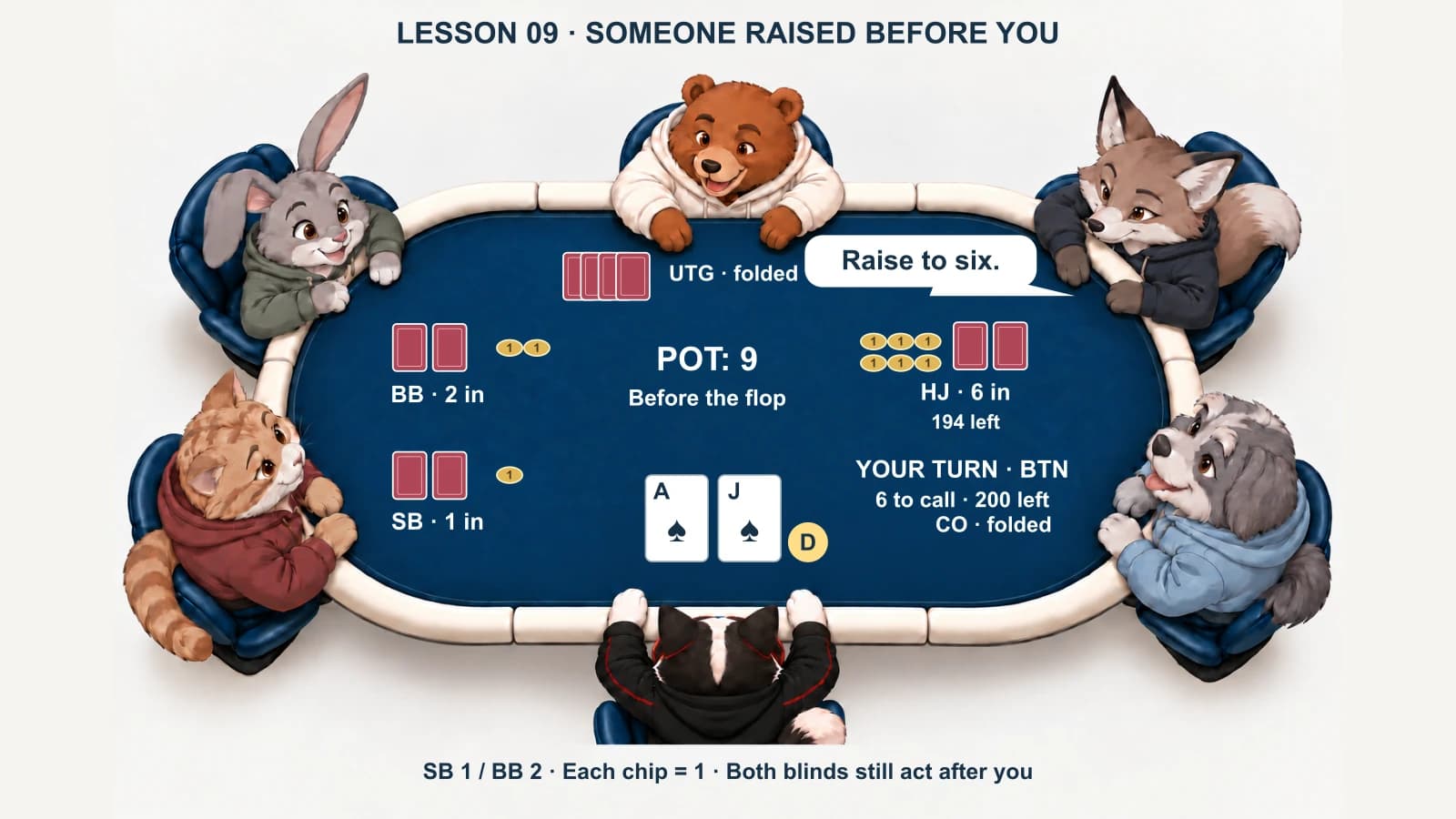
You look at your two cards and see A♠ J♠. They look promising. Before your turn arrives, another player says, “Raise to six.”
That sentence changes the decision. You are not opening the pot, because someone else has already raised. You must decide how to respond to their raise.
You still have three choices: fold, call, or raise again. You cannot check because there is an unmatched bet in front of you. You also cannot put in only the original big blind and stay in the hand.
Look at the whole situation first
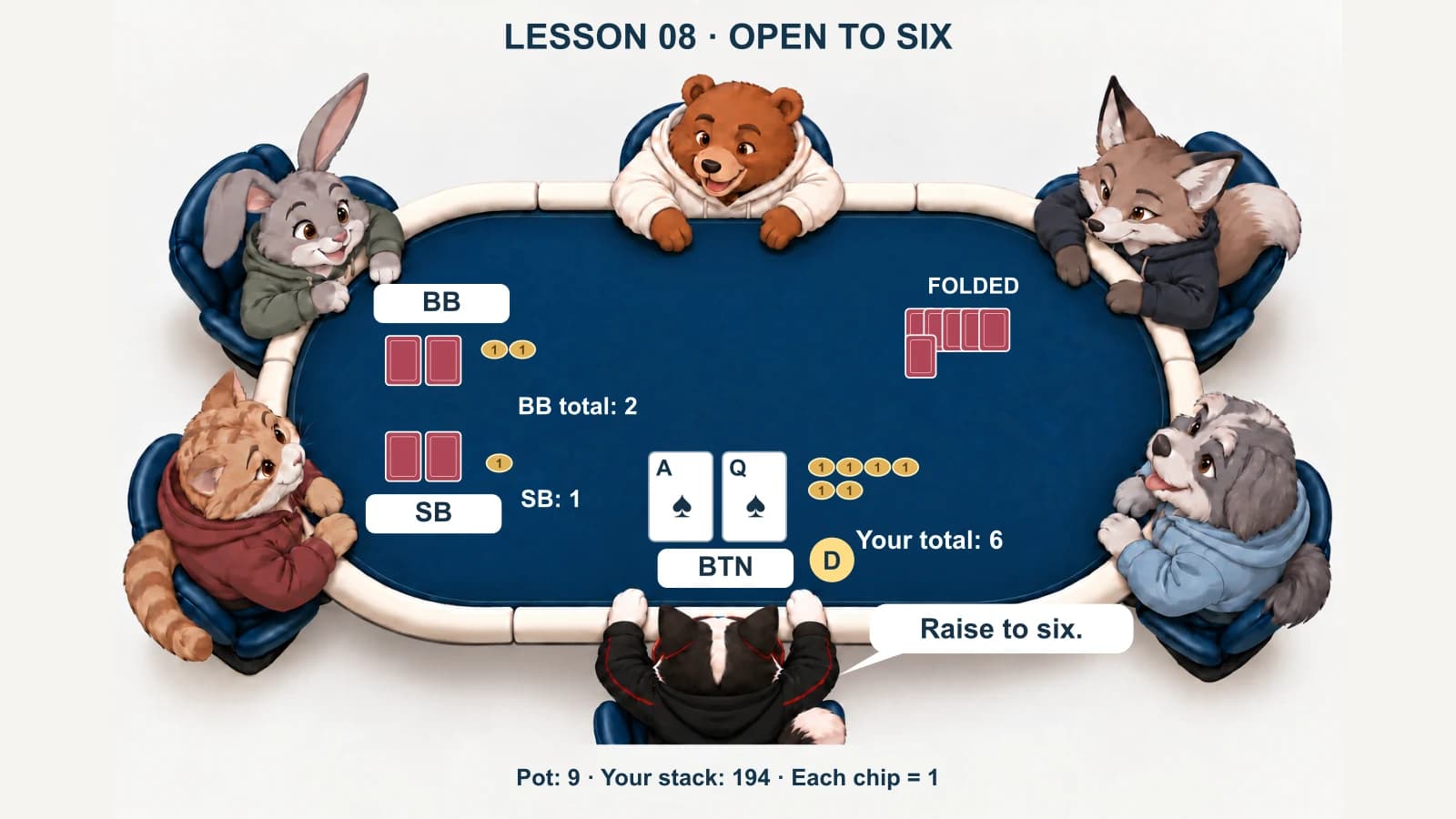
We use the same six-seat practice table. The small blind is 1 chip, the big blind is 2 chips, and every pictured chip is worth 1. Each player starts with 200 chips. There is no ante or rake.
UTG folds. HJ raises to 6. CO folds. You are on BTN with A♠ J♠. The small blind and big blind have not acted on the raise yet. No community cards have been dealt.
There are 9 chips in the pot: HJ’s 6, SB’s 1 and BB’s 2. You have not contributed anything, so calling would cost you 6. Both you and HJ started with 100 BB; HJ now has 194 chips behind their bet.
Before reaching for chips, ask: who raised, how much is the total, where am I sitting, and who still has a turn after me?
Choice one: fold
Folding means giving up your cards and your chance to win this hand. You do not have to pay the six-chip price first. Because you have not put in any chips, you still have 200.
HJ has not won yet. SB and BB still get their turns. Your fold ends your participation, not necessarily everybody’s hand.
A hand can be attractive enough to open when nobody has entered, but too weak to continue against a particularly tight raiser. Folding is a normal decision, not a punishment or an admission that you played badly.
Choice two: call
Calling means matching the current highest contribution. You put in 6, leaving 194. There are now 15 chips committed: HJ 6, you 6, SB 1 and BB 2.
The flop does not appear immediately. SB and BB still have decisions. Either could call, fold or make another legal raise. Calling is not a guarantee that six chips buys you a flop.
For one simple continuation, suppose both blinds fold. You and HJ see the flop together, with 15 in the pot and 194 left each. HJ acts first and you act second because of your seats, not because of who raised.
If instead BB raises, the price changes again. You must make a new decision; your earlier call does not oblige you to pay more.
Choice three: raise again
Raising again increases the amount opponents must match. In this separate example, you announce, “Raise to eighteen,” and put in 18 in total. You have 182 left. The pot is temporarily 27: your 18, HJ’s 6 and the posted blinds’ 3.
This preflop reraise is commonly called a three-bet. The posted big blind is the first bet, HJ’s opening raise is the second, and your reraise is the third. “Three-bet” does not mean exactly three chips or exactly three times the opening amount.
SB and BB act next. If both fold, action returns to HJ. HJ has already put in 6 and needs another 12 to match your total of 18. If HJ calls, the pot becomes 39 and you both have 182 left. If HJ folds, your chips are returned with the opponents’ committed chips; an uncalled part of your raise is not extra profit.
Eighteen is an illustration of a legal total, not a sizing rule for every game. Stack depth, position and other callers change the decision. Nor are we claiming that A♠ J♠ must always be reraised.
Why the other player’s likely cards matter
You cannot see HJ’s private cards. A raise gives information, not proof.
Imagine one opponent raises only a narrow group of strong hands. Against that player, your ace-jack may often face an ace with a better second card, such as ace-queen or ace-king. If an ace appears, both players can make a pair while your jack loses the comparison. This is one reason “I have an ace” is not enough to justify every call.
Another opponent may raise many more hands. Your cards can fare better against that wider collection, but do not assume an unfamiliar player is loose without evidence.
We call a collection of possible hands a range. You do not need to memorise a chart here. First learn to ask whether the raiser is likely to have many possible hands or only a few strong ones.
Position helps, but does not make a call automatically good
On BTN, if you reach the flop, you act after the remaining opponents. Seeing their actions first is useful. It does not rescue every weak hand or make any price affordable.
SB and BB are still behind you before the flop in this example. They can raise and make your original call more expensive. This is why the immediate price is only part of the decision.
Do not copy this button example into a blind seat. A blind has already contributed chips, and its postflop position is different. We will examine those decisions separately in Lesson 10.
Three habits to avoid
- Calling because the chips look cheap, without considering who raised and who can still act.
- Reraising only because you dislike being pushed around. A raise needs a poker reason, not an emotional one.
- Treating an earlier investment as a promise to continue. Committed chips are already in the pot; the next decision concerns the new price and situation.
Words to keep
- Facing a raise: another player has already increased the amount to match.
- Call: match the current total by adding the amount you are short.
- Reraise or three-bet preflop: raise after the opening raise.
- Range: the different hands an opponent might hold.
- Dominated ace: an ace hand vulnerable to another ace with a higher second card.
DIP’s takeaway
Pause before copying the previous player’s chips. Identify the raiser, the total price, your position and the players still to act. Then choose fold, call or raise for that situation. Two attractive cards alone do not answer the whole question.
Practise with play chips. Real-money play is unnecessary for learning. Follow local eligibility rules, set limits if you choose to play for money, and never treat poker as guaranteed income.