Three cards everyone can use
The flop is the first three community cards. They belong to neither player. Everyone still in the hand may combine them with their own cards to make the best five-card hand.
Before asking 'Did I hit?', look at what those cards make possible for everybody. Poker players call these features the board's texture. You do not need to memorise a complicated chart. Start with three observations: suits, nearby ranks and repeated ranks.
First, look at the suits
K♦ 7♣ 2♠ has three different suits. This is called a rainbow flop. Nobody can already have a flush, because even two matching private cards would supply only three cards of one suit. A player with two spades would need a spade on both the turn and river to make a flush.
K♠ 7♠ 2♦ has two spades. Someone holding A♠ Q♠ has four spades across their private cards and the board. One more community spade would make a flush. That possibility is a flush draw, not a flush already made.
K♠ 7♠ 2♠ has three spades. Someone with two private spades already has a flush. Someone with just one private spade does not: they currently have four spades and still need another. A scary-looking board does not prove an opponent has the matching cards.
These are three alternative flops, not three stages of one hand.
Next, look at the ranks
On K♦ 7♣ 2♠, the ranks are spread apart. No one can make a straight on this flop using only two private cards.
On 9♠ 8♦ 7♣, the ranks sit next to one another. J♠ 10♥ already makes a jack-high straight: 7-8-9-10-J. A player holding 6♥ 5♥ also has a straight, but a lower one: 5-6-7-8-9. The highest card of the straight decides which is stronger.
Connected ranks create more ways for a turn or river to change the strongest hand. That is why the same pair can face very different possibilities on different boards.
Finally, notice pairs on the board
On Q♣ Q♦ 4♠, everyone has access to the two queens. Holding A♥ K♥ gives you a pair of queens with your best available kickers; it does not give you three queens.
An opponent holding Q♥ 9♥ has three queens. An opponent holding 4♣ 4♦ has a full house, three fours and two queens. A board pair is shared, but different private cards still matter.
Follow one actual hand
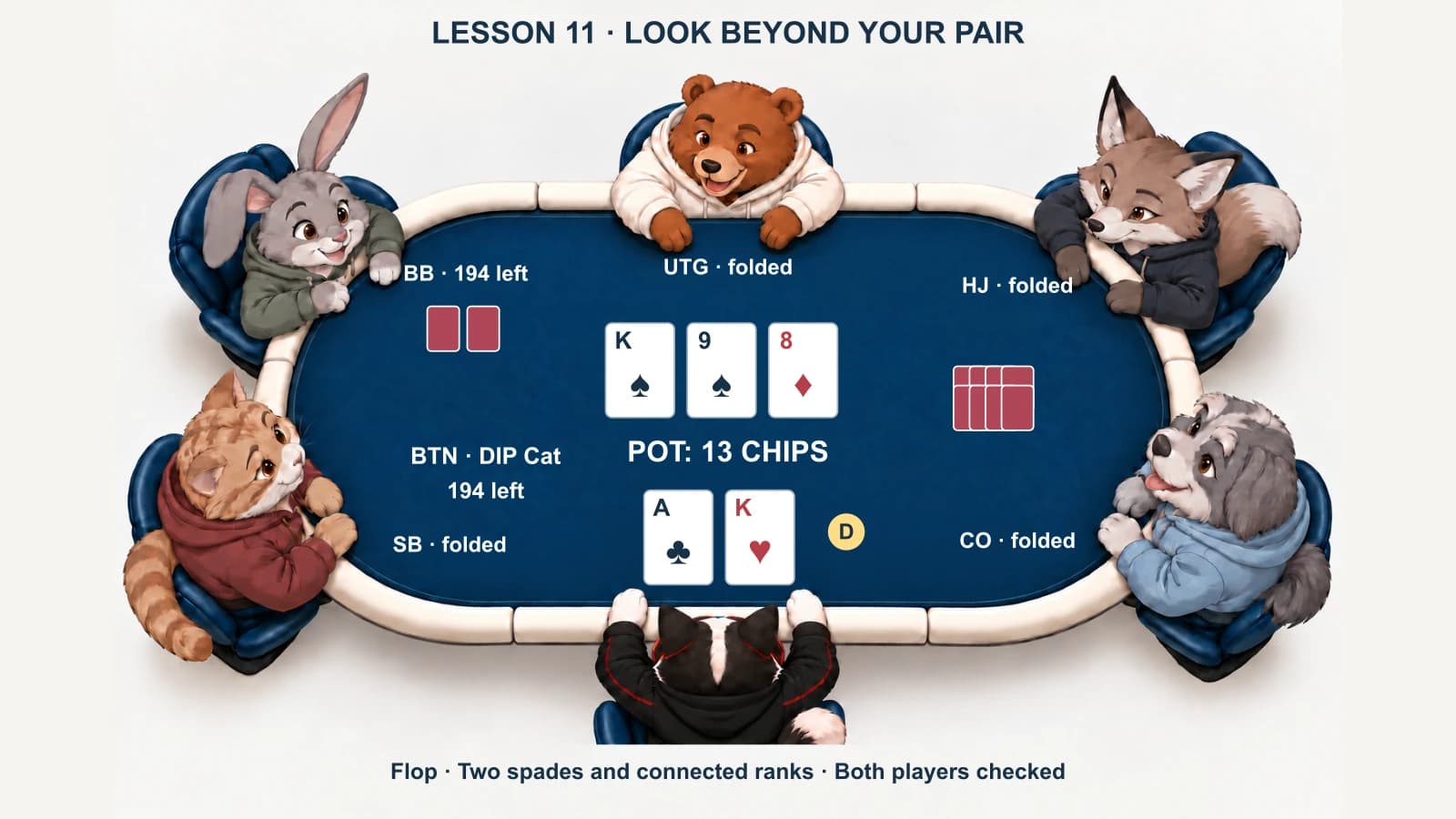
Our six-seat example uses small blind 1, big blind 2 and starting stacks of 200, with no ante or rake. UTG, HJ and CO fold. DIP Cat on BTN raises to 6 holding A♣ K♥. SB folds and BB calls another 4. The pot is 13: six from each remaining player and the folded small blind's one. Each active player has 194 left.
The flop is K♠ 9♠ 8♦. BB acts first and checks. DIP Cat has top pair, kings, with an ace kicker. Now look beyond that pair: there are two spades and the nine and eight are close together. An opponent with two spades could have a flush draw; QJ could be waiting for a ten to make a straight. Neither possibility means the opponent definitely has that hand.
DIP Cat checks back in this teaching example. No chips move, so the pot stays 13 and both stacks stay 194. Checking here is an example action, not a rule that top pair must always check.
The turn is 2♠. There are now three community spades. An opponent who held two spades has made a flush. DIP Cat has no spade and still has one pair. The king pair did not disappear, but its strength relative to possible opposing hands has changed.
BB acts first again. We stop before that decision: this lesson is about seeing what changed, not prescribing a bet from incomplete information.
Avoid two shortcuts
- 'I have top pair, so I must be winning.' A pair's value depends on the shared cards, possible opposing hands and the action.
- 'Three spades means they have a flush.' Three spades make a flush possible; they do not reveal anyone's private cards.
Mini glossary
- Rainbow: three different suits on the flop.
- Two-tone: two flop cards share a suit and the third does not.
- Monotone: all three flop cards share a suit.
- Connected: ranks close enough to create straight possibilities.
- Paired board: at least two community cards share a rank.
- Draw: an incomplete hand that needs a later card to improve.
DIP's takeaway
Before acting, look at suits, rank connections and board pairs. Then ask how your private cards fit, and what a new community card changed. A board describes possibilities, not an opponent's exact hand.
Practise with play chips. Learning does not require real-money play. If you choose to play for money, follow local eligibility rules and set limits.