
DIP Hold’em Starter Course / Lesson 02 of 20
You have reached the river. Five cards are in the middle, two are beside you, and someone says “I have two pair.” What are you supposed to compare?
Not seven cards at once. Not the total of the printed numbers. Your task is to choose the strongest legal five-card hand available to each player, then compare those two five-card results. We will do this slowly, using clear card symbols and a separate picture for every exercise.
If the words private card, community card or river are unfamiliar, return to Lesson 01 through Related stories below. You do not need to know betting strategy for today’s exercises.
What you will be able to do
- Recognise the main hand categories using a picture reference.
- Choose five cards without forcing both private cards into the answer.
- Compare two hands in the same category.
- Recognise a genuine tie, including when everyone uses the board.
Our examples are no-money teaching deals with two players still at showdown. The top player is your opponent; you are at the bottom. Both private hands are shown so you can learn. In normal play they would not all be visible throughout the deal.
1. Read a card before reading a hand
Q means queen, K means king and A means ace. The symbol tells you the suit: ♠ spades, ♥ hearts, ♦ diamonds, ♣ clubs. A pair uses two cards of the same rank, such as Q♣ and Q♦. It does not mean two red cards or two cards next to each other.
A five-card hand must use five distinct physical cards. You cannot count the same community ace twice to invent a pair. Two players may each use that ace in their own comparison, because community cards are shared, but neither player can duplicate it inside their own five.
2. Keep this ranking reference beside you
The pictures run from strongest to weakest. Do not try to memorise all ten labels before continuing. Find the cards in each row and read the short description. These new Lesson 02 reference sheets use fresh example hands.
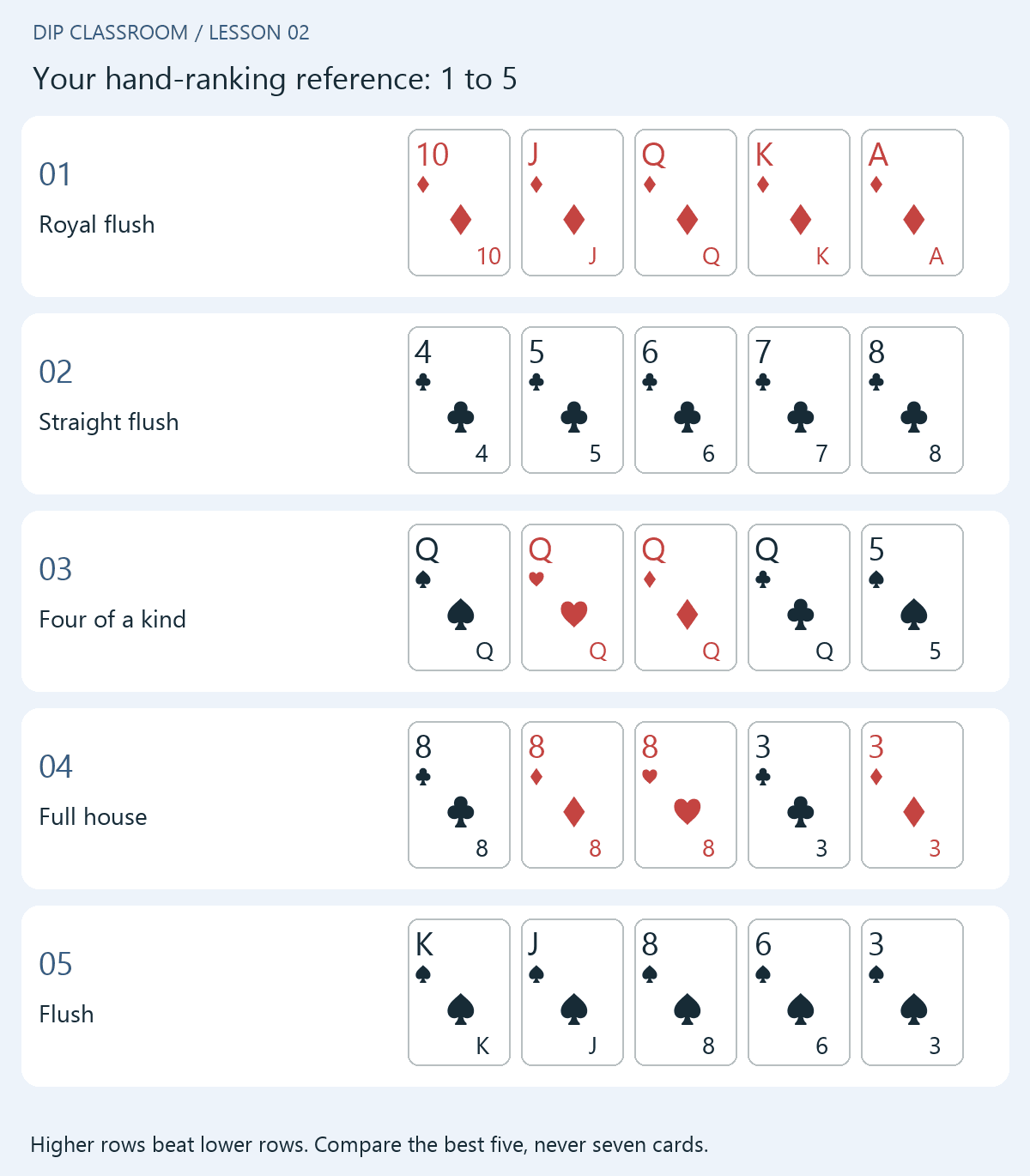
- Royal flush: A, K, Q, J and 10 in one suit. It is the highest straight flush, not a separate rule for using private cards.
- Straight flush: five consecutive ranks, all in the same suit.
- Four of a kind: all four cards of one rank, plus one other card.
- Full house: three cards of one rank and two of another.
- Flush: five cards of one suit, without a straight flush.
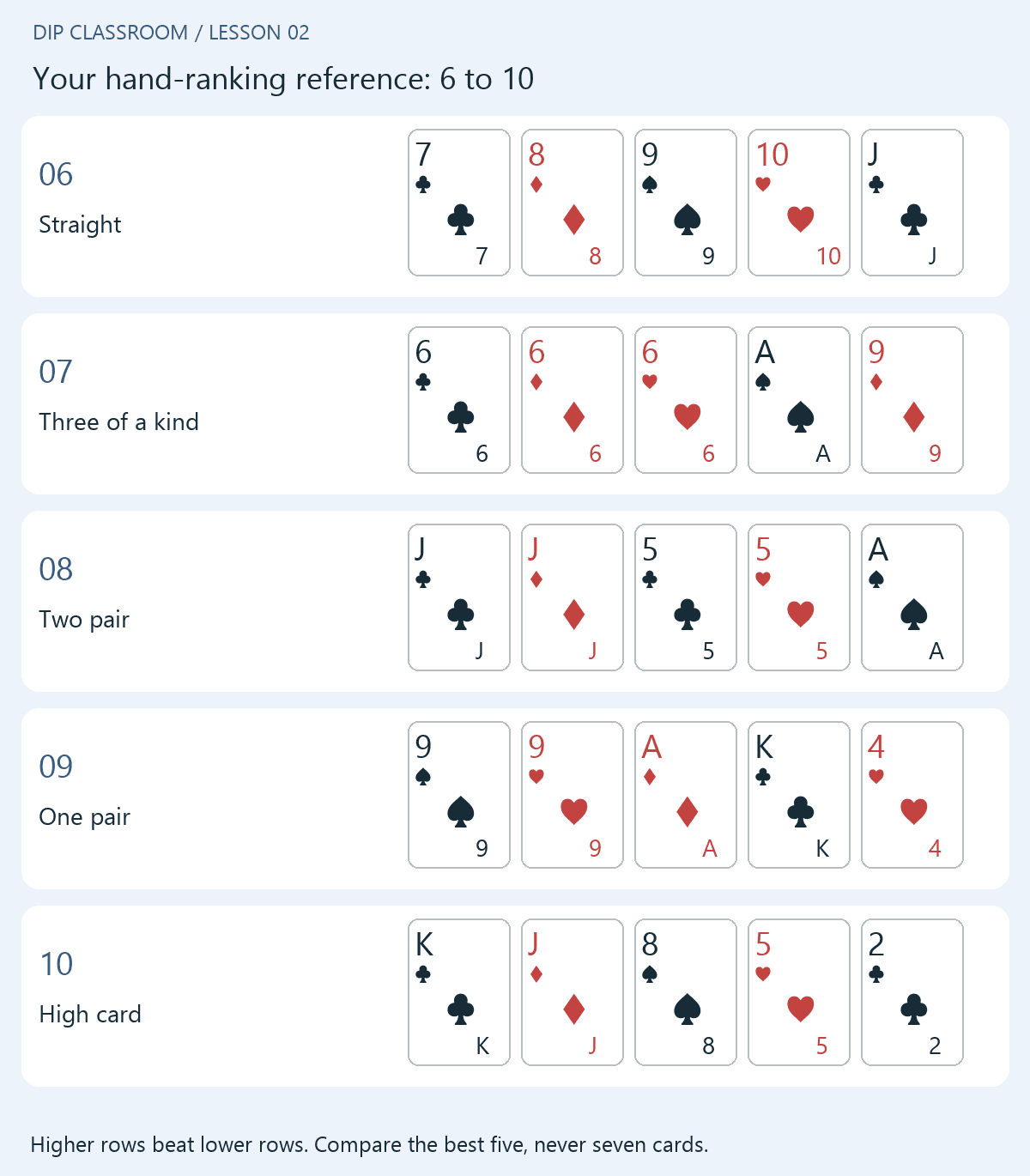
- Straight: five consecutive ranks, without all five being one suit.
- Three of a kind: three matching ranks, with two other cards that do not make a stronger category.
- Two pair: one pair of one rank, another pair of a different rank, and a fifth card.
- One pair: one matching pair and three other cards, without a stronger category.
- High card: none of the stronger combinations. The highest relevant cards decide.
Category comes first. Even a low straight beats a pair of aces. A full house beats a flush even when the flush contains an ace. “I have an ace” is not enough information to decide who wins.
3. What is a kicker?
A kicker is a side card used to complete or compare a hand when its main group has tied. In A-A-K-9-7, the two aces make the pair. K, 9 and 7 complete the five cards. Those three can decide a tie against another pair of aces.
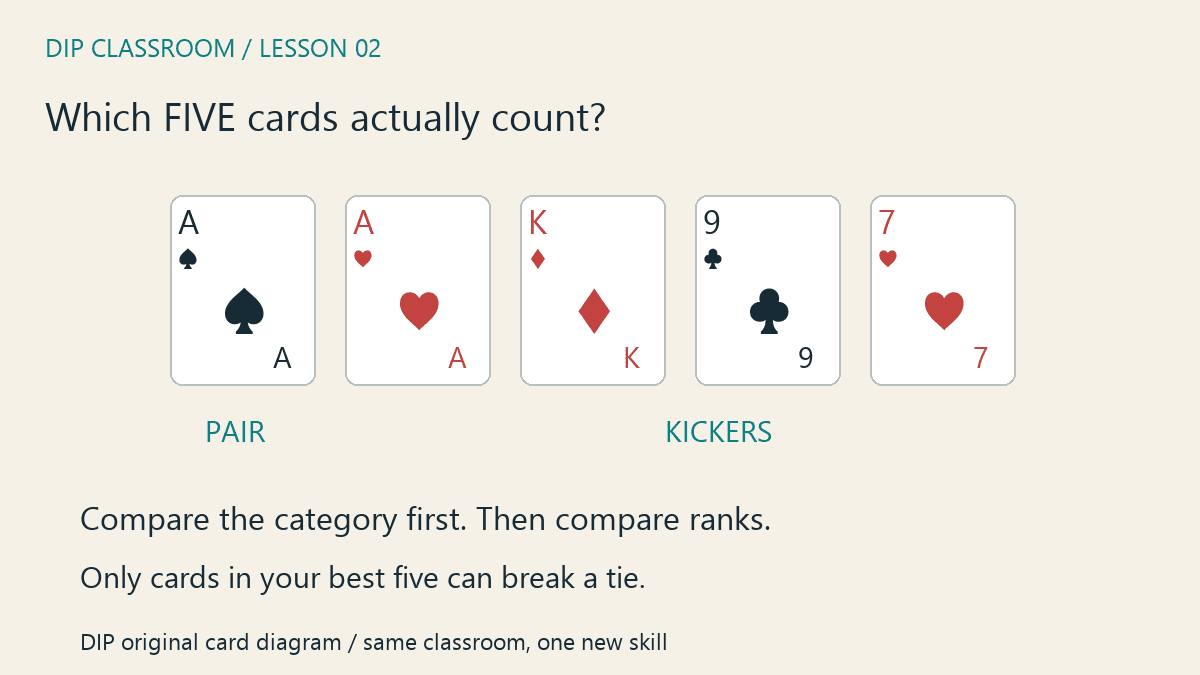
Compare the highest relevant side card first. If it ties, compare the next, then the next. Stop at the first difference. Do not add K+9+7 as a score, and do not use a sixth card after the best five have tied.
A straight has no extra kicker: all five cards form its sequence. A full house also has no spare kicker: its three-card and two-card groups already occupy all five places.
4. Same pair, different result
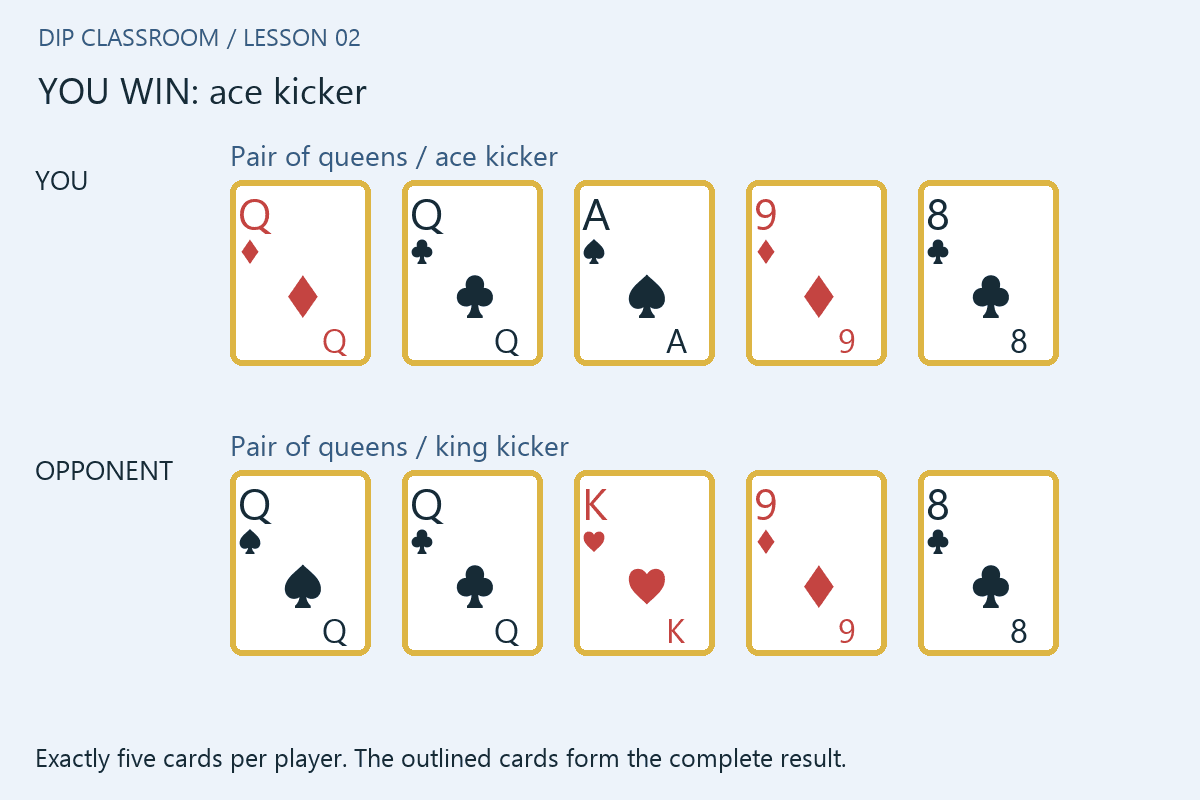
The board is Q♣ 9♦ 4♠ 2♥ 8♣. You have A♠ Q♦. Your opponent has K♥ Q♠. First locate both queens that each player can use: one private queen and the shared Q♣.
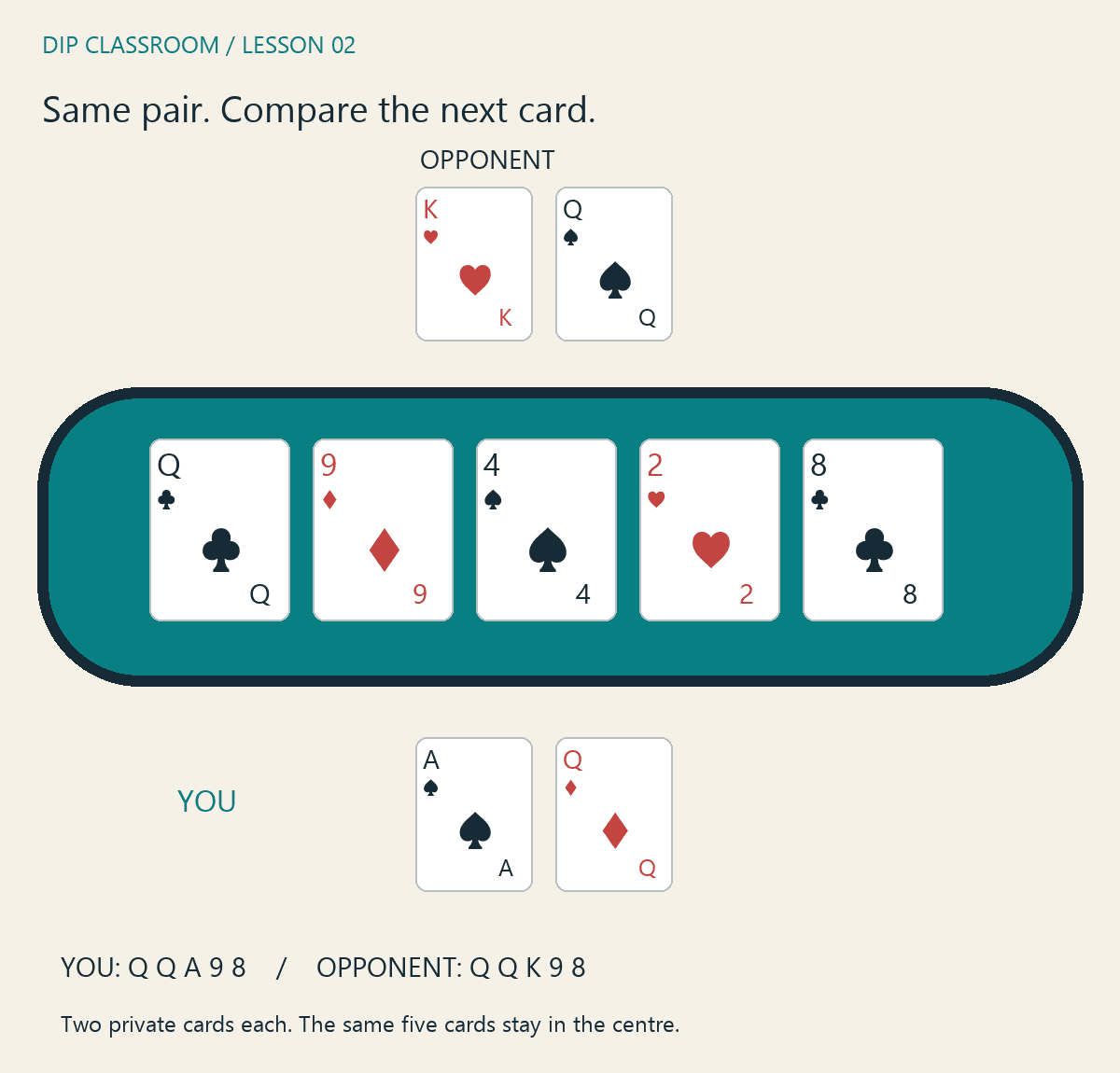
Your best five are Q♦ Q♣ A♠ 9♦ 8♣. Your opponent’s are Q♠ Q♣ K♥ 9♦ 8♣. Both have one pair of queens. Compare the first kicker: your ace against their king. You win. The remaining 9 and 8 do not need to break the tie because the ace already did.
Why not include the shared 4? Because 9 and 8 are higher available side cards. Why not compare the suits of the queens? Because suits do not break a tie in ordinary Hold’em hand rankings.
This example uses both private cards for each player. That is what produces the best five here; it is not a requirement for every deal.
5. A full house is not decided by its highest single card
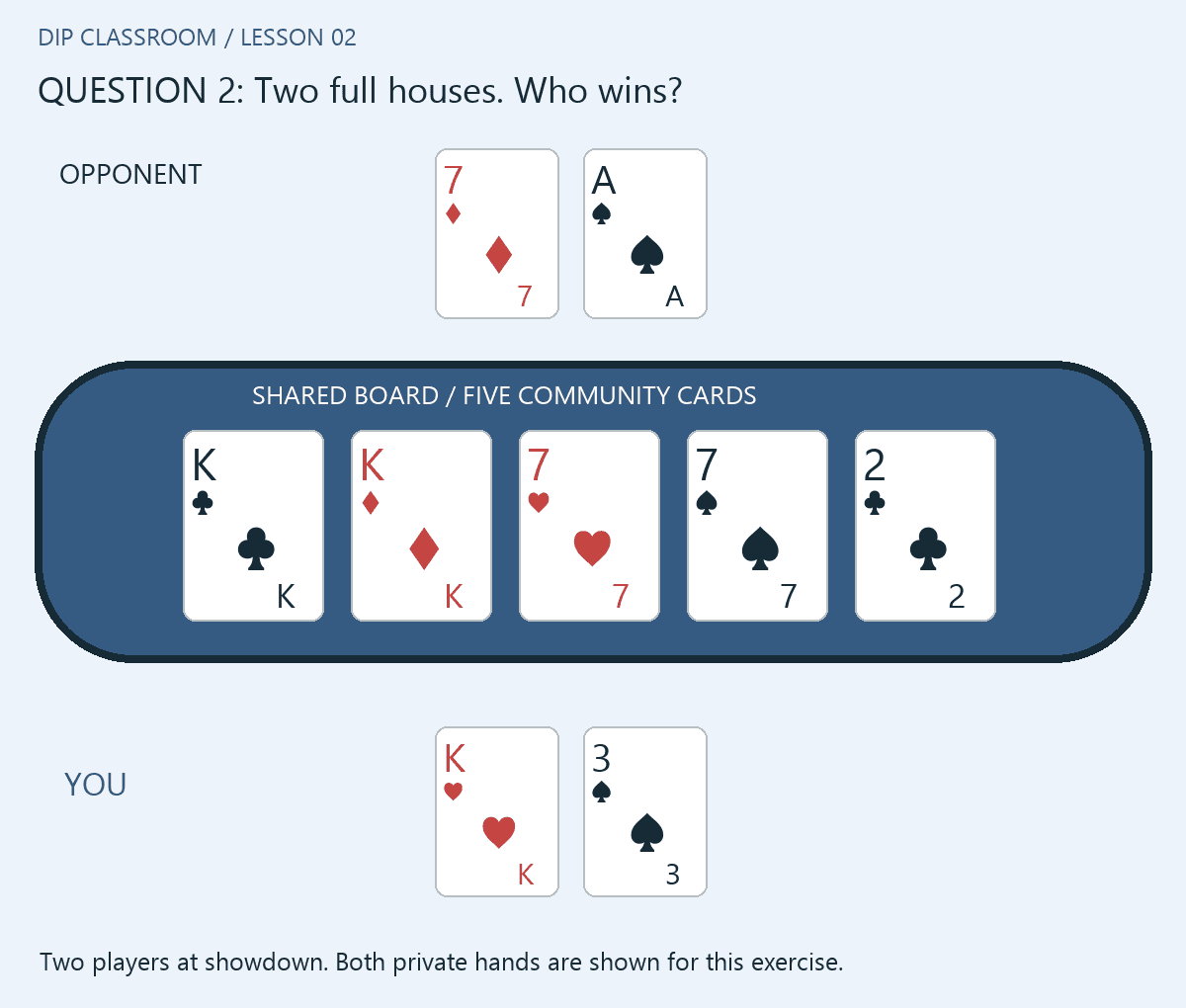
Move to a completely new teaching deal. The board is K♣ K♦ 7♥ 7♠ 2♣. You have K♥ 3♠. Your opponent has 7♦ A♠.
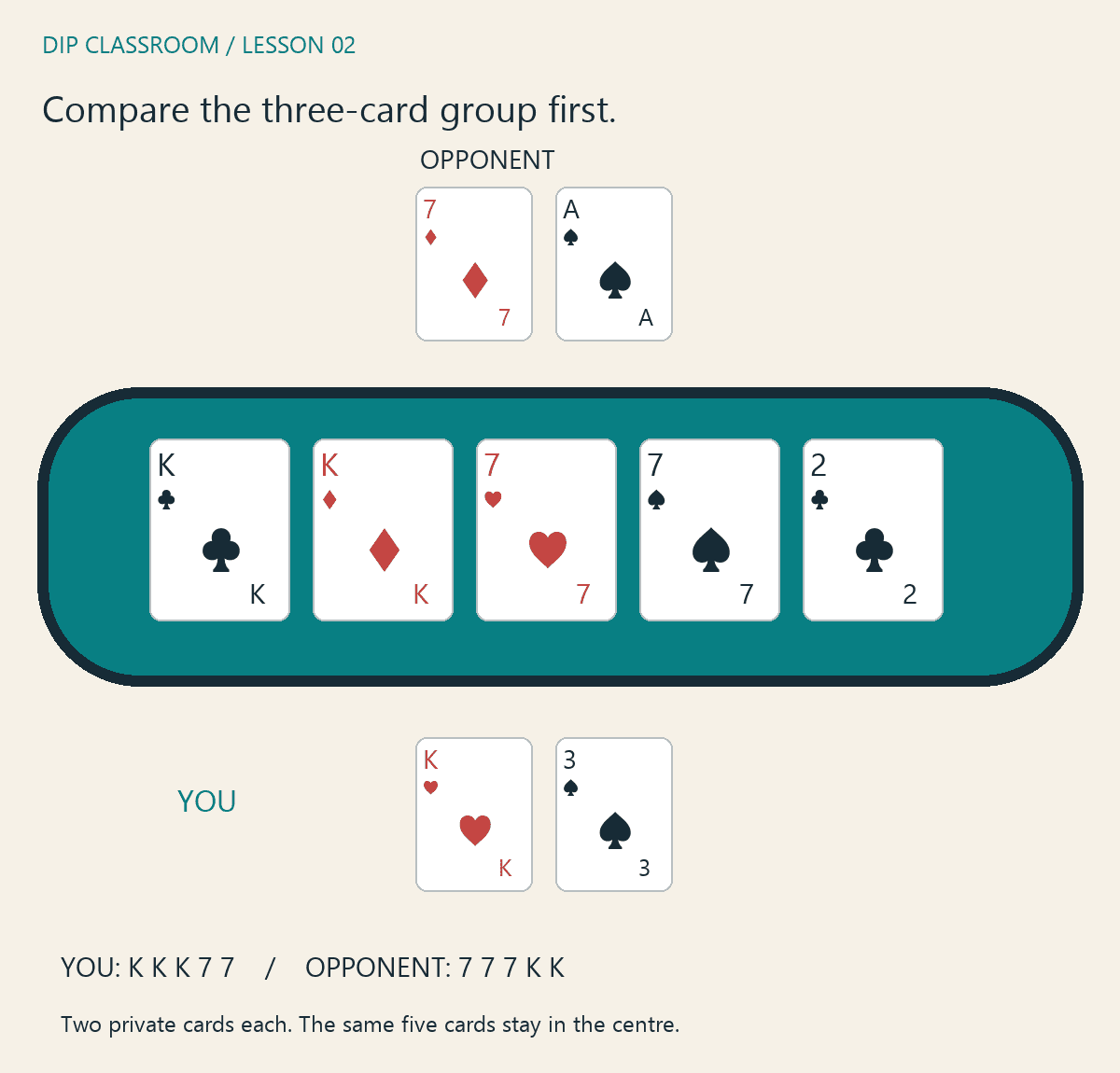
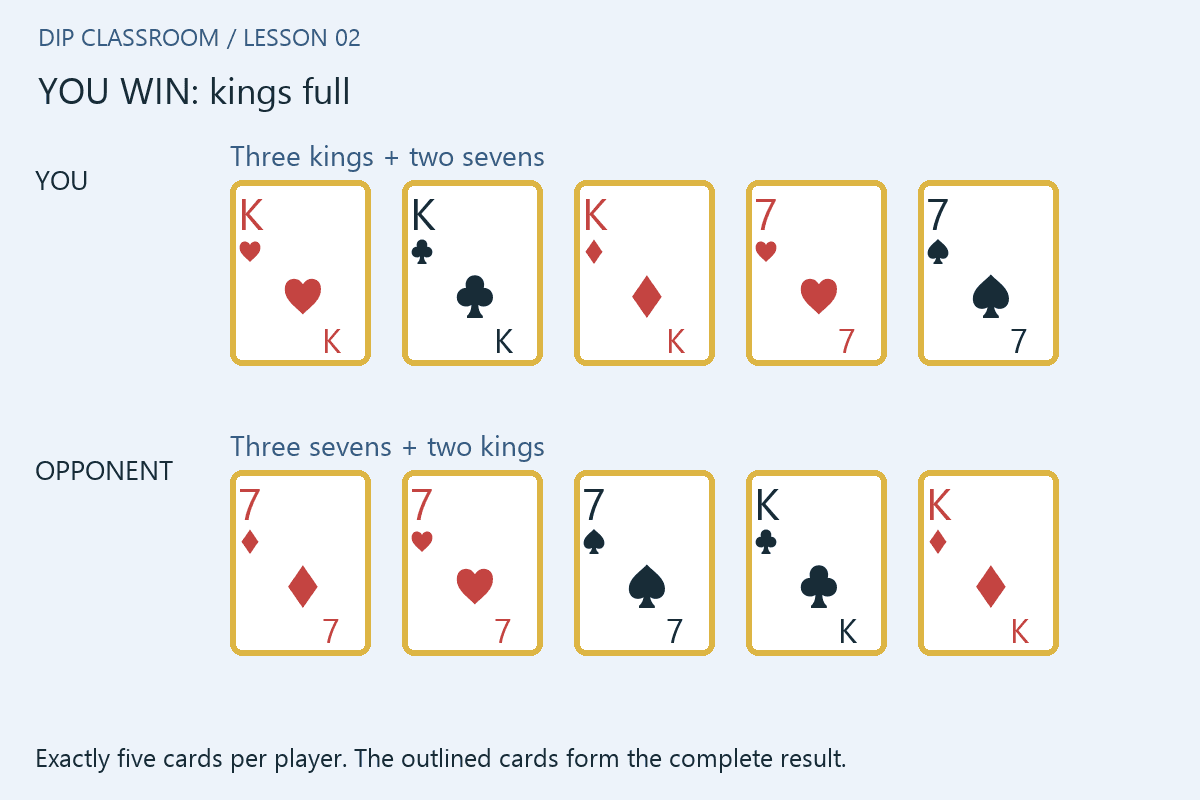
You can take three kings and two sevens: K♥ K♣ K♦ 7♥ 7♠. Say “kings full of sevens.” Your opponent takes three sevens and two kings: 7♦ 7♥ 7♠ K♣ K♦. Say “sevens full of kings.”
Both hands are full houses. Compare the rank of the three-card group first. Kings beat sevens, so you win. Your opponent’s ace is not a sixth-card tie-breaker. It is outside their best five. Your 3♠ is outside your best five too.
Each player used only ONE private card. Four of the five cards came from the centre. Notice how this differs from the previous picture without changing any rule.
6. Sometimes neither private card counts
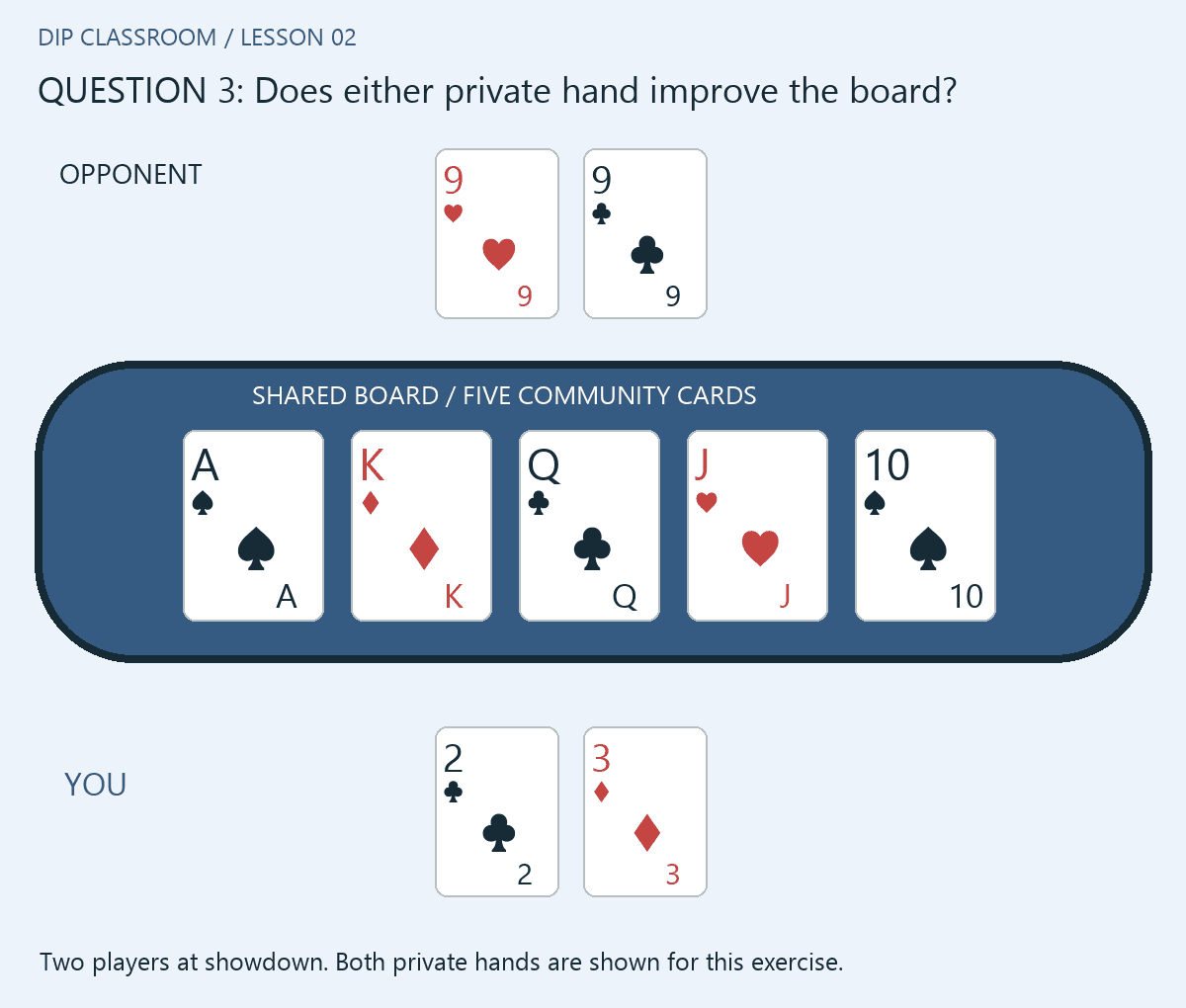
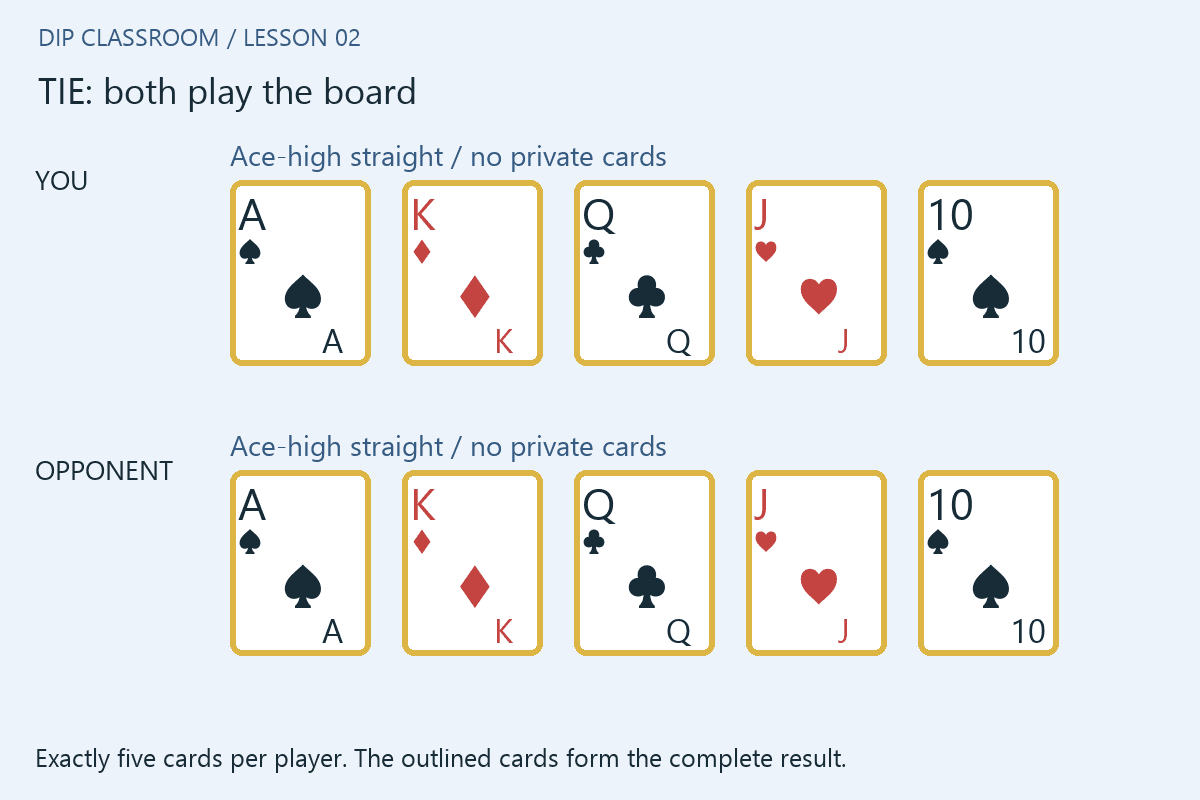
Another new deal: the shared cards are A♠ K♦ Q♣ J♥ 10♠. You hold 2♣ 3♦. The opponent holds 9♥ 9♣.
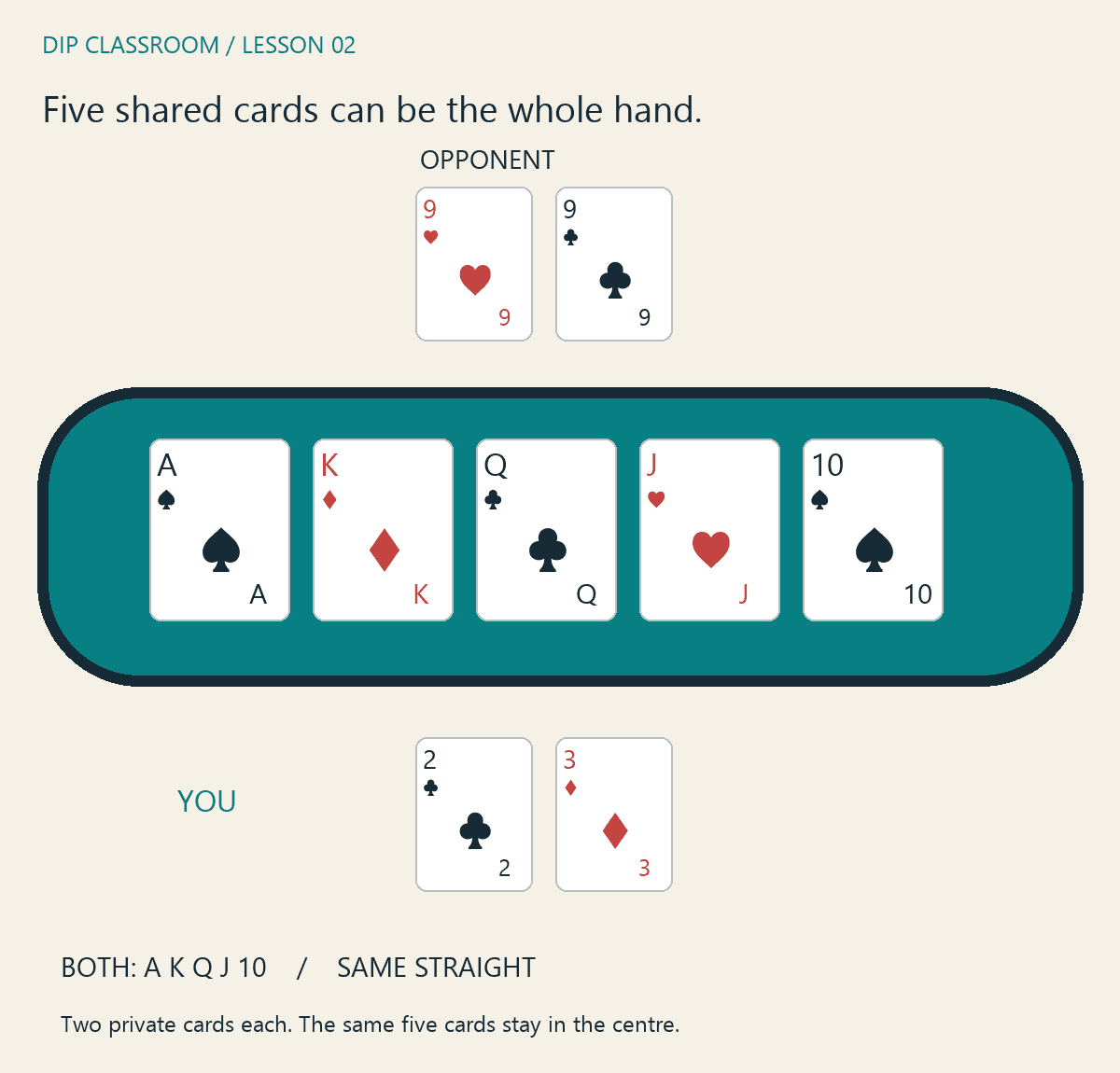
The board itself is an ace-high straight. Your private cards do not improve it. The opponent’s pair of nines does not improve it either. Each player’s best five are exactly the five shared cards. The result is a tie.
If the example pot contains 20 practice chips, with only these two eligible players and no deductions, each receives 10: 20 ÷ 2 = 10. This is a sharing example, not a betting recommendation. Real odd-chip and side-pot procedures need separate explanation; we avoid those complications here.
Do not assume a board straight always means a tie. A player might make a higher straight on a different board, or a flush if the suits allow it. In THIS picture the board is already ace-high and neither player can make a stronger category.
7. How the other ties are compared
Use this as a reference rather than another memory test:
- Two pair: compare the higher pair, then the lower pair, then the fifth card. A-A-2-2-3 beats K-K-Q-Q-A because aces beat kings at the first comparison.
- Three of a kind: compare the trip rank first, then the two side cards in descending order if needed.
- Four of a kind: compare the four-card rank, then the fifth card if needed.
- Flush or high card: compare the highest card, then the next until a difference appears. Having an ace in both flushes does not automatically mean a tie.
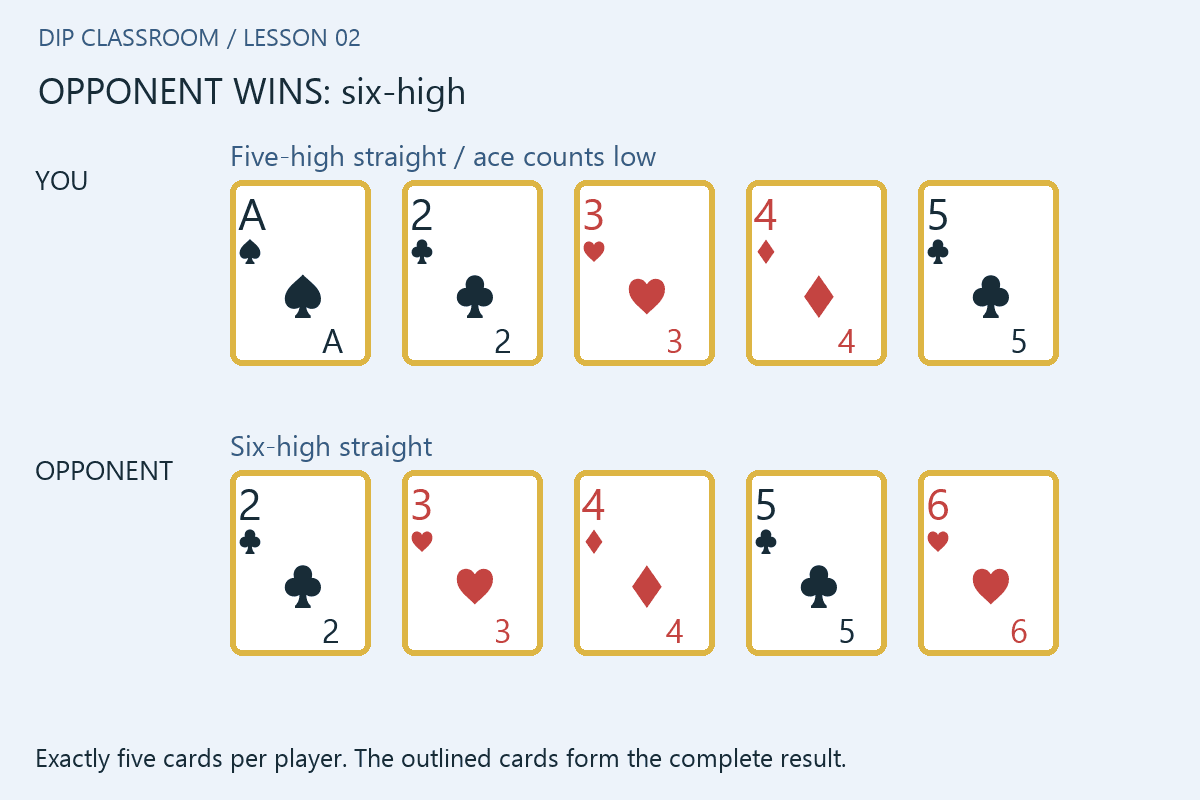
- Straight or straight flush: compare the top of the sequence. A-2-3-4-5 is five-high, so 2-3-4-5-6 beats it. Q-K-A-2-3 is not a straight.
- Full house: compare the three-card rank, then the pair rank if the three-card ranks tie.
There is no sixth-card comparison. If every relevant rank in the best five ties, equal suits are not required for a split.
8. A three-step habit for showdown
First name the strongest category each player can make. Second lay out exactly five cards for each. Third compare ranks in the order for that category.
Use physical cards if you have them. Put the unused cards slightly to one side, but keep clear which cards are shared. Say the five-card results aloud. If someone says “my ace wins,” ask them to point to the ace in their best five and explain which comparison it wins.
Practise with the cards in front of you
Each question is a separate exercise. Everything you need is repeated beside its diagram. Choose your answer first, then open Show answer to see the explanation. You do not need to scroll back to an earlier example.
Question 1: Same pair: who wins?
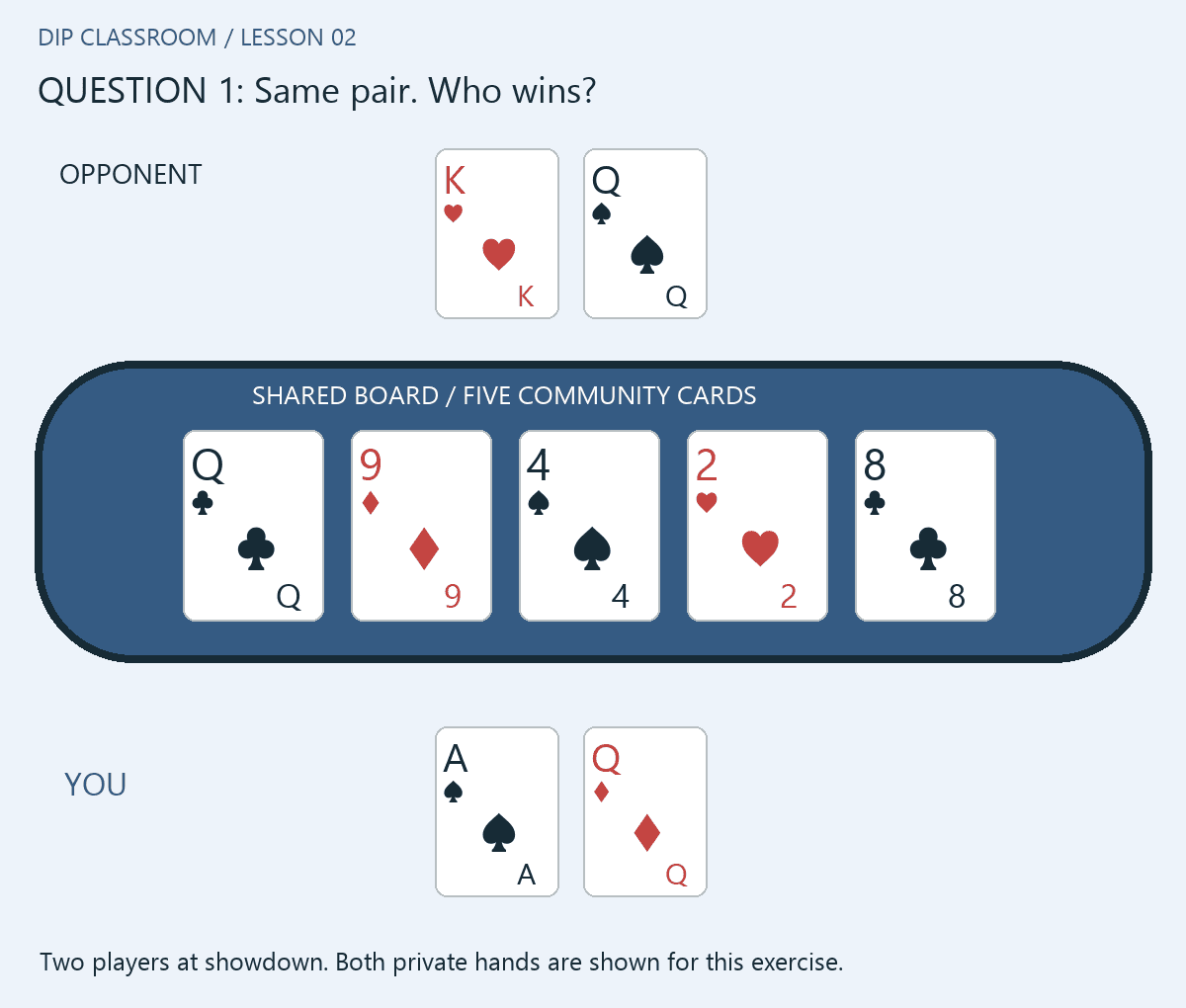
The shared board is Q♣ 9♦ 4♠ 2♥ 8♣. You hold A♠ Q♦. Your opponent holds K♥ Q♠. Both players are still in at showdown. Who wins: you, your opponent, or a tie? Which card decides it?
Show answer 1Hide answer 1
You win. Your best five are Q♦ Q♣ A♠ 9♦ 8♣. Your opponent uses Q♠ Q♣ K♥ 9♦ 8♣. The pair of queens ties, so compare the highest side card: your ace beats their king. Do not compare the suits.
Question 2: Which full house wins?
The shared board is K♣ K♦ 7♥ 7♠ 2♣. You hold K♥ 3♠. Your opponent holds 7♦ A♠. Who wins at showdown? Does the opponent’s ace help?
Show answer 2Hide answer 2
You win with K♥ K♣ K♦ 7♥ 7♠: kings full of sevens. Your opponent uses 7♦ 7♥ 7♠ K♣ K♦: sevens full of kings. Compare the three-card group first. Three kings beat three sevens. The opponent’s ace and your three are unused.
Question 3: Must you use a private card?
The shared board is A♠ K♦ Q♣ J♥ 10♠. You hold 2♣ 3♦. Your opponent holds 9♥ 9♣. Who wins at showdown? Must either player include a private card?
Show answer 3Hide answer 3
It is a tie. Each best five is A♠ K♦ Q♣ J♥ 10♠, the ace-high straight already on the board. Neither private hand improves it, and neither makes a flush. You use zero private cards here. A pocket pair does not beat a straight.
Question 4: Does your unused king win?
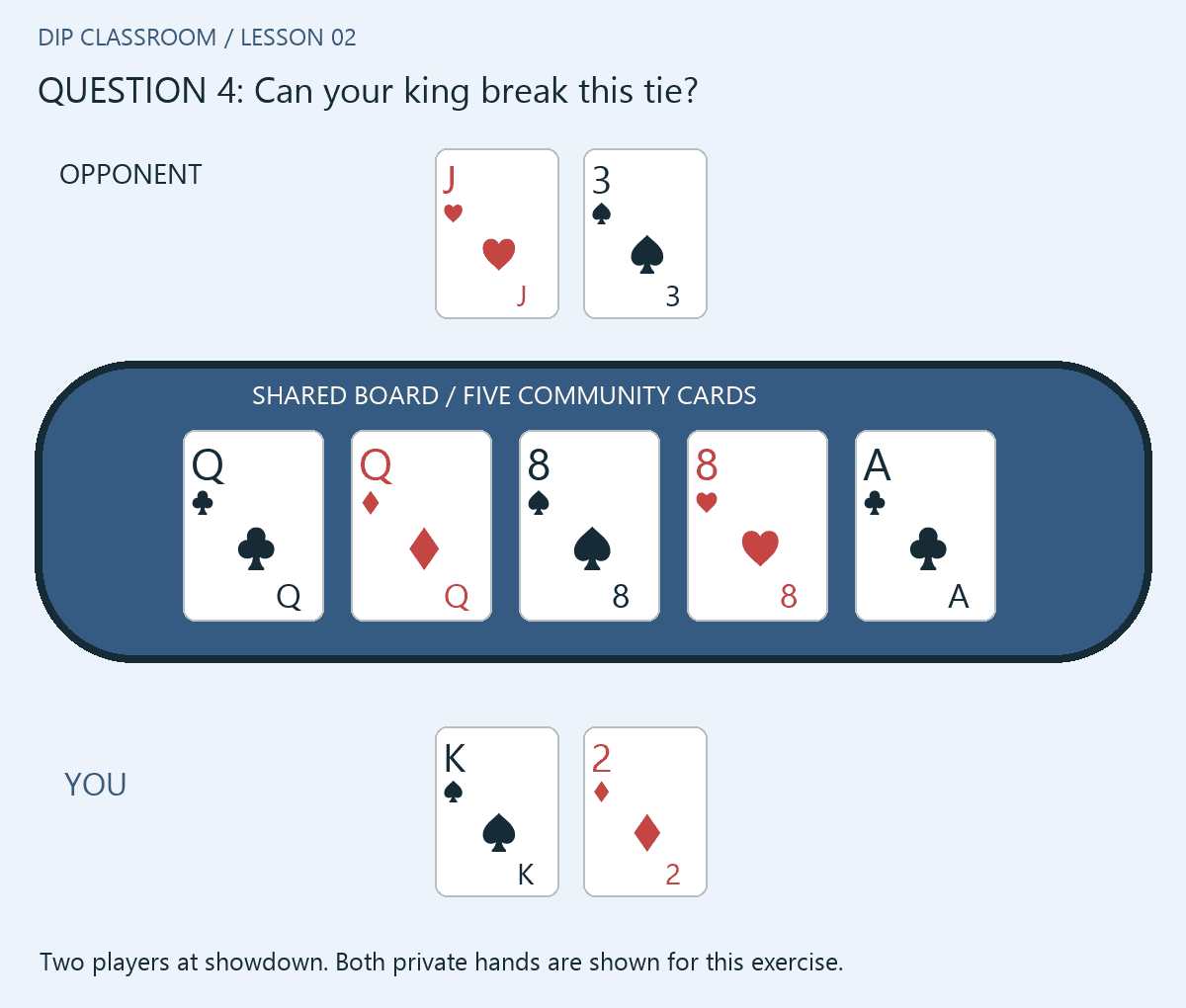
The shared board is Q♣ Q♦ 8♠ 8♥ A♣. You hold K♠ 2♦. Your opponent holds J♥ 3♠. Who wins at showdown: you because you hold a king, your opponent, or a tie?
Show answer 4Hide answer 4
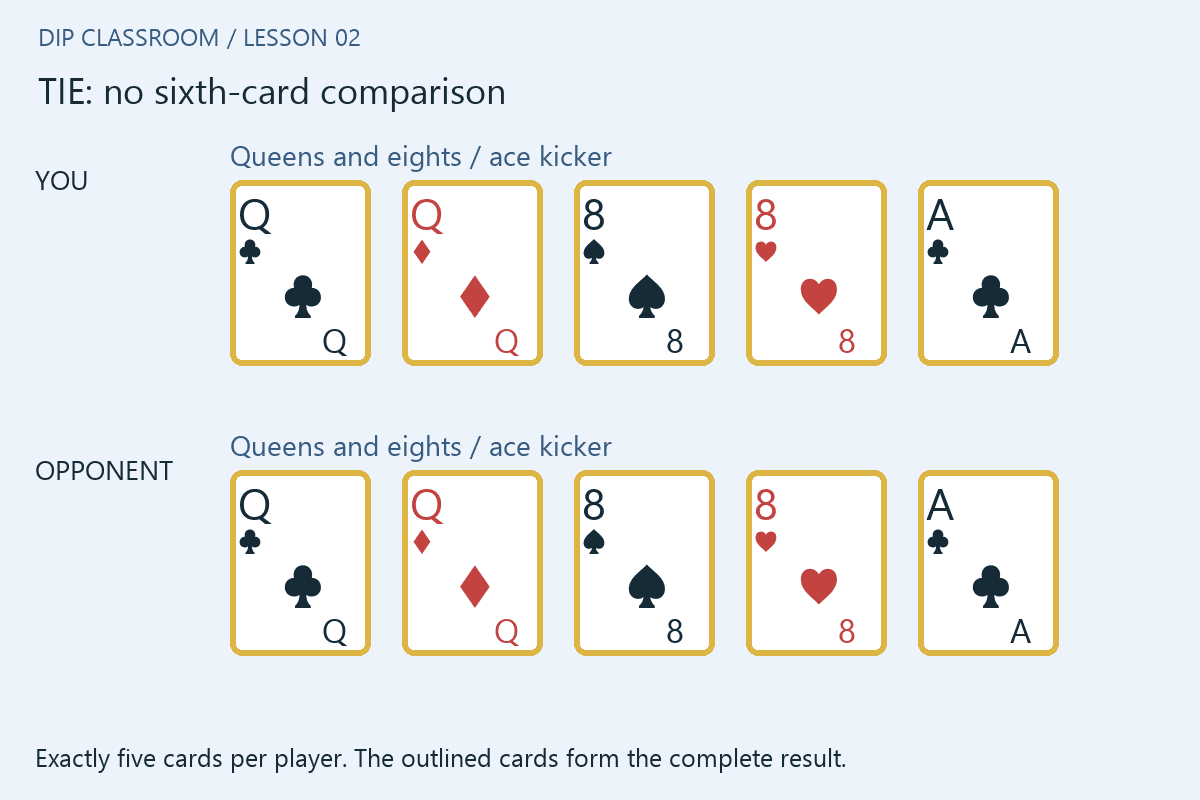
It is a tie. Both best hands are Q♣ Q♦ 8♠ 8♥ A♣: queens and eights with an ace kicker. The shared ace is already a better fifth card than your king. Your king is outside the best five; it cannot become a sixth-card tie-breaker.
Question 5: Five-high or six-high?
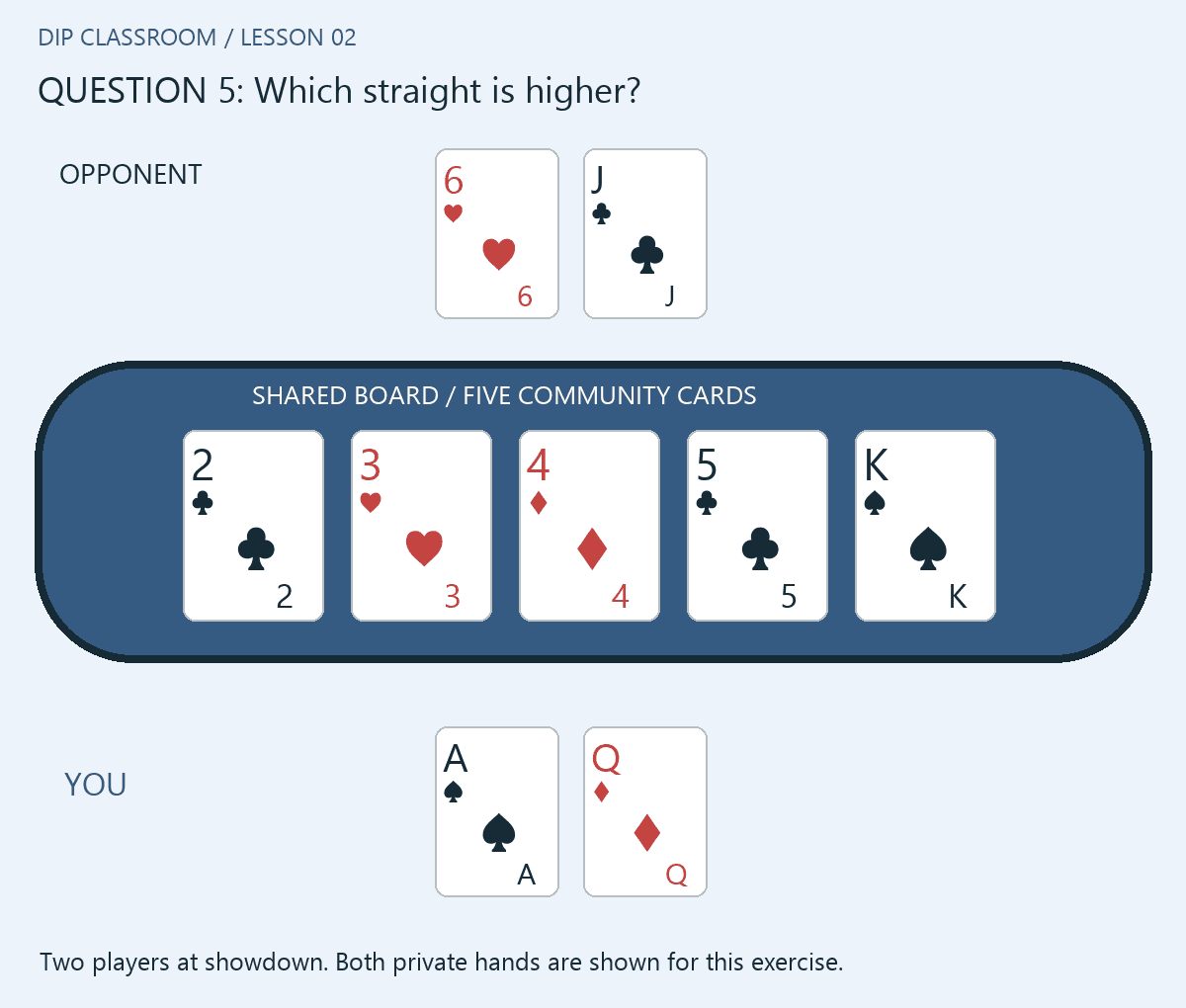
The shared board is 2♣ 3♥ 4♦ 5♣ K♠. You hold A♠ Q♦. Your opponent holds 6♥ J♣. Who wins at showdown? Read the top card of each straight carefully.
Show answer 5Hide answer 5
Your opponent wins. You use A♠ 2♣ 3♥ 4♦ 5♣, a five-high straight. The ace counts as low in this sequence. Your opponent uses 2♣ 3♥ 4♦ 5♣ 6♥, a six-high straight. Six-high beats five-high. The unused king on the board does not change either sequence.
Question 6: Flush against full house
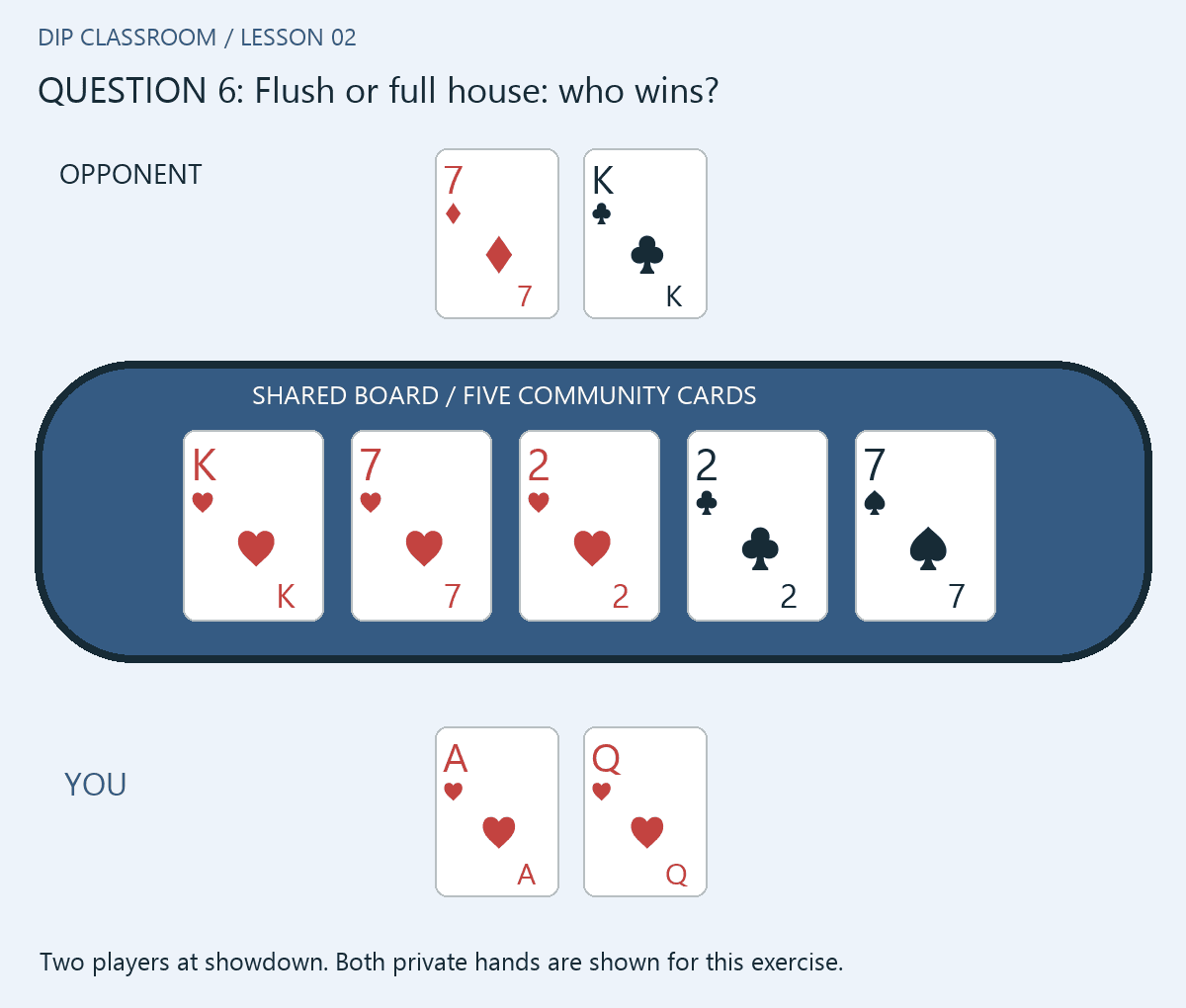
The shared board is K♥ 7♥ 2♥ 2♣ 7♠. You hold A♥ Q♥. Your opponent holds 7♦ K♣. Who wins at showdown? First name each player’s strongest category.
Show answer 6Hide answer 6
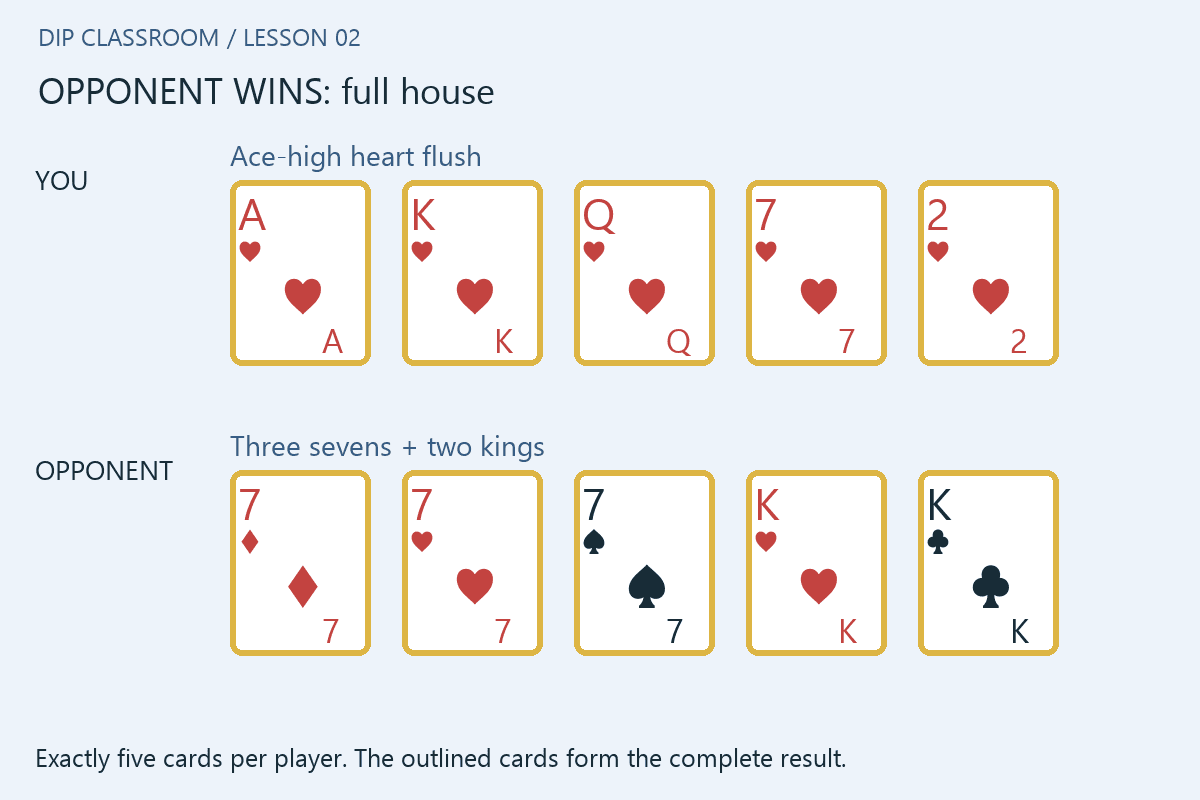
Your opponent wins. Your A♥ K♥ Q♥ 7♥ 2♥ make an ace-high flush. Their 7♦ 7♥ 7♠ K♥ K♣ make a full house, sevens full of kings. Full house ranks above flush, even an ace-high flush. They choose the pair of kings rather than the smaller pair of twos.
Mini glossary
- Category: the type of combination, such as pair, flush or full house.
- Best five: the strongest legal selection of five available cards.
- Kicker: a relevant side card, not a spare sixth card.
- Playing the board: using all five shared cards and neither private card.
- Split pot: a pot divided between tied eligible winners.
- Wheel: the A-2-3-4-5 straight, the lowest straight.
DIP’s takeaway
The useful skill is not reciting ten names quickly. It is being able to point to five cards and explain the comparison. Today’s three pictures deliberately use two, one and zero private cards. If those all feel legal to you now, you have understood one of Hold’em’s most important rules.
Lesson 03 will cover check, call, bet, raise and fold. There is no need to put money on the table to practise this lesson.
Verification: September 11, 2026. Standard hand-building rules checked against PokerStars’ Hold’em rules. All examples and teaching diagrams are DIP originals; the ranking sheets, six self-contained quizzes and best-five answer diagrams were revised September 14, 2026. DIP Cat keeps the same identity in a new hand-comparison scene.
Responsible play: Practise without money. If you later choose real-money play, follow local eligibility rules, set an affordable limit and never borrow or chase losses.