Two cards, one decision
You are dealt two private cards. No shared cards have appeared yet. Before thinking about a straight or flush, look at what you actually hold.
Your starting hand is those two private cards. It is not yet a five-card poker hand. A strong starting hand gives you useful possibilities; it does not promise that you will win.
Today we are learning to describe our cards and spot important differences. We are not learning a rule that says always play one hand and always fold another. The price, your seat and the players still to act matter too. We will build those decisions in later lessons.
First look: do the numbers or letters match?
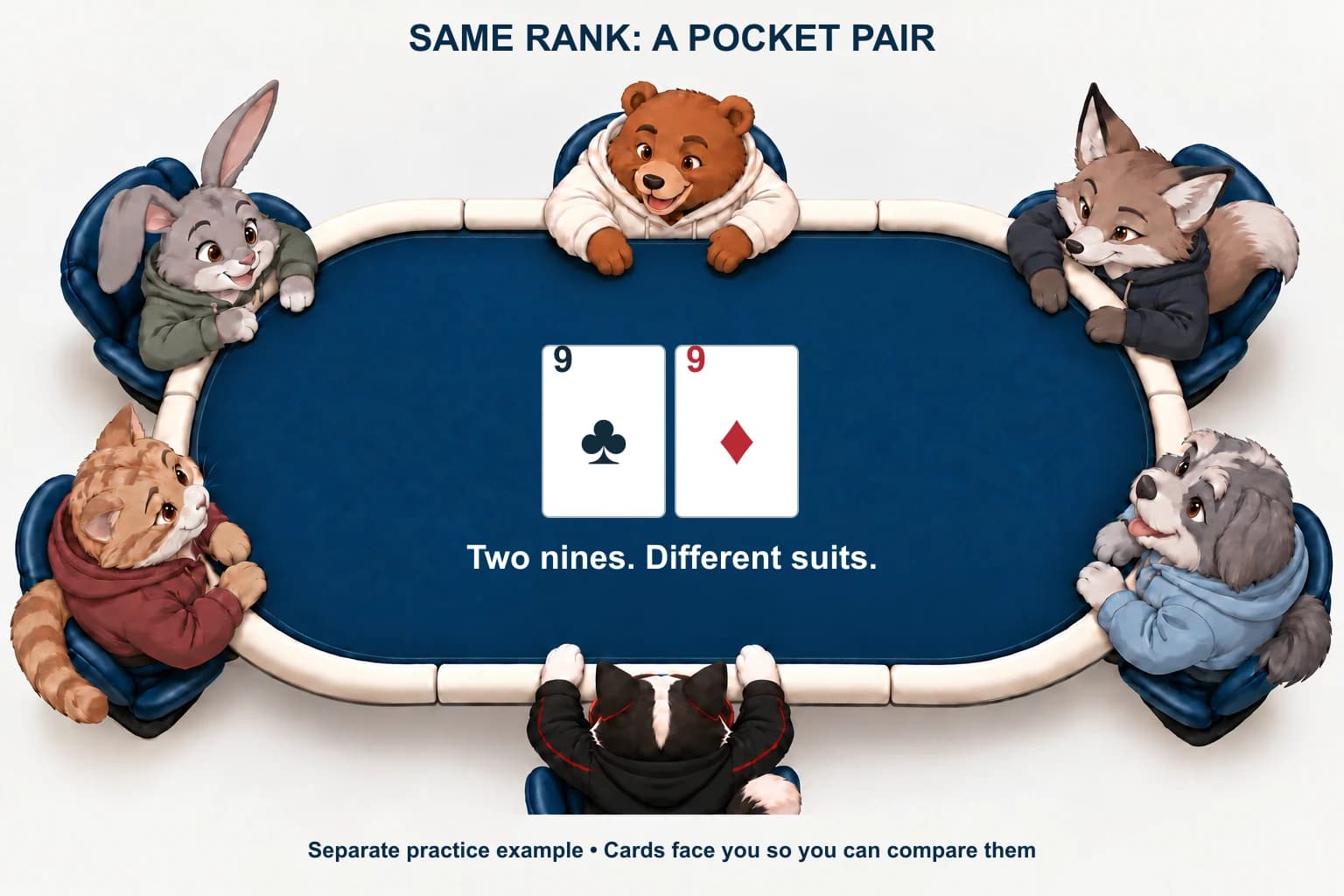
Suppose you receive 9 of clubs and 9 of diamonds. Both cards have the same rank, nine. You already have a pair. Because both nines are your private cards, we call this a pocket pair.
The suits are different, and that is normal. A standard deck contains only one nine of each suit. Two identical nines of clubs cannot appear in the same ordinary single-deck hand.
A pair of aces begins higher than a pair of nines. But a higher pocket pair can still lose after the shared cards appear. Do not confuse a better starting position with a finished result.
Second look: do the suits match?
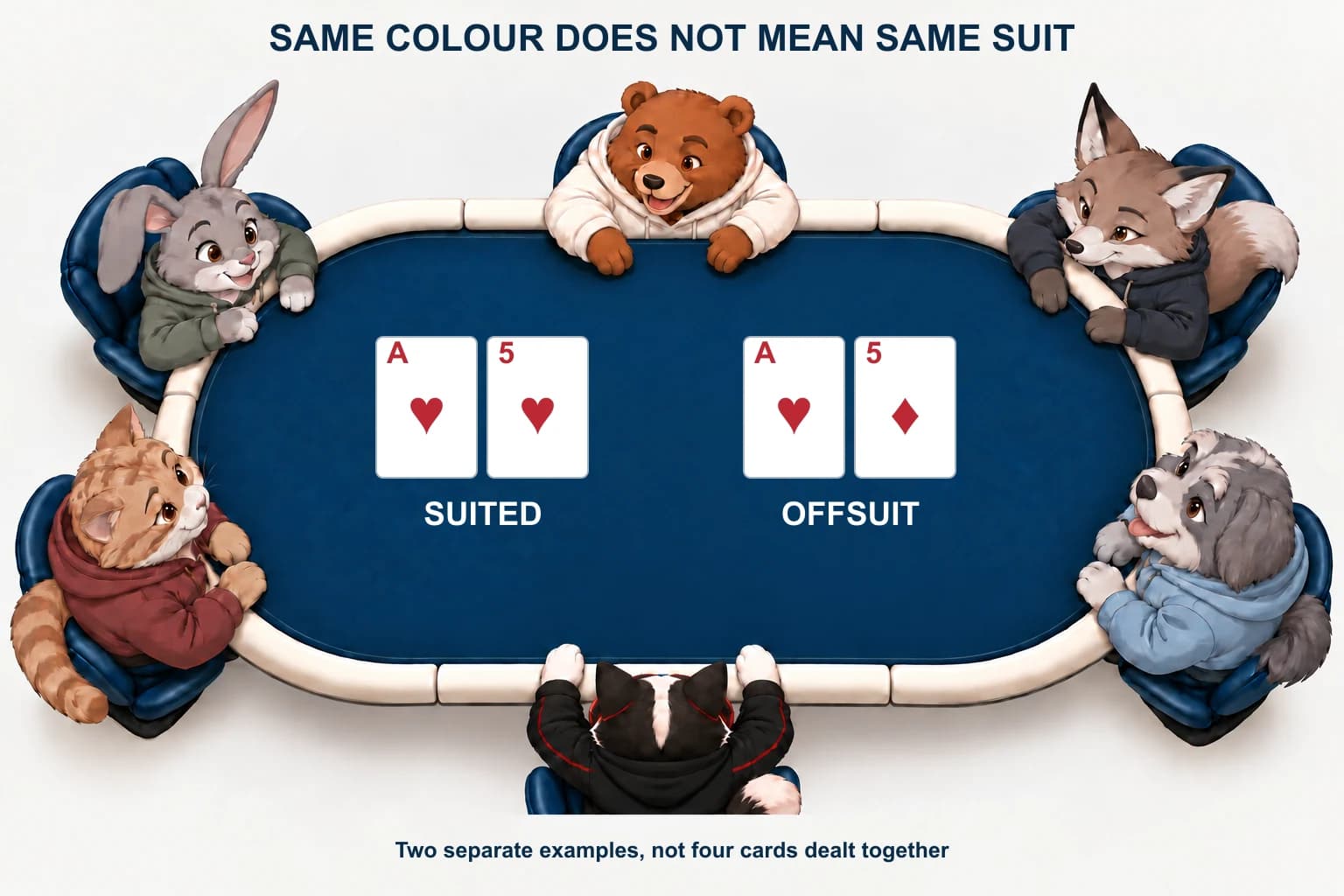
Now imagine ace of hearts and five of hearts. The ranks differ, but both cards are hearts. These are suited cards.
Compare that with ace of hearts and five of diamonds. Both cards are red, but hearts and diamonds are different suits. That hand is not suited. Different suits are called offsuit.
Suited cards give you a way to use both private cards in a flush. You would still need three more cards of that same suit among the shared cards to make that flush. Two hearts alone are not a flush, and matching suits do not make every starting hand worth playing.
For example, seven of hearts and two of hearts are suited. They still have low ranks and a large gap. Being suited improves some possibilities; it does not erase every weakness.
Third look: are the ranks next to each other?
Nine and ten sit beside each other in the rank sequence. A starting hand containing those ranks is connected. Connected cards can work together in a straight.
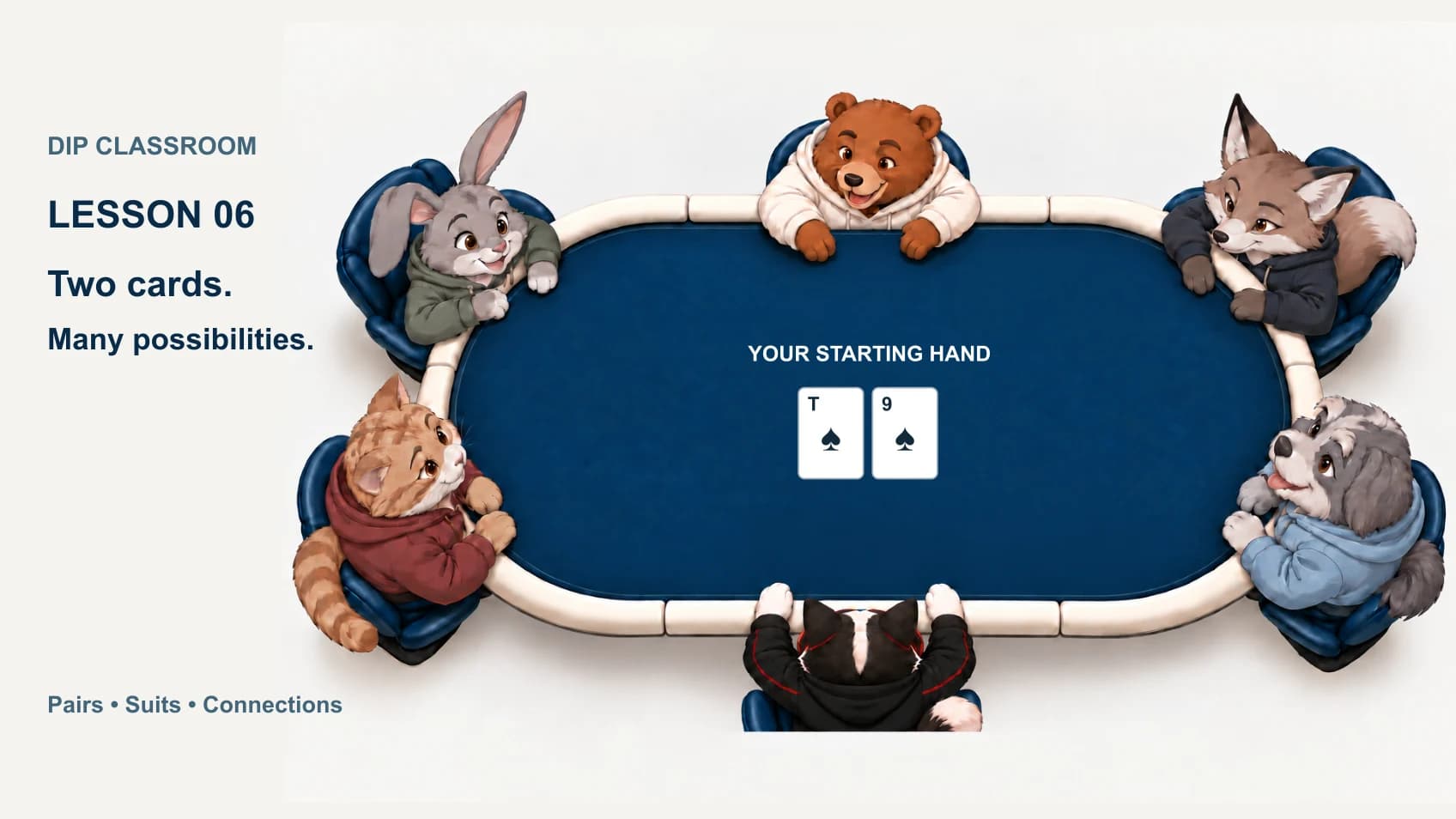
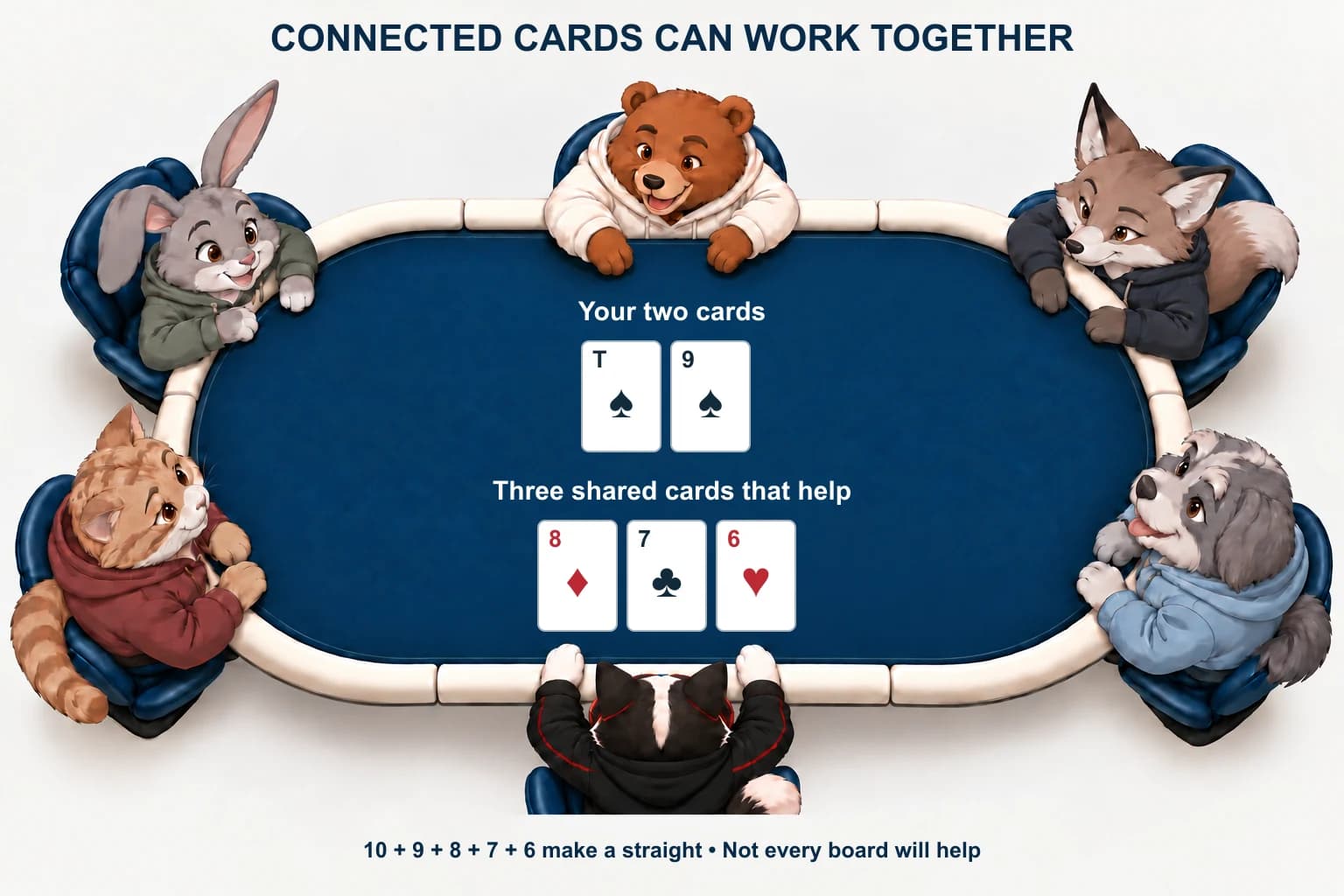
Ten of spades and nine of spades are both connected and suited. We call them suited connectors. Ten of spades and nine of diamonds are connected but offsuit.
Connected does not mean you already have a straight. A straight requires five consecutive ranks. With your ten and nine, shared cards such as eight, seven and six can complete one. Other shared cards may not help at all.
An ace can be low in A-2-3-4-5 or high in 10-J-Q-K-A. It cannot wrap a straight around from king through ace to two: Q-K-A-2-3 is not a straight.
Reading short hand names
You will see short names in poker articles. Each part describes something specific:
- AA means two aces, a pocket pair.
- AKs means an ace and a king of the same suit. The s means suited.
- AKo means an ace and a king of different suits. The o means offsuit.
- T9s means a ten and a nine of the same suit. T is a short way to write ten.
These labels do not specify one exact suit. AKs could be two hearts, two clubs, two diamonds or two spades. When the exact cards matter, we show their actual suits.
The same pair can hide an important difference
Here is an illustration, not a recommendation to enter this hand.
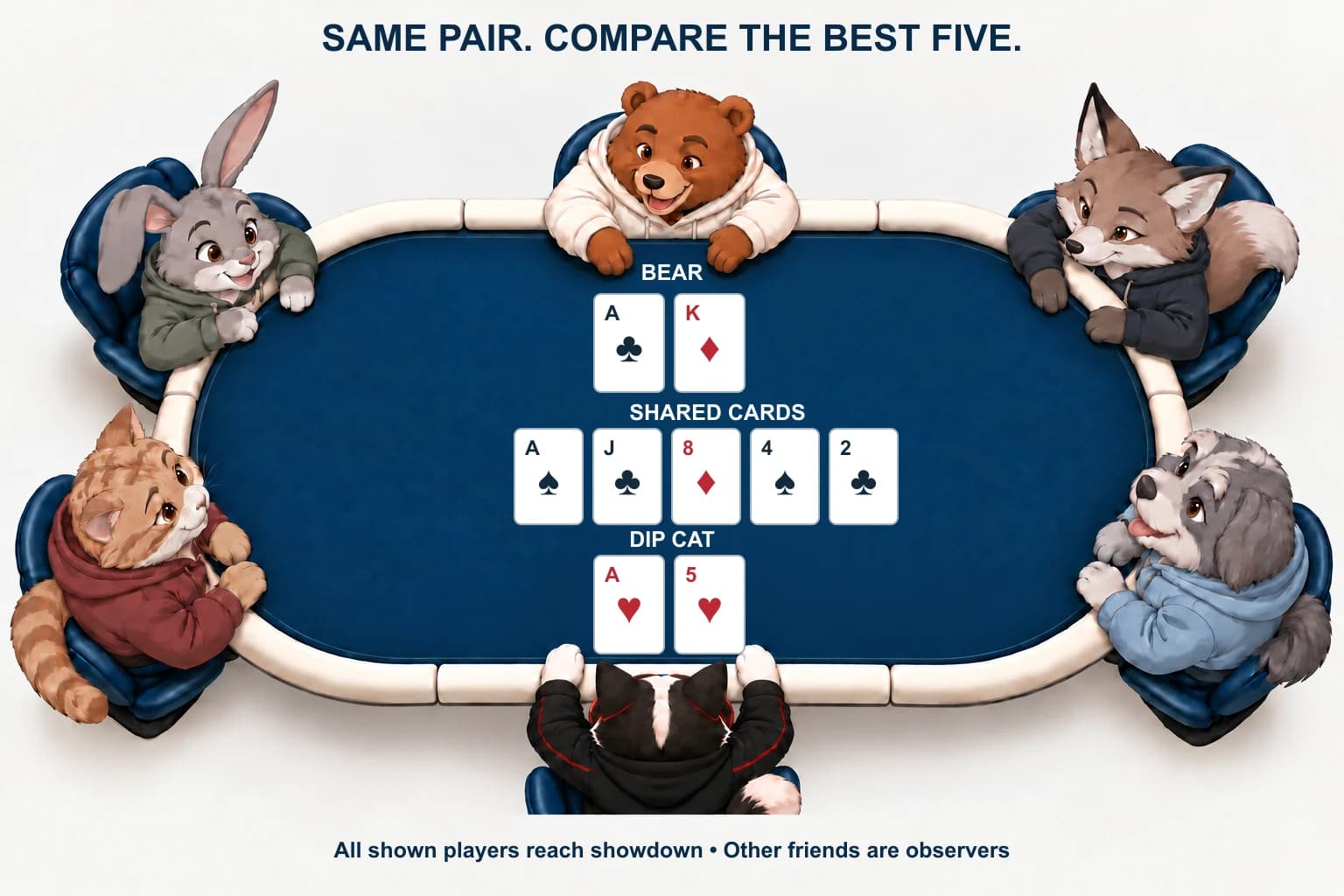
You hold ace of hearts and five of hearts. Bear holds ace of clubs and king of diamonds. The five shared cards eventually become ace of spades, jack of clubs, eight of diamonds, four of spades and two of clubs.
Both players have a pair of aces. Your best five are A-A-J-8-5. Bear's best five are A-A-K-J-8. Bear wins because king beats jack at the first different card after the equal pair.
Your five did not disappear, but it was not enough to win. The two hearts in your starting hand did not produce a flush either. This is why “I have an ace” and “my cards are suited” are not complete reasons to play.
Before the shared cards were dealt, you would not know Bear's private cards. We reveal both hands here only to explain how the comparison works.
Recognise the hand, then look at the situation
Imagine you are at our six-seat practice table. You recognise your cards as ten-nine suited. That description stays the same in each of these situations:
- Everyone before you folded, and nobody has raised yet.
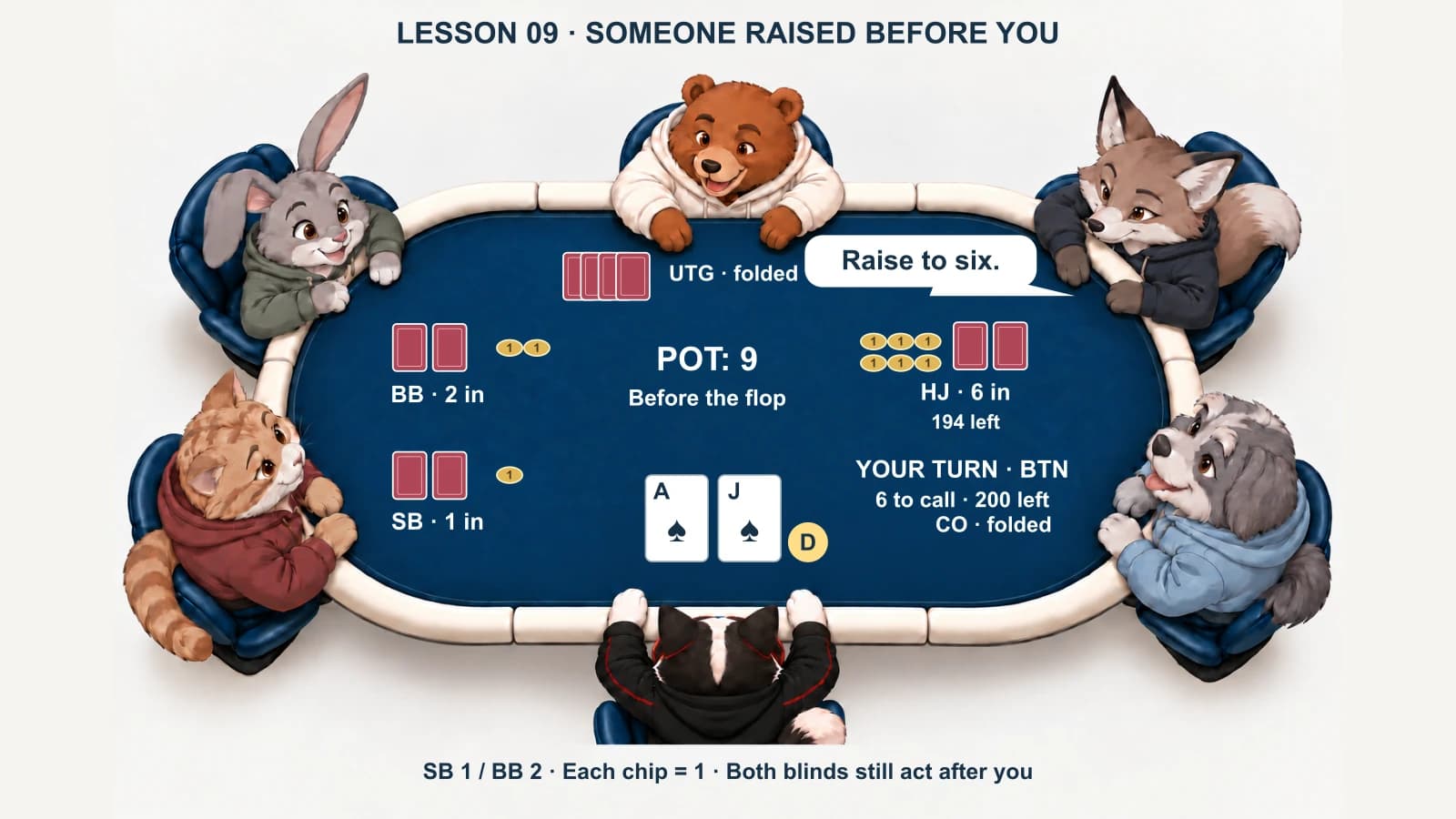
- One player raised and two other players still have decisions after you.
- One player raised, another raised again, and it is now your turn.
The cards have not changed, but the decision has. Different amounts are at risk, and the action gives different information about the hands you may face. A hand with interesting possibilities does not automatically justify paying any price.
Do not try to memorise an entire starting-hand chart today. First learn to recognise a pair, matching suits and connected ranks. Next we will put those cards into specific seats and situations.
Try these three hands
Question 1 tests starting-hand strength. Questions 2 and 3 review how the shared cards decide the final result. All cards needed are shown again in each question. All active players are eligible for the same pot; ignore fees and odd chips. The other seated friends are observers.
Question 1: strongest before the flop?
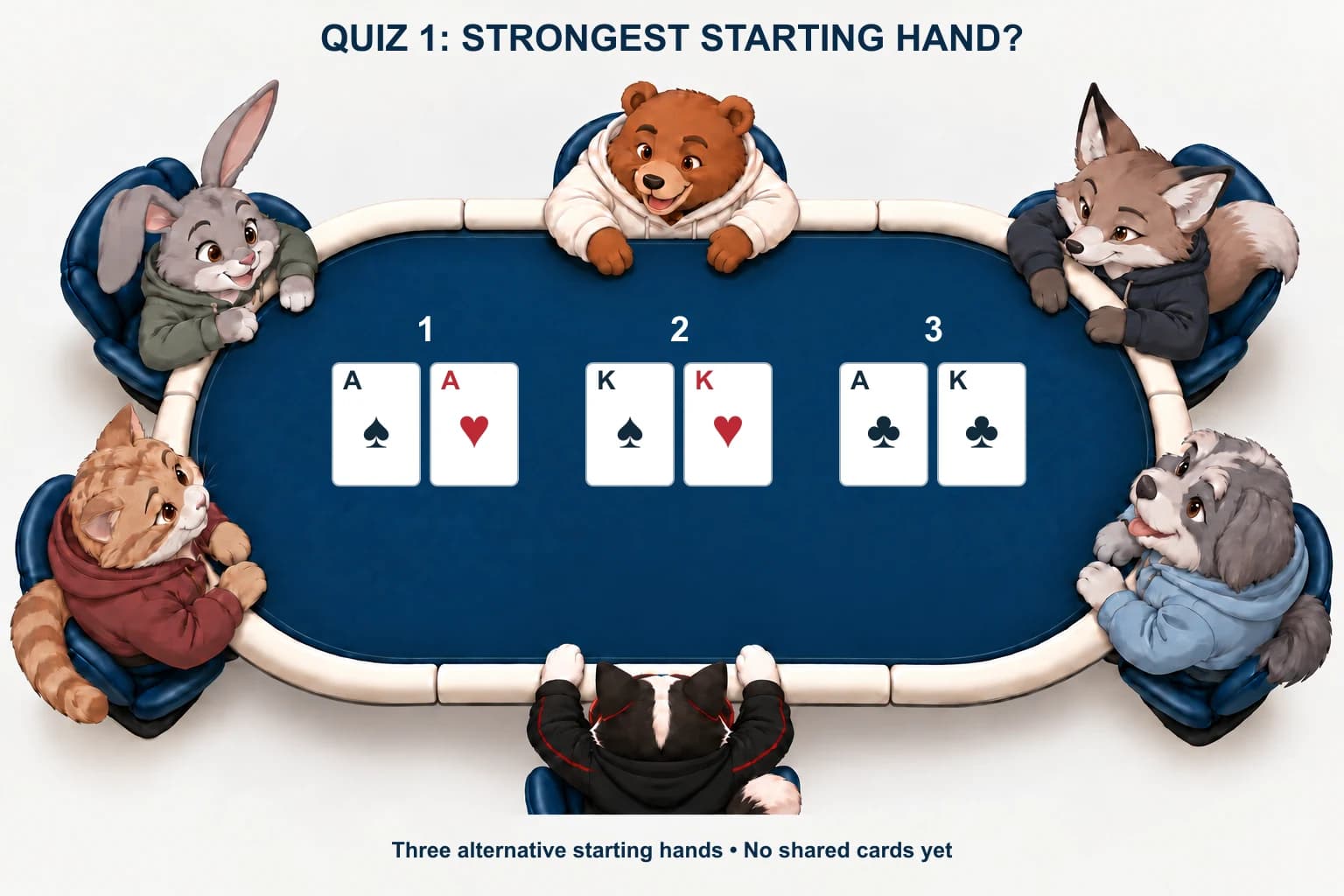
No shared cards have been dealt. Which is the strongest starting hand: 1) A♠ A♥, 2) K♠ K♥, or 3) A♣ K♣?
Show answer 1Hide answer 1
Choice 1: A♠ A♥. Pocket aces are the strongest starting hand in Hold'em. That is a starting advantage, not a guarantee of winning after the shared cards arrive.
Question 2: both made a flush. Who wins?
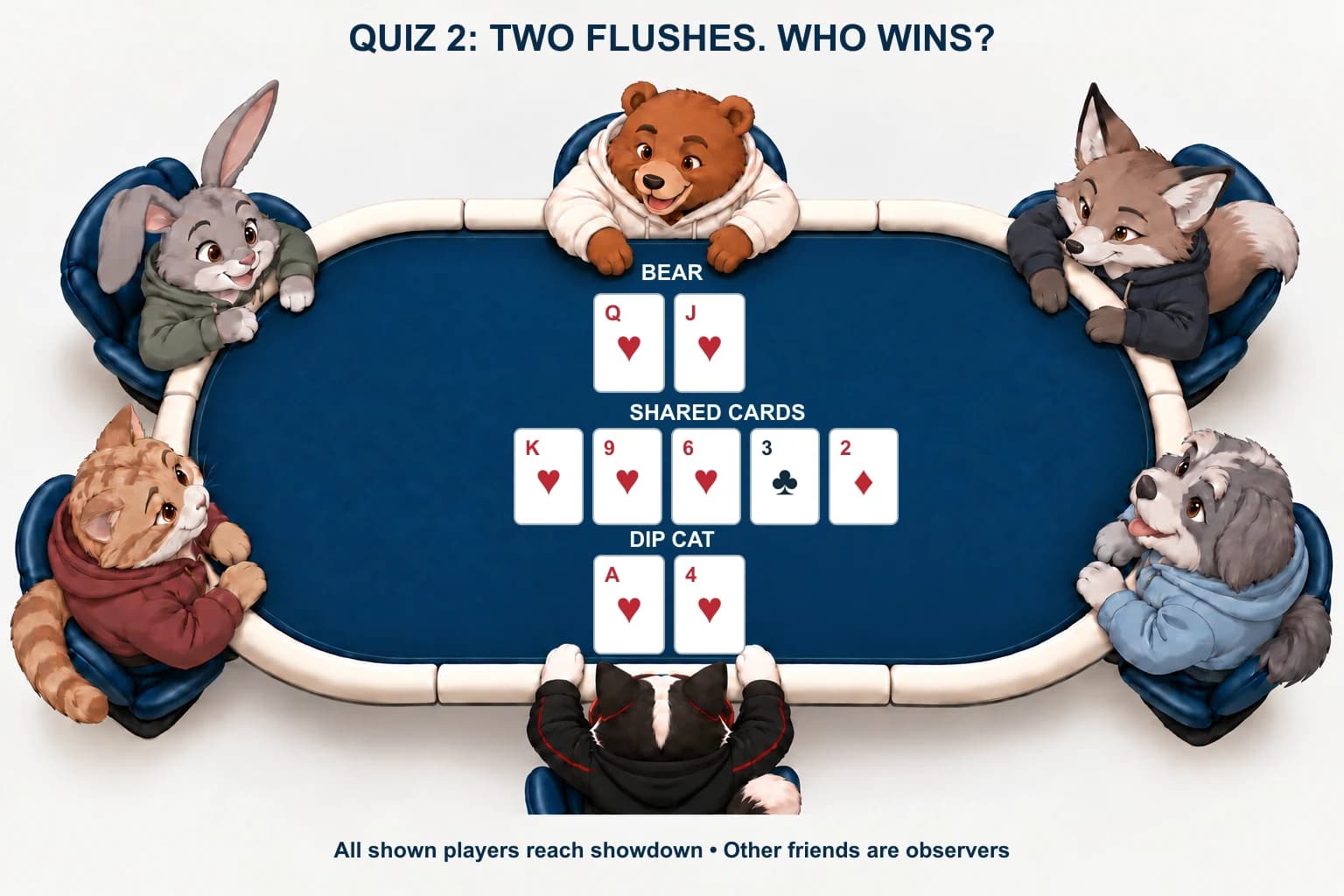
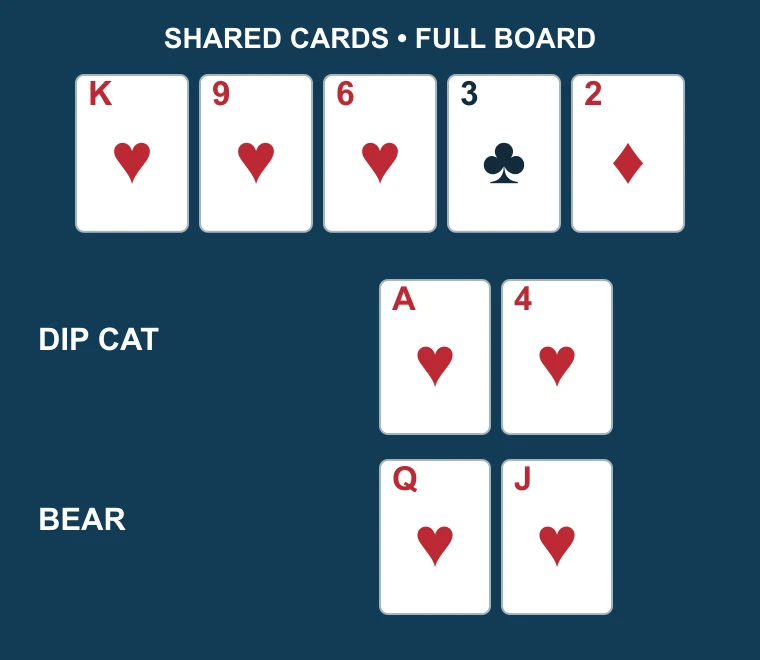
The board is K♥ 9♥ 6♥ 3♣ 2♦. DIP Cat holds A♥ 4♥. Bear holds Q♥ J♥. Both remain at showdown. Does Cat win, does Bear win, or do they split the pot?
Show answer 2Hide answer 2
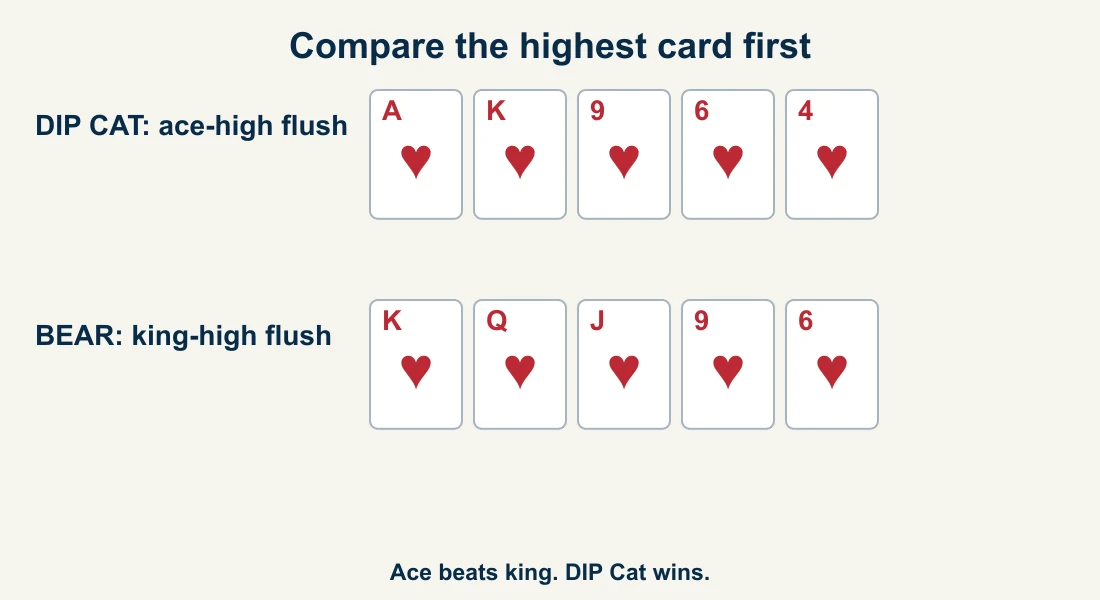
DIP Cat wins. Cat's flush is A♥ K♥ 9♥ 6♥ 4♥. Bear's flush is K♥ Q♥ J♥ 9♥ 6♥. Compare the highest cards first: ace beats king. Two flushes do not automatically tie.
Question 3: four of a kind on the board. Does everyone split?
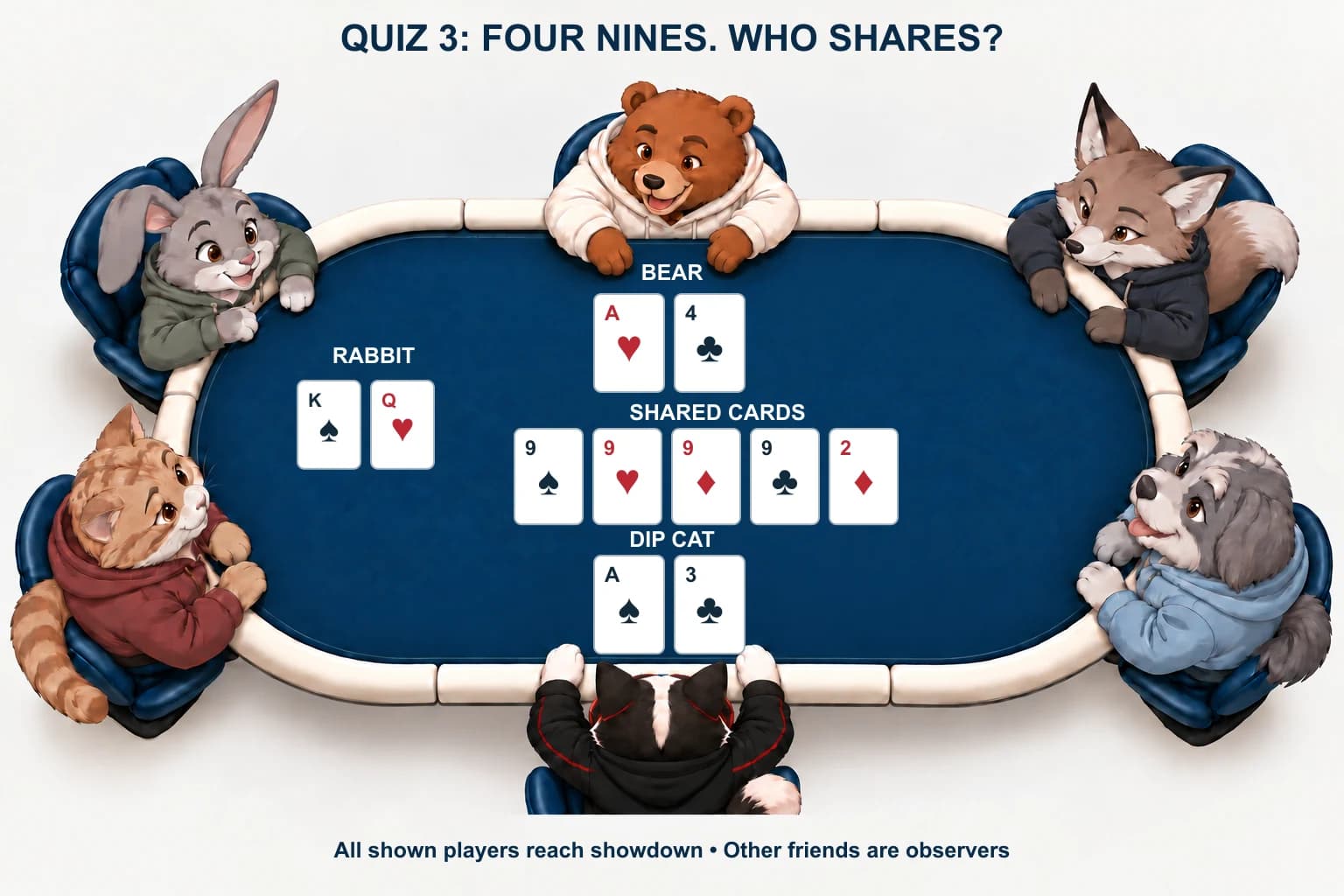
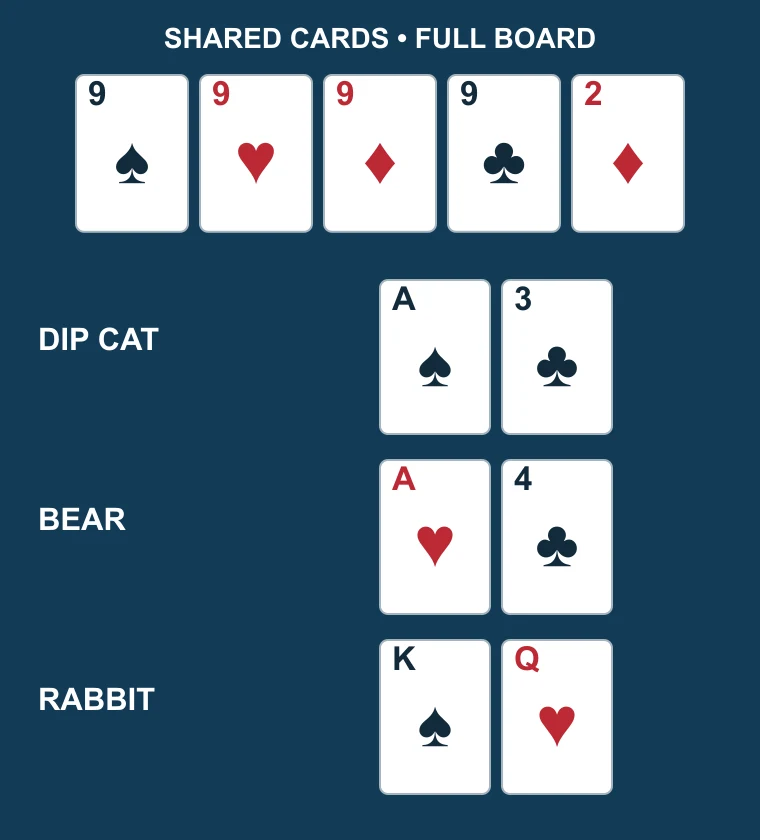
The board is 9♠ 9♥ 9♦ 9♣ 2♦. DIP Cat holds A♠ 3♣, Bear holds A♥ 4♣, and Rabbit holds K♠ Q♥. All three remain at showdown. Do all three split, does Bear win alone, or do Cat and Bear split while Rabbit loses?
Show answer 3Hide answer 3
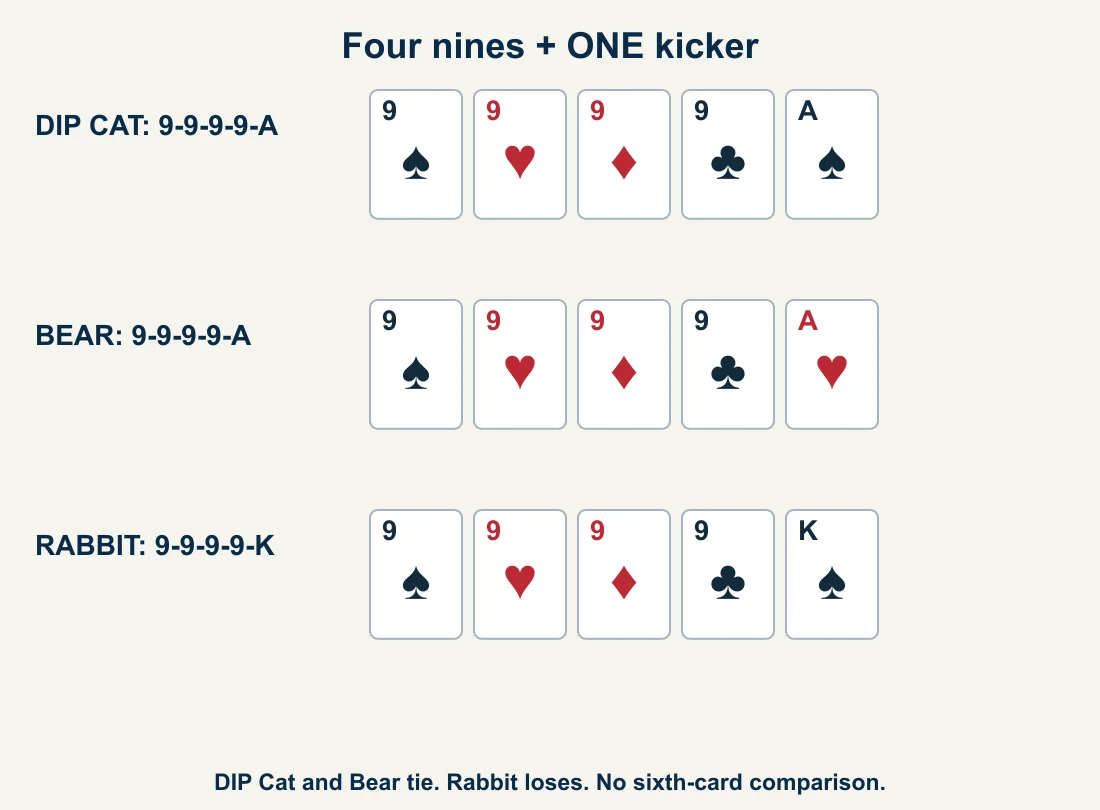
Cat and Bear split the pot equally. Each uses the four nines and an ace: 9-9-9-9-A. Rabbit uses 9-9-9-9-K and loses to the ace kicker. Bear's four and Cat's three are not in their best five, so they cannot break the tie. A split pot is also called a chop.
Mini glossary
- Starting hand: your two private cards before the shared cards arrive.
- Pocket pair: private cards of the same rank.
- Suited: both private cards have the same suit.
- Offsuit: the two private cards have different suits.
- Connected cards: cards with neighbouring ranks.
- Kicker: a card outside the made combination that can help decide a tie, but only if it belongs to the best five cards.
DIP's takeaway
Look for three things: matching ranks, matching suits and ranks that work together. Then remember that these are possibilities, not promises. The shared cards and the betting situation still matter.
Learn with free practice cards and counters. Real-money play carries risk. Follow local eligibility rules, set limits you can afford, and never borrow or chase losses.