A blind is a starting payment, not a promise
You put two chips in before seeing your cards because you are the big blind. Someone raises. Do you now have to protect those two chips?
No. The blind is already committed. Your decision is whether putting in more chips makes sense. Folding loses the posted blind, but it stops you spending more on a hand you do not want to play.
Look at the big blind's actual price
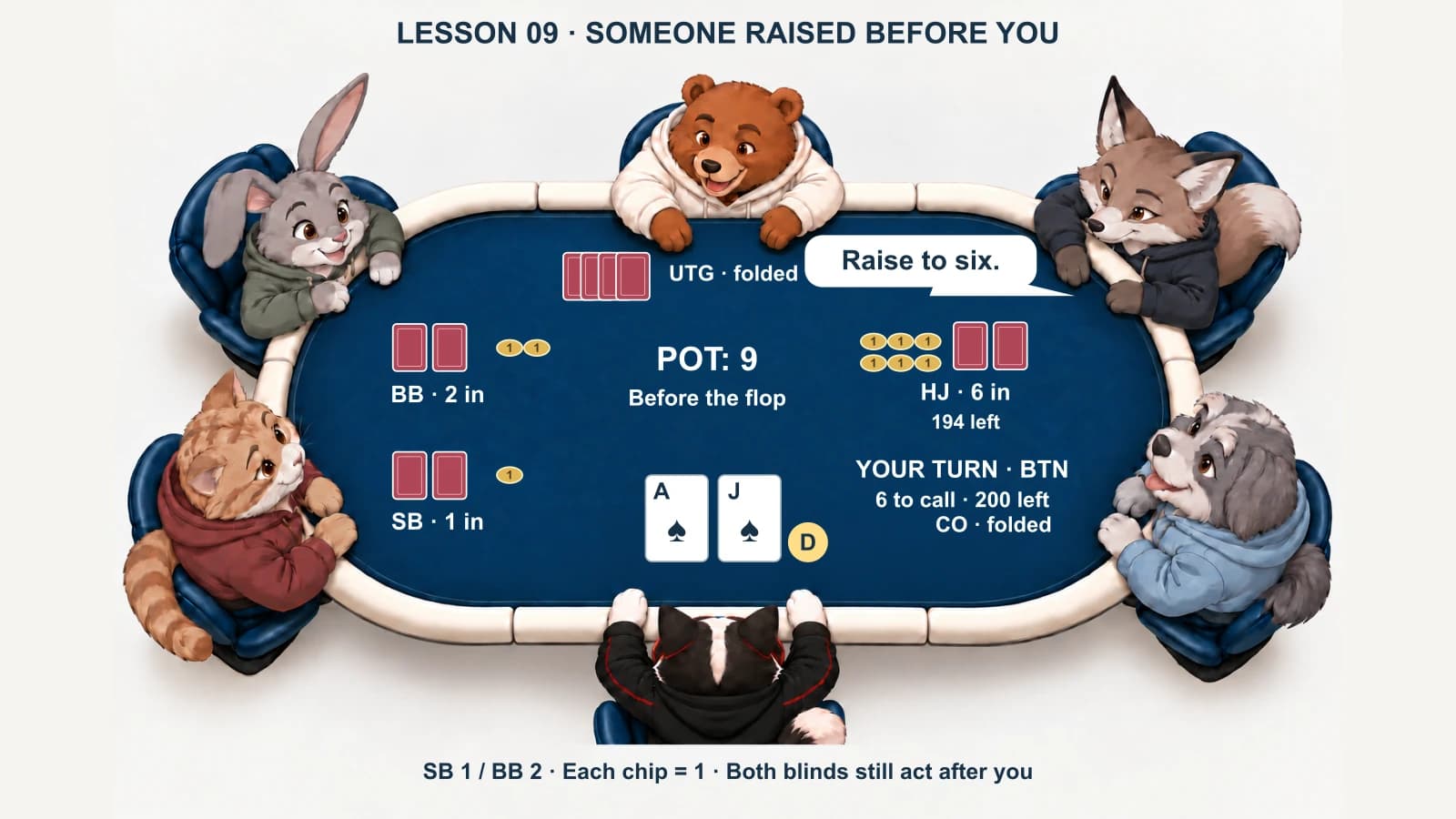
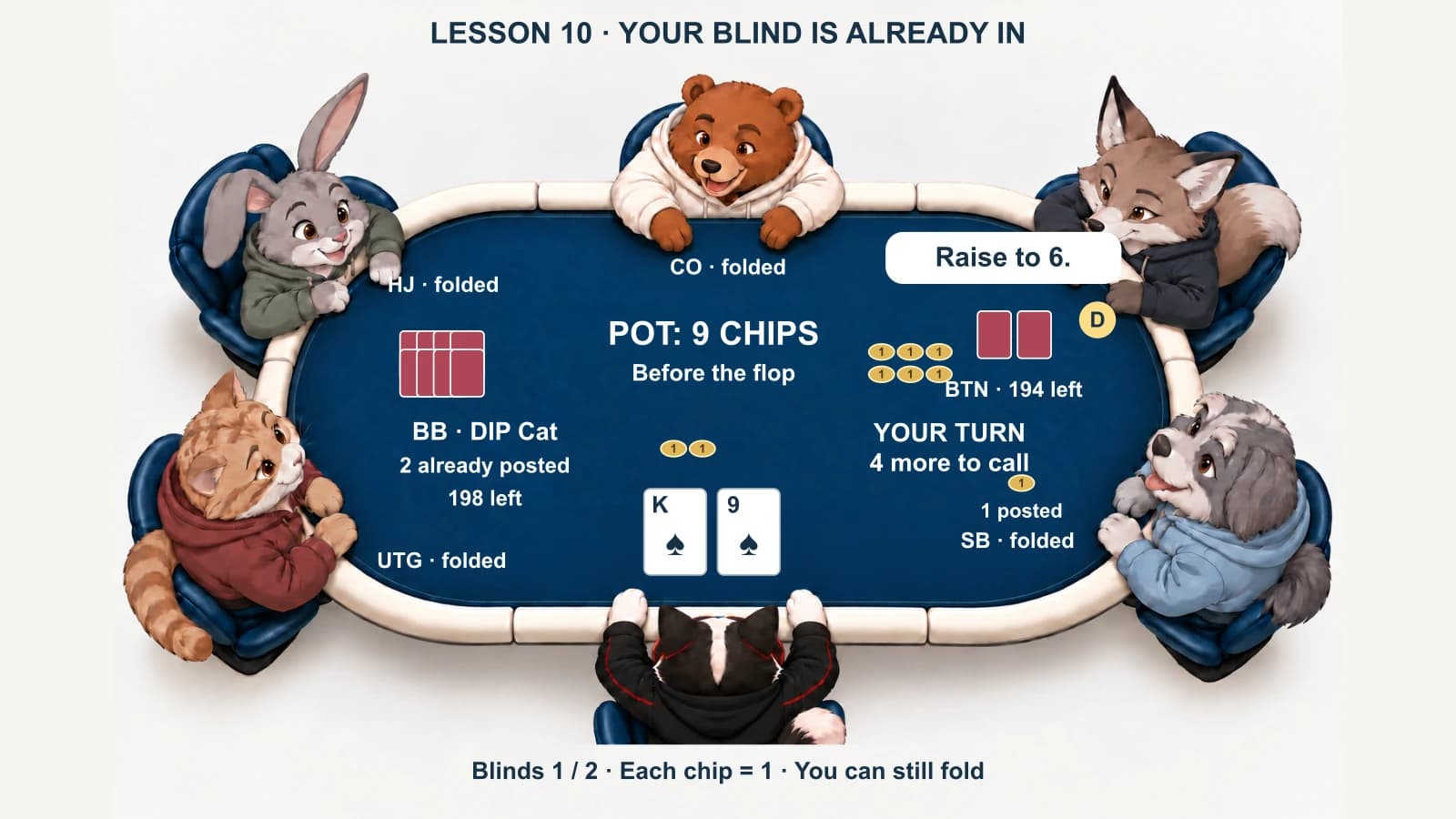
We use six seats, small blind 1, big blind 2, and starting stacks of 200. There is no ante or rake. UTG, HJ and CO fold. BTN raises to 6. SB folds. You are BB with K♠ 9♠.
The pot is 9: BTN's 6, SB's 1 and your 2. You have 198 left. A call costs another 4, not 6, because your posted 2 already counts towards the current total.
If you call, the pot is 13. You and BTN each have 194 left, and you see the flop together. This is an example of the mechanics, not a claim that king-nine suited must always call.
If you fold, you keep your remaining 198. BTN wins without a flop. You do not owe another four merely because you posted the blind.
The discount does not fix your position
You act last before the flop in this example because SB has already folded and there are no other players waiting behind you. Once the flop arrives, you act first and BTN acts second.
That changes what you know when making decisions. BTN gets to see your action first. A cheaper call is useful, but it does not make every two cards a good investment.
Suited cards can make a flush, but most flops will not give you a made flush. An attractive possibility is not the same as a guaranteed outcome. Think about the raiser's likely hands as well as your price.
Raising is another choice
In a separate branch of the same starting situation, you raise to 20 total. Your posted 2 counts, so you add 18 and have 180 left. BTN has already put in 6 and would need another 14 to call.
The pot before BTN responds is 27: your 20, BTN's 6 and SB's folded 1. If BTN calls, it becomes 41, with 180 left each. If BTN folds, the unmatched part of your raise comes back; receiving your own chips is not extra profit.
Twenty is an example, not a mandatory size. Do not raise simply to take revenge for someone attacking your blind.
The small blind is a different seat
Now rewind and put yourself in SB instead. BTN has raised to 6 and you have posted 1. Calling costs you 5 more. BB still has a decision after you and may raise again.
If BB folds after your call, the pot is 14: BTN 6, SB 6 and BB's folded 2. You act first on the flop. If BB also calls, three players see the flop with 18 in the pot; you still act first.
This is why you cannot copy the big blind's four-chip price into the small blind. Both the amount already posted and the players still to act have changed.
When can the big blind check?
Checking is possible when nobody has raised and your posted big blind already matches the required amount. For example, if everyone folds to SB and SB adds one chip to match two, BB may check or raise.
Facing a raise to six is different. Your two does not match six, so checking is not an option. You must fold, call the difference, or make a legal raise.
DIP's takeaway
Before acting from a blind, ask three things: how much have I already posted, how much more is required now, and who acts after me? Then consider your cards, the raiser's likely hands and your position after the flop. A blind gives you a contribution towards the price, not an obligation to pay it.
Practise with play chips. Learning does not require real-money play. If you choose to play for money, follow local eligibility rules and set limits.