A suited wheel ace can look too weak to move all-in, especially when the opener covers you. At 18 big blinds, however, the decision is not about whether A5 suited is a premium hand. It is about whether the dead money, fold equity, blockers and called equity combine to make a reshove profitable.
This lesson uses one explicit tournament spot and a simplified model. Change the ranges and the answer changes. The goal is to build a process you can repeat at the table.
The spot
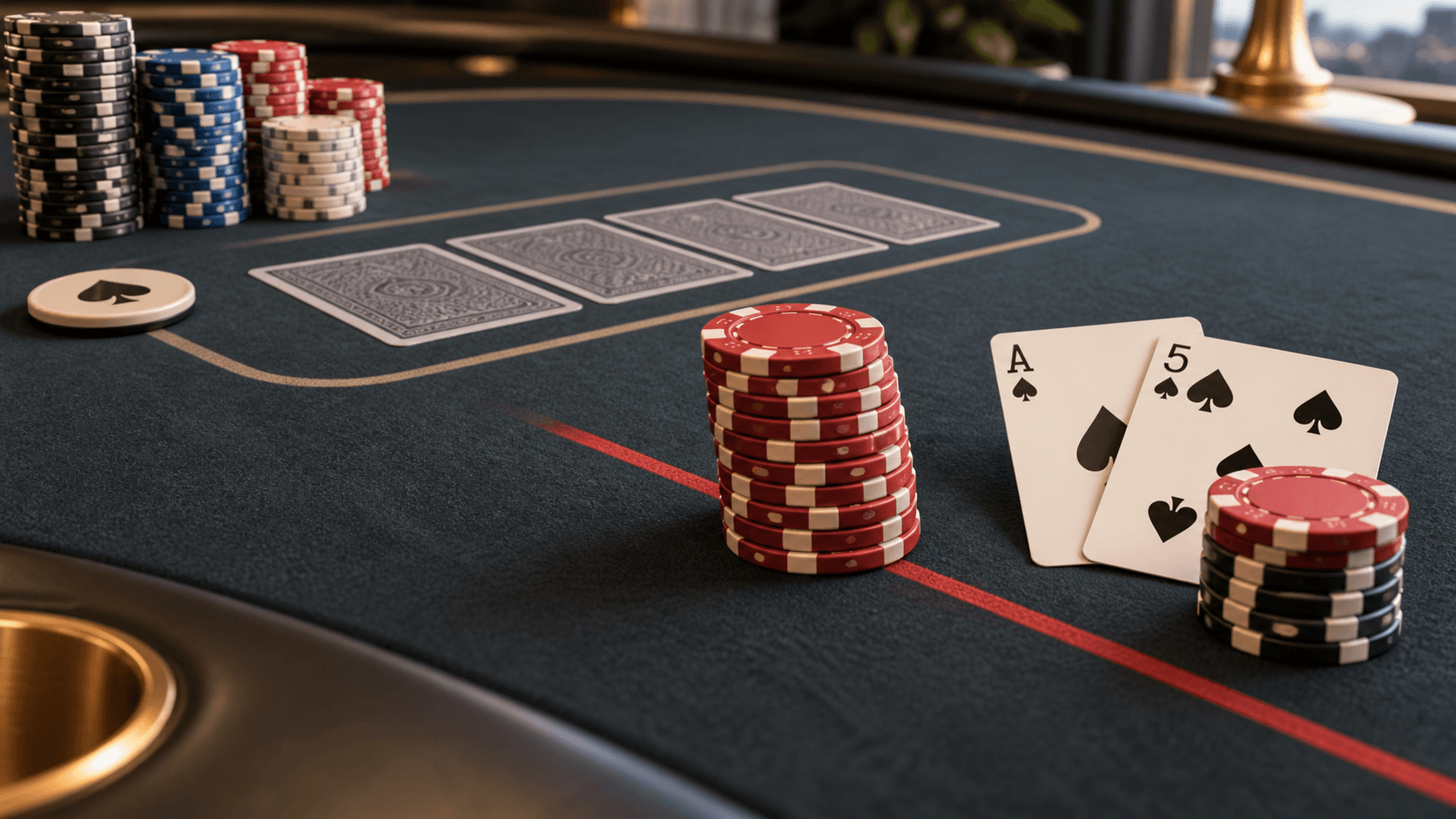
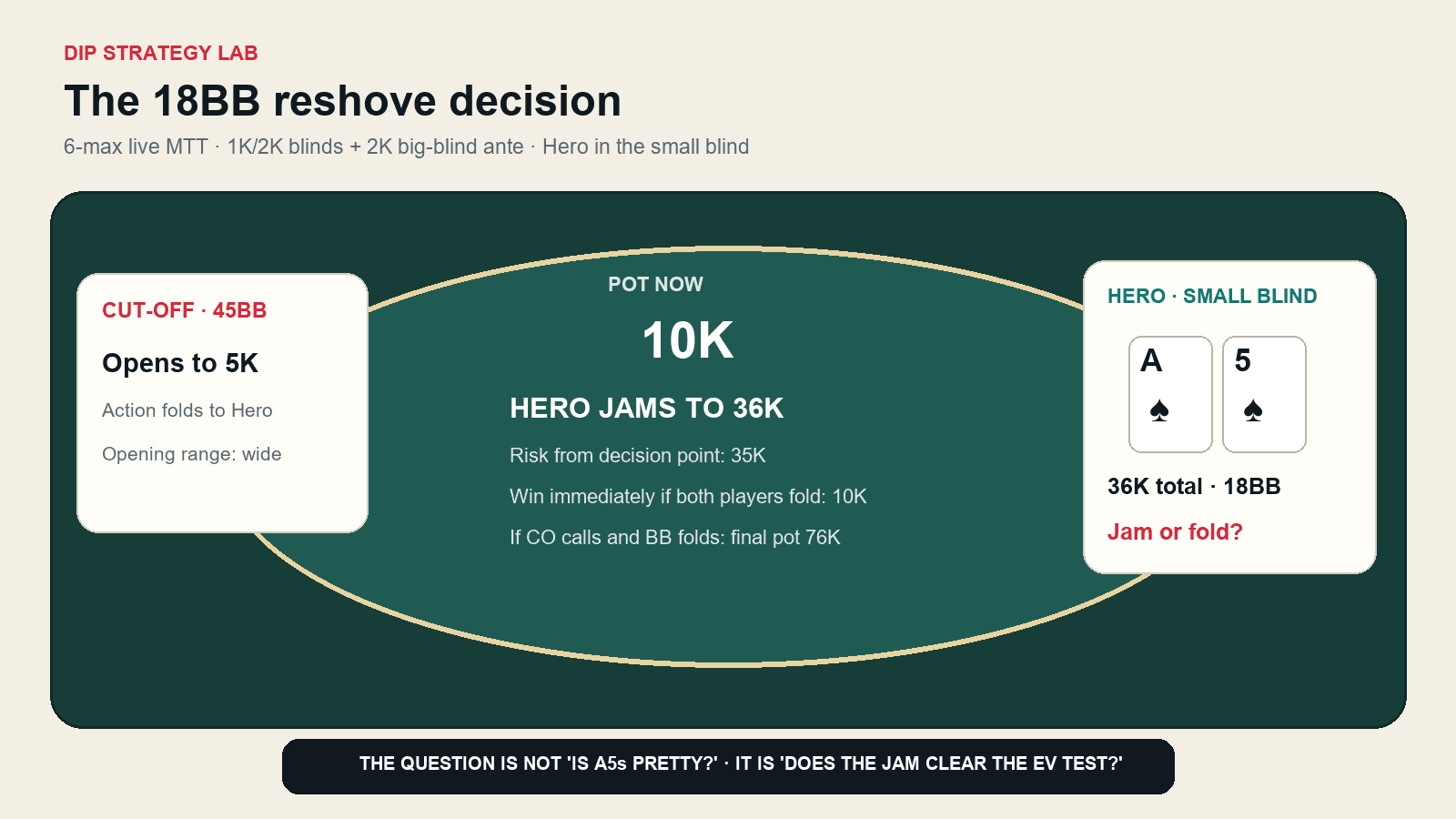
Six players remain at the table. Blinds are ₱1,000/₱2,000 with a ₱2,000 big-blind ante. The cut-off has 45BB and opens to ₱5,000. The button folds. Hero is in the small blind with A♠5♠ and ₱36,000 total, exactly 18BB. The big blind has 25BB and has not acted.
Before Hero acts, the pot is ₱10,000: the ₱1,000 small blind, ₱2,000 big blind, ₱2,000 big-blind ante and the cut-off's ₱5,000 raise. Hero has ₱35,000 behind after posting the small blind. The decision is jam or fold; calling is the third option we will test rather than assume.
Build the clean heads-up-called model first
Start with one simplifying assumption: if Hero jams, the big blind folds, and the cut-off either folds or calls. Hero adds ₱35,000 to make a total shove of ₱36,000. If the cut-off folds, Hero wins the ₱10,000 already in the middle.
If the cut-off calls, that player adds ₱31,000. The final pot is therefore ₱76,000: the original ₱10,000 plus Hero's ₱35,000 additional chips plus the cut-off's ₱31,000 call.
Measured from Hero's decision point, losing costs ₱35,000. Winning the called pot leaves Hero with ₱76,000 instead of the ₱35,000 that remained after folding, so the gain is ₱41,000.
The called branch can be written as:
Called EV = equity × ₱41,000 − (1 − equity) × ₱35,000
The same expression simplifies to:
Called EV = ₱76,000 × equity − ₱35,000
The fold-equity test
Let F be the probability that both players fold, and let e be Hero's equity when called. The full shove model is:
Shove EV = F × ₱10,000 + (1 − F) × (₱76,000 × e − ₱35,000)
Set the result to zero to find the break-even fold rate:
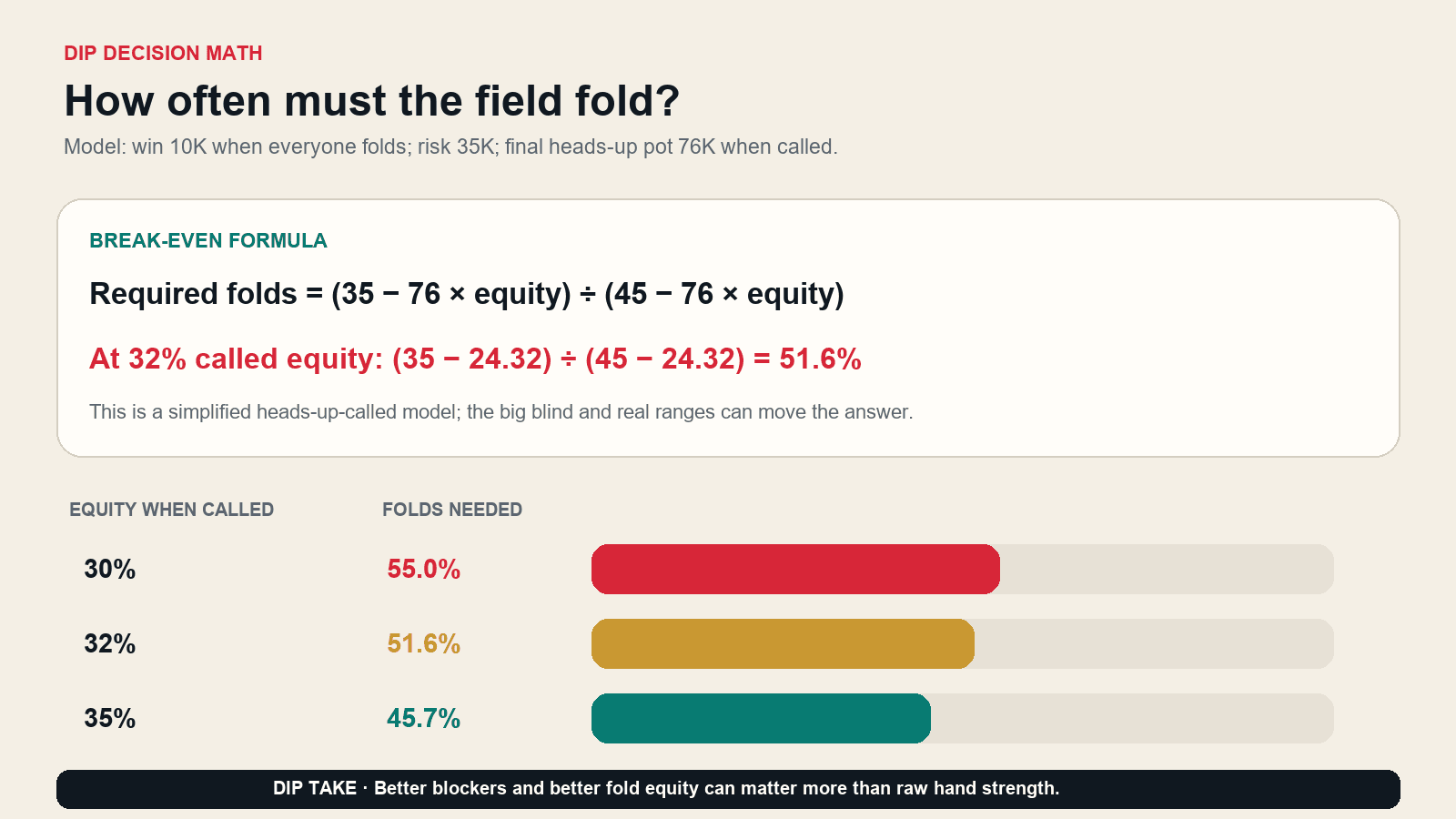
Required folds = (35 − 76 × e) ÷ (45 − 76 × e)
Use 32% as an illustrative called-equity estimate. This is not a universal A5s number; it represents one plausible result against a fairly strong calling range. At 32%, the formula becomes:
(35 − 24.32) ÷ (45 − 24.32) = 10.68 ÷ 20.68 = 51.6%
In that model, the shove needs the field to fold a little more than half the time. If Hero has only 30% equity when called, the requirement rises to 55.0%. At 35% equity it falls to 45.7%.
Why A5 suited can outperform its face value
A5 suited has two useful properties. First, the ace removes combinations of AA, AK and AQ from the opener's possible holdings. That does not guarantee a fold, but it slightly reduces the number of strong hands available to call. Second, when called, A5 suited can make a flush, wheel straight or two pair without being dominated in exactly the same way as many weak offsuit aces.
This is why raw hand rankings can mislead in reshove spots. A hand such as AJo appears stronger, but it is often in poor shape when a tight player calls with AQ, AK or big pairs. A5 suited accepts that it is usually behind while retaining cleaner ways to improve and applying a useful blocker.
The blocker is not magic. Against a player who opens tight and calls nearly every open, there may not be enough folds to buy. Against a cut-off who opens widely but continues only with a disciplined top range, the same blocker and dead money become much more valuable.
What calling creates
Calling ₱4,000 more from the small blind produces a pot of ₱14,000 before the big blind acts and leaves Hero ₱31,000 behind. If the big blind only calls, the flop pot becomes ₱16,000 and Hero's stack-to-pot ratio is about 1.94. Hero is out of position, can face a squeeze, and will miss a pair or strong draw on most flops.
That does not make calling forbidden. It can work when the big blind is passive, the opener plays poorly after the flop and the tournament structure rewards lower variance. But calling should be chosen for those reasons. It is not automatically the safe option; it often transfers a difficult preflop decision into an even harder low-SPR postflop decision.
The big blind is not a footnote
Our first calculation assumed the big blind folds. Real hands do not always cooperate. A strong or aggressive big blind lowers Hero's fold equity and can create a three-way all-in. If the big blind wakes up with a calling hand, the final pot grows, but Hero's equity can fall sharply against two ranges.
Before jamming, estimate two separate frequencies:
- How often does the cut-off open and then fold to an 18BB shove?
- How often does the big blind call after the open and the shove?
- Does either player call wider because of bounties, a satellite bubble or a short-handed payout jump?
- Is the opener's raise size a normal open or an unusual size that signals strength?
Do not multiply rough guesses and pretend they are precise. Use the model as a threshold. If your table read suggests the true fold rate is comfortably above the required rate, jamming becomes attractive. If it is close, the unmodelled big blind and ICM pressure deserve more weight.
When the reshove improves
- The cut-off opens many hands and has shown an ability to raise-fold.
- The big blind is tight and not incentivised to gamble.
- Hero's image is credible rather than visibly desperate.
- There is meaningful dead money from the ante and raise.
- The tournament is not at an extreme ICM point that makes survival unusually valuable.
When folding improves
- The opener uses a tight range or has already called short-stack shoves too wide.
- The big blind is a loose caller or covers both players in a bounty format.
- A satellite seat bubble makes losing catastrophic while gaining extra chips has limited value.
- Hero's equity when called is lower than the model because the calling range is exceptionally strong.
- The table is soft enough that waiting has clear future value and the shove is only marginal.
Common mistakes
- Looking at 18BB and deciding every suited ace is an automatic jam.
- Using a chart without adjusting for the opener's position and actual opening frequency.
- Forgetting that Hero has already posted ₱1,000 and therefore risks ₱35,000 from the decision point, not ₱36,000.
- Ignoring the big blind when estimating how often the field folds.
- Treating 32% called equity as a fact instead of a range-dependent assumption.
- Calling because it feels lower variance without planning for a shallow, out-of-position flop.
DIP's take
A5 suited is a candidate, not a command. In this exact chip-EV model, 32% called equity needs about 51.6% folds. That gives the live player a practical question: will the cut-off and big blind together release their hands more than half the time?
If the answer is clearly yes, the jam converts blockers, suited equity and ₱10,000 of dead money into pressure. If the answer is uncertain, tighten the assumed called equity, include the big blind, and let the threshold protect you from a pretty-looking but unprofitable shove.
Information verified: September 9, 2026. All calculations are DIP's original simplified chip-EV model; exact equities and tournament incentives vary with ranges, payout structure and format.
Responsible play notice: Poker involves financial risk. Tournament chips are not cash, and strategic edges do not remove variance. Set a budget before playing and never risk money needed for living expenses.