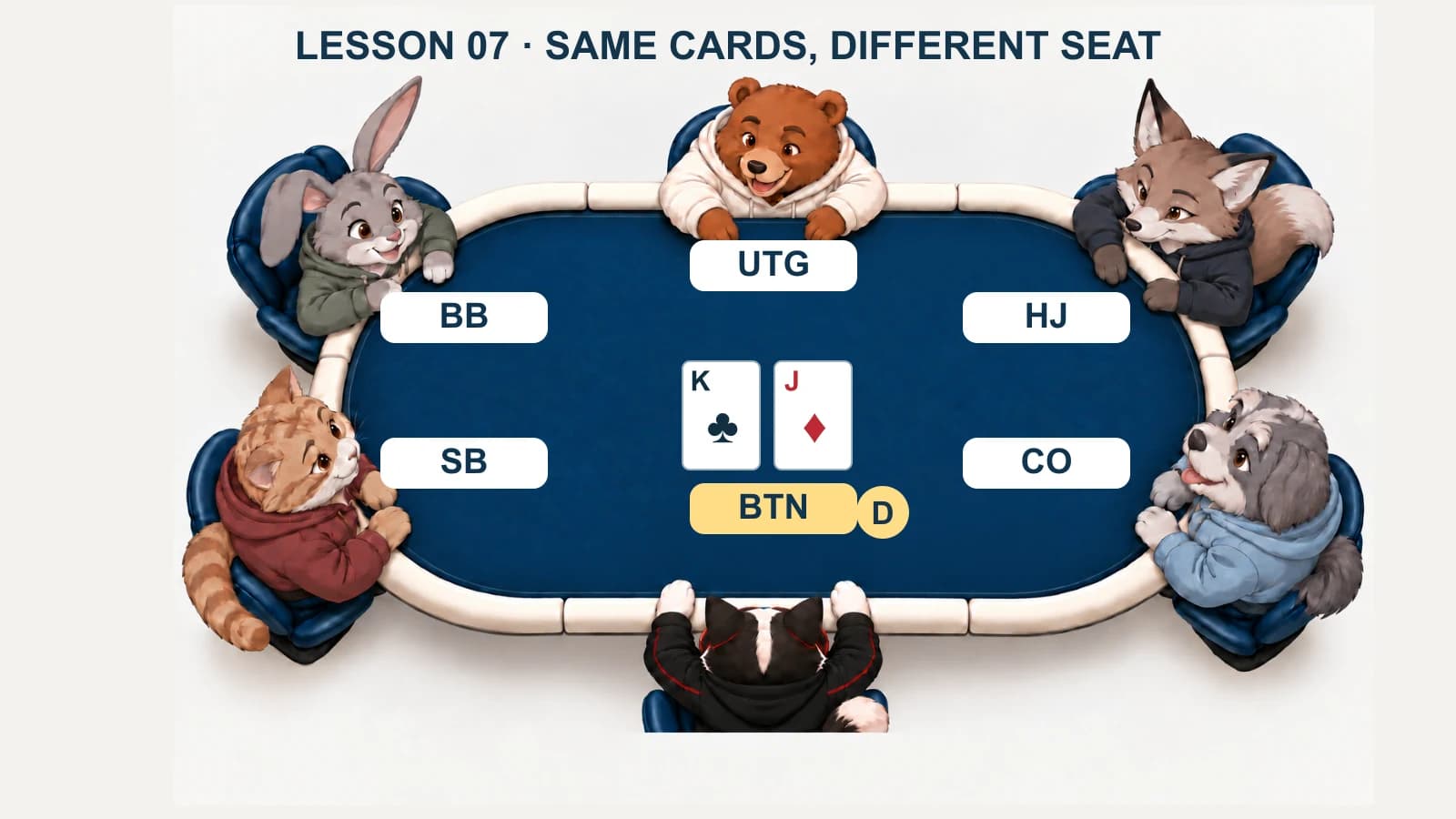
You have chosen a hand. Now how do you enter?
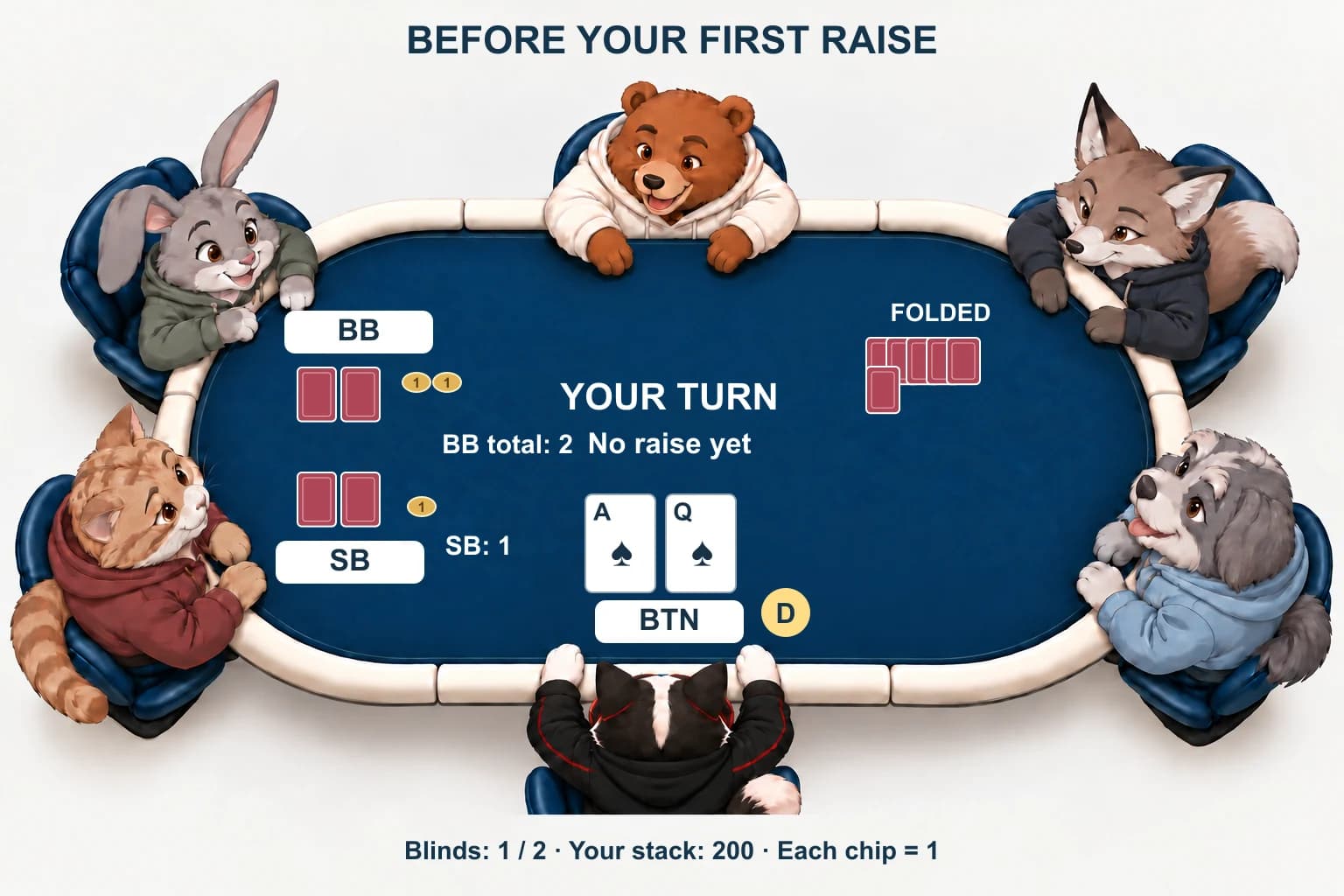
You are on the button with A♠ Q♠. The three players before you fold. The small blind and big blind still have cards. No community cards have been dealt.
You would like to play. You could match the big blind, or increase the amount everyone must match to continue. That increase is a raise.
When nobody has voluntarily entered before you and you make the first raise, we call it an open raise. The blinds are already in the pot, so “open” does not mean there are no chips on the table.
This lesson uses a simple raise-or-fold starting approach when the action reaches you in an unopened pot outside the small blind. It is a learning framework, not a claim that experienced players never enter by calling. Small-blind decisions will have their own lesson.
First look around
Check three things: is it your turn, has anybody already called or raised, and how many chips do you and your opponents have?
If somebody has already raised, you are facing a raise, not deciding whether to open. If somebody has only called the big blind, they have limped. Raising after a limper is different from the unopened-pot example below.
Our first open raise
At our six-seat practice table the small blind is 1 chip and the big blind is 2 chips. Every chip in the pictures is worth one practice unit. Each player began with 200 chips, or 100 BB. There is no ante or rake.
UTG, HJ and CO fold. You are BTN with A♠ Q♠ and have not put anything in yet. SB has posted 1 and BB has posted 2, so there are 3 chips in the pot.
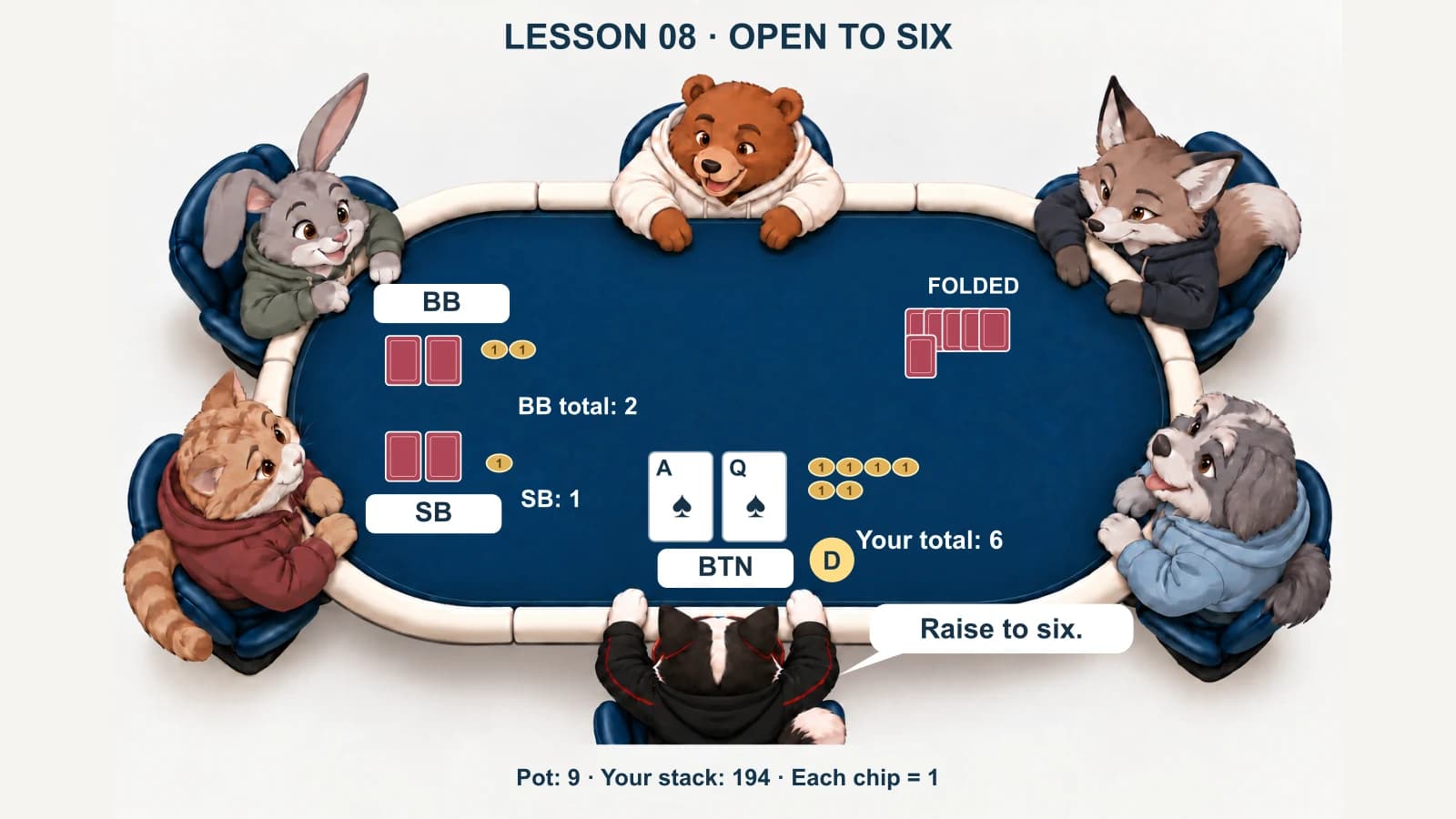
You announce, “Raise to six.” You put 6 chips in front of your seat. Since the big blind is 2, six chips is 3 BB.
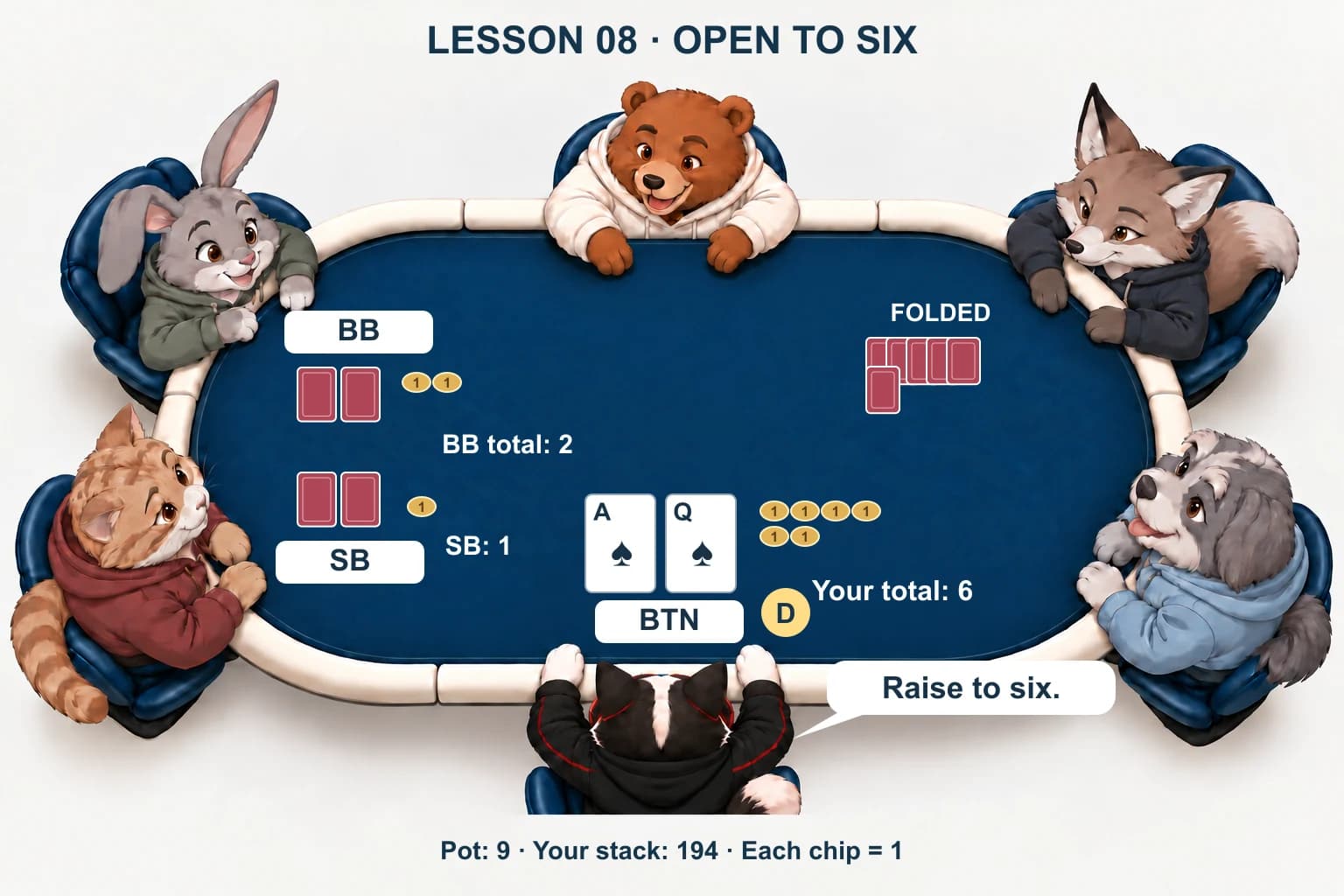
You now have 194 chips left. The pot contains 9 including the blinds. You did not put in 2 and then another 6; your total contribution is 6.
At a live table, make your intended total clear before moving chips and follow the dealer's procedure. Avoid saying “six more” when you mean “six total.”
Why raise rather than just match two?
A raise asks the blinds to pay more, raise again, or fold. Sometimes both fold and you win their posted chips without a flop.
If someone calls, you have built a pot with a hand you selected deliberately. On the button, you also act after the blinds on later betting rounds.
None of this makes ace-queen unbeatable. You can miss the flop, and an opponent can have a stronger starting hand. Opening is not a promise to keep betting or calling forever.
Three alternative responses
Each example below starts after your raise to 6. These are separate branches, not consecutive actions. Do not add their pots together.
A: both blinds fold
SB and BB fold. The hand ends before the flop. You receive all 9 chips: your own 6 comes back with the blinds' 3. Your stack becomes 203, a net gain of 3, not 9.
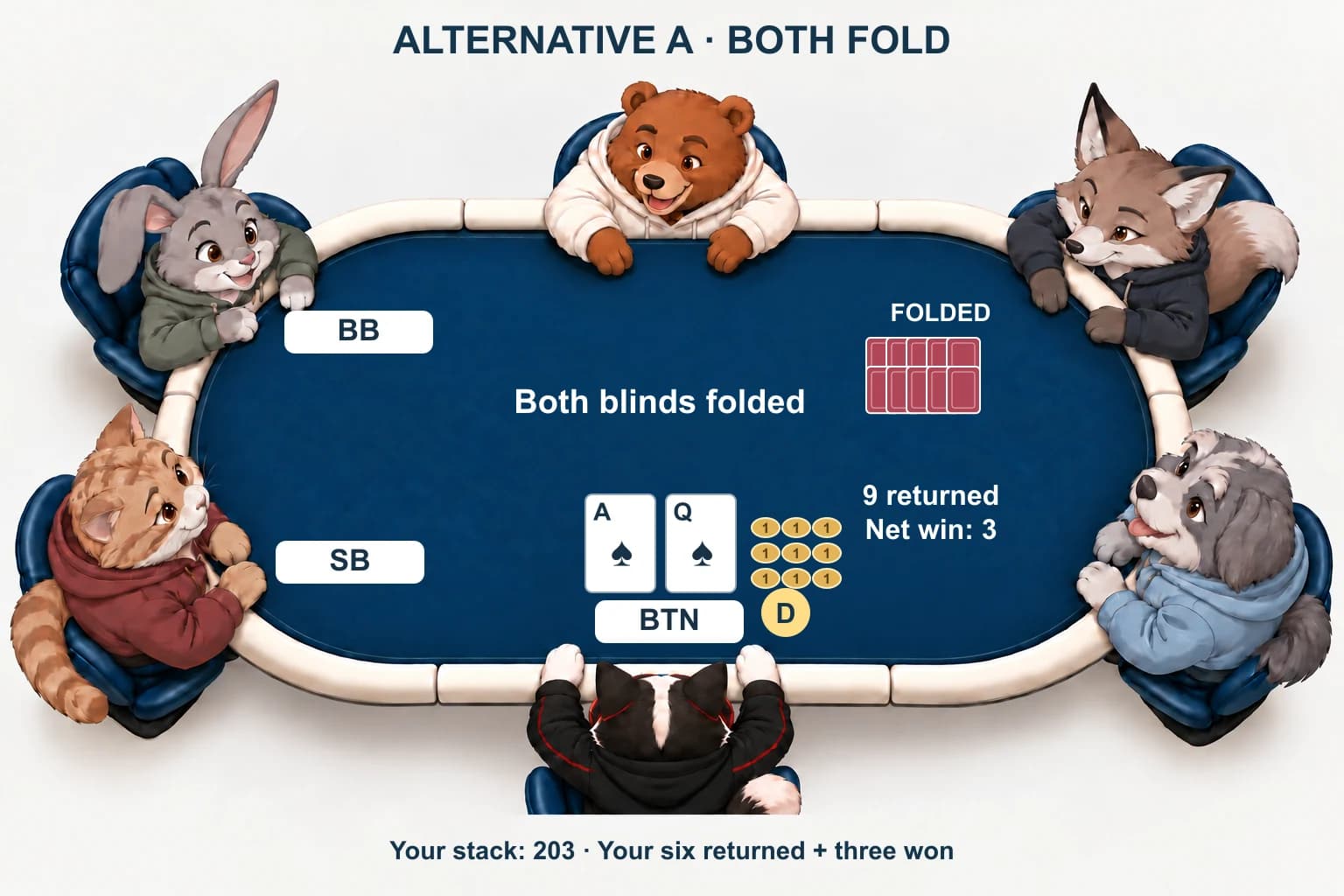
Receiving a pot is not the same as winning the entire pot amount as profit.
B: SB folds and BB calls
BB has already posted 2. To match your total of 6, BB adds 4, not another 6. The pot is now 13: your 6, BB's 6 and SB's folded 1.
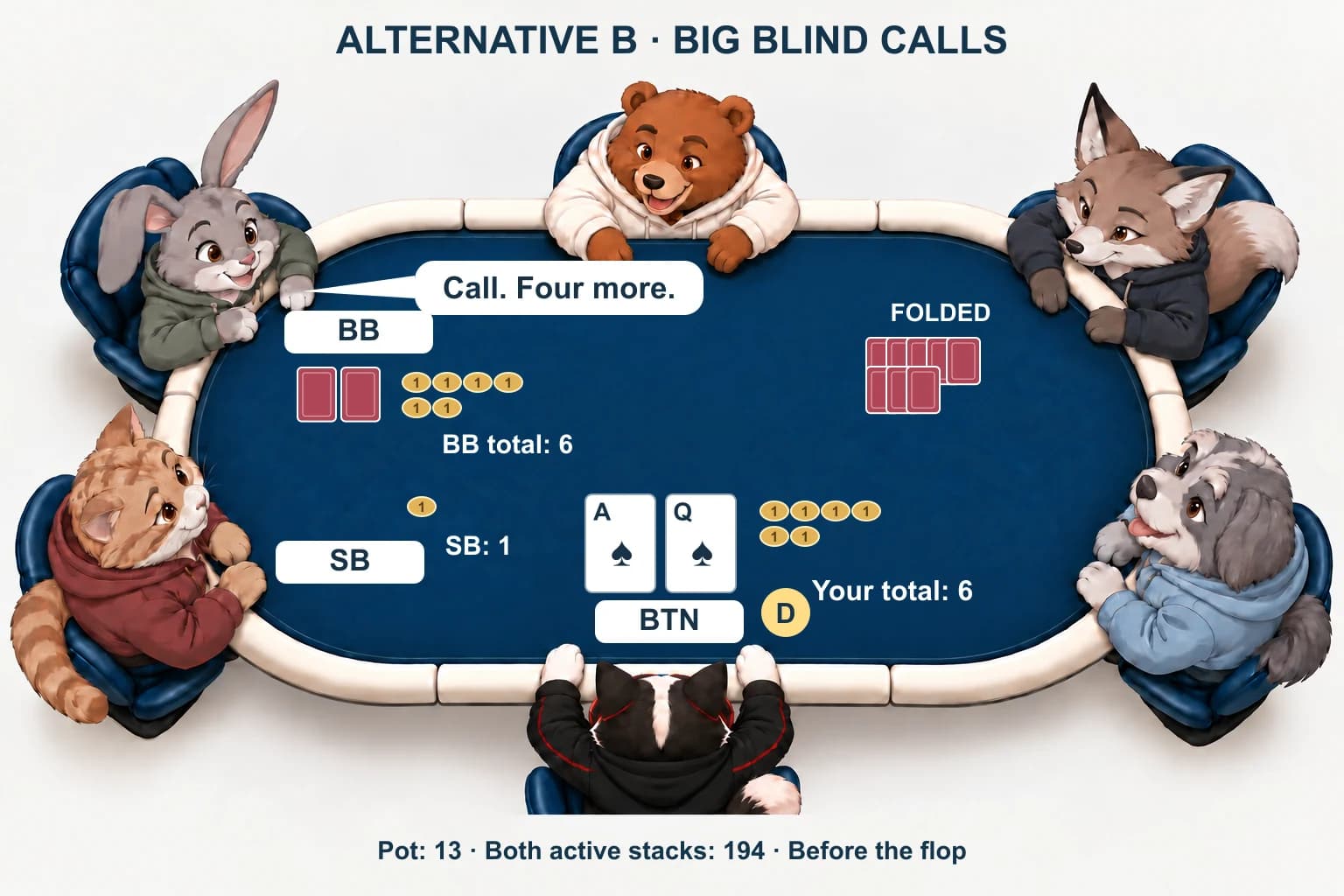
Three community cards are dealt next. BB acts first on the flop and you act second. Your preflop raise does not change that order. Look at the board and BB's action before deciding; you do not have to bet every flop.
C: SB folds and BB raises to twenty
BB increases their total from 2 to 20 by adding 18. Your 6 is still committed. You would need another 14 to call and match BB's total.
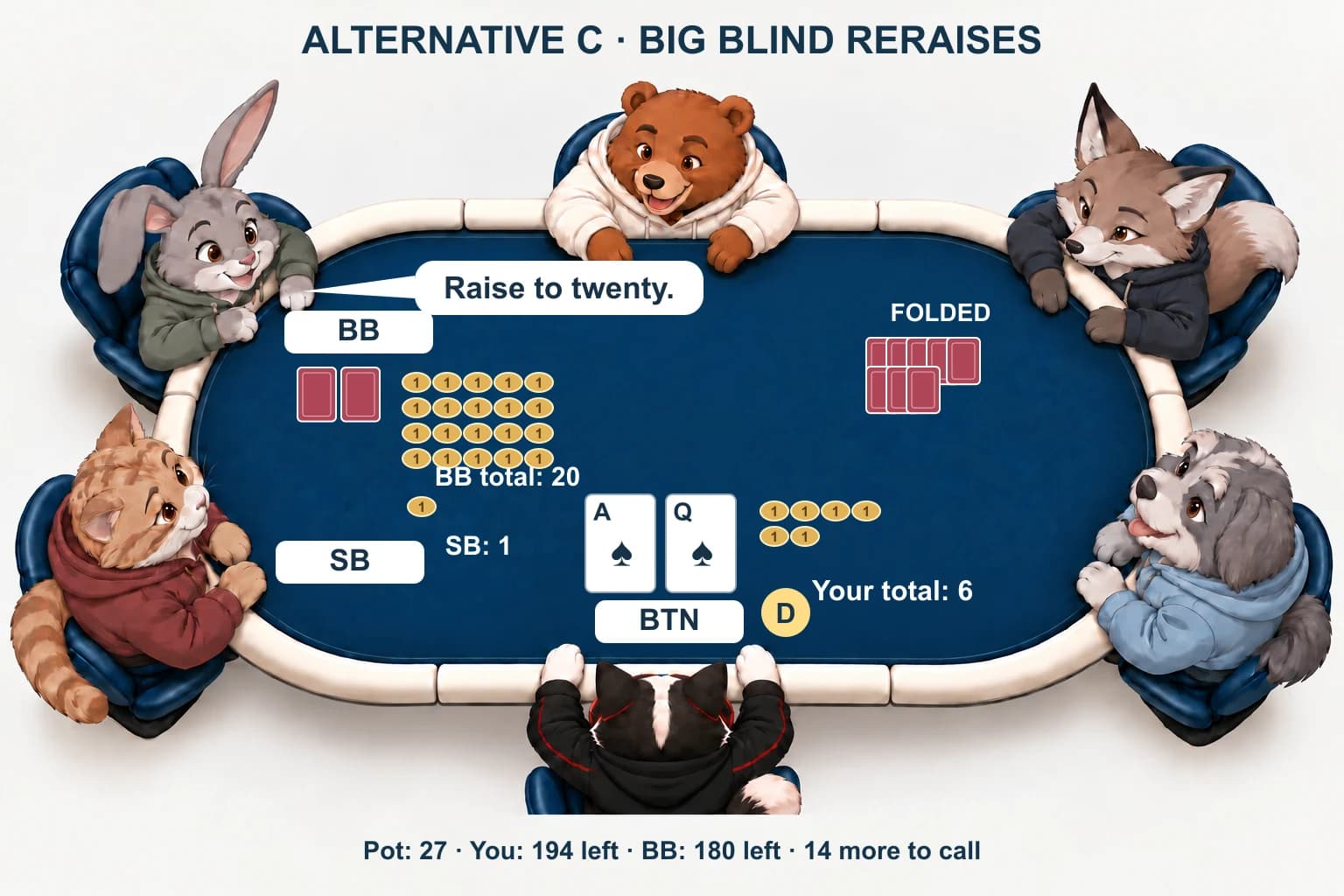
You can fold, call, or make a legal further raise. Folding leaves you with 194 and surrenders the 6 already committed. The fact that you opened does not oblige you to call.
We study facing a raise in the next lesson. For now, recognise that the price has changed, so you have a new decision.
Is three BB always the right opening size?
No. We used 3 BB to make the example easy to follow. Different stack sizes, antes, positions and opponents can call for different choices. It is not a universal recommendation for every game.
For your first practice sessions, use an agreed example size and concentrate on acting in turn, announcing the total and counting what remains. Do not automatically bet bigger because you are excited or smaller because you are nervous.
You also do not have to open every time it folds to you. Your cards, position and the players still to act all matter. Folding an unsuitable hand is normal.
One quick question: how many BB?
This is a new example with different blinds. The small blind is 2 chips and the big blind is 4 chips. Each pictured chip is worth one unit.
UTG, HJ and CO fold. On the button, DIP Cat announces, “Raise to eight,” and puts in 8 chips in total. The blinds have not responded yet.
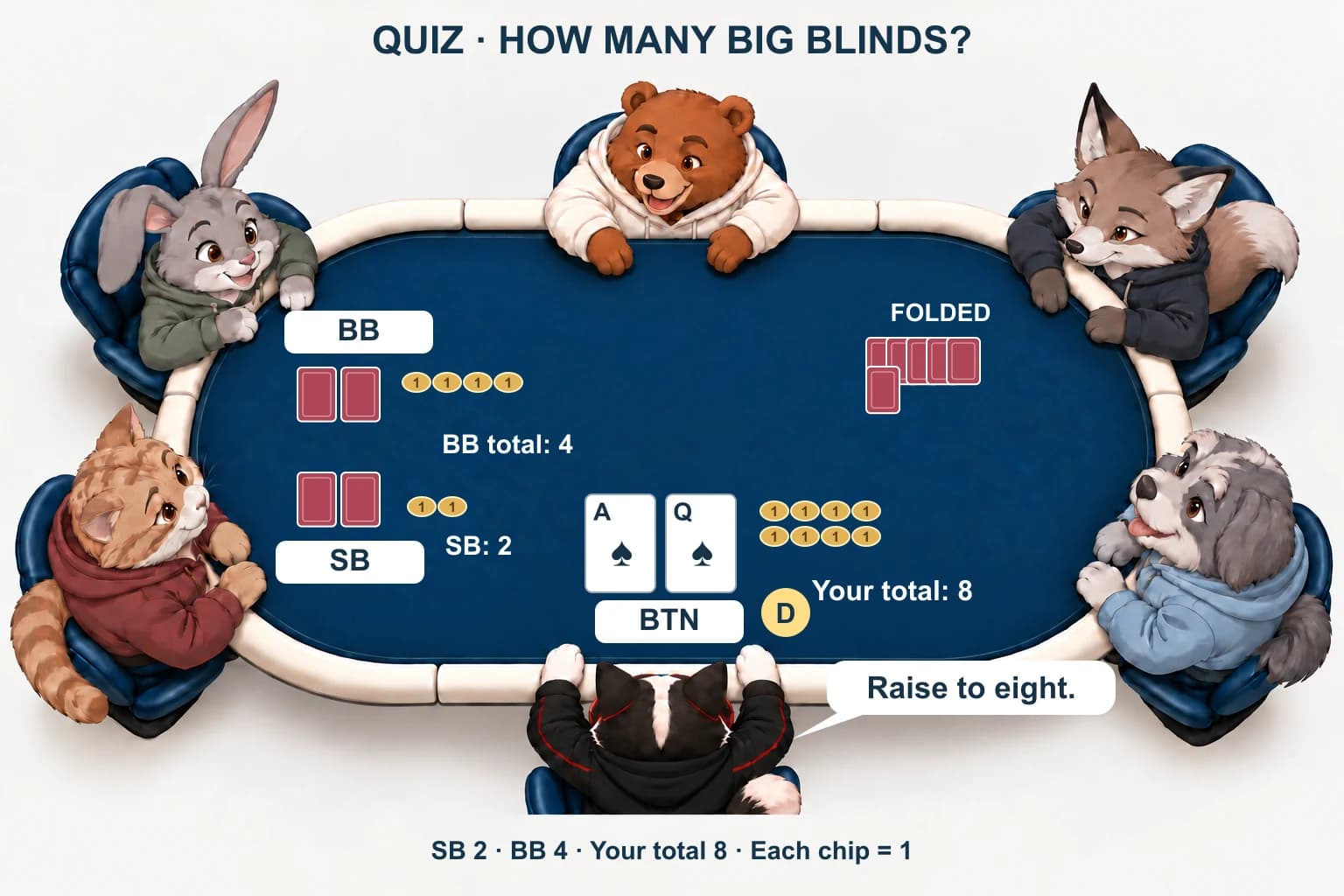
How many BB did DIP Cat open to?
- ① 2 BB
- ② 4 BB
- ③ 8 BB
Show answer 1Hide answer 1
① 2 BB. One big blind is 4 chips, so 8 ÷ 4 = 2 BB.
Eight is the total raise amount, not eight extra on top of a blind. DIP Cat is on the button and had not posted a blind. The small blind's two chips do not define the BB unit.
Words you can now recognise
- Unopened pot: nobody has voluntarily entered yet; posted blinds can still be there.
- Open raise: the first raise used to enter that unopened pot.
- Limp: enter by calling the big blind instead of raising.
- Raise to: your total contribution on the current betting round.
- Call amount: the extra needed to match the highest current total after subtracting what you already contributed on that round.
DIP's takeaway
Choose the hand, check the pot is unopened, announce a clear total and watch the response. Winning the blinds, seeing a flop and facing a new raise are different outcomes. An open raise starts a decision process; it does not finish one.
Practise with play chips. Real-money play is unnecessary for learning. If you choose to play for money, follow local eligibility rules, set limits before sitting down and never treat poker as guaranteed income.