Same cards. A different decision.
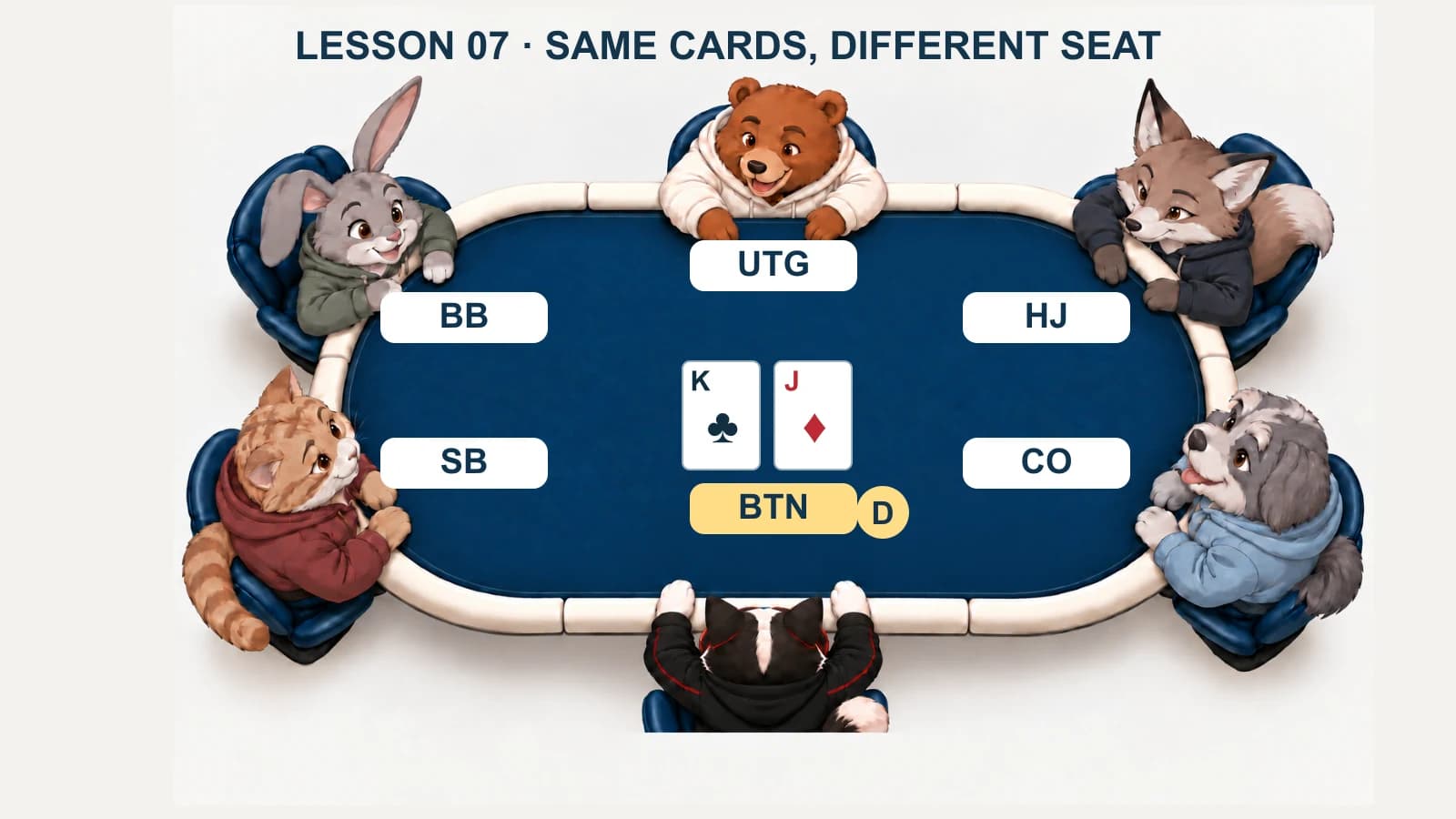
You look down at K♣ J♦, a king and a jack of different suits. Should you play?
Before deciding, look around. Has anyone already called or raised? How many players still get to act after you? And who will act first after the flop?
We will compare the same cards in two different seats. These are separate starting situations, not a player changing seats during one hand.
First, find the button
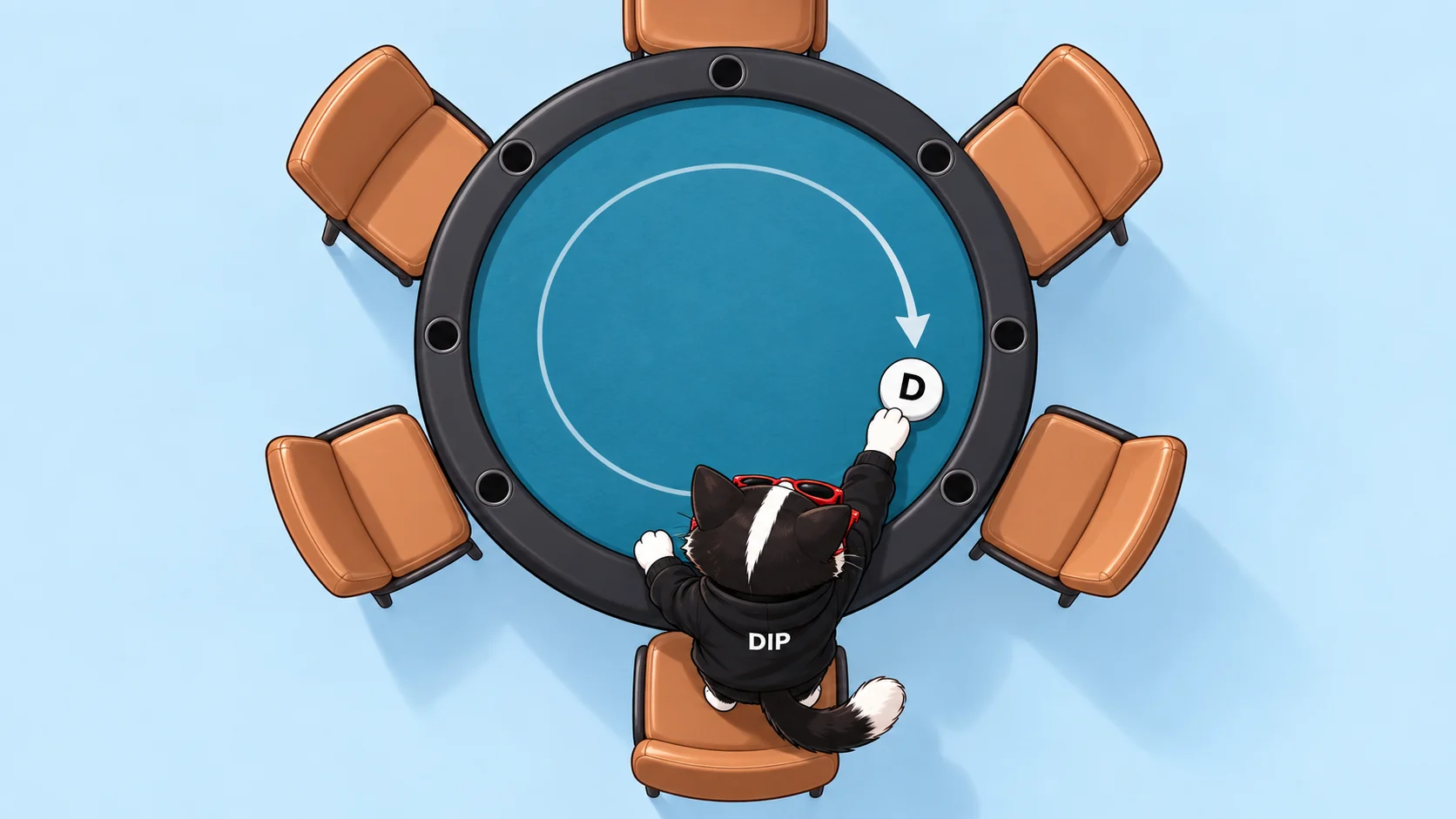
Our teaching table has six seats. The small round marker labelled D is the dealer button. The player beside it occupies the button position, or BTN. The marker moves around the table between hands, so your physical chair does not always have the same position.
Moving clockwise from the button, the next seats are small blind (SB), big blind (BB), under the gun (UTG), hijack (HJ) and cutoff (CO).
Before the flop, the first decisions go in this order: UTG, HJ, CO, BTN, SB, BB. If somebody raises, players who already acted may face another decision.
Do not worry about memorising six abbreviations at once. Find your seat and count who still has a decision.
Situation one: five players still have a say
You are UTG, the first player to act before the flop. All six players began with 100 big blinds. You hold K♣ J♦. Nobody has folded, called or raised yet.
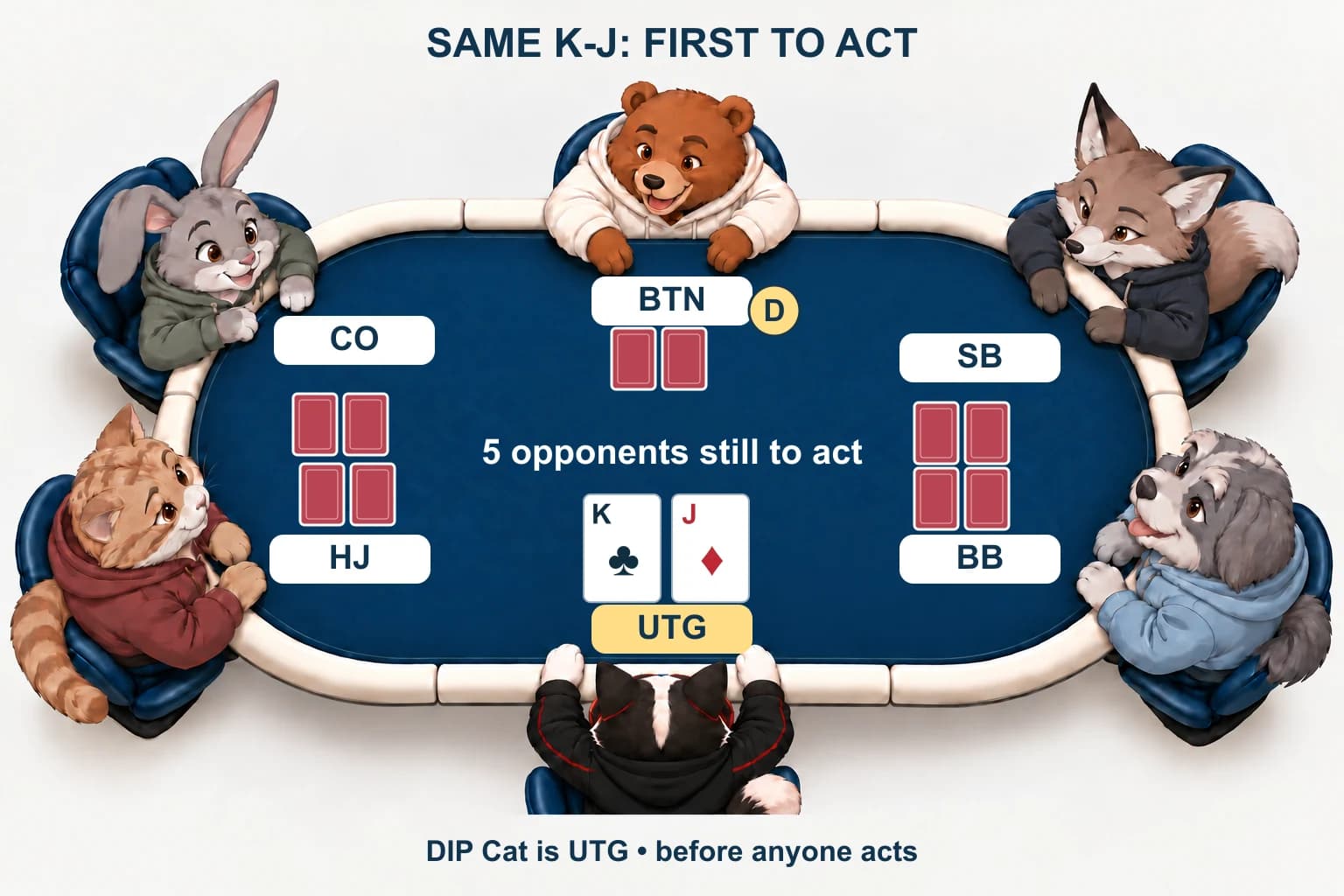
Five opponents can still wake up with a better hand, call you, or raise. If several players continue, one pair becomes harder to rely on.
Your king-jack is not worthless. But there are more unknown decisions ahead of you, and you may have to act before opponents on later streets. A complete beginner can reasonably fold this marginal offsuit hand in this situation. That is a cautious learning choice, not a rule that K-J must always fold UTG in every six-seat game.
Why a king does not always rescue king-jack
Look at this separate comparison. You hold K♣ J♦; an opponent holds A♠ K♦. The flop is K♥ 8♠ 3♣.
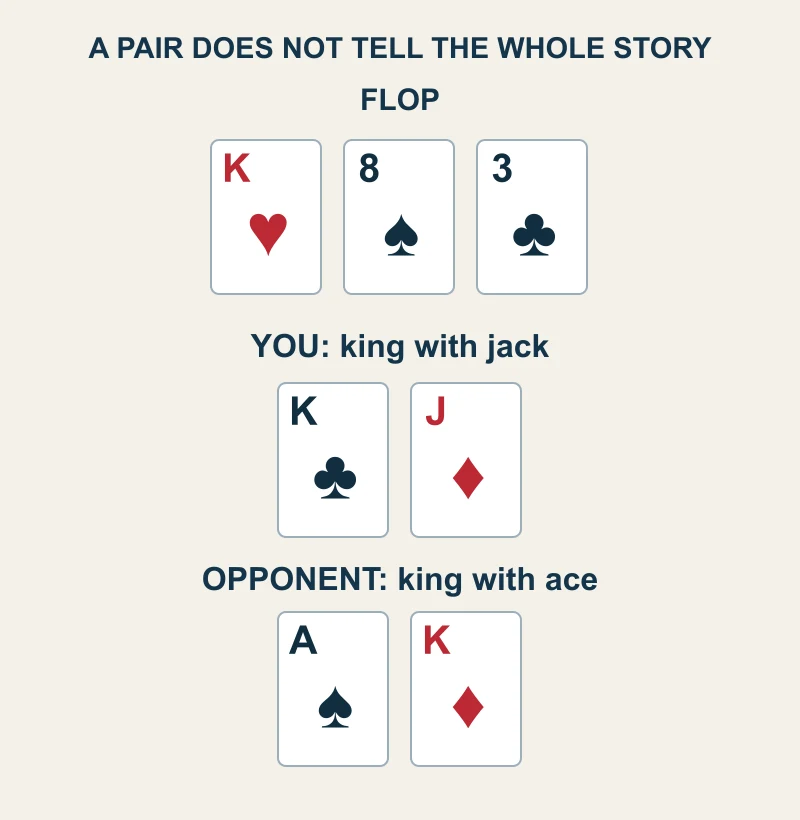
You both paired the king. Your current five-card hand is K-K-J-8-3; theirs is K-K-A-8-3. The ace beats the jack in the comparison. This accompanying card is called a kicker.
You can still improve later, so the hand is not over. The point is that a card which looks helpful can improve you and still leave you behind. This is one reason to be cautious about entering with hands that can make second-best pairs.
Situation two: only the blinds remain
Now consider a different hand. You are on the button with the same K♣ J♦ and the same starting stack. UTG, HJ and CO have all folded. Only SB and BB are left to act after you.
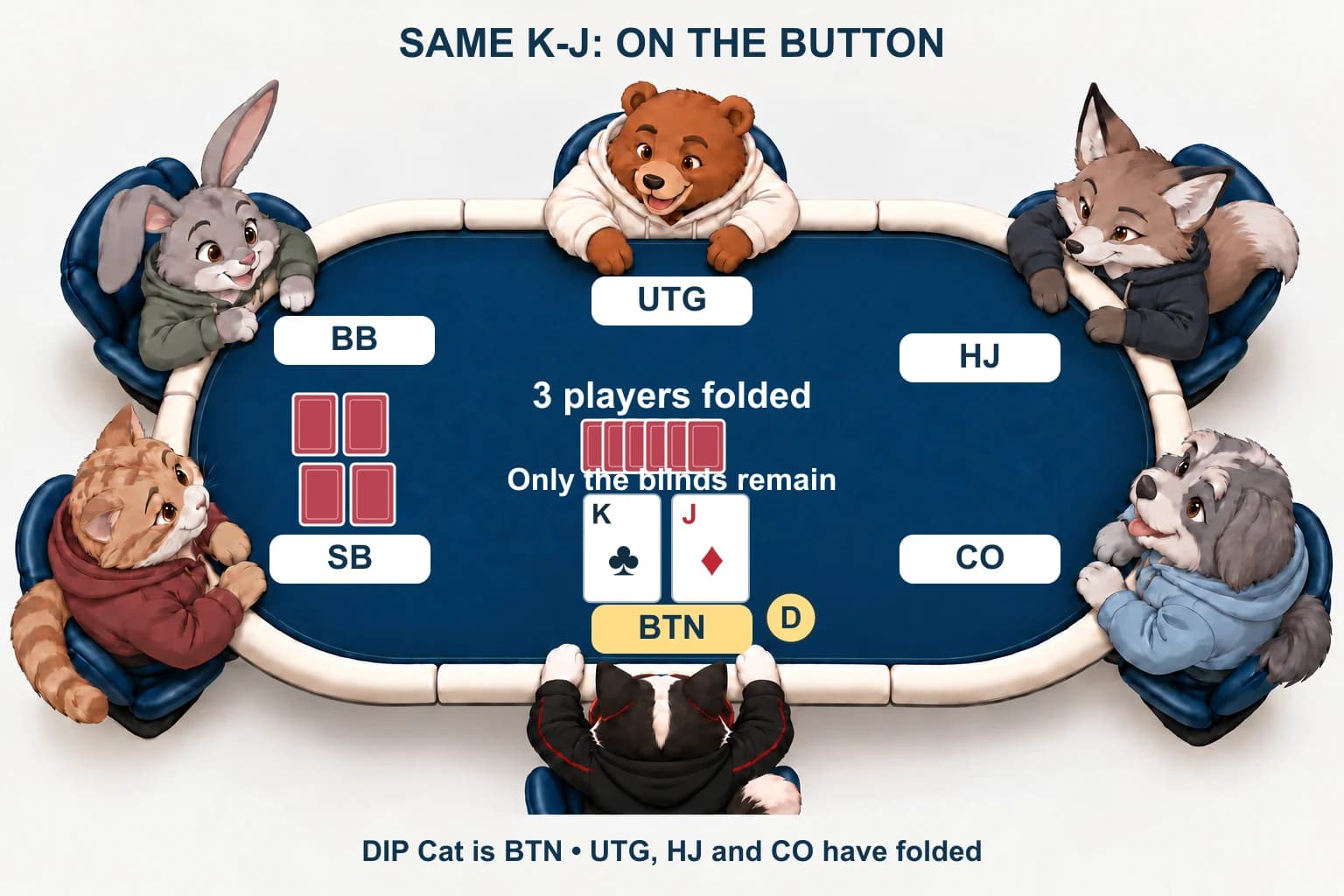
Those folds matter. You no longer need to get through five unknown decisions. You might win the blinds immediately if both remaining players fold to your raise.
There is another advantage. If either blind calls, you will act after that opponent on the flop, turn and river. You can see what they do before deciding.
This makes king-jack a reasonable candidate to open from the button when everyone folds to you. An open here means entering the unopened pot with a raise. It does not mean you must keep playing if somebody raises again.
Players can generally choose more starting hands from the button than from an early seat. More does not mean every hand, and position does not guarantee a win.
Follow the button example onto the flop
Use play chips measured in big blinds (BB). Six seats, 100 BB starting stacks, no ante and no rake. The following amounts are for this example, not a compulsory betting formula.
1. UTG, HJ and CO fold. 2. You raise to 2.5 BB in total with K♣ J♦ on the button. 3. SB folds. Their posted 0.5 BB stays in the pot. 4. BB has already posted 1 BB, so adds 1.5 BB to call.
You and BB have each contributed 2.5 BB, leaving 97.5 BB each. The pot is 5.5 BB: your 2.5, BB's 2.5 and the folded small blind's 0.5.
The flop comes K♥ 8♠ 3♣. Unlike the earlier card comparison, you do not know BB's private cards in this hand. You have a pair of kings, but you do not yet know whether it is best.
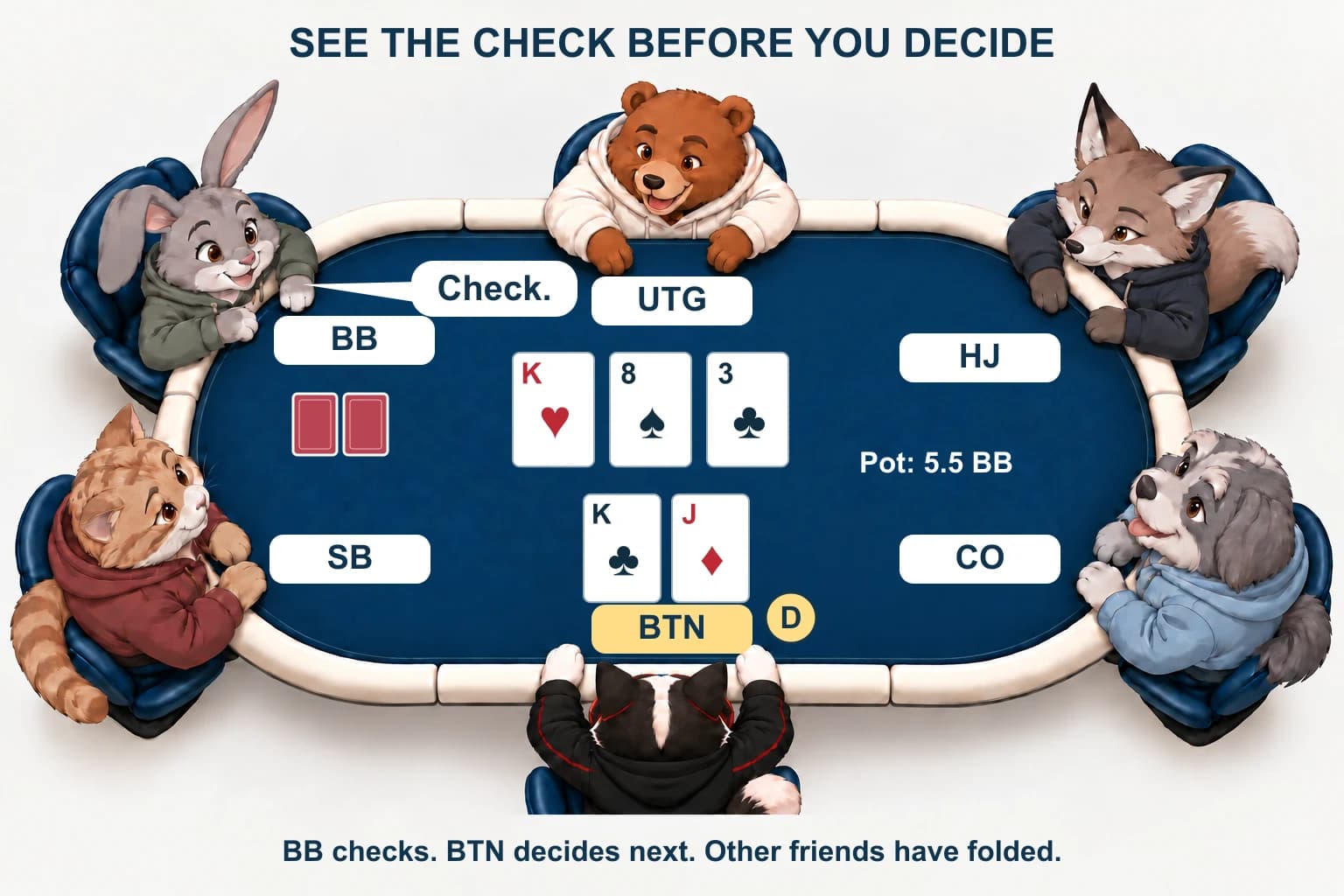
BB checks. That means they place no new bet and pass the action. It does not prove they are weak. Now you can check behind, ending this betting round, or bet and give BB another decision.
Imagine instead that BB had bet. You would see the bet amount before choosing whether to fold, call or raise. These are alternative situations: a check does not automatically get followed by a bet from that same player.
In both situations the advantage is the same: you receive information about BB's action before committing to yours. We are not choosing the best flop bet today. We are learning why acting later helps.
Position is information, not magic
You cannot see an opponent's private cards just because you act last. A strong hand can check and a weak hand can bet. Their action is a clue, not proof.
On a full six-seat table, the button has the strongest position after the flop because it acts last whenever it remains in the hand. The small blind has the weakest position by that same action-order measure: if still playing, it acts first.
That does not mean the small blind always loses, or that it must fold every hand. We are comparing the information available when making decisions, not guaranteeing results or ranking every seat by profit.
The big blind illustrates an important difference. It acts last in the initial preflop sequence, but before the button after the flop. Acting late before the flop does not necessarily give you position for the rest of the hand.
What if someone has already entered?
Our button example requires UTG, HJ and CO to fold. The posted blinds do not stop a pot being called unopened; nobody has voluntarily called or raised yet.
If UTG raises instead, that is a different situation. Being on the button does not cancel their raise or make calling automatically sensible. A hand you might open with is not automatically a hand you should call a raise with.
Similarly, someone who calls the big blind, known as limping, has not folded. Do not count that player out. We will study opening and facing raises in the next lessons.
One question: which seats help and hurt?
Consider this six-seat table. Assume all six players remain in the hand, and judge the seats by their usual action-order advantage after the flop, not by the cards they hold.
Which position is generally the most favourable, and which is the least favourable? Name both before opening the answer.
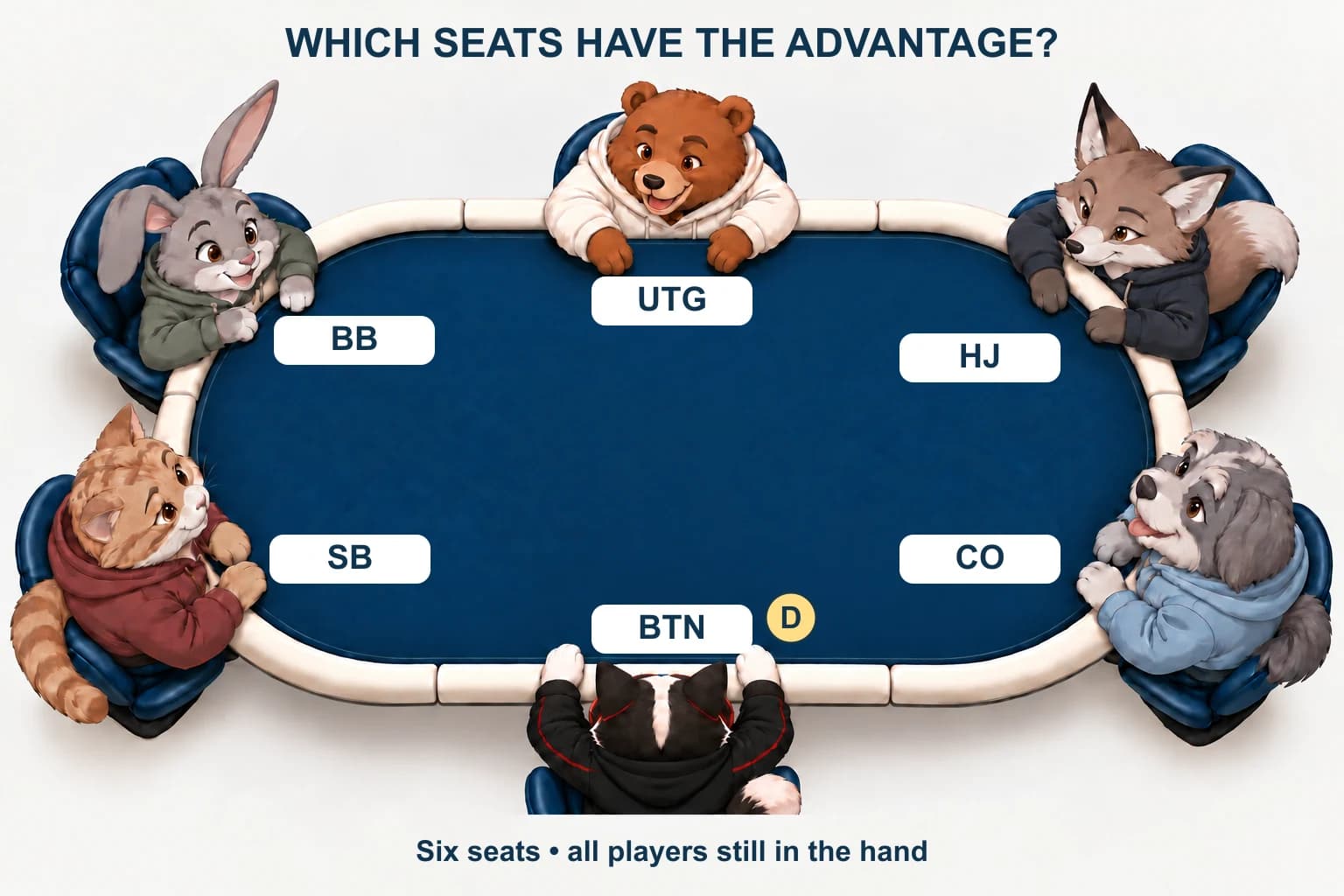
The choices are button (BTN), small blind (SB), big blind (BB), under the gun (UTG), hijack (HJ) and cutoff (CO).
Show answer 1Hide answer 1
Most favourable: the button (BTN). It acts last after the flop, so it sees the other remaining players' actions before deciding.
Least favourable by this action-order measure: the small blind (SB). If it is still in the hand, it acts first after the flop, before seeing how the others respond.
This answer assumes the six-seat situation shown. It is about position, not a promise that BTN wins or SB loses. If a player folds, they take no further actions in the hand.
Small glossary
- Early position: a seat near the start of the preflop action order.
- Button: the position beside the dealer marker; last to act after the flop.
- In position: acting after a particular opponent on a betting round.
- Unopened pot: nobody has voluntarily called or raised before your turn.
- Kicker: an accompanying card that can break a tie when it is part of your best five cards.
DIP's takeaway
Do not ask only, “Are these good cards?” Ask, “Are these good cards for this seat and the action so far?”
Find the button, check who has entered, and count who still has a decision. The same K-J can be uncomfortable first to act and a reasonable opening candidate when everyone folds to your button.
Practise with play chips. You do not need to risk money to learn these decisions. If you choose real-money play, follow local eligibility rules, set limits and never borrow or chase losses.