

DIP Hold’em Starter Course — Lesson 01 of 20
Start here: even if you have never held a playing card
When you first watch Texas Hold’em, unfamiliar terms such as “raise,” the cards on the table, and the movement of chips can make it hard to know what to pay attention to. This lesson explains each part step by step. You do not need to know card names, poker hand rankings or betting rules before you begin.
We will start with the deck, separate your private cards from the shared cards, and reveal the shared cards in four separate pictures. Only then will we look at the combinations that make a winning hand. Read slowly. Point at the pictures. There is no need to memorise every new word on your first visit.
Texas Hold’em is one type of poker, not another name for every poker game. Other types, including Omaha and stud, use different dealing or hand-building rules. Here we are learning ordinary Texas Hold’em with a standard 52-card deck. You can practise with cards and counters without playing for money.
1. What is in a deck of cards?
A deck is one complete set of playing cards. In this game it contains 52 cards, without jokers. Each card has two identifiers: a rank, shown as a number or letter, and a suit, shown as a symbol. Think of these as two separate labels, not two separate scores.
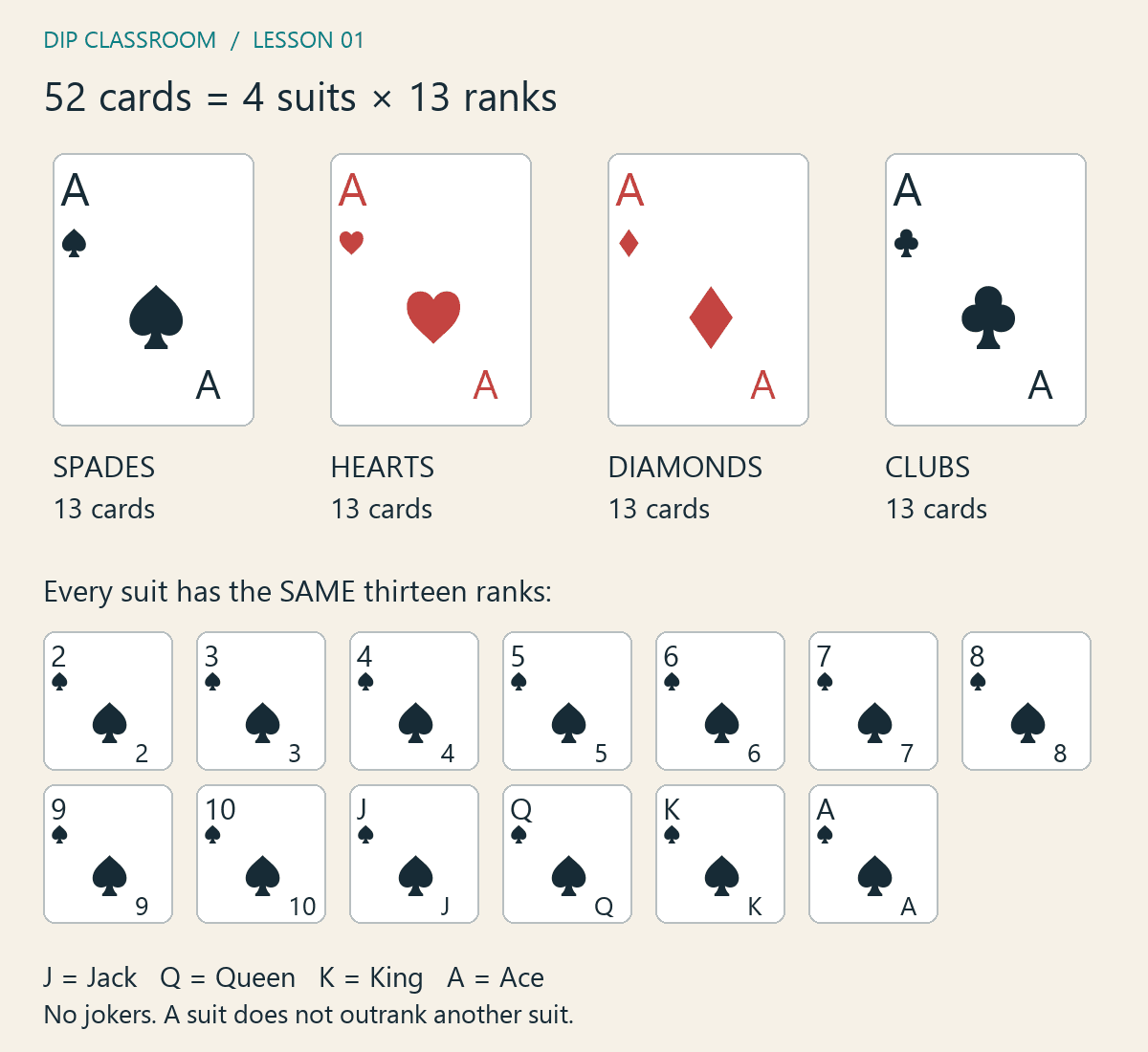
The four suits are spades ♠, hearts ♥, diamonds ♦ and clubs ♣. Hearts and diamonds are red; spades and clubs are black. The colour alone is not a suit: a heart and a diamond are two different suits even though both are red. The same is true of a spade and a club.
Each suit contains 2, 3, 4, 5, 6, 7, 8, 9, 10, J, Q, K and A. J means jack, Q means queen, K means king, and A means ace. J, Q and K often carry human portraits on physical cards; those pictures do not add a special power. Our teaching cards use large letters and symbols so they stay easy to read.
There are four aces in the deck: A♠, A♥, A♦ and A♣. They share a rank but are four different cards. There is only one A♠ in a single standard deck. If A♠ is in your hand, no opponent can hold that exact card and it cannot also appear on the table.
For ordinary rank comparisons, ace is highest, followed by king, queen, jack, 10 down to 2. An ace can also serve as the low end of the specific straight A-2-3-4-5. You cannot wrap a straight around the ace, such as Q-K-A-2-3. We will revisit this in Lesson 02. No suit automatically beats another suit: spades do not outrank hearts.
DIP’s first checkpoint: when you see K♦, say “king of diamonds.” The K tells you its rank; the diamond tells you its suit. Do not worry yet about whether you should bet with it.
2. Your two cards are private; the middle cards are shared
At the start of a deal, each player receives two cards face down. These are private cards, also called hole cards. You may look at your own two cards without showing them to the other players. They may look at theirs. You cannot normally see what they have.
As the deal progresses, up to five cards are placed face up in the centre of the table. Face up means their ranks and suits are visible. These are community cards: every player still competing in the deal can use the same cards. They stay in the centre. Players do not take a community card into their own hands or divide the five cards between them.
By the river, you have seven cards available for choosing a hand: your two private cards plus the five shared cards. An opponent has their own two private cards plus those same five shared cards. You cannot use the opponent’s private cards.
Our pictures keep you at the bottom and the opponent at the top. Your cards are drawn face up so you can study them; that does not mean you should expose them to opponents in a real deal. The opponent’s red card backs mean their cards are unknown to you. This is a simplified two-player view of the cards, not a lesson on seating order.
3. Before the shared cards: PREFLOP
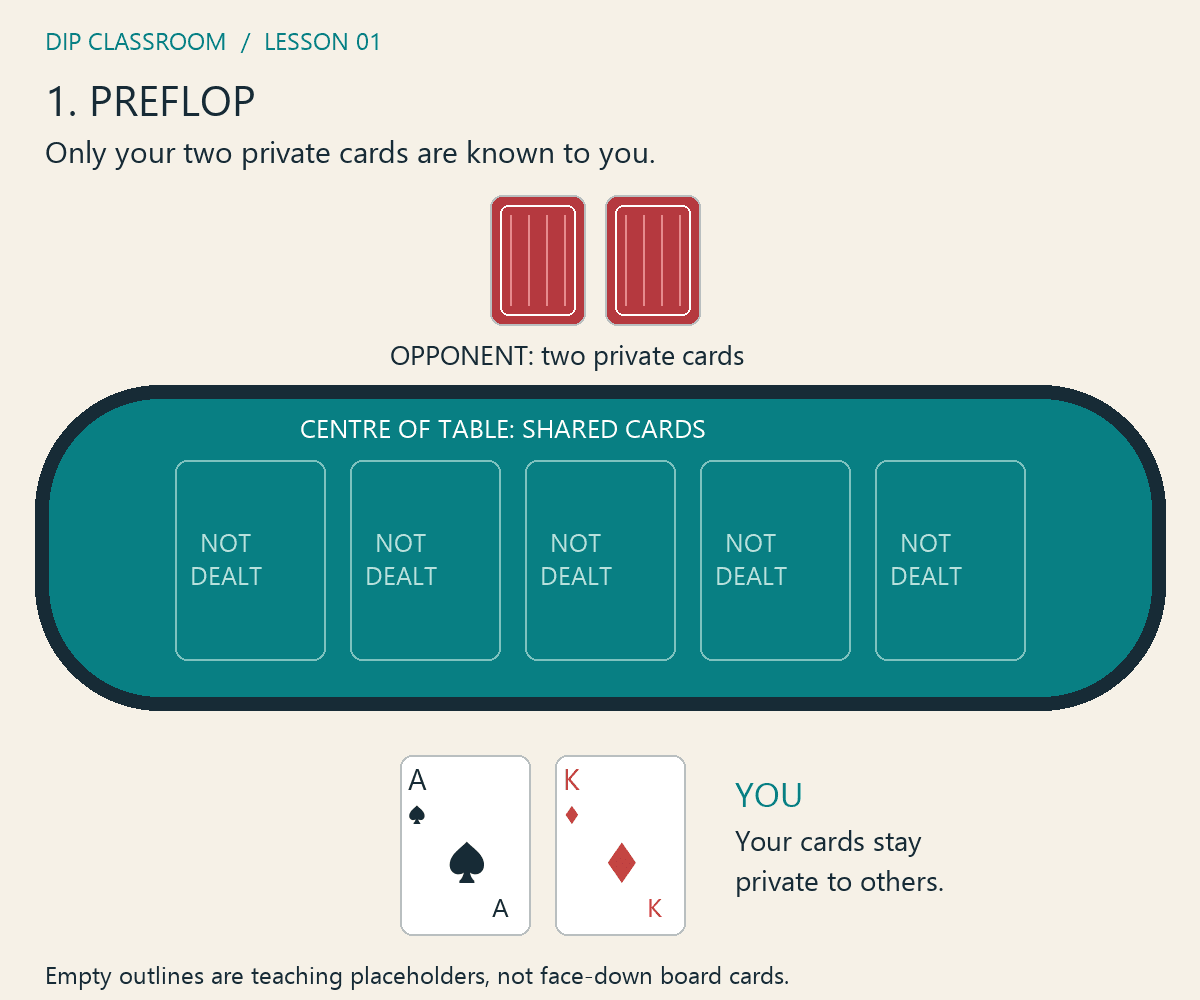
Look at the bottom of the picture. Your two cards are A♠ and K♦. Now look at the centre: there are no shared cards yet. This stage is called preflop — literally before the flop. Players already have their private cards, but the first three community cards have not been revealed.
You know your own starting cards. You do not know the opponent’s. There is a betting round at this stage. A betting round means players take turns deciding whether to continue and whether to commit chips, following the action rules. Chips committed by players form the pot, the amount being contested in this deal.
Before the voluntary decisions begin, designated players put in compulsory bets called blinds. This gives the deal an initial pot. We will teach the blind positions and full action order in later lessons; you do not need to calculate them to follow the cards today.
A player’s betting action can help you form a guess about their cards, but it does not reveal them. A raise might come from a strong hand, a weaker hand used as a bluff, or a mistaken decision. A big bet does not prove a big hand. At this stage, players are making decisions with incomplete information, not taking a test that announces who has the strongest two cards.
Your cards do not change when someone bets. If you continue, you keep A♠ and K♦. You do not exchange them for new cards. When the betting round is complete and the deal continues, the first shared cards can be dealt.
4. Three cards together: THE FLOP
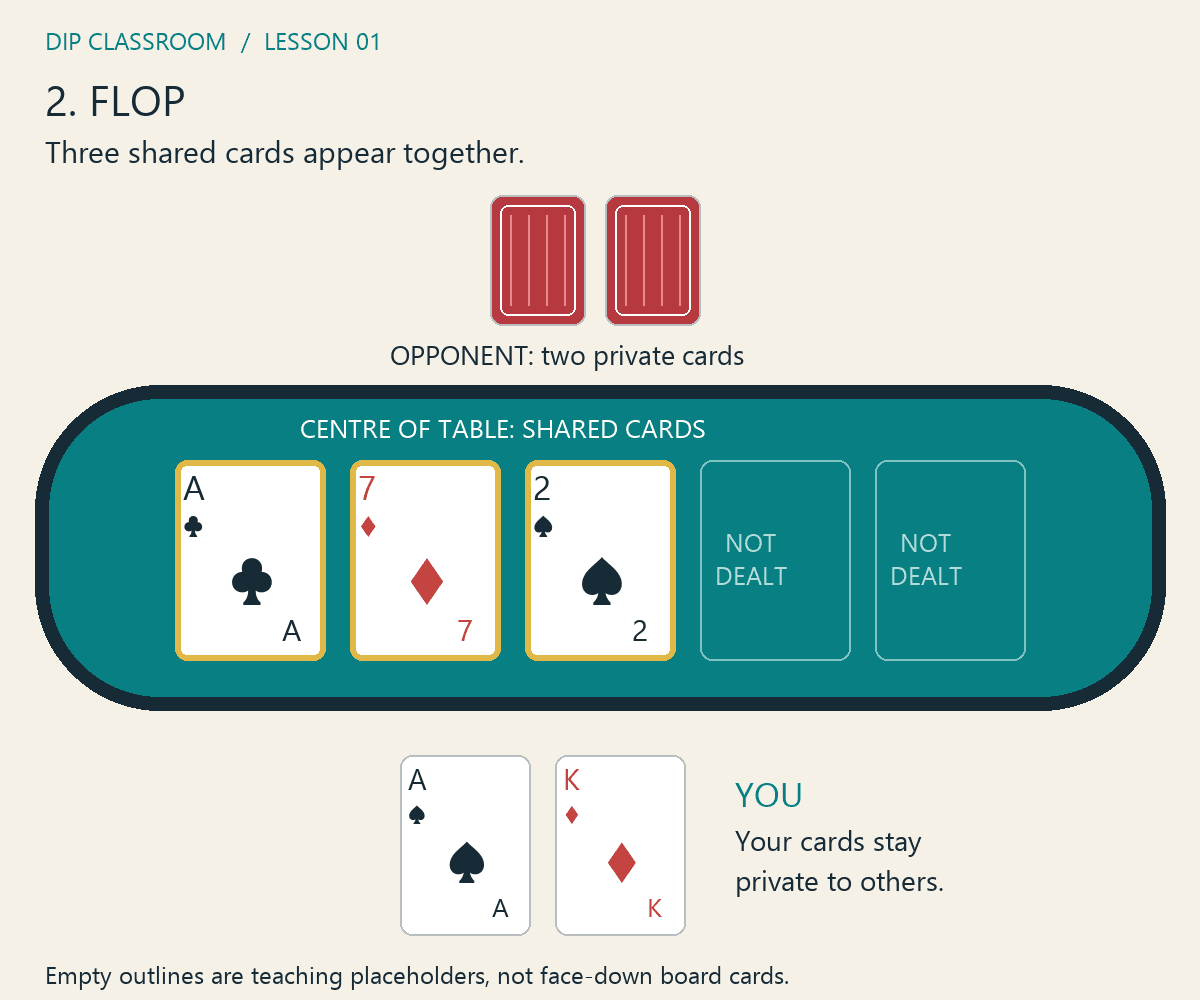
The dealer reveals A♣, 7♦ and 2♠ in the middle. These first three community cards are called the flop. They arrive as a group before the next betting round. There is not a separate betting round between the first, second and third flop cards.
Your A♠ and K♦ are still at the bottom. The opponent still has two private cards. Both players may now use A♣, 7♦ and 2♠ in the centre. Nobody gets exclusive ownership of the A♣ simply because it helps them.
Notice the two aces available to you: A♠ in your private cards and A♣ on the table. Two cards of the same rank form a pair. You have a pair of aces. That is your first example of a poker combination. It does not guarantee a win, because the opponent’s private cards and later community cards can matter.
Another betting round takes place after the flop. If the players check, they can continue without adding a new wager on that round. If someone bets, the other player must respond under the rules. We explain those choices below; for now the important visual fact is that the three flop cards stay where they are.
5. One more card: THE TURN
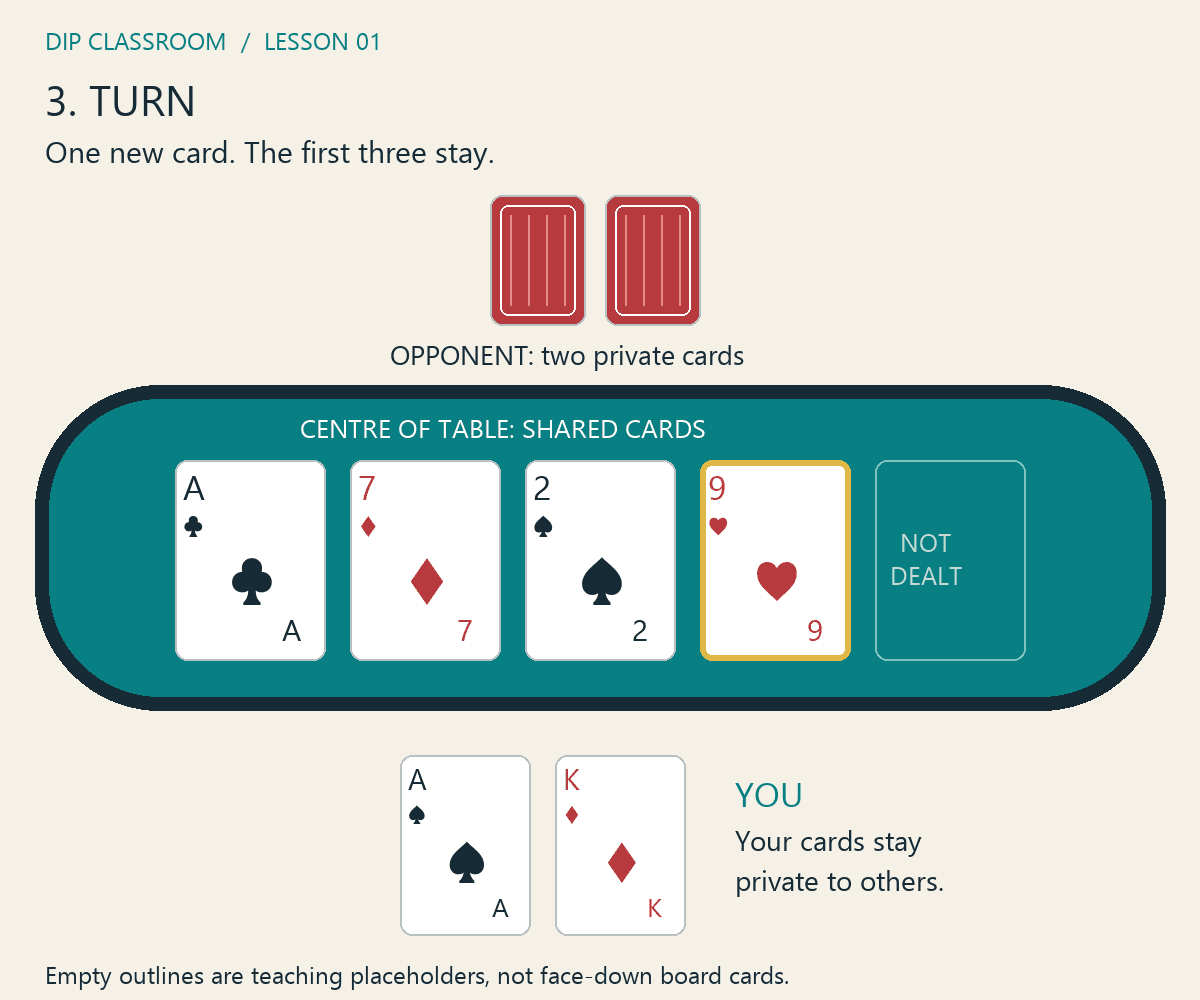
The next shared card is 9♥. It is called the turn. Count the cards in the centre: A♣, 7♦, 2♠ and 9♥. There are four in total. The original three have not been removed, replaced or handed to anyone.
You still have A♠ and K♦. So you now know six cards you can consider: two private plus four shared. Everyone still in the deal can use the new 9♥. A new betting round follows.
Do not confuse a new card with an automatic payment. Dealing the turn does not itself add chips to the pot. Chips enter when players commit them under the betting rules. If everyone checks, the pot stays the same size during that round.
6. The fifth and final shared card: THE RIVER
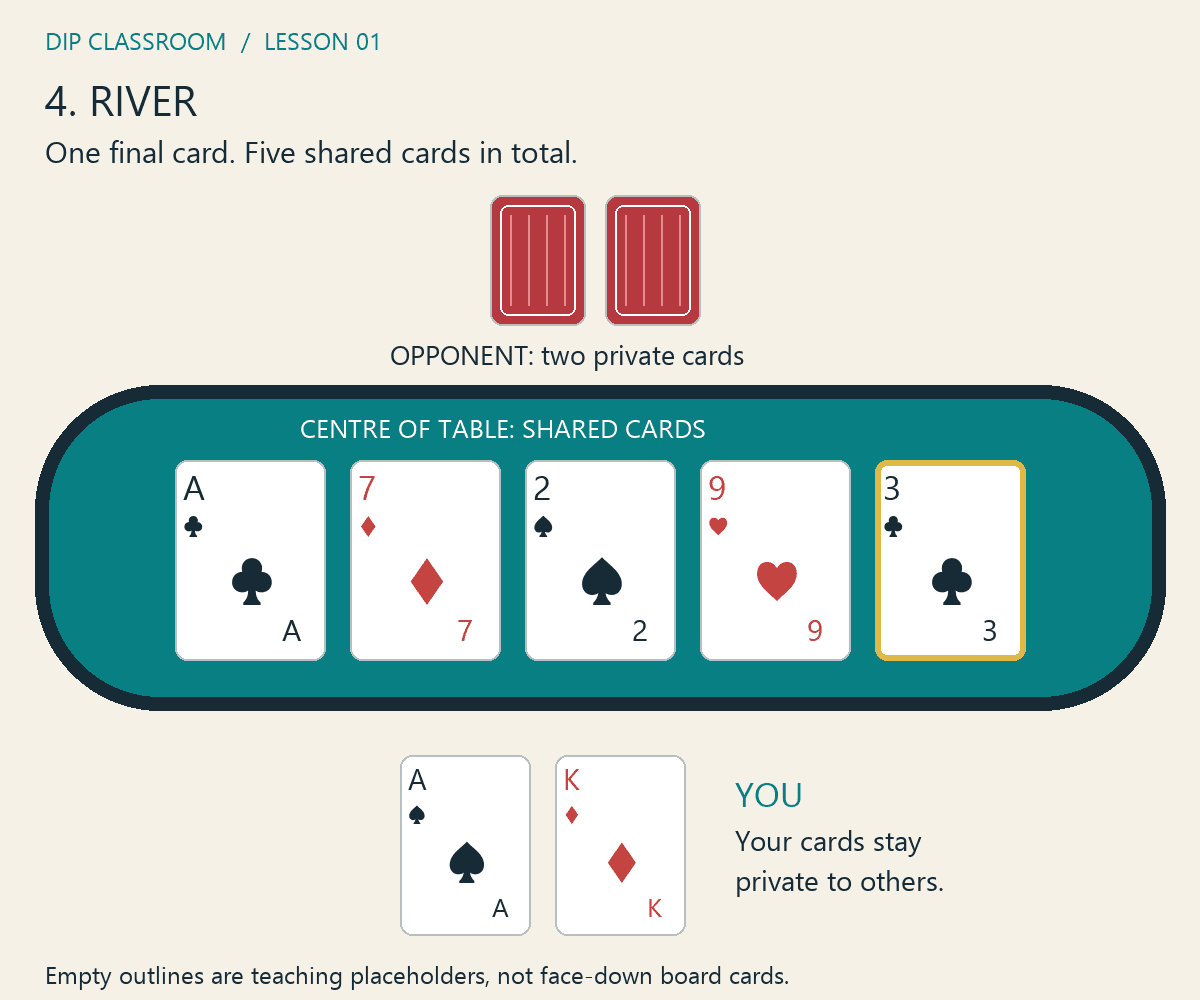
The last community card is 3♣, called the river. Now the centre contains five cards: A♣, 7♦, 2♠, 9♥ and 3♣. Ordinary Texas Hold’em has no sixth community card after this.
A final betting round takes place after the river. If at least two players remain when that round ends, their eligible hands are compared. That comparison is called showdown. Showdown is not another card or another betting round.
Pause and trace the change with a finger: no shared cards → three shared cards → four → five. The names are preflop → flop → turn → river. Your original two private cards stayed with you throughout.
Not every deal reaches the river. If everyone except one player folds earlier, that remaining player wins the pot and the deal ends. The rest of the board does not have to be dealt. When players are all-in and no further betting is possible, remaining board cards may be dealt without further betting decisions. Today’s pictures show the ordinary sequence, not a promise that every deal contains four active rounds of decisions.
7. What makes one hand stronger than another?
Poker compares five-card combinations. It does not add the numbers on all your cards. A pair means two cards of the same rank; a flush means five cards of the same suit; a straight means five ranks in sequence. These categories have a fixed order.
The two pictures below are your first reference sheet, not a memory test. Read down from the strongest category to the weakest. Lesson 02 will explain ties and tricky examples in more detail. You can return to these pictures whenever you forget a name.
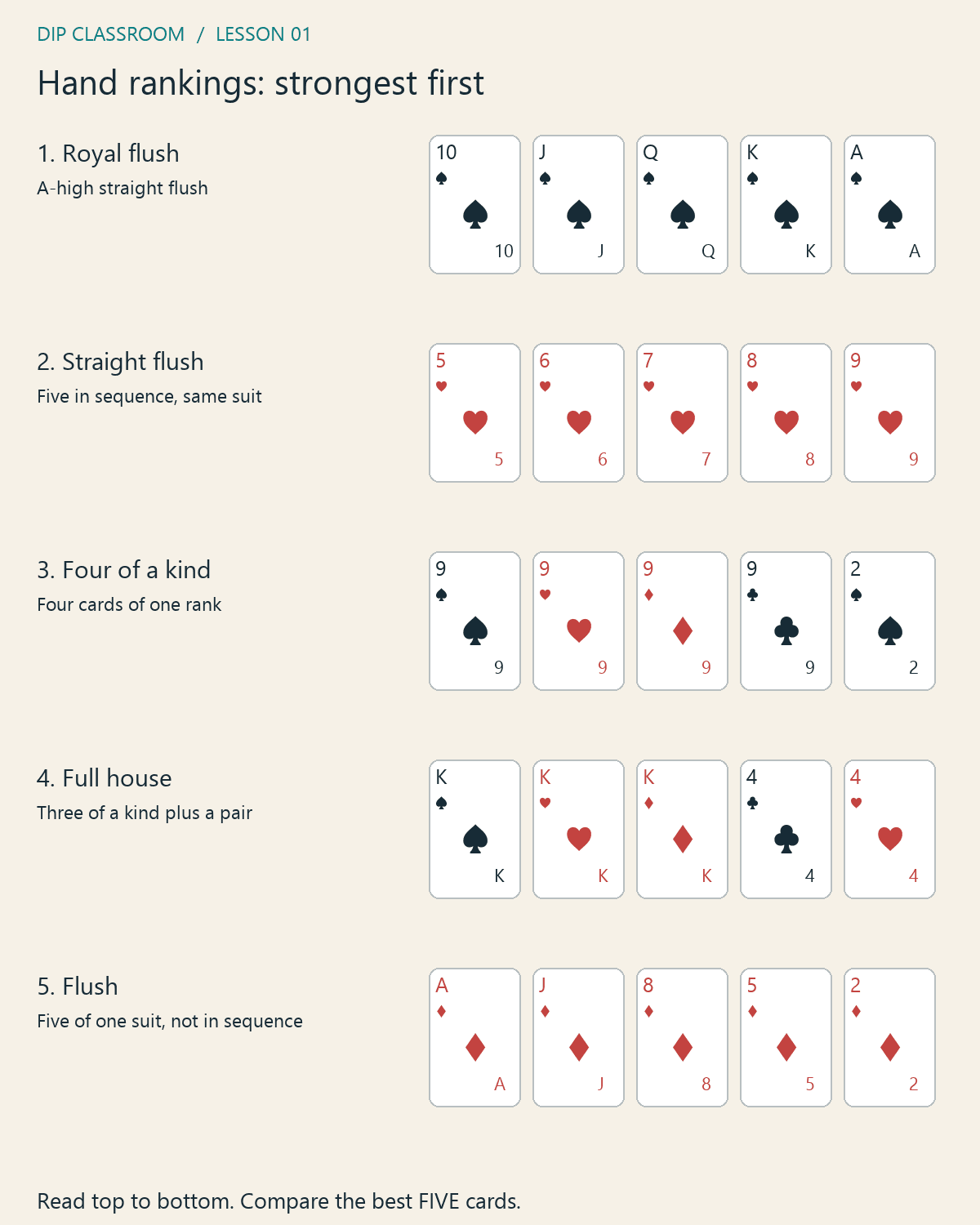
- Royal flush: 10-J-Q-K-A, all in one suit. It is the highest straight flush, often displayed as its own line in beginner charts.
- Straight flush: five consecutive ranks, all in one suit.
- Four of a kind: all four cards of a rank, plus a fifth card.
- Full house: three cards of one rank and two of another.
- Flush: five cards of one suit that do not form a straight flush. Five red cards are not enough if they mix hearts and diamonds.
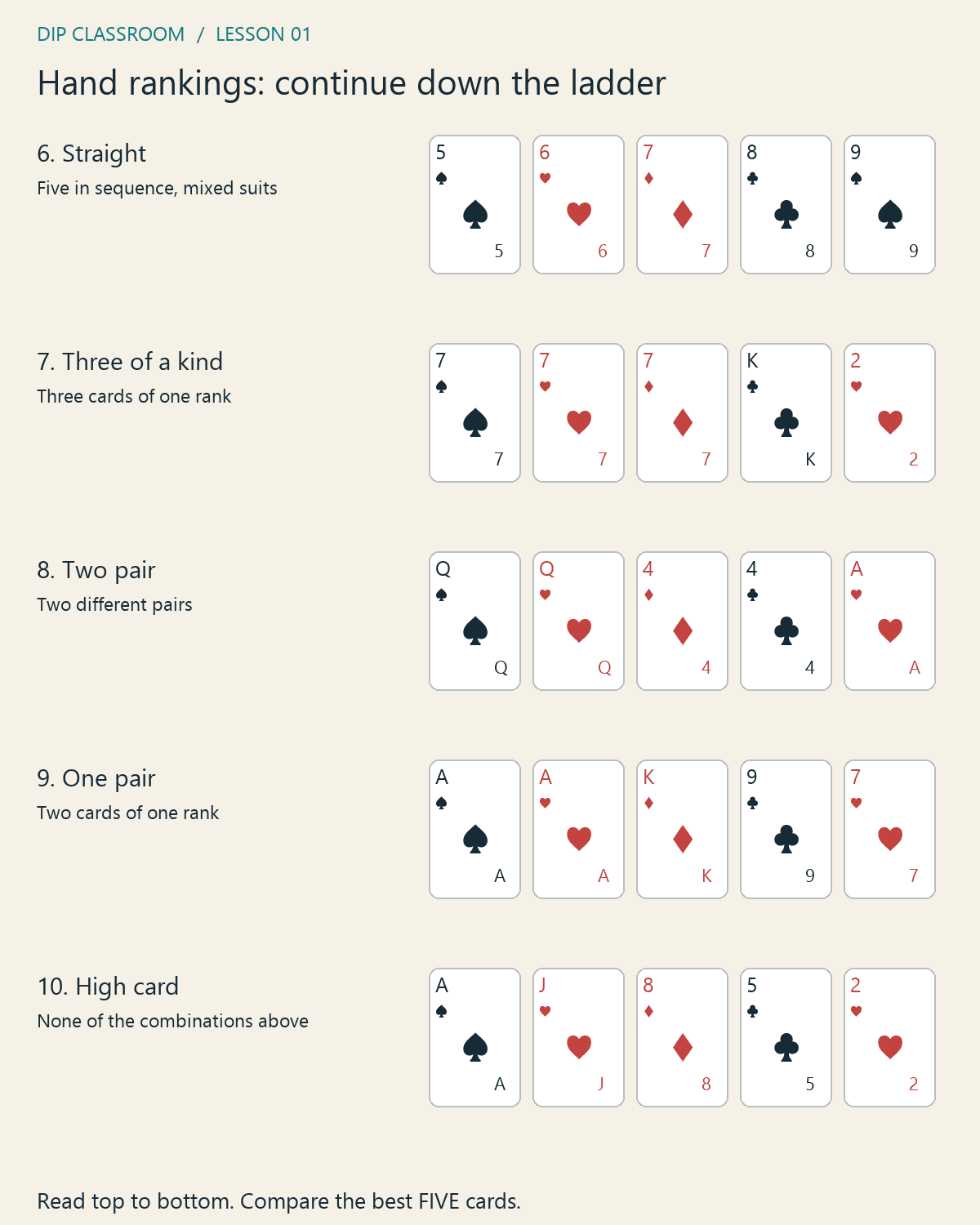
- Straight: five consecutive ranks without all five being the same suit.
- Three of a kind: three cards of one rank, with two other cards that do not turn it into a full house or four of a kind.
- Two pair: two cards of one rank and two of another, plus a fifth card.
- One pair: two cards of one rank, with three other cards.
- High card: none of the stronger combinations. The highest relevant cards determine the comparison.
A higher category beats a lower category. For example, a straight beats any one pair. If both players have one pair, the rank of the pair is compared first. A pair of aces beats a pair of sevens. If the pair ranks tie, remaining cards can break the tie; these side cards are called kickers. If the complete best five-card hands tie, the pot is split under the room’s procedures. Suits are not used as a stronger-versus-weaker ranking to break the poker-hand tie.
8. Seven cards available, but only FIVE count
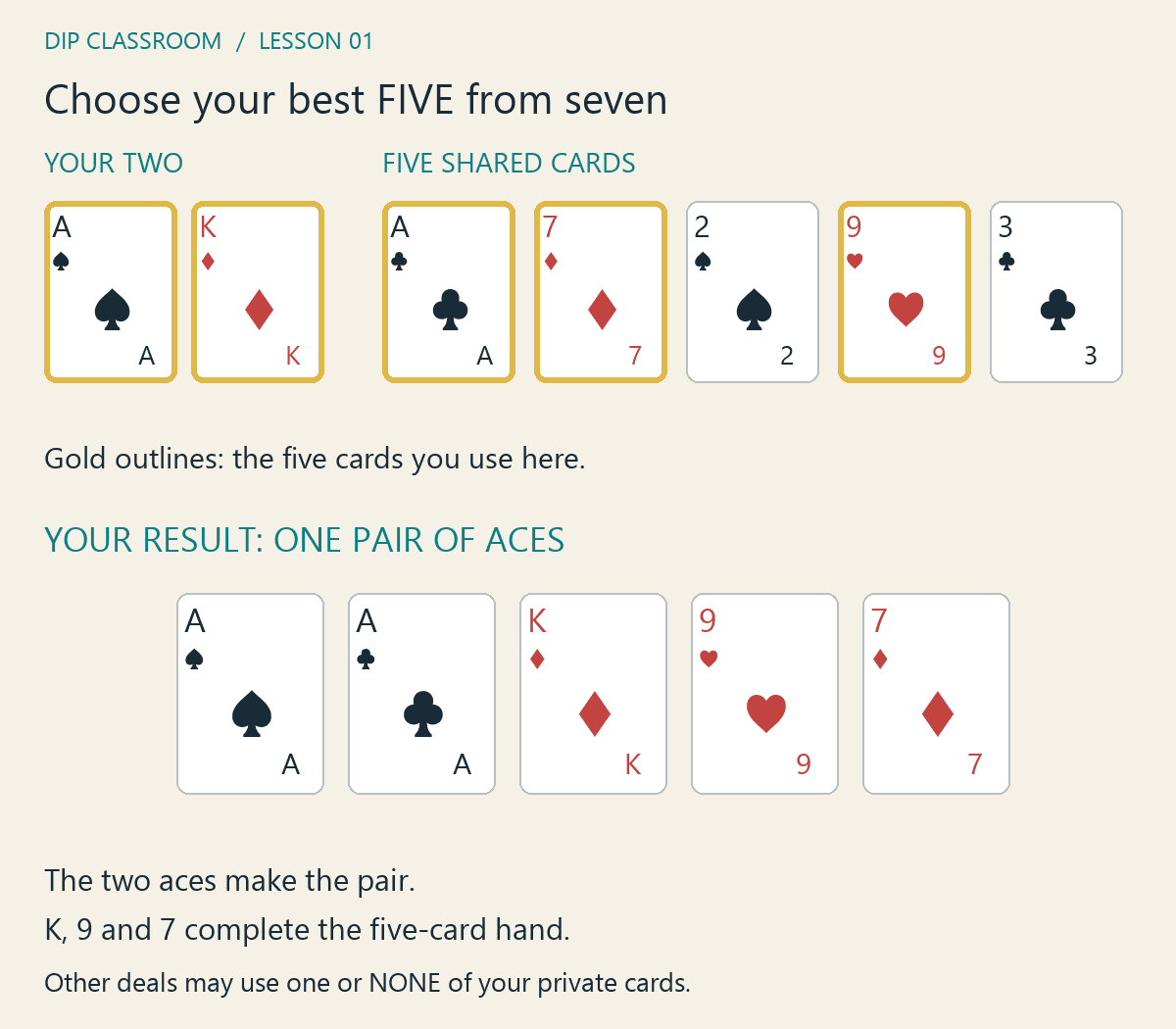
Look back at your two cards, A♠ and K♦, and the final board, A♣, 7♦, 2♠, 9♥, 3♣. The two aces make a pair. To complete the five-card hand, take the highest three other available ranks: K, 9 and 7. Your result is A♠, A♣, K♦, 9♥, 7♦.
The 2♠ and 3♣ do not count in that best five. They are still on the table, but “available” is not the same as “used.” You are choosing five, not collecting points from all seven.
In this example you use both of your private cards. That is allowed, not compulsory. In another deal your best five might use one private card, or might be entirely the five community cards. Do not assume your two cards must always appear in your final combination.
The same board can help multiple players at once. Even though you have a pair of aces here, you cannot announce yourself the winner until you know whether any remaining opponent has a stronger eligible hand. Knowing your own category is the start of comparison, not the end.
9. What are players choosing during betting?
You now know what the cards do. The five common actions below describe what players can do with their chips and their participation. We will practise the exact rules in Lesson 03.
- Check: pass without adding chips when you have no outstanding wager to match. You keep competing. It does not mean you have folded.
- Bet: make a wager when there is no existing wager on that betting round.
- Call: match the amount required to continue, paying the extra amount you still owe on that round.
- Raise: increase an existing wager, within the legal betting rules.
- Fold: stop competing for this pot. Chips you already committed stay in it; you do not have to risk more.
If you face an outstanding bet, you cannot simply check to avoid paying. You generally choose between folding, calling and a legal raise. All-in situations introduce additional rules that we will cover later.
A small example: if you have already put in 2 chips on this round and the amount to match is 6, a call adds 4, not another 6. You do not need to memorise betting sizes today. Just distinguish a free check from a call that matches an outstanding amount.
You are usually competing against the other players, not against a hand held by the dealer. There are two ways to win a pot: be the last player who has not folded, or have the best eligible hand at showdown. A strong-looking starting hand is not a guaranteed winner, and winning one pot is not the same as winning a whole tournament.
10. Point-at-the-picture practice
- 1) How many private cards does each player receive at the start of a Texas Hold’em hand?
- 2) In the preflop picture, how many shared cards have been dealt?
- 3) Which picture first shows exactly three community cards?
- 4) On the turn, are the flop cards replaced or kept?
- 5) At the river, how many cards are available to you, and how many form your final hand?
- 6) Must you use both private cards?
- 7) Does an opponent’s raise prove that they hold a stronger hand?
Answers — with explanations
Show answer 1Hide answer 1
Two private cards. Each player receives their own two cards face down; these are separate from the community cards shared in the centre of the table.
Show answer 2Hide answer 2
Zero. You have private cards, but the first shared cards have not appeared.
Show answer 3Hide answer 3
The flop. The first three arrive together before the next betting round.
Show answer 4Hide answer 4
Kept. One new card is added, bringing the shared total to four.
Show answer 5Hide answer 5
Seven available: your two plus the shared five. Choose the best five for the final hand.
Show answer 6Hide answer 6
No. Hold’em allows two, one or zero private cards in your best five.
Show answer 7Hide answer 7
No. Betting gives information to interpret, not direct proof of the cards.
Your first glossary — keep this nearby
- Deck: the complete 52-card set used here.
- Rank: a card’s number or letter, such as 7 or K.
- Suit: the symbol ♠, ♥, ♦ or ♣.
- Hole cards / private cards: your own two cards, normally hidden from opponents.
- Community cards / board: the shared face-up cards in the centre.
- Preflop: the stage before the first three community cards.
- Flop: the first three community cards, and the stage played with them.
- Turn: the fourth community card and its stage.
- River: the fifth community card and its stage.
- Pot: the chips committed to the current deal.
- Showdown: comparing the remaining eligible hands after betting is complete.
- Hand: either a complete deal, or a player’s cards/combination, depending on context.
DIP’s takeaway
You do not need a clever bluff to finish your first lesson. You need to recognise a card’s rank and suit, point to your private cards and the shared cards, and follow the 0 → 3 → 4 → 5 sequence. Then use the ranking pictures to identify a simple combination without guessing.
Try this with a deck and no money: put two cards near you, leave the centre empty, then reveal three, one and one in the centre. Say who may use each card. Finally choose five cards, leaving two unused. Repeat slowly rather than rushing to betting strategy.
Next in the series: Lesson 02 will practise hand rankings and choosing the best five, including ties. It will be linked after publication. This lesson remains part of the same adult beginner course, not a recommendation to start real-money play.
Responsible play notice: Learn with no-money practice first. If you choose to play for money, follow local eligibility requirements, set an affordable loss limit and never borrow or risk funds needed for essentials. Poker does not guarantee income.