
DIP Cat has a practice seat ready for you. You are at the bottom of the table. Your opponent is at the top. Keep your eyes on those two places: that is where each player’s cards and new bets belong.
Today, we will try one action at a time. You do not need to decide who will win. Just watch what happens when you check, bet, call, raise or fold.
You do not have all five choices on every turn. The first question is simple: do you currently need to add chips to match someone else's wager?
What you will learn
- How checking differs from folding.
- How the first bet differs from a raise.
- Why a call matches a wager instead of starting a new one.
- How “raise to 12” differs from “raise by 12”.
- When betting is finished and another shared card can appear.
A quick reminder about the cards
Texas hold'em is one kind of poker. A normal deck contains 52 cards with four suits: spades ♠, hearts ♥, diamonds ♦ and clubs ♣. Each suit has thirteen ranks, from 2 through 10, followed by jack J, queen Q, king K and ace A. The suits do not outrank one another.
You receive two private cards. Other players have their own two private cards. Up to five shared cards appear in the centre. The first three together are the flop; a fourth is the turn and a fifth is the river. If a hand reaches a showdown, players compare their best five-card hands from the available seven cards.
Today your cards are A♠ and K♦. Read those as ace of spades and king of diamonds. The first three shared cards are A♣, 7♦ and 2♠. Your private ace and the shared ace make one pair: two cards of the same rank. Your opponent cannot see your private cards. A bet does not prove who has the stronger hand.
Set up our practice table
Only two players are playing this demonstration. That is called heads-up. You are shown at the bottom and your opponent at the top in every diagram. Your cards stay in the same place. The centre cards belong to neither player individually: both can use them.
Use 100 identical practice chips each. Every gold chip in these pictures is worth 1. No money is needed. There is no ante or house deduction (rake).
The cream area in the middle holds the shared cards and the OLD POT: chips already paid before this flop. A new bet stays pictured in front of the person who paid it. The total pot counts the old pot and both players’ new bets together, once each. “Chips left” means chips still available to that player, not their bet.
Before private cards are dealt, two forced bets are posted: the small blind of 1 and the big blind of 2. In this heads-up example, your opponent has the dealer button and posts the small blind. You post the big blind. Your opponent acts first before the flop and raises to 4; you call by adding 2 to the 2 you already posted. This is only the setup, not a suggested starting-hand strategy.
Each player has put in 4. The pot, meaning the chips being contested, is 4 + 4 = 8. Each stack, meaning chips still in front of its owner, is 100 − 4 = 96. After the flop, you act first because you are the big blind. Your opponent, the button/small blind, acts last. This two-player order differs from a table with three or more players.
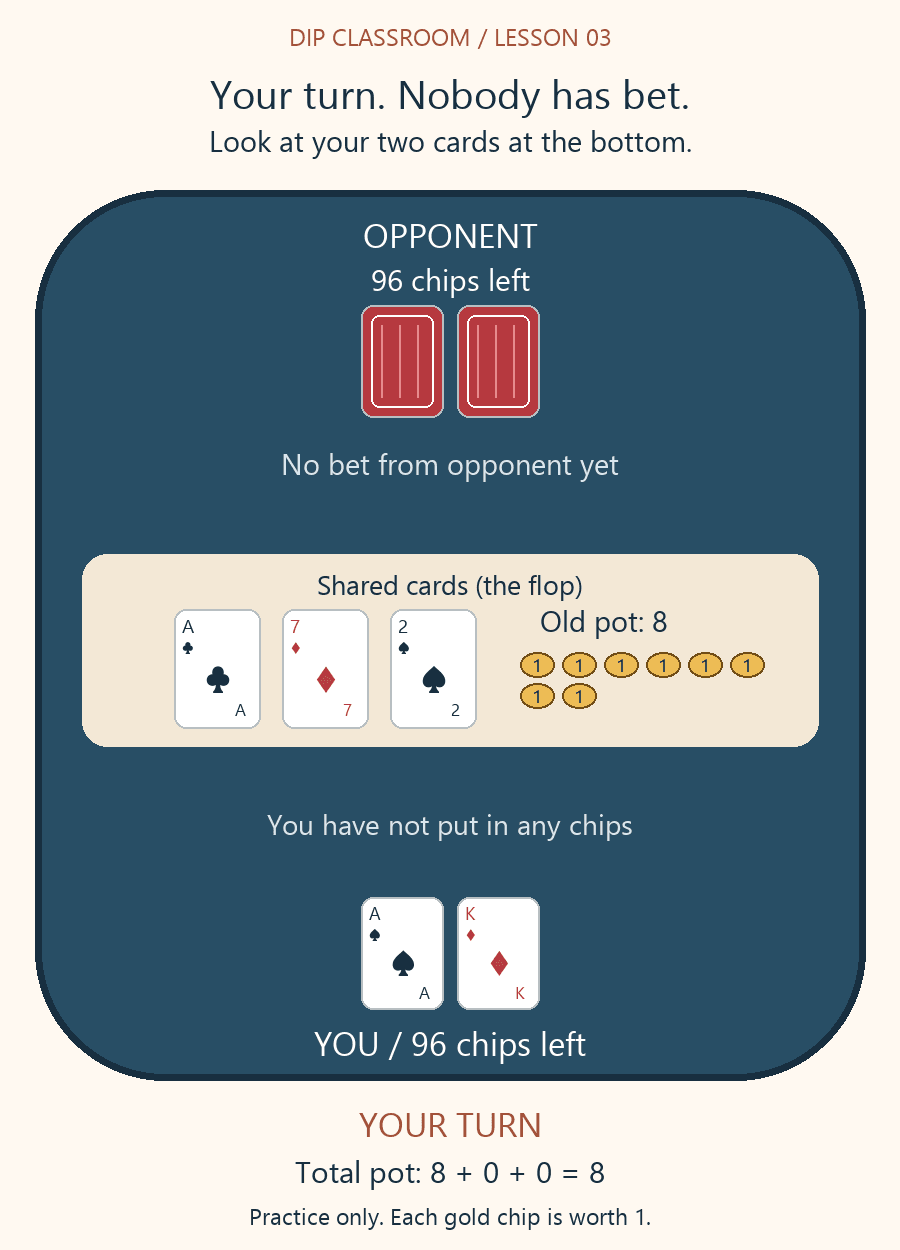
First, try a CHECK: keep your cards and pay nothing
No one has bet on this flop. You owe nothing to match the current round, so you may check. Checking passes the action to the next player while keeping your hand live. Say “check” when it is your turn.
You add zero chips. You do not throw your cards away. You have not promised to fold later. If somebody bets after your check, you will get another decision when the action returns to you.
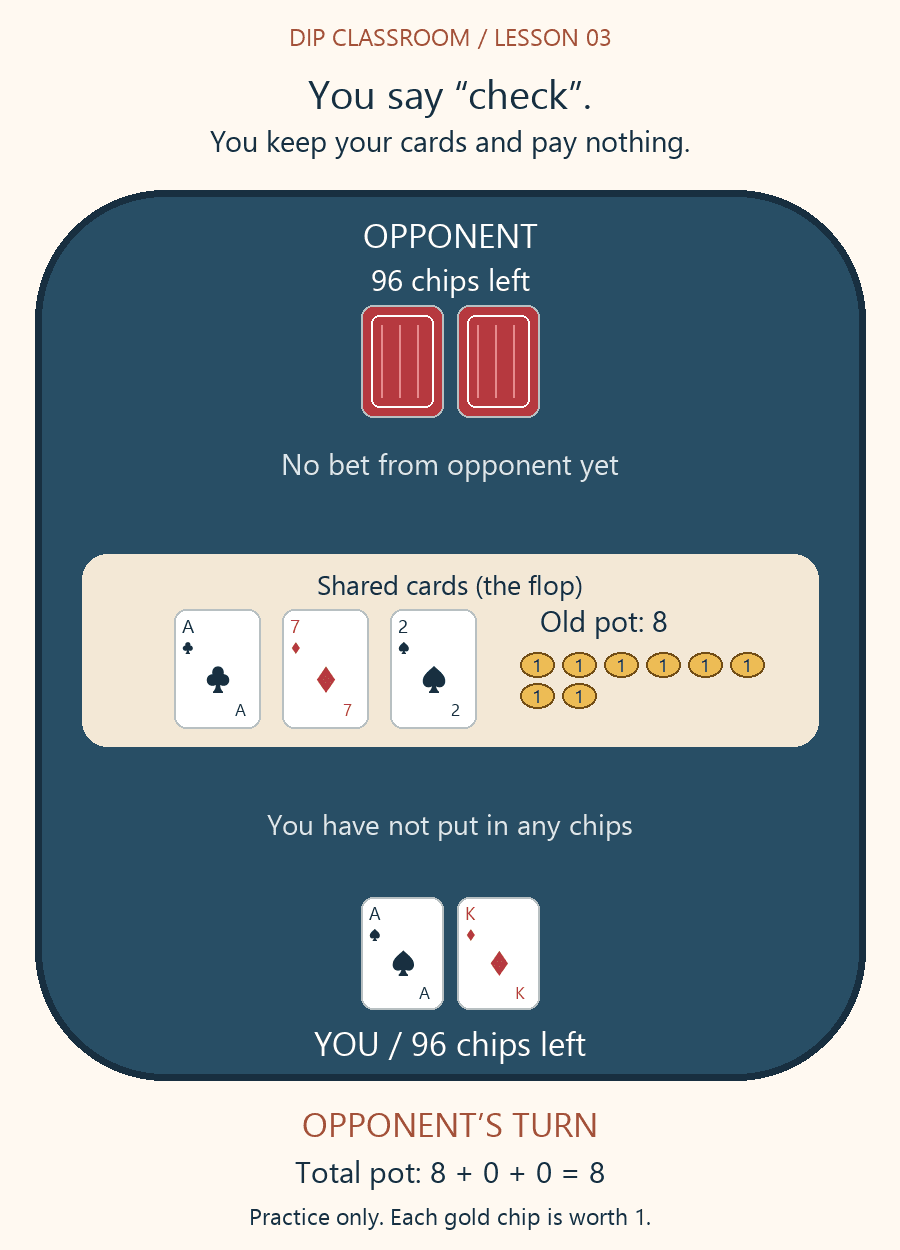
If your opponent also checks, both players have finished this flop round. The dealer can then deal the turn. You do not need to put in chips merely to keep your cards when checking is available.
Next, your opponent BETS: the first chips go in
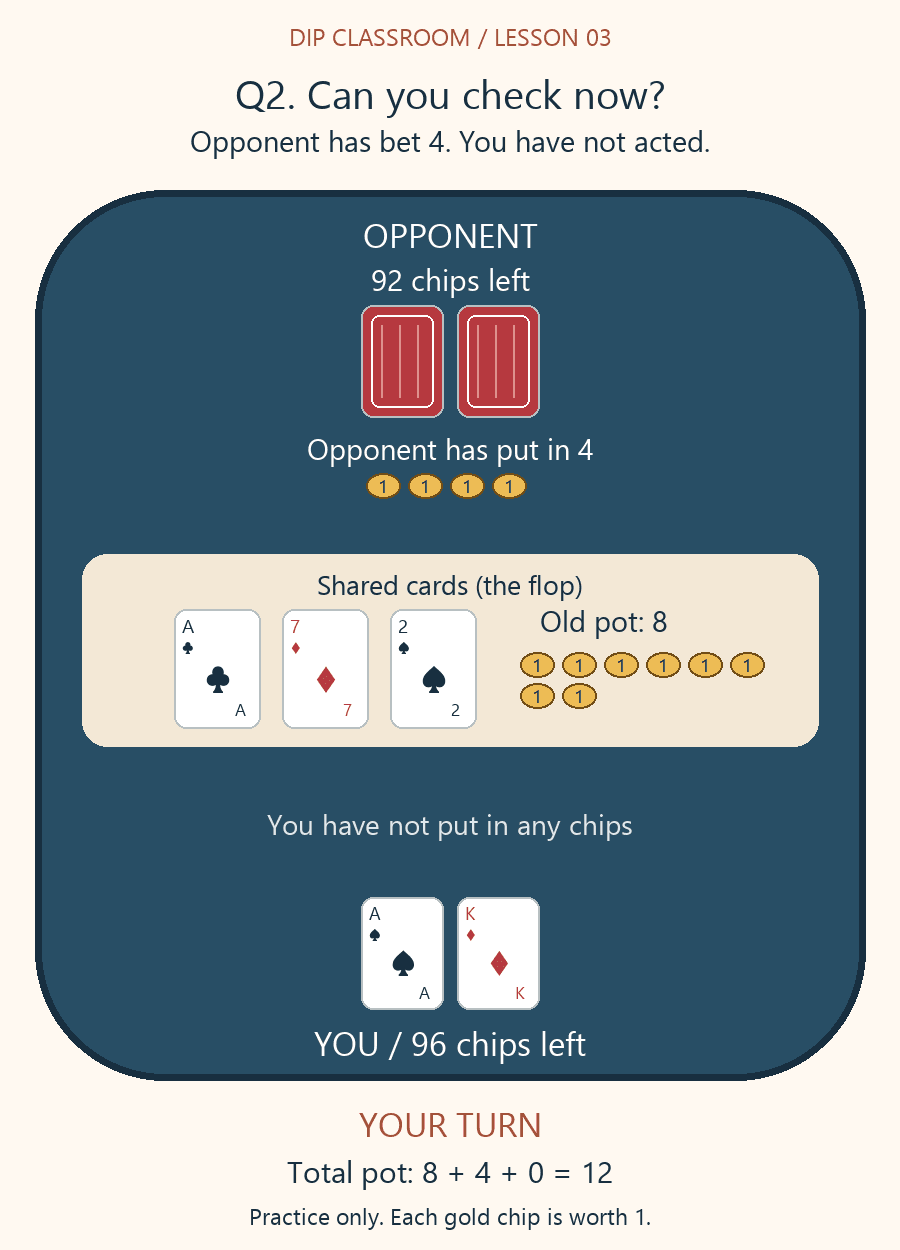
Instead of checking behind, your opponent puts in 4. Because no one has yet wagered on this flop, this is a bet, not a raise. They are not raising your check. A check is not a wager of chips.
Your opponent now has 96 − 4 = 92 left. The displayed pot includes that pending wager: 8 + 4 = 12. You still have 96, but now you must respond to the 4-chip bet.
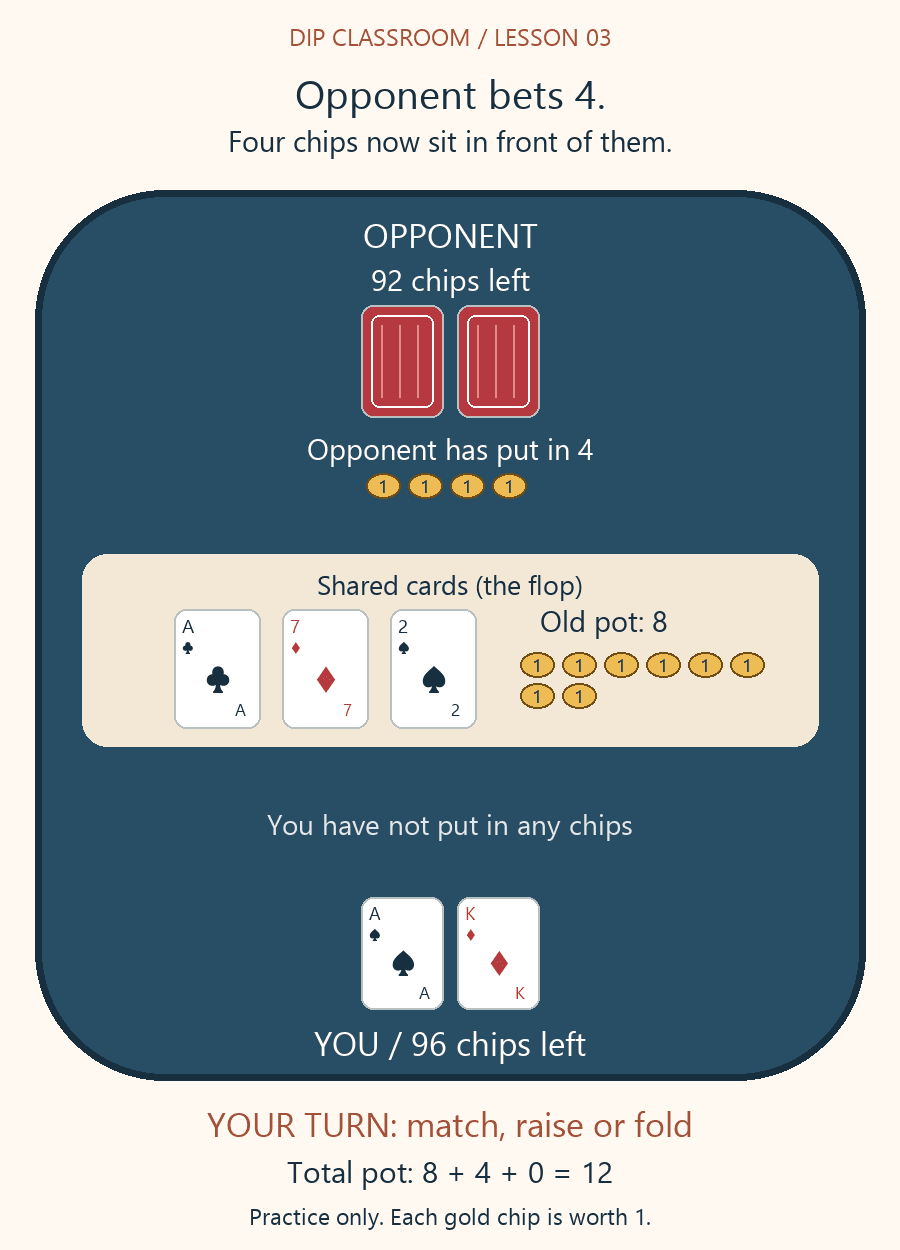
You cannot check in response to this outstanding bet. Your ordinary choices are call, raise or fold. We will rewind to this exact picture for three separate branches. They are alternatives, not actions you perform one after another.
Branch A: CALL means match
To call the 4-chip bet, add 4 from your own stack. You had contributed zero on this flop, so you owe all four. Your earlier preflop contribution of 4 does not count toward matching a new flop wager.
The pot becomes 12 + 4 = 16. Both players now have 92 left, and each has contributed 4 during this flop round. As there are only two players and the bet is matched, the flop betting ends. The dealer can deal the turn next.
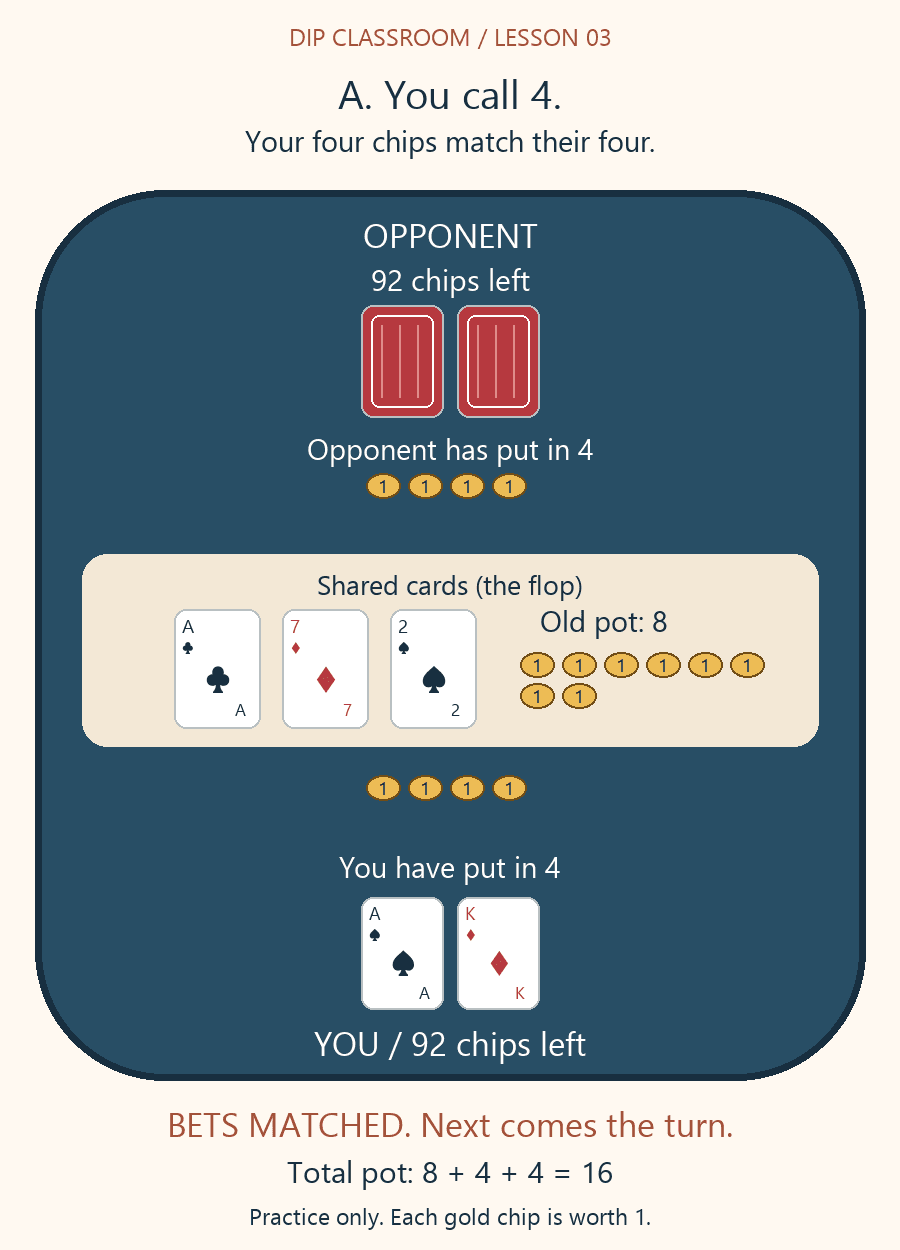
Calling does not mean you have won. It keeps you in the hand and pays the amount required to continue. The next shared card can change which hand is best, and another betting round follows.
Branch B: RAISE means increase the wager
Rewind to the opponent's 4-chip bet and pot 12. Instead of calling, you say “raise to twelve” and commit 12 chips in total on this flop. You are matching the 4 and increasing the required total by another 8.
Your stack becomes 96 − 12 = 84. The pot is 12 + 12 = 24. Your opponent has already put in 4 on this round, so they need 12 − 4 = 8 more to call. They do not need another 12.
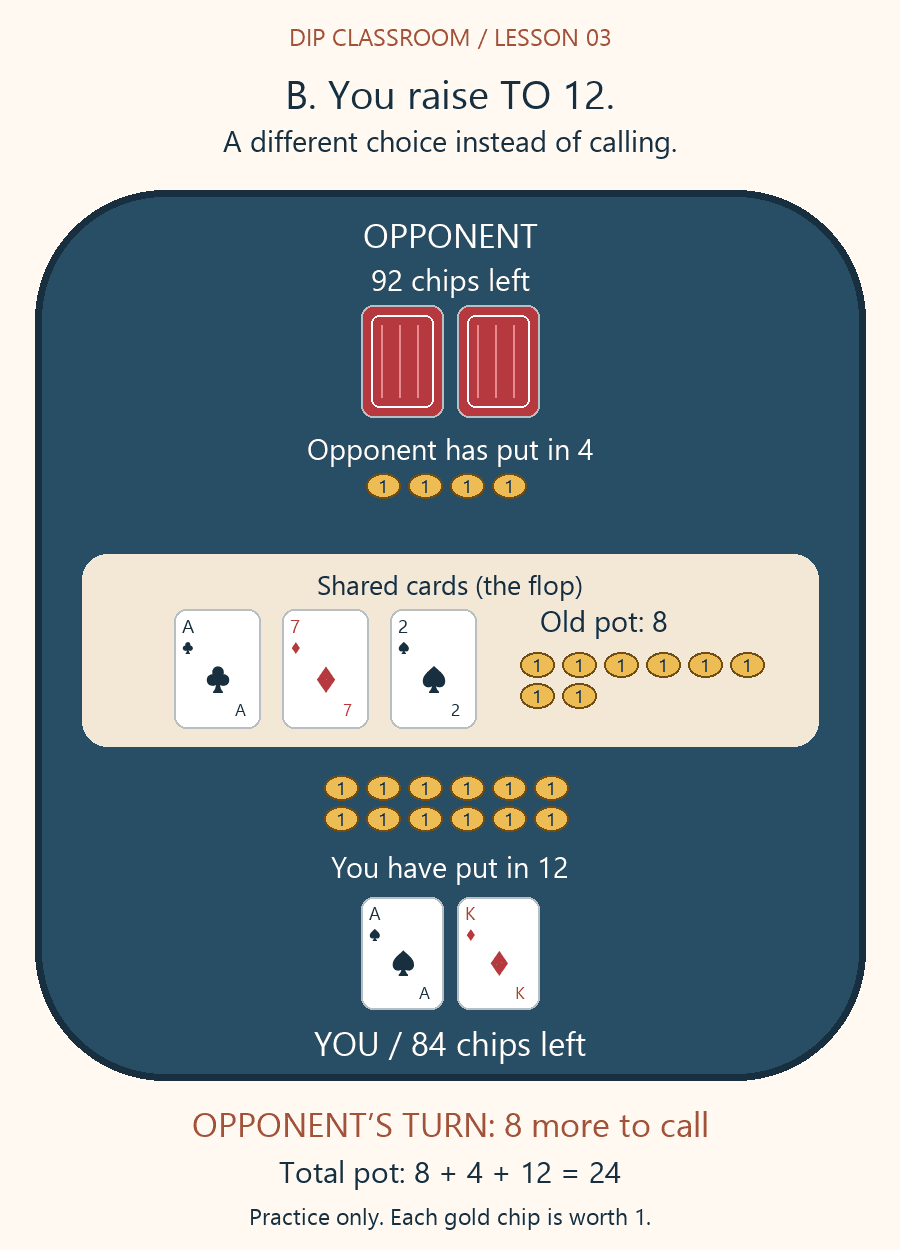
“Raise to 12” means a total of 12. “Raise by 12” over a bet of 4 would mean a total of 16. Those are different wagers. In a live room, saying the total clearly before moving chips helps avoid ambiguity. If you are unsure, ask the dealer what the total is before acting.
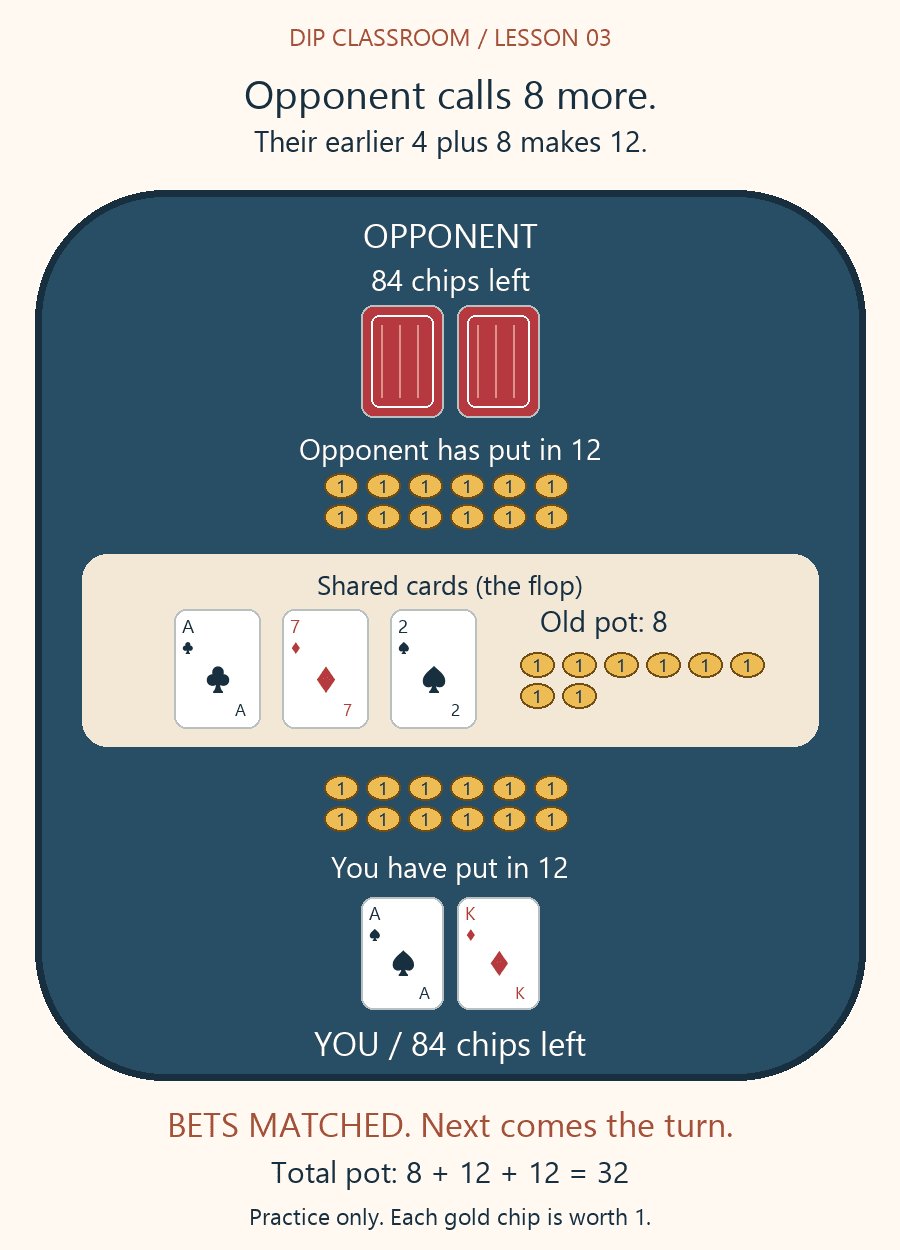
Here the opponent chooses to call the extra 8. Their stack becomes 92 − 8 = 84. The pot grows from 24 to 32. Both players have now put in 12 on the flop. The round ends and the turn may be dealt.
Branch C: FOLD means leave this hand
Rewind again to the opponent's bet of 4 and pot 12. You may fold instead of calling or raising. You release your private cards face down toward the dealer's discard area. Do not expose them or interfere with another player's cards.
You add no chips, but your hand is no longer live. You cannot change your mind and rejoin after the next shared card. Chips you contributed earlier are not refunded just because you fold.
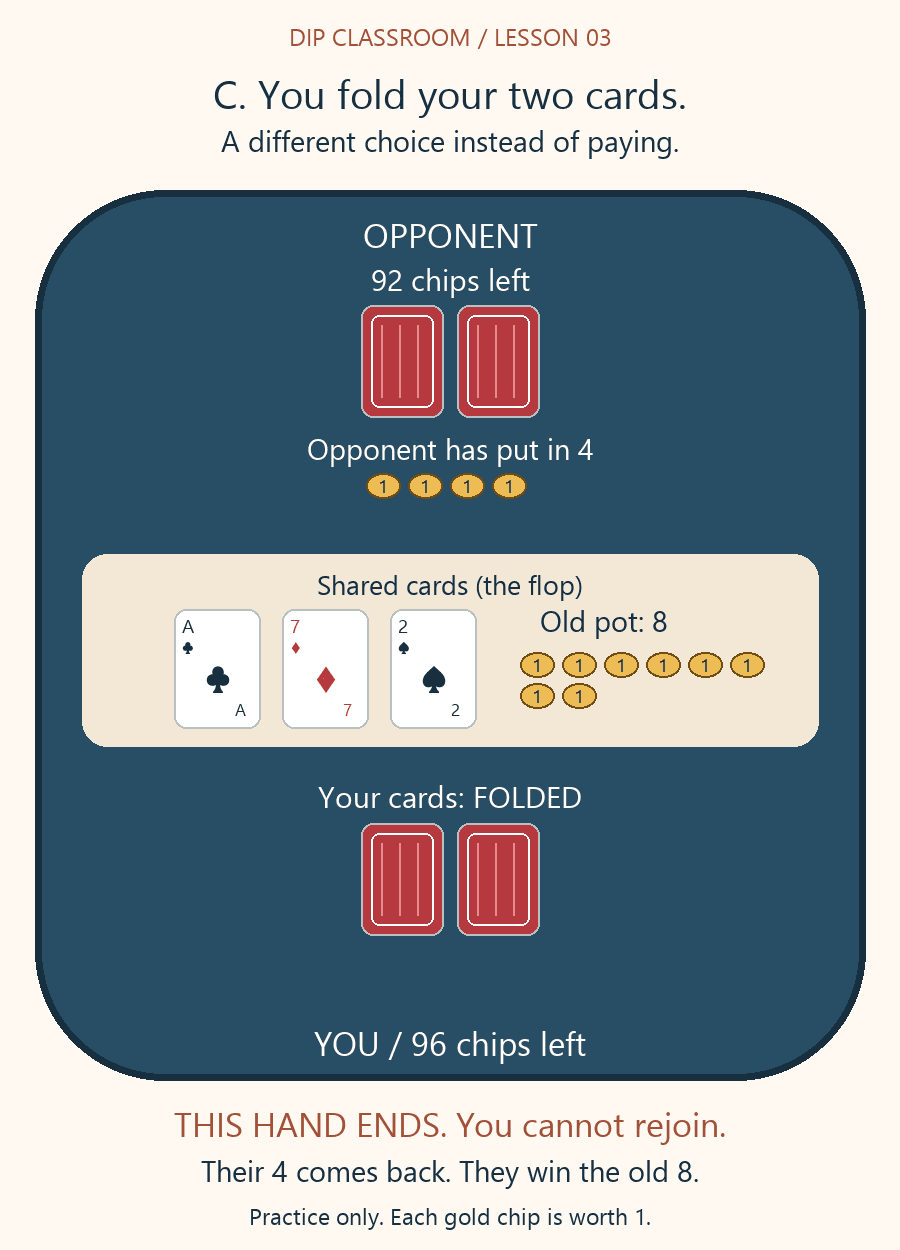
Because only your opponent remains, the hand ends without needing a turn, river or showdown. Their uncalled 4 is returned; they receive the 8-chip contested pot. Their stack finishes at 92 + 4 + 8 = 104. You keep 96. Together those stacks still total the original 200 practice chips.
We used the same ace-king hand in every branch so you can focus on the actions. Folding this particular pair is not our strategy recommendation. Knowing what a fold does and choosing when to fold are different lessons.
Five words, one useful question
If you owe nothing, checking keeps you in without adding chips; betting starts a wager. If you face a wager, calling matches it, raising increases it, and folding gives up the hand. All actions must wait until your turn.
A player who has checked can later call, raise or fold if an opponent bets. A player who has folded is done for that hand. Those two actions are not interchangeable.
Try it with your practice chips
Reset both stacks to 96 and place 8 in the middle. Keep the same flop and private cards. Act out each branch separately: check, opponent bets 4, then choose call, raise to 12, or fold. Say both the pot and each remaining stack aloud. Reset before trying the next branch.
Do not deal a turn immediately after one player bets. Wait for the response and for betting to finish. If everyone except one player folds, no more shared cards are needed.
Practise with the cards in front of you
Each question is a separate exercise. Everything you need is repeated beside its diagram. Choose your answer first, then open Show answer to see the explanation. You do not need to scroll back to an earlier example.
Question 1: Stay in without betting
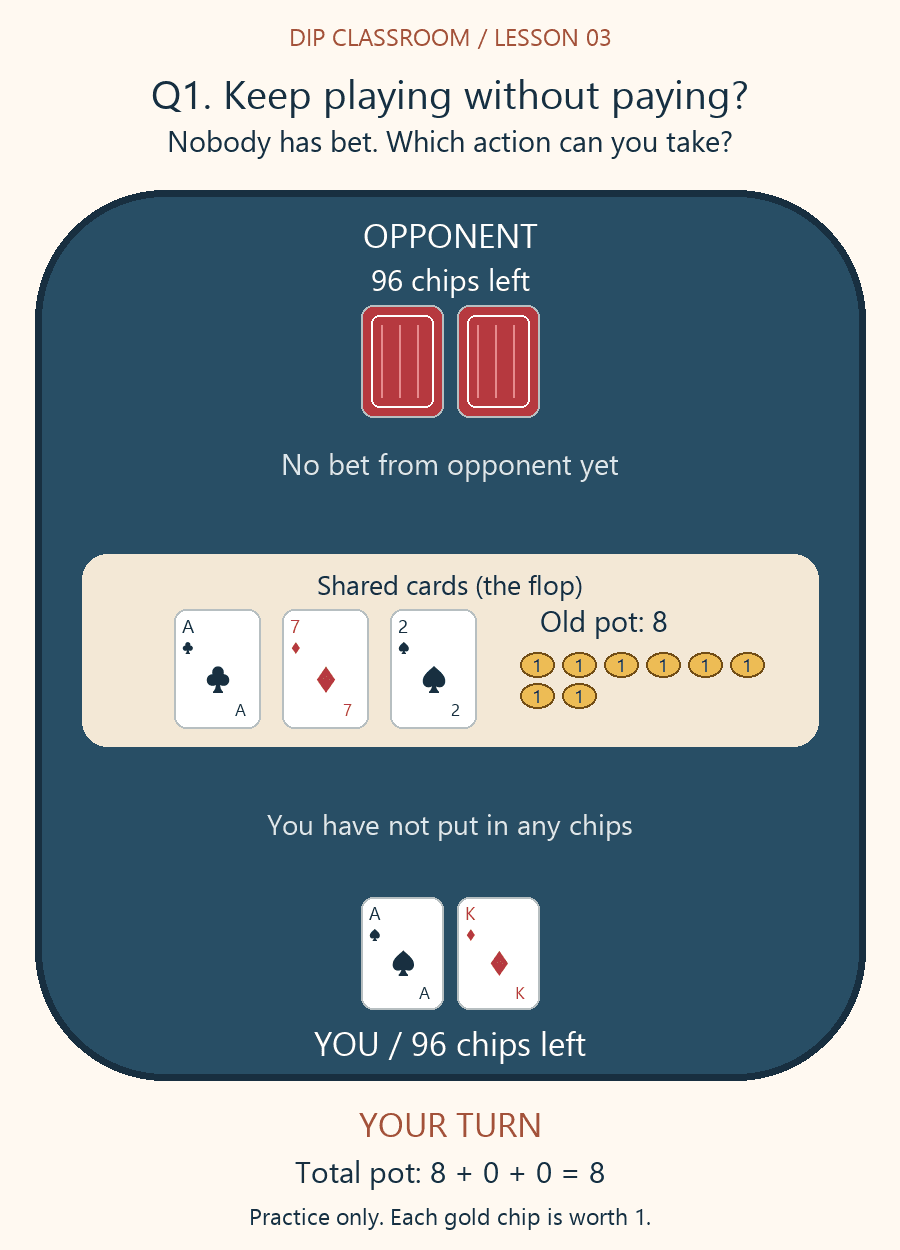
Two players see A♣ 7♦ 2♠. You hold A♠ K♦; the opponent’s cards are hidden. The pot is 8 and each stack is 96. No one has bet on this flop and it is your turn. Which action keeps your hand live without adding chips?
Show answer 1Hide answer 1
Check. You owe zero, your cards stay live and the pot remains 8. Folding also adds no chips, but it gives up your hand.
Question 2: Facing a bet
On A♣ 7♦ 2♠, you hold A♠ K♦ and have checked. Your opponent now bets 4 into the old pot of 8. The displayed pot is 12; you have 96 left and the opponent has 92. May you check again instead of matching the bet?
Show answer 2Hide answer 2
No. You now owe 4. With these stacks, you may call, raise or fold. A check is available only when you owe nothing in the current round.
Question 3: Add a call once
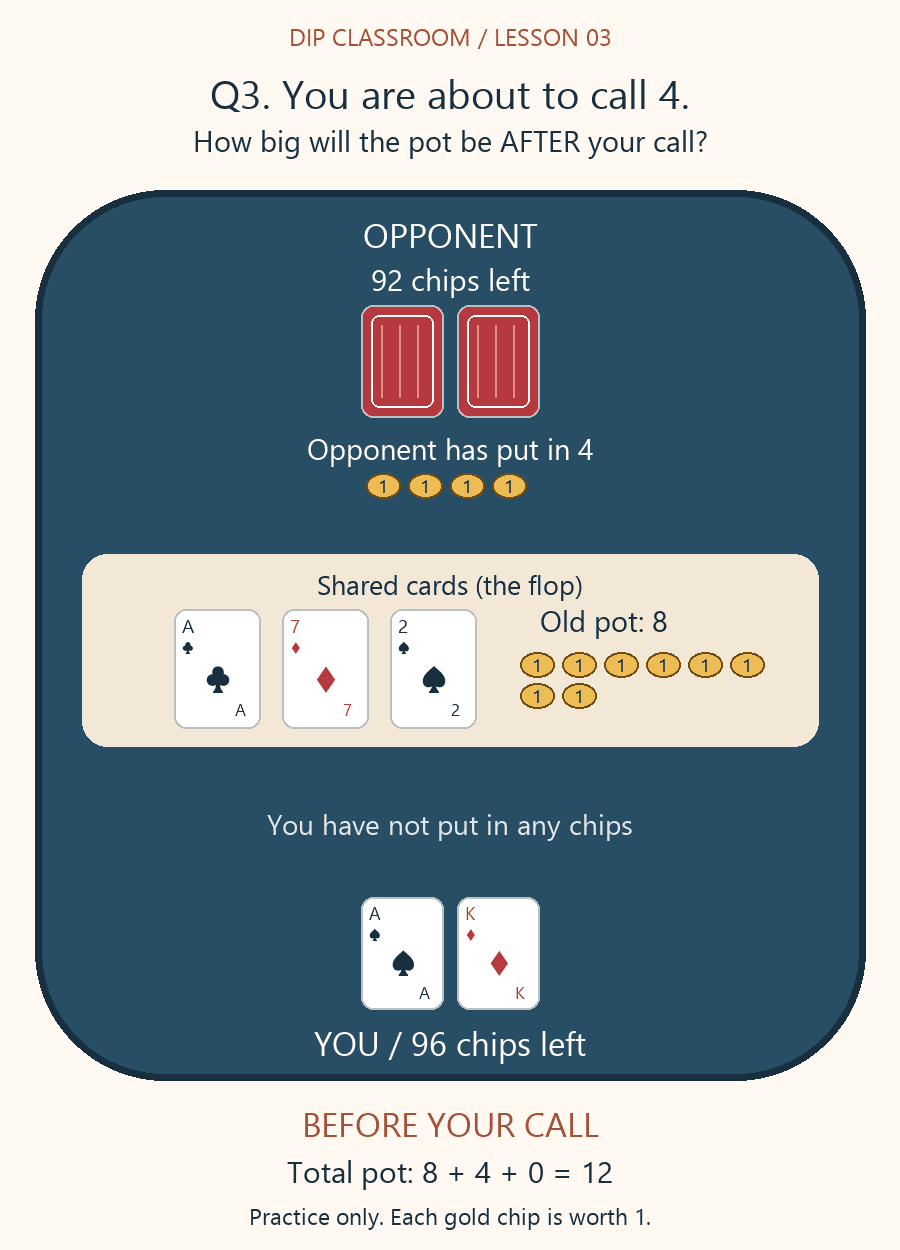
The flop is A♣ 7♦ 2♠ and you hold A♠ K♦. The pot is already 12, INCLUDING the opponent’s 4-chip bet. You have not added chips on this flop and now call 4 from your stack of 96. What is the new pot?
Show answer 3Hide answer 3
16 chips: the displayed 12 plus your new 4. The opponent’s bet is already included, so do not add it twice. Both players now have 92 behind.
Question 4: Raise TO a total
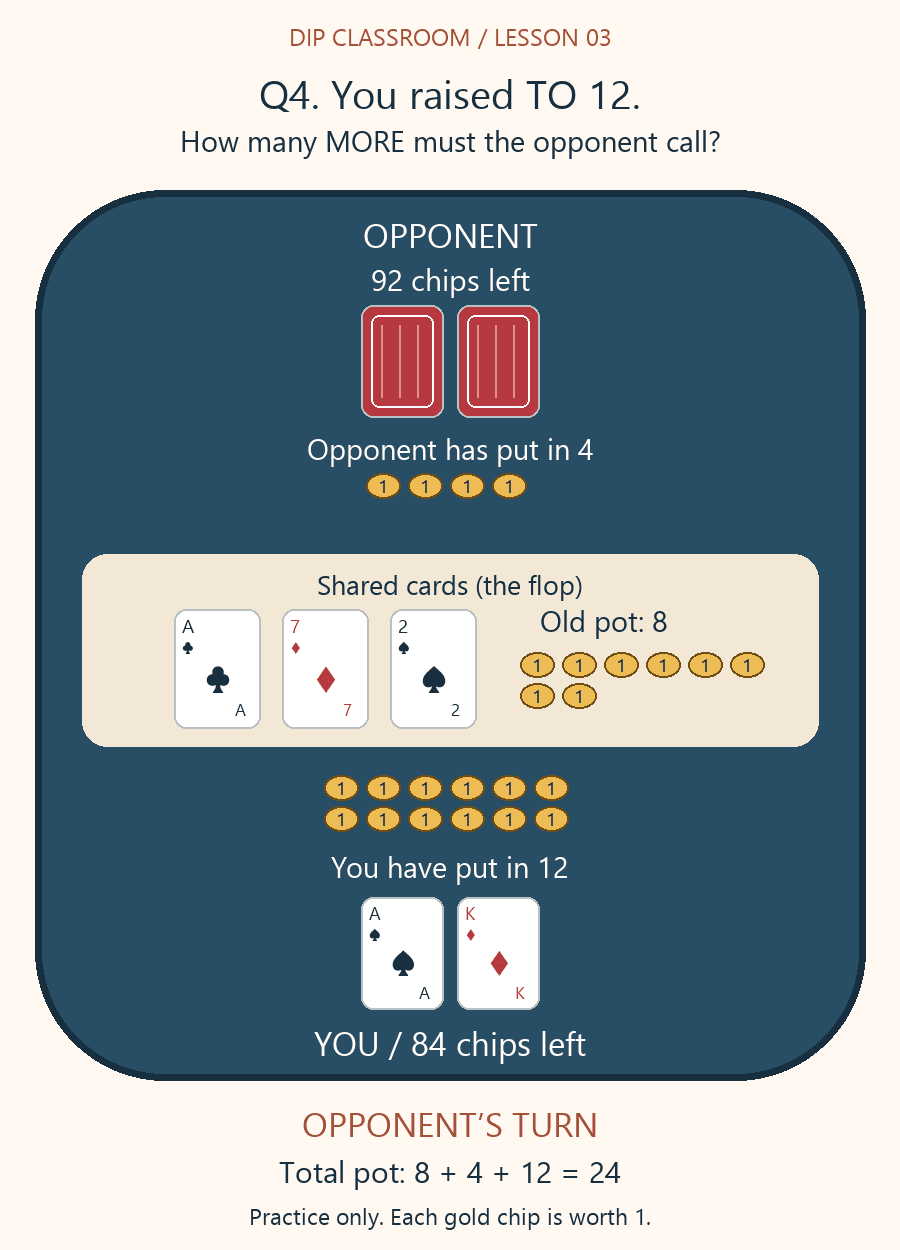
On A♣ 7♦ 2♠ with your A♠ K♦, the flop began with 8 in the pot. Your opponent bet 4; you then put in 12 total as a raise TO 12. You have 84 behind, the opponent has 92, and the pot is 24. How many MORE chips must the opponent add to call?
Show answer 4Hide answer 4
8 more: 12 minus the 4 already contributed. After that call, the pot is 24 + 8 = 32 and both remaining stacks are 84. Raise TO 12 means twelve total for this round, not twelve extra on top of a call.
Question 5: Rebuild the pot
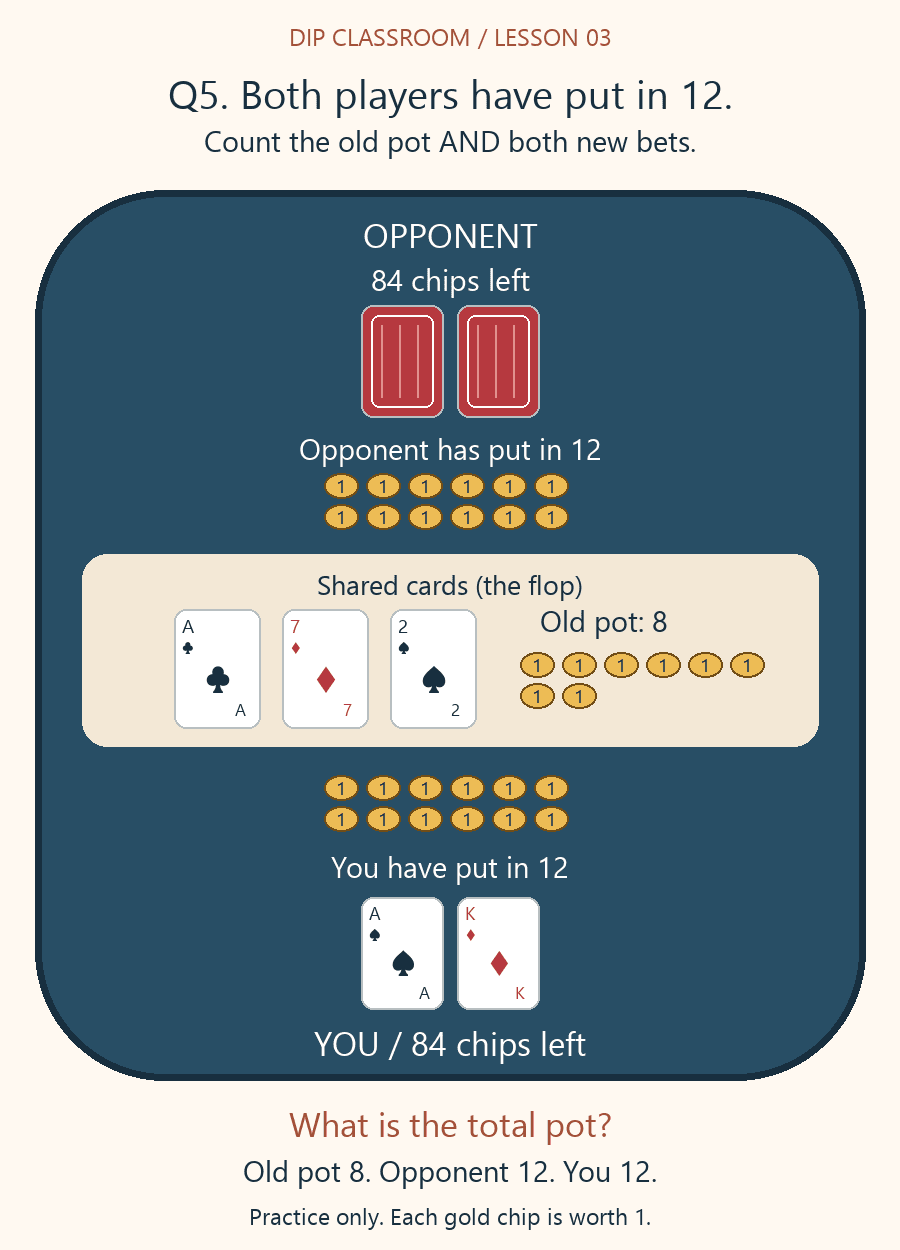
Two players see A♣ 7♦ 2♠; you hold A♠ K♦. The pot at the START of the flop was 8. By the end of this betting round, you have added 12 and the opponent has added 12. Each has 84 left. What is the total pot now?
Show answer 5Hide answer 5
32: the original 8 + your 12 + their 12. All 200 practice chips are accounted for: 84 + 84 + 32 = 200. The new contributions do not replace the original pot.
Question 6: After you fold
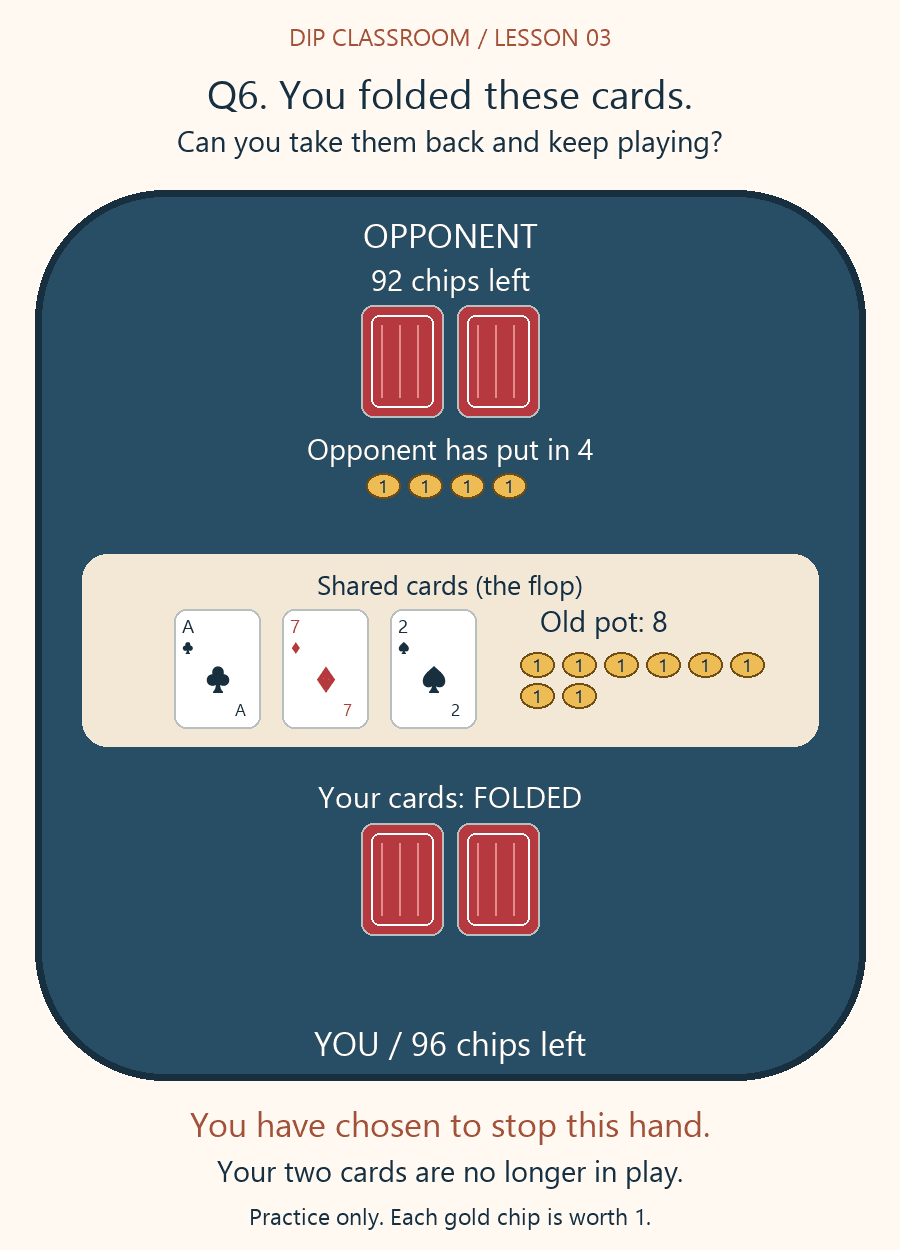
There are two players on A♣ 7♦ 2♠. The opponent bet 4 into 8; the displayed pot is 12. You choose to release your private cards and fold instead of calling. Can you rejoin this same hand when another community card appears?
Show answer 6Hide answer 6
No. A fold ends your participation in this hand. With only one player left, this hand ends immediately, so there is no need to deal a turn. The opponent receives their uncalled 4 back and wins the original 8. Wait for the next deal.
Optional detail: the smallest allowed raise
In ordinary no-limit hold'em, a full raise must increase the wager by at least the size of the last full bet or raise. Against the first bet of 4 in this example, the minimum full raise is to 8: match 4, then increase by at least 4. Raising to 12 is also allowed when your stack covers it.
If someone then raises over your 12, your raise increased the wager from 4 to 12, a difference of 8. The next minimum full raise would therefore be to 20, not automatically to 24. Short all-ins create additional rules about whether raising is reopened. We are deliberately not using short stacks here. Ask the dealer rather than guessing in a real game.
The big blind is already a live wager before the flop. That is why a player usually cannot simply check when they still owe chips to match it. The big blind can check their option if no raise has occurred and the action reaches them with nothing more to call.
Mini glossary
- Action: the decision a player makes when their turn arrives.
- Bet: the first voluntary wager on a betting round.
- Call: add enough chips to match the current wager, subject to all-in rules.
- Check: pass the action without a wager when you owe nothing to match.
- Fold: give up your private cards and your claim to this pot.
- Raise: increase the current wager.
- Pot: the chips being contested. Our diagrams include pending wagers before the round finishes.
- Stack: chips a player still has available to wager.
- Heads-up: a hand or game with two players.
- Uncalled bet: a wager no opponent matches; its unmatched portion is returned.
DIP's takeaway
Before worrying about whether an action is clever, make sure you know what it does. Ask: “Do I owe chips? What is the total wager? What happens to the pot if I choose this?” Once those answers feel natural, the table becomes much less confusing. Lesson 04 will focus on the button, blinds and where you sit in the action order.
Rules and arithmetic reviewed: September 17, 2026. Standard betting rules checked against PokerStars Learn. All examples, chip accounting and teaching diagrams are original DIP work.
Responsible play notice: Learn with free practice chips. Poker involves financial risk and no lesson guarantees a win. Never borrow to play or chase losses. Follow local age and legal requirements, and stop when playing is no longer enjoyable.