You have two hearts. Two more land on the flop. Someone bets, and the familiar thought arrives: “I make my flush about one time in three. Surely I can call.”
The number is close. The decision might not be.
The missing question is what you are buying. One call does not necessarily pay for both remaining cards. If another bet arrives on the turn, getting to the river has a new price.
First, count what is actually unseen
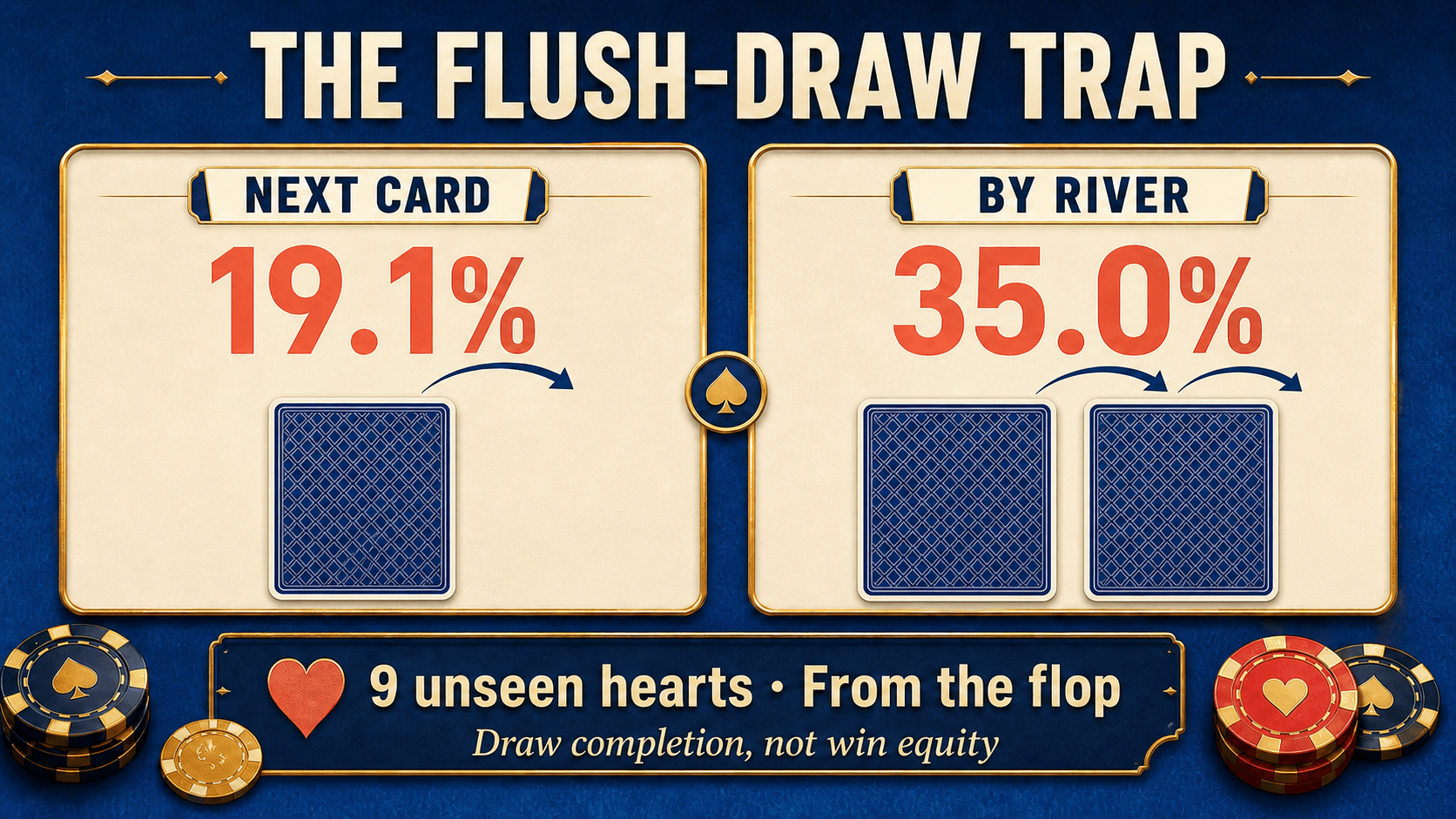
Consider A♥ J♥ on K♥ 8♥ 2♣. Four hearts are visible to you, leaving nine among the 47 unseen cards. We are counting the chance of completing a flush, not calculating your chance of beating a particular opponent.
Using only your five known cards and treating unseen cards as equally likely:
- Flop to turn: 9 ÷ 47 = 19.1%.
- Flop to river: 1 − (38 ÷ 47 × 37 ÷ 46) = 35.0%.
- After a non-heart turn: 9 ÷ 46 = 19.6% on the river.
Why is the second number larger? You get two opportunities. The calculation subtracts the chance of missing hearts on both cards from 100%.
These are exact card-counting calculations rounded to one decimal place. The familiar “rule of two and four” is a quick approximation—not a replacement for asking how many cards your decision covers.
Put a price on the call
Use this formula for a simple, heads-up decision with no further betting:
Required winning equity = amount you must call ÷ total pot after your call.
Suppose the turn is a blank, the pot contains 1,000 chips, and your opponent bets 500. Calling 500 creates a final pot of 2,000. Your break-even requirement is 25%.
Now isolate the draw: assume every heart wins, every non-heart loses, and there is no additional money won or lost on the river. The 19.6% completion chance falls short of that direct price.
Change the bet to 250. Your call makes a final pot of 1,500. The requirement drops to 16.7%, below the same draw's 19.6%.
Same cards. Different price. Different answer under those assumptions.
Real hands need more information, but this calculation gives you a starting point that “I have a draw” does not.
Why the flop's 35% can be misleading
Return to the flop. If you call a half-pot bet, you might compare a 25% price with the roughly 35% chance of a heart arriving by the river.
That shortcut leaves out the turn.
If you miss and face another bet, the original call has not bought a free river. You must decide whether to pay again, fold, or take another action. A flop call can still be good, but the two-card number alone does not prove it.
When your opponent is all-in and calling closes the action, you do get both remaining cards without another betting decision. Even then, compare the price with your actual winning equity against the opponent's possible hands—not merely your flush-completion percentage.
Nine hearts do not always mean nine winning cards
A completed flush is not a guarantee of winning the pot. A smaller flush can lose to a bigger one. A board-pairing heart can be dangerous against a set. Conversely, an ace or jack might sometimes win our example hand without completing the flush.
Opponent ranges change the calculation. Multiway pots change it again. This is why an honest analysis separates “my draw gets there” from “I win at showdown.”
Do not quietly count every favorable possibility as certain while ignoring the unfavorable ones.
A useful live-table checklist
- Count your outs without counting the same card twice.
- Ask whether your current decision covers one card or both.
- Work out the call price using the pot after your call.
- Check whether your apparent outs can still leave you behind.
- Consider future bets, position and possible extra winnings—but do not invent a future payoff just to justify calling.
The DIP view
Our preferred habit is simple: say the price before saying the percentage.
“I need 25%, and I have one card to come” is a much stronger starting point than “flush draws are 35%.” It forces the decision to match the situation.
Pot odds are a tool, not an instruction to gamble more. Tournament payouts, survival considerations and other players can add complications that a one-street example intentionally leaves out.
Information verified: August 31, 2026. Educational references: PokerStars Learn, Pot Odds and Calculating Outs. Numerical examples and calculations are DIP's own; the illustration shows draw completion, not win equity.
Responsible play notice: Poker involves financial risk. Set time and spending limits before playing, never chase losses, and do not use money needed for living expenses.