A missed flush draw feels like a natural bluff. You have spent two streets hoping for a spade, the river does not bring one, and your hand cannot win a meaningful showdown. But the two spades in your hand also remove possible spade draws from your opponent's hand. Some of those are exactly the hands you wanted to make fold.
The question is not simply whether you missed. It is whether your cards leave enough folds in the range that reaches the river.
The hand: 35BB in the middle
This is a hypothetical six-handed no-limit cash hand with 100BB effective starting stacks, blinds of 0.5BB/1BB, no ante and no rake. BB means big blind. Effective stack means the smaller stack that two players can wager against one another.
- BTN opens to 2.5BB. Hero in the small blind holds 6♠5♠ and three-bets to 10BB. The big blind folds; BTN calls. Both live players have contributed 10BB, plus the folded big blind's 1BB: pot 21BB.
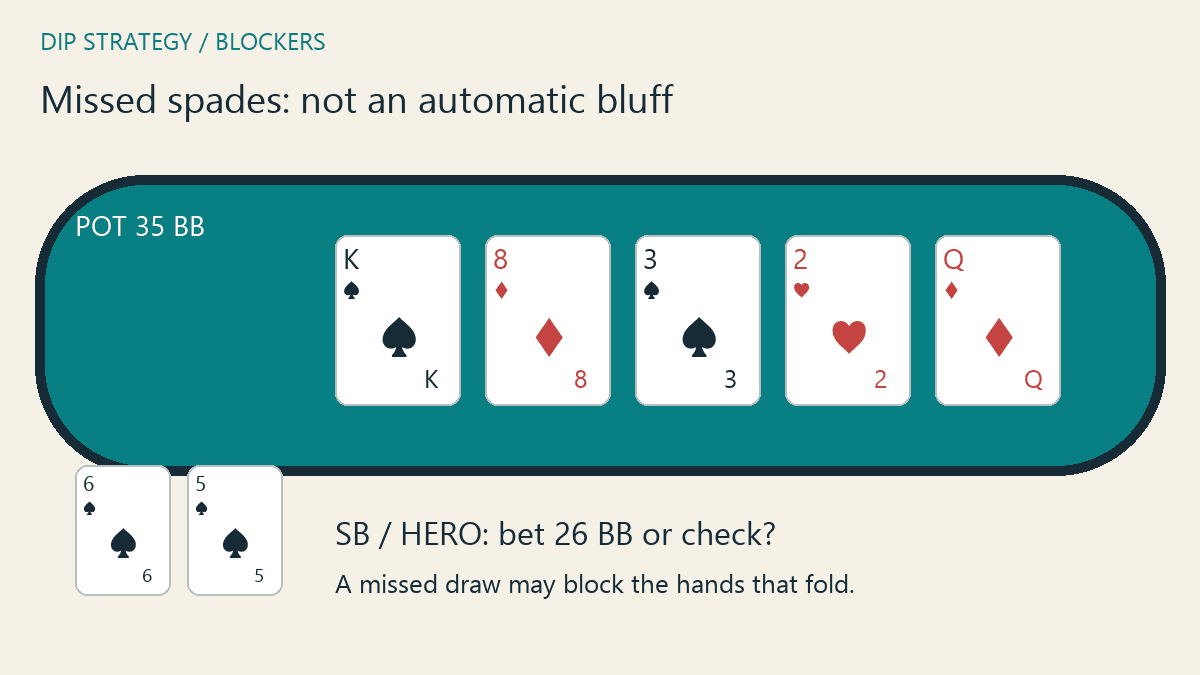
- Flop: K♠8♦3♠. Hero bets 7BB and BTN calls. Pot: 21 + 7 + 7 = 35BB. Each player has 83BB left.
- Turn: 2♥. Hero checks and BTN checks. No chips are added.
- River: Q♦. Hero acts first with six-high. The decision is whether to bet 26BB or check. River SPR is 83 / 35 = 2.37.
This is a river decision exercise, not a recommendation to routinely three-bet small suited connectors from the small blind. The earlier actions are fixed assumptions. Choosing a profitable preflop range is a separate problem.
First calculate the price of the bluff
Suppose every better hand either folds or calls, and a call always beats Hero. If BTN folds, Hero gains the existing 35BB. If BTN calls, Hero loses the new 26BB wager. Previously invested chips are already in the pot; do not subtract them again from this river calculation.
EV of betting = fold frequency × 35 − call frequency × 26.
Break-even fold frequency = 26 / (35 + 26) = 42.62%. That is not 26 / 87. The latter denominator includes a caller's additional chips and answers a different question. A zero-equity bluff needs to recover its cost through folds, not through winning a called pot.
If folds happen half the time, the result is 0.5 × 35 − 0.5 × 26 = +4.5BB. If folds happen one-third of the time, it is 35/3 − 52/3 = −5.67BB. Both use the same board and bet size.
A small, explicit range model
To isolate card removal, start with sixteen equally weighted opponent combinations. These are teaching cases, not a measured live-player range or solver output. We deliberately omit many plausible hands and assign a simple response to each.
Eight assumed folds:
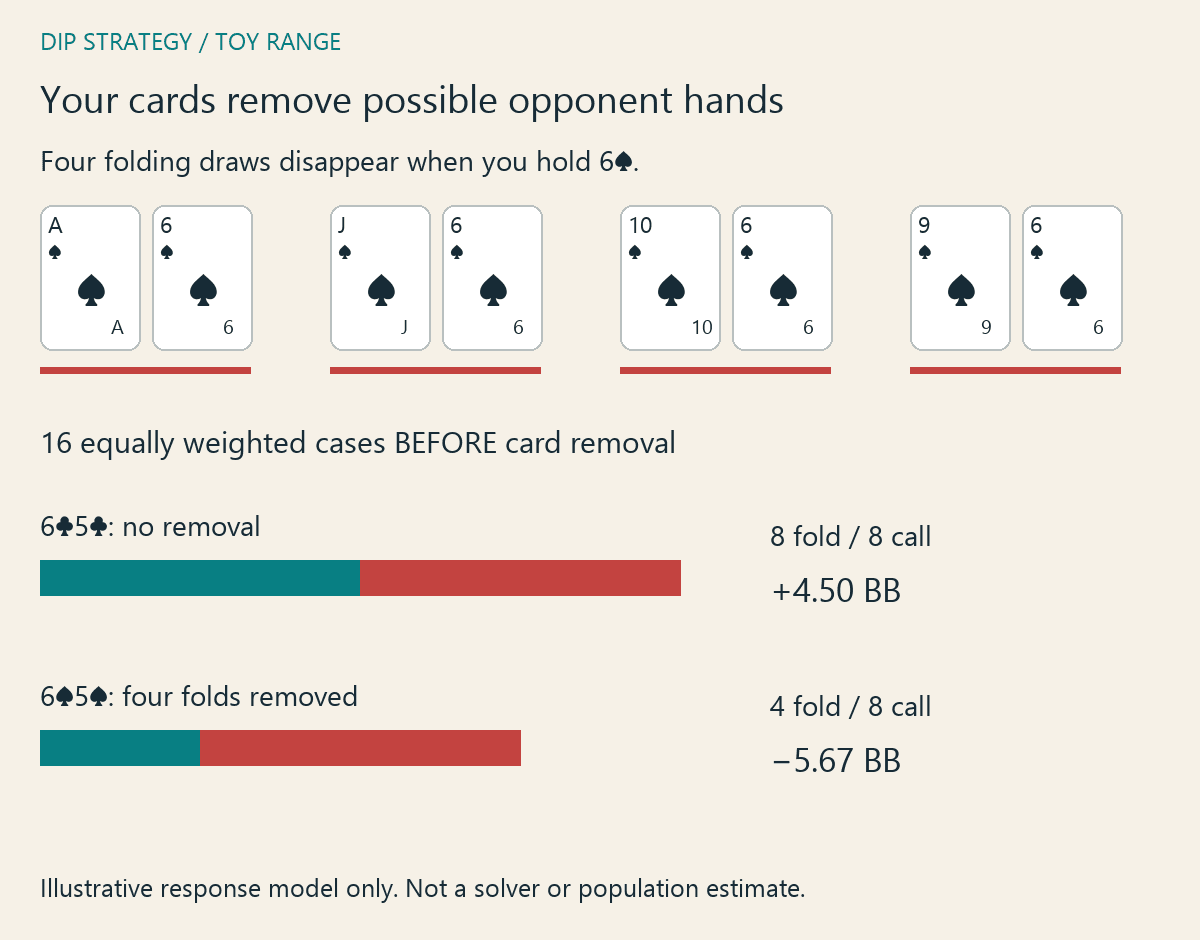
- A♠6♠, J♠6♠, 10♠6♠, 9♠6♠.
- J♣10♣, J♦10♦, J♥10♥, J♣9♣.
Eight assumed calls:
- K♣Q♣, K♣Q♥, K♦Q♣, K♦Q♥, K♥Q♣, K♥Q♥.
- K♣J♦, K♥J♣.
Every listed hand beats six-high on this board. Some would reach the river very infrequently under sensible preflop and flop strategies. Equal weighting is only a controlled demonstration. It must not be mistaken for a prediction about the player in front of you.
Now remove the impossible cards
With Hero holding 6♠5♠, BTN cannot hold any combination containing 6♠. The first four folding hands disappear. All eight calling hands remain. We now have four folds out of twelve possible cases, not eight folds out of sixteen.
That produces 33.33% folds and a −5.67BB bluff in this toy model.
For comparison only, substitute 6♣5♣ as a hypothetical river candidate. Neither club appears in the listed range, so all sixteen cases remain. Eight out of sixteen fold, giving +4.5BB. This does not tell us to take the same preflop and flop line with both hands. It shows how suit removal changes a fixed response model after we arrive at the decision.
What the model leaves out
Real opponents do not bring each listed combination to the river equally often. Some weak suited hands fold preflop. Some backdoor draws fold the flop. Some strong hands raise before the river. Other hands missing from this model, including different missed draws and pairs, matter enormously.
BTN can also raise. A bluff that folds to a raise still loses the 26BB wager, but a raising strategy changes our response categories and cannot simply be ignored when building a real range. Nor is checking automatically worth zero against every real opponent: six-high might beat a rarer lower hand, and later actions can change the result. Here, checking down loses against every listed combination, so zero is a useful reference for this restricted model.
Changing the bet size also changes which hands fold. A 12BB bluff needs 12/47 = 25.53% folds, but BTN may call that smaller bet much wider. A lower mathematical threshold does not create the required folds by itself.
The practical decision
- Check when you cannot identify enough realistic folds, especially against a player who rarely releases a pair. Giving up an unsuitable bluff is part of a complete strategy.
- Consider betting when the line represents credible value, the opponent has enough hands that can fold, and your specific cards do not remove too many of those folds.
- Separate blockers to calls from blockers to folds. Removing a strong calling hand can help a bluff. Removing a likely fold can hurt it. A card is not a good blocker in isolation.
- Do not bluff every missed draw. Candidate selection and total bluff frequency must fit the value hands that take the same line.
DIP's view
Before saying “I block spades,” finish the sentence: “I block spades that would do what?” On a river where the flush missed, that answer may be “fold.” The useful habit is to name the opponent's folding and continuing hands before reaching for chips. Card removal refines a credible range estimate; it cannot rescue a range you invented to justify a bet.
Information verified: September 12, 2026. All hands, range models, diagrams and calculations are original DIP teaching examples. No solver or population-frequency claim is made.
Responsible play notice: Poker involves financial risk. Study with play chips, set affordable limits and do not chase losses. No strategy guarantees a profit. Only play where you meet local age and legal requirements. Do not gamble with borrowed money.