A flush draw gives you a way to win at showdown. A shove gives you another way: your opponent can fold. The mistake is treating the first fact as proof that the second action is profitable.
Here is a turn decision where the missing ingredient is not the number of spades. It is how often the bettor will actually release a hand.
The hand: 30 BB, two players, one card to come
This is a hypothetical six-seat tournament hand, away from meaningful payout pressure. Both relevant players begin with 30 big blinds. There is no ante and no rake. We evaluate chips, not cash value.
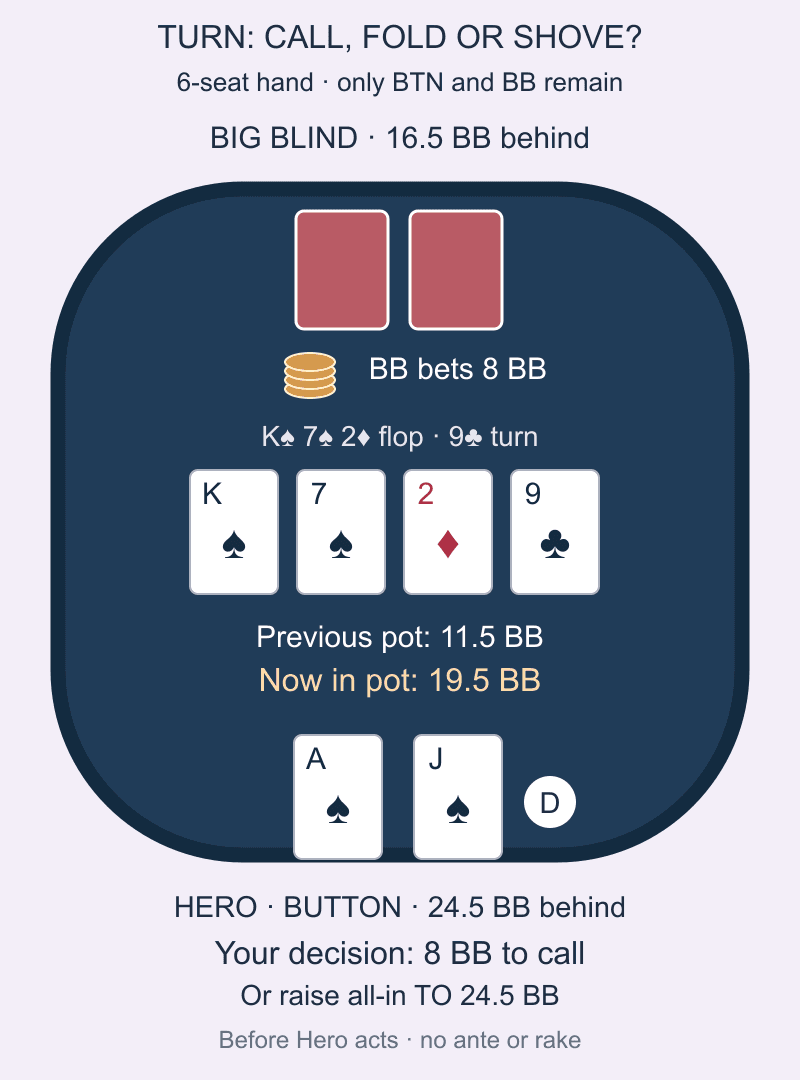
UTG, HJ and CO fold. Hero raises to 2.5 BB on the button with A♠ J♠. The small blind folds, leaving 0.5 BB behind. The big blind calls.
- Preflop pot: 2.5 + 2.5 + 0.5 = 5.5 BB.
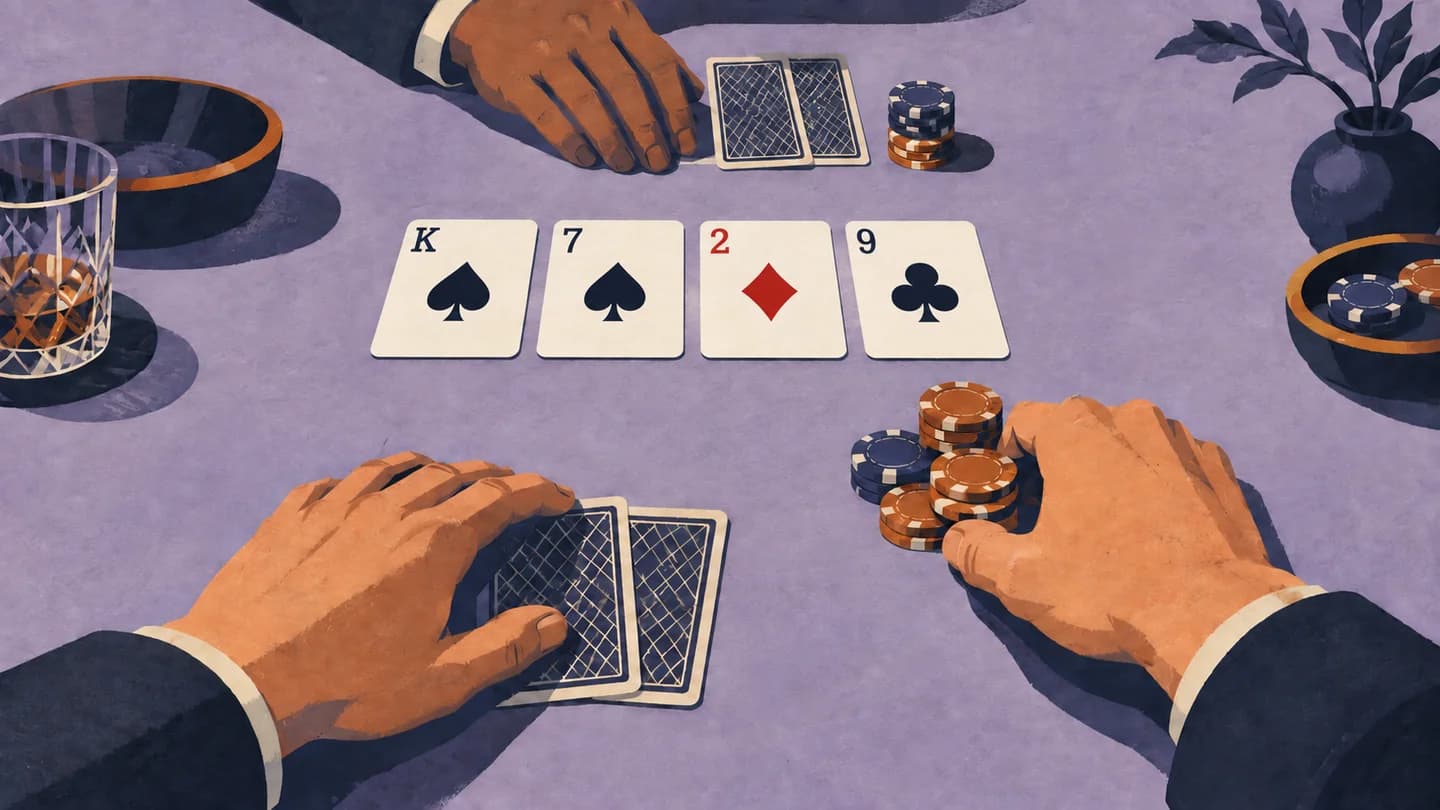
- Flop: K♠ 7♠ 2♦. BB checks, Hero bets 3 BB, and BB calls.
- Turn pot: 11.5 BB. Both players have 24.5 BB remaining.
- Turn card: 9♣. BB leads for 8 BB, leaving 16.5 BB.
- Hero faces 8 BB with 24.5 BB behind. The pot currently contains 19.5 BB.
Hero has ace-high and the nut-flush draw, not a made flush. The decision is fold, call 8, or shove the remaining 24.5. The shove is a raise TO 24.5 BB on this street, not 24.5 on top of a call.
Calling is not automatically cheap enough
Calling costs 8 BB and makes the pot 27.5 BB. If that bought a guaranteed showdown, the break-even equity would be 8 ÷ 27.5 = 29.1%.
But it does not guarantee showdown. Both players would still have 16.5 BB, and the river can bring another bet. A call needs a plan for both a spade and a blank, including whether an improved hand can collect more chips. Do not count a hoped-for river payment as guaranteed income.
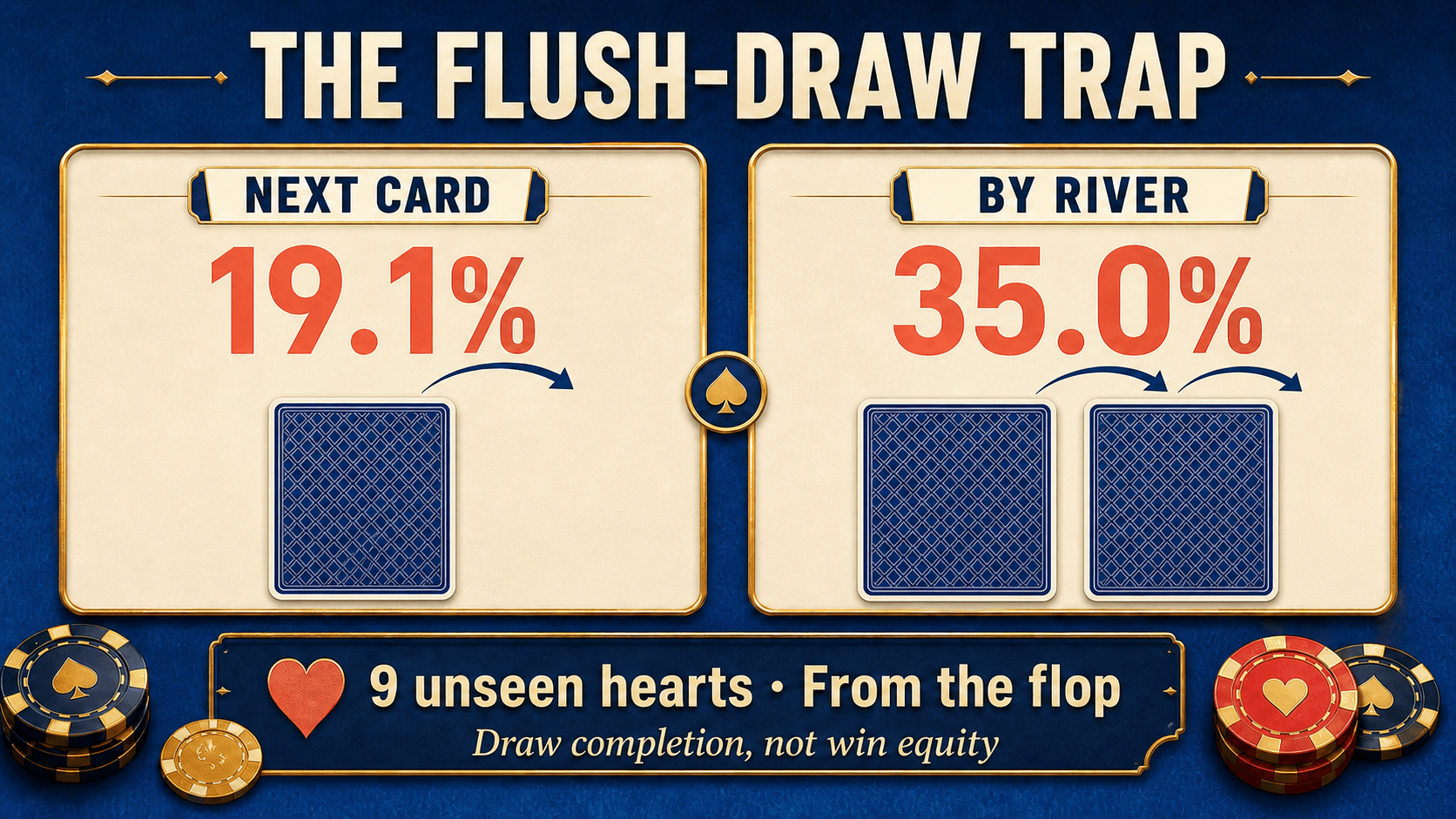
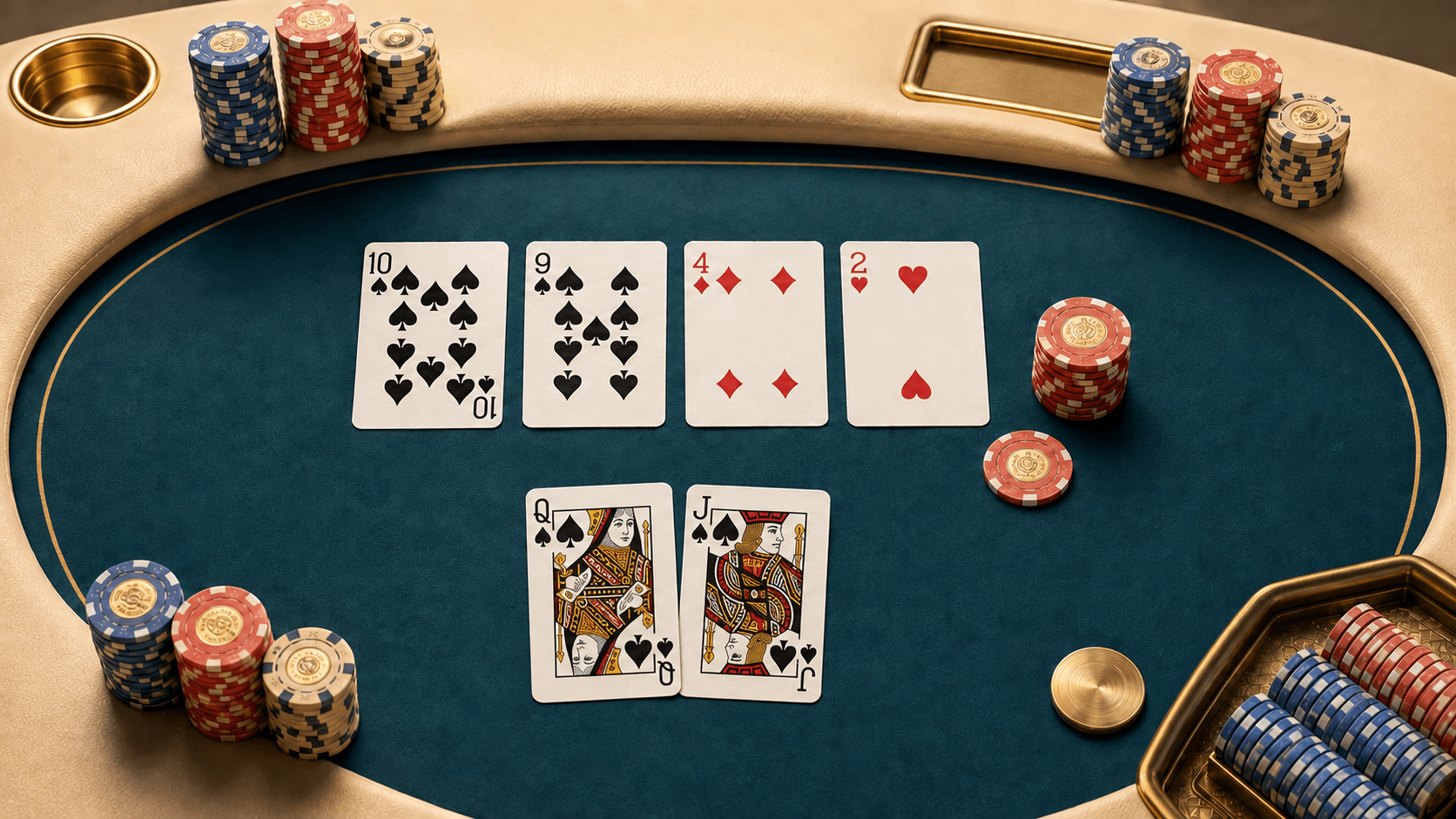
Four spades are visible between Hero's cards and the board, leaving nine unseen spades. The simple draw count is 9 out of 46 unseen cards, or 19.6%. That is a starting count, not an exact equity calculation against a betting range. Some aces may also win; a board-pairing spade can lose to a full house.
For a concrete contrast, suppose the opponent's otherwise unknown hand were K♣ Q♦. With both hands exposed, 44 river cards remain: nine spades and three aces win for Hero, for 12/44 = 27.3%. Against 7♥ 7♦, only seven spades win: 2♠ and 9♠ make the opponent a full house. That is 7/44 = 15.9%. Neither hand is information Hero actually possesses. They show why “I have a flush draw” is not enough.
The shove closes future betting
If Hero shoves and BB calls, BB adds 16.5 BB. The final pot is:
19.5 + 24.5 + 16.5 = 60.5 BB.
Hero risks 24.5 now. Previously invested chips are already in the pot; do not charge them again. If BB folds, Hero gains the current 19.5 BB relative to folding now. The uncalled portion of Hero's shove is returned, not won from the opponent.
Unlike calling, the called shove leaves no river betting. We can therefore test it with a simple model.
Assume Hero has 25% equity against the hands that CALL the shove. This is a sensitivity assumption, not a solver result or a claim about this opponent. The calling range matters: hands that fold do not belong in that equity estimate.
When called, average net result = 0.25 × 60.5 − 24.5 = −9.375 BB.
Let F be the chance BB folds. The shove's expected value, measured against folding, is:
EV = F × 19.5 + (1 − F) × (−9.375).
Set EV to zero. Hero needs F = 9.375 ÷ 28.875 = 32.5%, rounded. Under this particular assumption, roughly one fold in three makes the shove break even.
Change the read, change the answer
At 25% called equity:
- If BB folds 20% of the time, the shove averages −3.60 BB.
- If BB folds 45%, it averages +3.62 BB.
The same cards can therefore support very different decisions. Also test the equity assumption itself:
- 20% called equity needs 38.9% folds.
- 25% called equity needs 32.5% folds.
- 30% called equity needs 24.6% folds.
These are model boundaries, not recommended frequencies. A positive shove EV also does not prove shoving beats calling; calling needs its own river model.
What could BB be leading?
Build a plausible range before assigning a fold rate. A value-heavy lead containing sets, two pair and strong kings may continue often, leaving little fold equity. A player who leads weaker one-pair hands or draws and then gives up to pressure creates a different opportunity.
Hero's A♠ J♠ removes some spade draws from BB's possible hands. That may remove hands which would otherwise bet and fold. Holding the nut draw is not automatically a useful bluffing blocker in every line.
BB would call 16.5 to contest a final 60.5, a 27.3% equity price. That does not force a call, but it should discourage casually assuming every top pair disappears. Consider the actual opponent, previous bet-folds, board interaction and stack depth.
Three choices, three trade-offs
Fold: preserve 24.5 BB when the lead is strong and neither a call nor a shove has a convincing profit case. A draw does not create an obligation to continue.
Call: keep the investment smaller and retain position. The drawback is an awkward river with only 16.5 BB behind. Know which improvements are clean and what you will do against another bet.
Shove: deny the opponent a comfortable river decision and combine showdown equity with immediate folds. The drawback is risking all remaining chips against a stronger continuing range.
Near a bubble or pay jump, this chip-EV model is insufficient. Risk premiums can make a chip-profitable gamble undesirable.
DIP's take
Do not shove because the draw looks strong, and do not call just because shoving feels uncomfortable. Separate three questions: what calls, how much equity you have against those calls, and how often the bettor folds. If your conclusion needs a fold rate you cannot defend, the equation is a warning, not permission.
Practise with play chips first. Set limits before playing, never chase losses, and do not risk money you need for essentials.