A tiny bet can make top pair feel like an automatic raise. Before adding chips, ask a different question: which worse hands will pay the raise, and what will you do if the bettor raises again?
This worked cash-game hand compares calling with a modest value raise. The numbers are exact for the stated setup; the opponent descriptions are assumptions, not measured population tendencies or solver advice.
The big blind bets before the preflop raiser
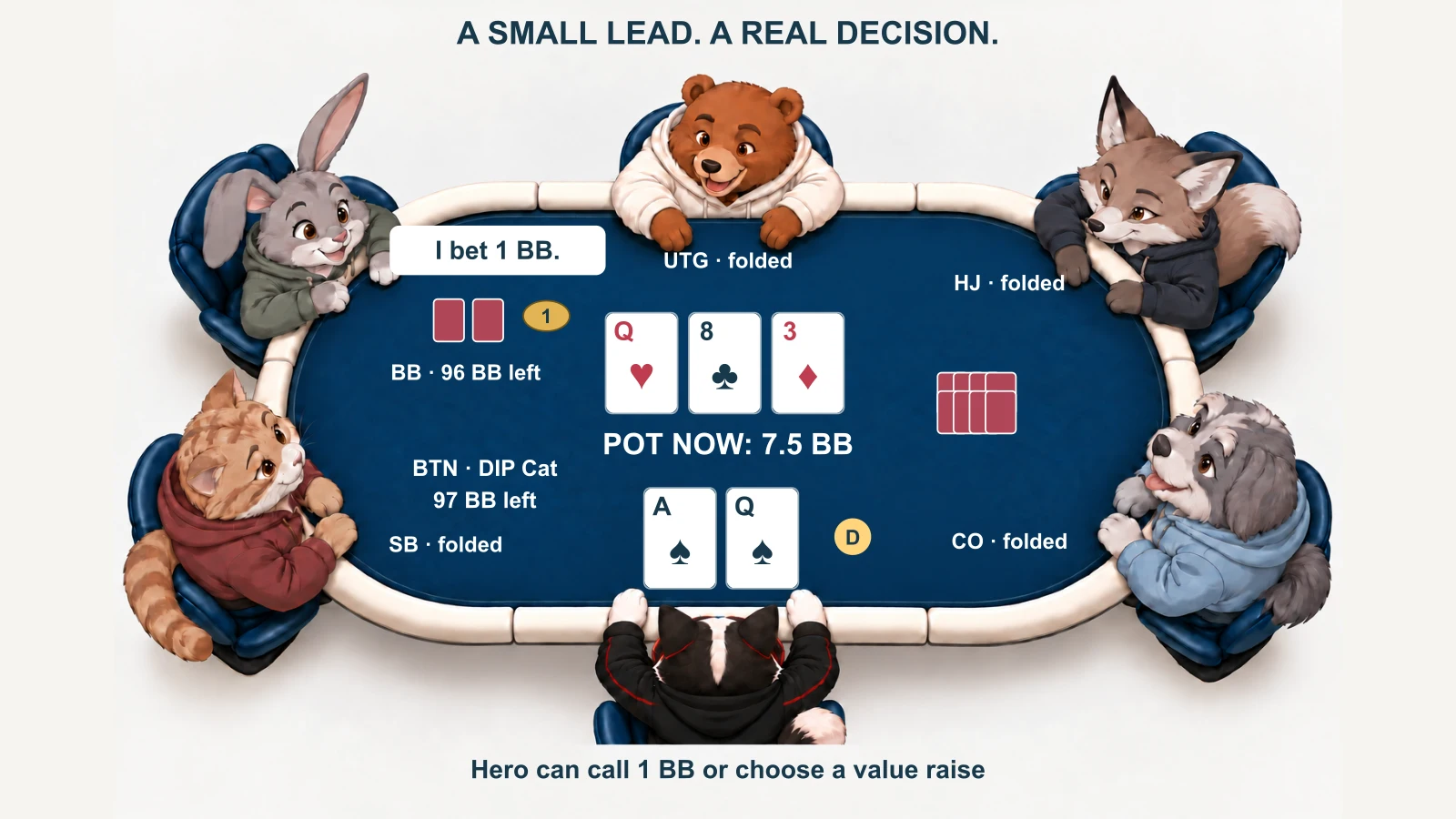
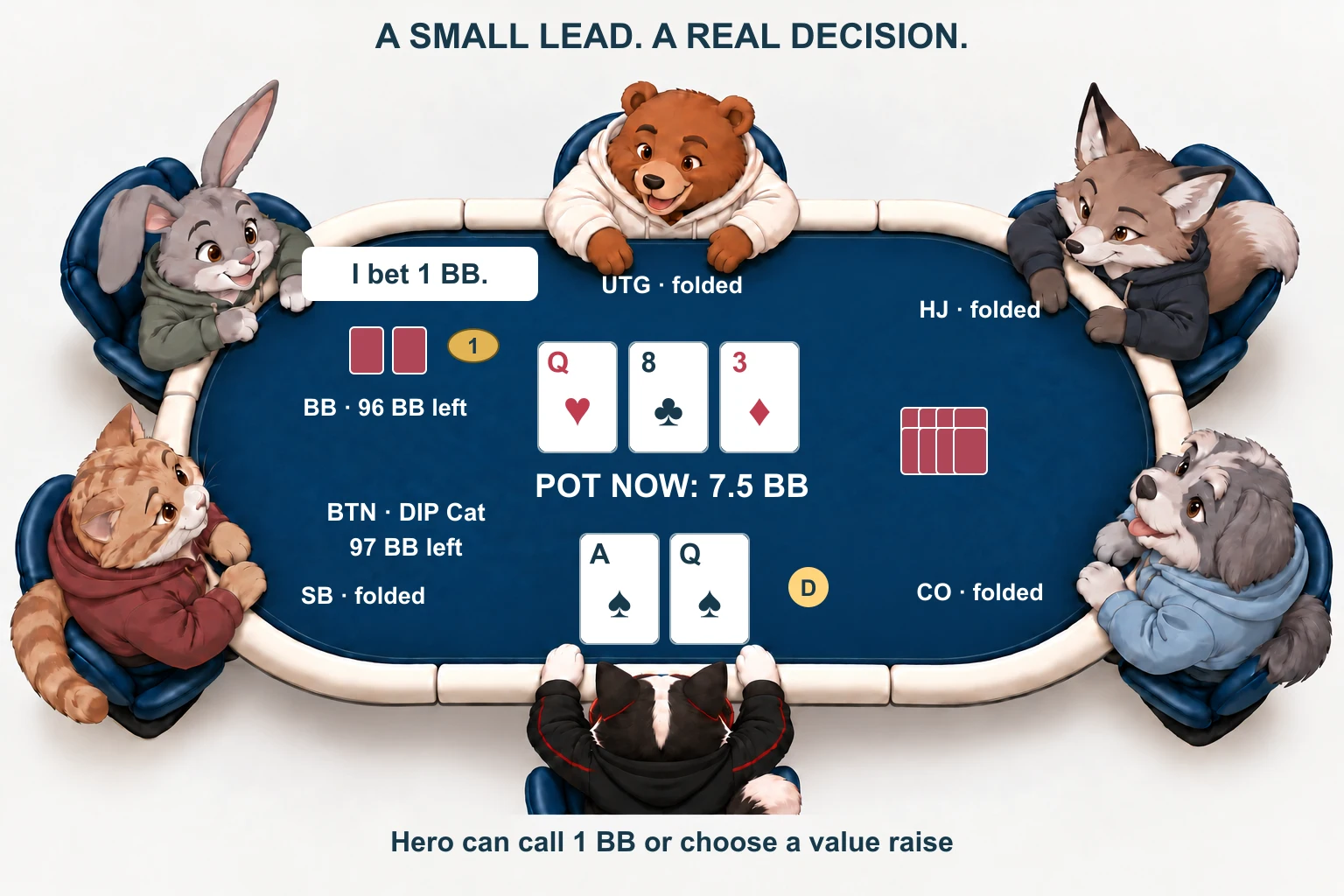
Six players start with 100 big blinds each. There are no antes, and we ignore rake for this example. UTG, HJ and CO fold. Hero on the button opens A♠ Q♠ to 3 BB. The small blind folds and the big blind calls another 2 BB.
The pot is 6.5 BB, including the folded small blind's 0.5 BB. Hero and the big blind each have 97 BB behind. Only these two players see the flop.
The flop is Q♥ 8♣ 3♦. The big blind leads for 1 BB into 6.5 BB. This is often called a donk bet: a player bets into the previous street's aggressor. The name describes the action, not whether the player is good or bad.
Hero has top pair, ace kicker. The pot is now 7.5 BB. The big blind has 96 BB behind; Hero still has 97 BB. Hero can fold, call 1 BB or raise.
The cheap call is a price, not the whole answer
Calling 1 BB creates an 8.5 BB pot. The immediate pot-odds threshold is 1 ÷ 8.5 = 11.76%.
That does not mean any hand with 12% raw equity should continue. More betting can follow, so equity realization and later costs matter. Here, top pair with the best kicker has much more practical value than an unmade hand, but it can already be behind a set or two pair.
The tiny size alone does not reveal the big blind's range. Possible hands include weaker queens, an eight, low pairs, occasional bluffs, and traps. Availability is not frequency: listing a hand does not tell us how often this opponent uses it.
Raise for calls from worse, not to punish the size
Consider a raise to 5 BB total. Hero puts in 5 BB, not 6. The big blind would need another 4 BB to call.
- Before that call, the pot would be 12.5 BB: the original 6.5, the big blind's 1 and Hero's 5.
- If called, the pot becomes 16.5 BB and both players have 92 BB remaining.
- The big blind's immediate call price is 4 ÷ 16.5 = 24.24%.
- The turn stack-to-pot ratio, or SPR, is 92 ÷ 16.5 = 5.58.
This size is an illustration, not a universal prescription. It builds a pot without forcing the entire stack in. It makes sense as a value raise when you have reason to expect hands such as KQ or QJ to call, perhaps alongside some stubborn eights.
There can also be protection value when a worse hand folds away a chance to improve. But if the raise drives out nearly every worse hand and only better hands continue, calling may preserve more value. “I do not want to be outdrawn” is not enough to justify any raise size.
Calling can keep useful hands in
A call leaves 96 BB behind each and an 8.5 BB pot, an SPR of 11.29. Hero retains position and keeps the big blind's possible bluffs in the hand.
That is attractive against an opponent who leads weak hands but folds them to raises, or whose small leads sometimes conceal strong hands. The cost is giving those weaker hands a cheaper chance to improve and missing immediate value from worse queens that would have called a raise.
Against an unknown opponent, calling is a reasonable starting choice. Against a player you have actually seen lead and call raises with weaker pairs, the modest value raise becomes more attractive. Neither description comes from the bet size alone. Folding top pair to this price would require an unusually compelling read; it is not our default.
Plan the turn before you raise
These are alternative branches after Hero raises to 5 BB and gets called, not successive boards. In both, the turn starts with 16.5 BB in the pot and 92 BB behind each.
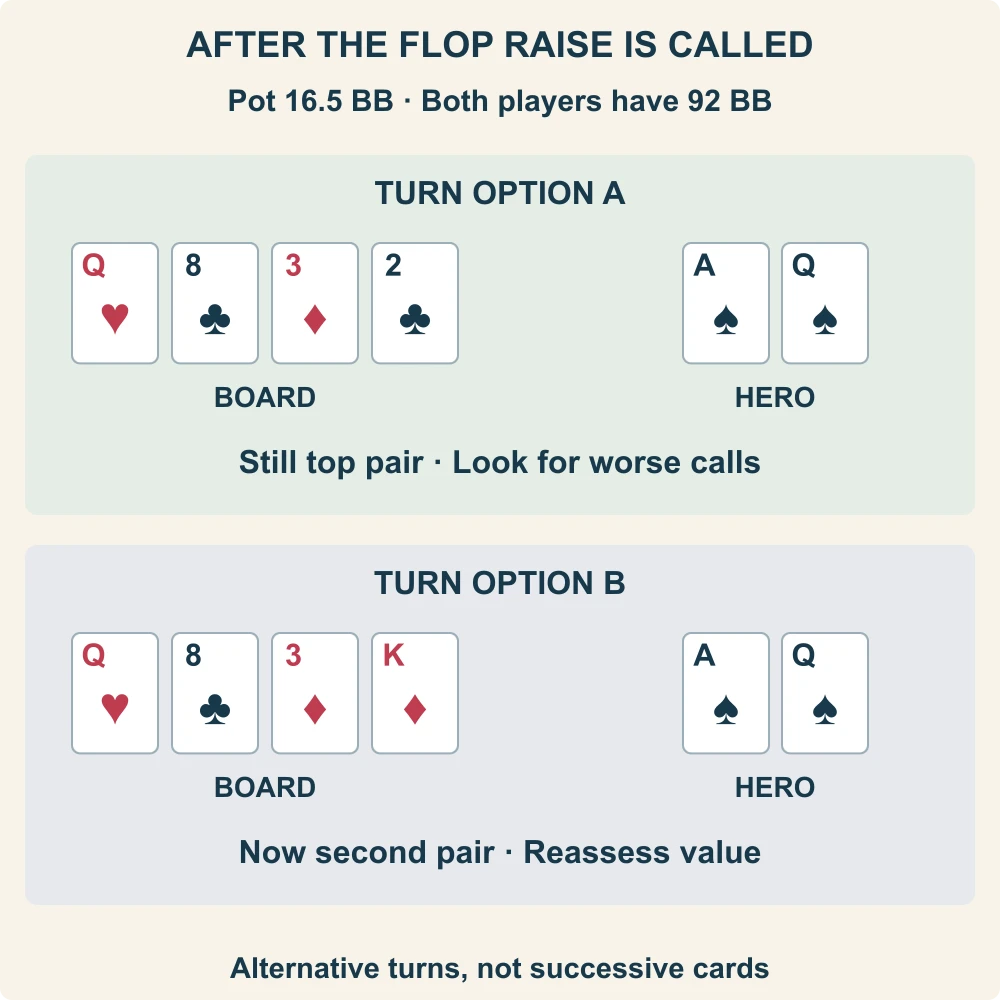
On the 2♣, if the big blind checks, Hero can consider another value bet when worse queens still call. A check back also remains available against a tighter continuing range. If Hero bets 8 BB and gets called, the river pot would be 32.5 BB with 84 BB behind each.
On the K♦, Hero still has a pair of queens, but KQ has improved to two pair and some other king-containing hands have improved. Do not automatically repeat the same value bet. Checking behind can preserve showdown value; a bet requires a fresh explanation of what worse hands call. The king is a reason to update, not proof that every opponent now has a king.
What if the small lead becomes a big reraise
Suppose instead that the big blind reraises the flop to 18 BB total after Hero makes it 5 BB. Hero faces another 13 BB. The pot is 29.5 BB before Hero responds: 6.5 + 18 + 5. Calling would make it 42.5 BB, giving a price of 13 ÷ 42.5 = 30.59%.
Both players would still have 79 BB behind after that call. Hero is not automatically committed. Against a player whose reraise is strongly weighted toward sets and two pair, folding can be sensible. Against a genuinely aggressive range with enough weaker hands or bluffs, continuing can be justified. We have not assigned frequencies, so the pot odds cannot resolve that decision by themselves.
The original small lead does not make the later reraise small. Recalculate from the new action rather than defending your previous raise.
DIP takeaway
Do not turn a small bet into a contest of pride. With top pair, calling retains weaker hands and controls the pot; raising can collect value from worse hands that actually continue. Choose between them using the opponent's response range, then update when the board or action changes.
Avoid three traps: assuming a tiny bet is always weak, raising only to find out where you stand, and treating money already invested as a reason to keep calling.
Play only with money you can afford to lose, set session limits, and step away when frustration starts making decisions for you.