An open raise and a call put extra chips in the middle. That does not make them free money. From the small blind, a squeeze can reduce the number of opponents and charge them to continue, but it also builds a pot you will usually play out of position.
The exact decision
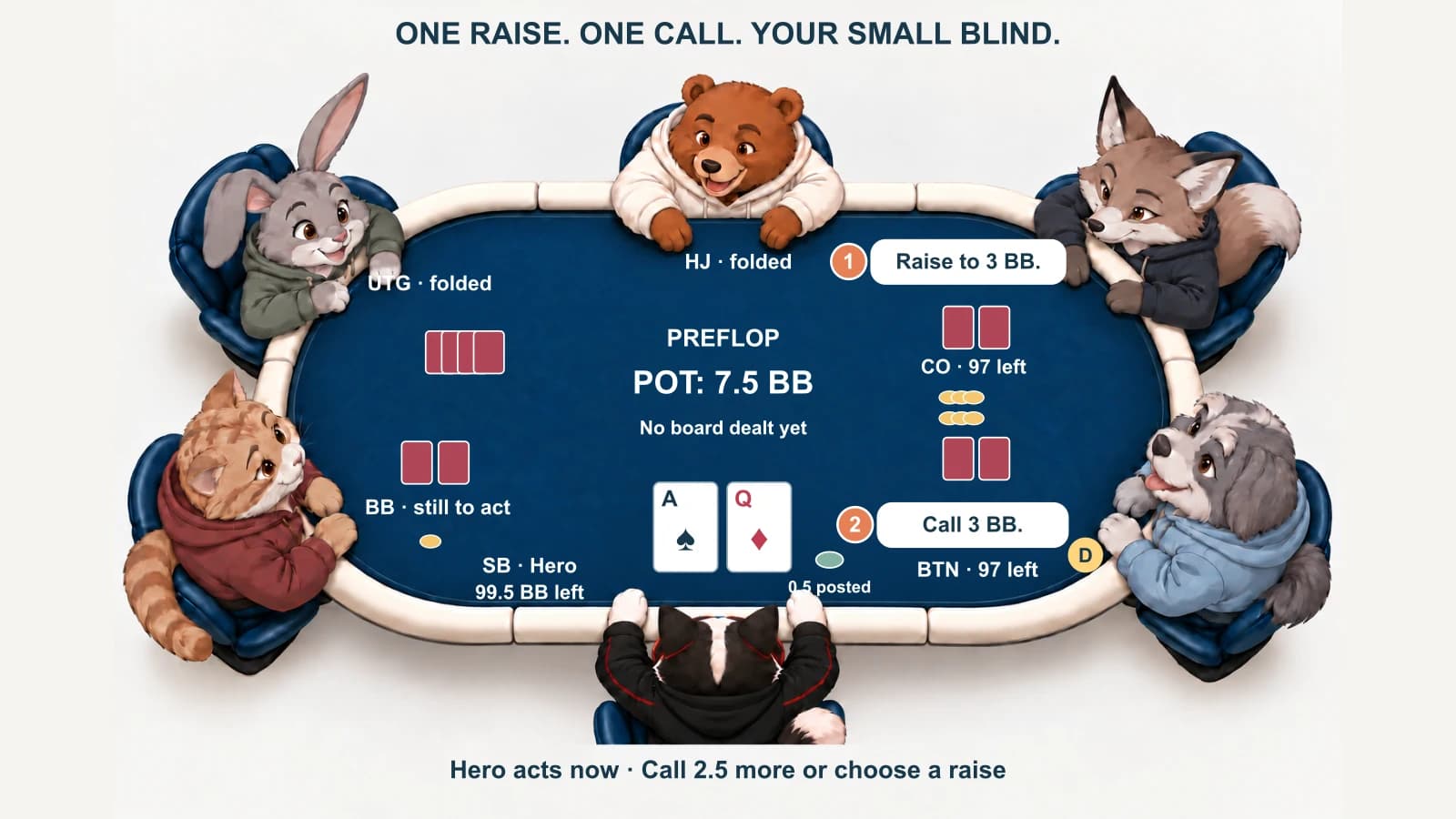
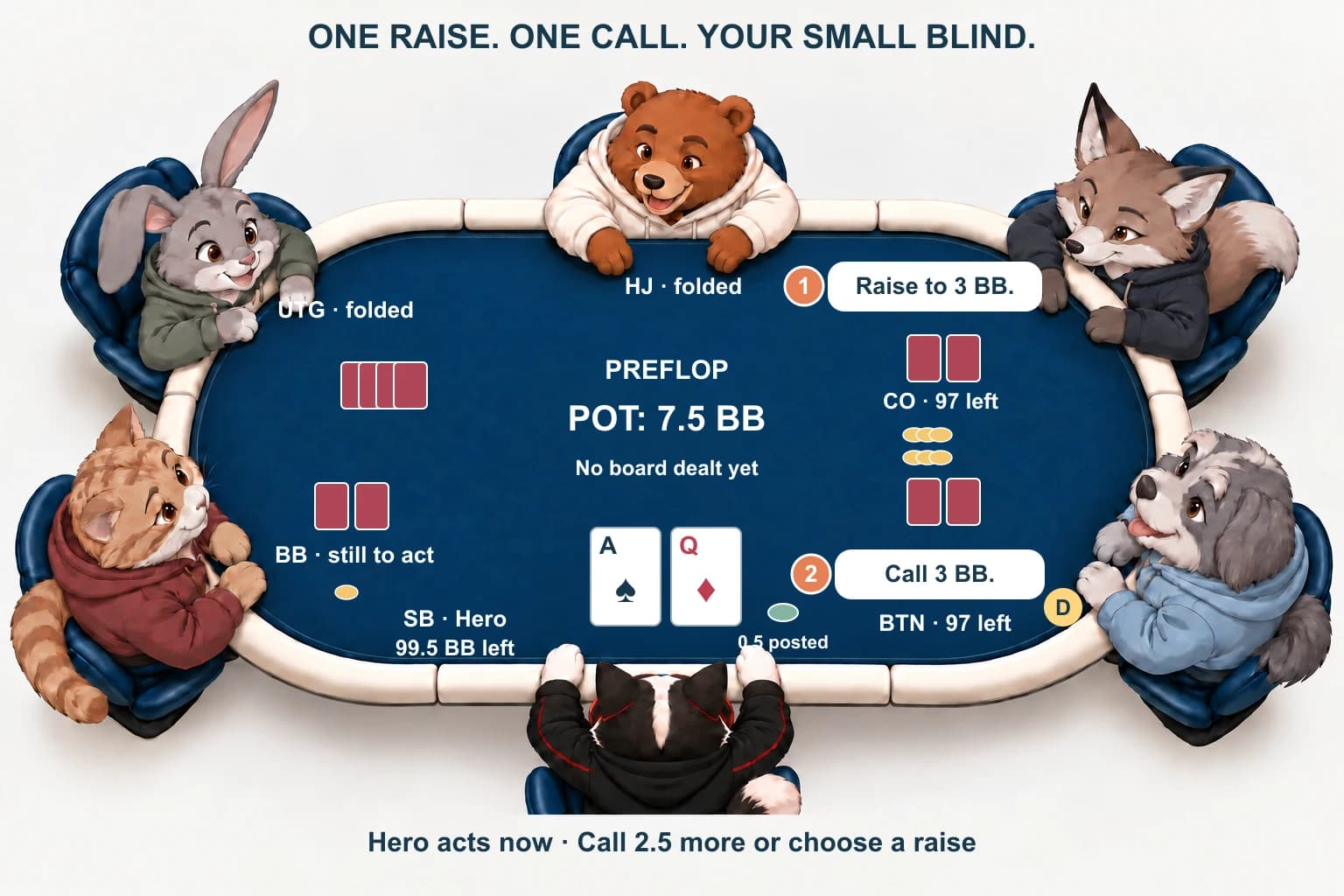
Consider a hypothetical six-handed cash game. Everyone starts with 100 BB, with no ante or rake. UTG and HJ fold. CO opens to 3 BB and BTN calls 3 BB. Hero is SB with A♠ Q♦, having posted 0.5 BB. BB has posted 1 BB and still has a decision.
The current pot is 7.5 BB: CO 3, BTN 3, SB 0.5 and BB 1. Hero has 99.5 BB behind. Calling costs another 2.5 BB. A squeeze is a re-raise after a raise and at least one call. We will examine a raise to 15 BB total, which costs Hero another 14.5 BB, not another 15.
What calling buys, and what it does not
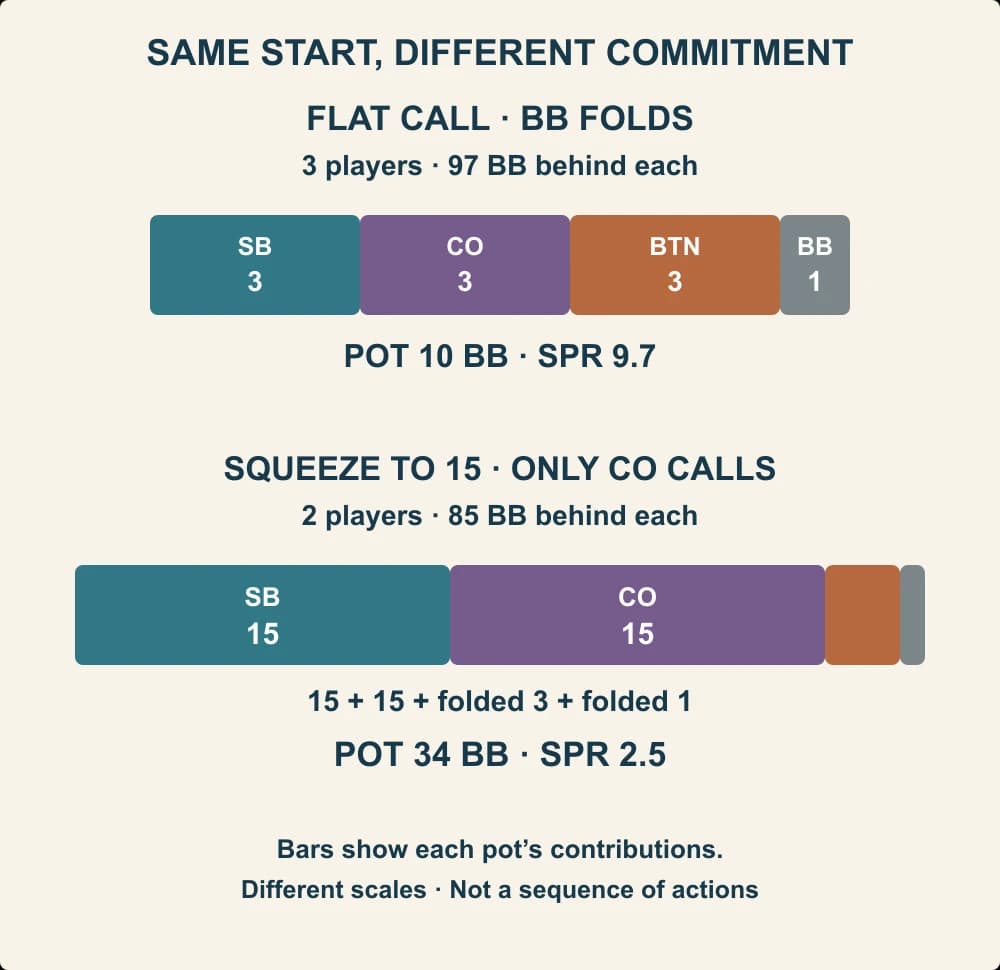
If Hero calls and BB folds, three players see a flop with 10 BB in the pot. Hero, CO and BTN each have 97 BB left. If BB also calls another 2 BB, four players see a 12 BB pot, with 97 BB behind each.
The immediate price with BB folding is 2.5/10, or 25%. But that is not a reliable 'call whenever my equity exceeds 25%' rule. BB can raise, later betting can cost more, and acting first makes it harder to realise equity. Hero does not buy an all-in showdown for 2.5 BB.
Calling keeps weaker hands in and avoids immediately committing more chips against a strong opener. The cost is a potentially multiway pot from the worst postflop seat. A queen-high flop can look comfortable while still requiring care against several ranges.
Why a squeeze may fit AQ
Against a reasonably wide CO opening range and a BTN who calls many hands but re-raises most premiums, AQ can benefit from taking the initiative and reducing the field. Worse aces or broadway hands may continue, depending on the players. A♠ Q♦ also removes combinations of AA, QQ and AQ from opponents' possible holdings.
That is an assumption-led argument, not proof that everyone behind is weak. BTN can trap with AA or KK. CO can open tightly. BB can wake up with a premium. Against those conditions, the same squeeze becomes less attractive. AQ offsuit is not an instruction to put in 100 BB regardless of the response.
Fifteen BB is a worked size, not a universal chart recommendation. There is already a caller, Hero is out of position, and a small re-raise can offer several opponents an easy price. Larger opens, deeper stacks and unusually sticky players change the sizing problem; do not transplant this number without those details.
Count everyone who must fold
For a deliberately simplified pure bluff, Hero risks 14.5 BB to win the existing 7.5 BB. Assuming Hero always loses the entire new investment whenever anyone continues, the immediate break-even all-fold rate is:
14.5 / (14.5 + 7.5) = 65.9%.
This is not a required fold rate for AQ, which has value when called. It is a stress test showing why 'there is dead money' is an incomplete argument. It also measures everyone folding, not just the original raiser.
For illustration only, suppose BB folds 90% of the time, CO folds 60% given BB folded, and BTN folds 70% given both already folded. The joint chance is 0.90 × 0.60 × 0.70 = 37.8%. These are invented conditional probabilities, not database statistics. They are far below the pure-bluff threshold. Calling and postflop outcomes matter; this calculation alone does not estimate AQ's full expected value.
One caller changes the postflop plan
Take this branch: Hero raises to 15, BB folds, CO calls another 12 and BTN folds. The pot is 34 BB: Hero 15, CO 15, BTN's folded 3 and BB's folded 1. Both remaining players have 85 BB. The stack-to-pot ratio is 85/34 = 2.5, compared with 97/10 = 9.7 in the three-way flat-call branch.
Now deal Q♣ 7♦ 2♠. Hero has top pair, ace kicker, and acts first. In an illustrative continuation, Hero bets 10 BB and CO calls. The pot becomes 54 BB and each has 75 BB left. The pot has grown quickly without either player going all-in.
Against a range that includes worse queens and medium pairs, a modest value bet can make sense. Against a very tight range, fewer worse hands may pay. A low SPR makes big pots easier to reach; it does not prove that an opponent's raise is weak or that top pair must always stack off. A turn decision still depends on the turn card and the action.
If the squeeze gets re-raised
If BB folds and CO re-raises to 35 BB, the pot before BTN responds is 54 BB: SB 15, CO 35, BTN 3 and BB 1. Hero would need another 20 to call if BTN folds, making 74 BB with 65 BB behind each. The apparent price is 20/74 = 27.0%, but this still buys a flop, not a guaranteed showdown.
Against a player whose re-raises are overwhelmingly AA, KK and AK, folding AQ can be a disciplined response. Against a wider range, the decision changes. Do not invent bluffs to justify defending your first raise, and do not forget BTN has not yet acted when CO makes the re-raise.
DIP's conclusion
A squeeze with AQ can be a practical option against a wide opener and a loose caller, provided Hero has a plan for a call or another raise. Flat-calling is cheaper now but often creates a difficult multiway pot. Folding becomes more reasonable as the opener and players behind become unusually strong. Start with ranges, position and response plans; use the dead money as part of the calculation, not the whole reason to raise.
Practise these branches with play chips. If you play for money, follow local eligibility rules, set limits and never chase losses.