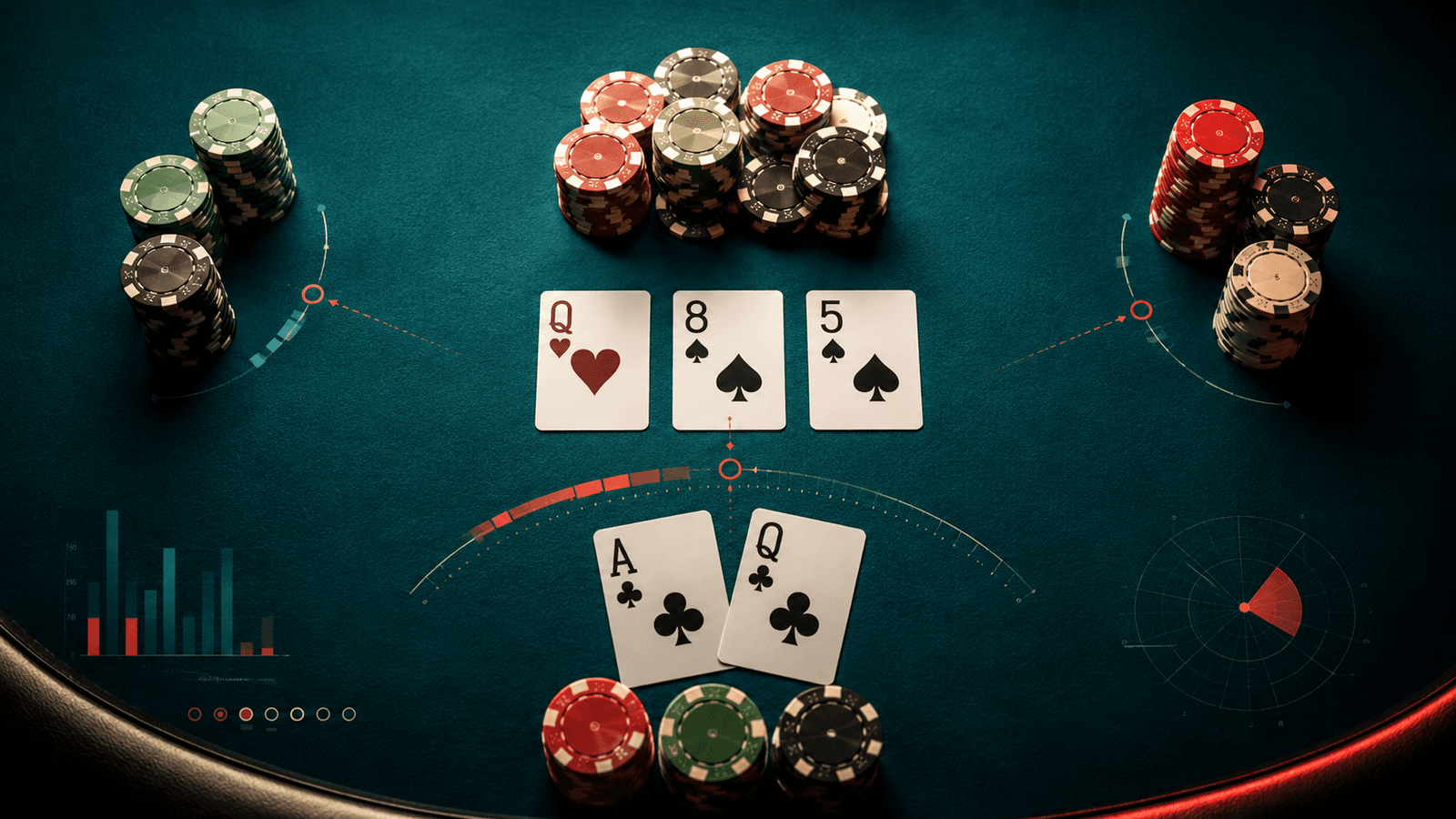
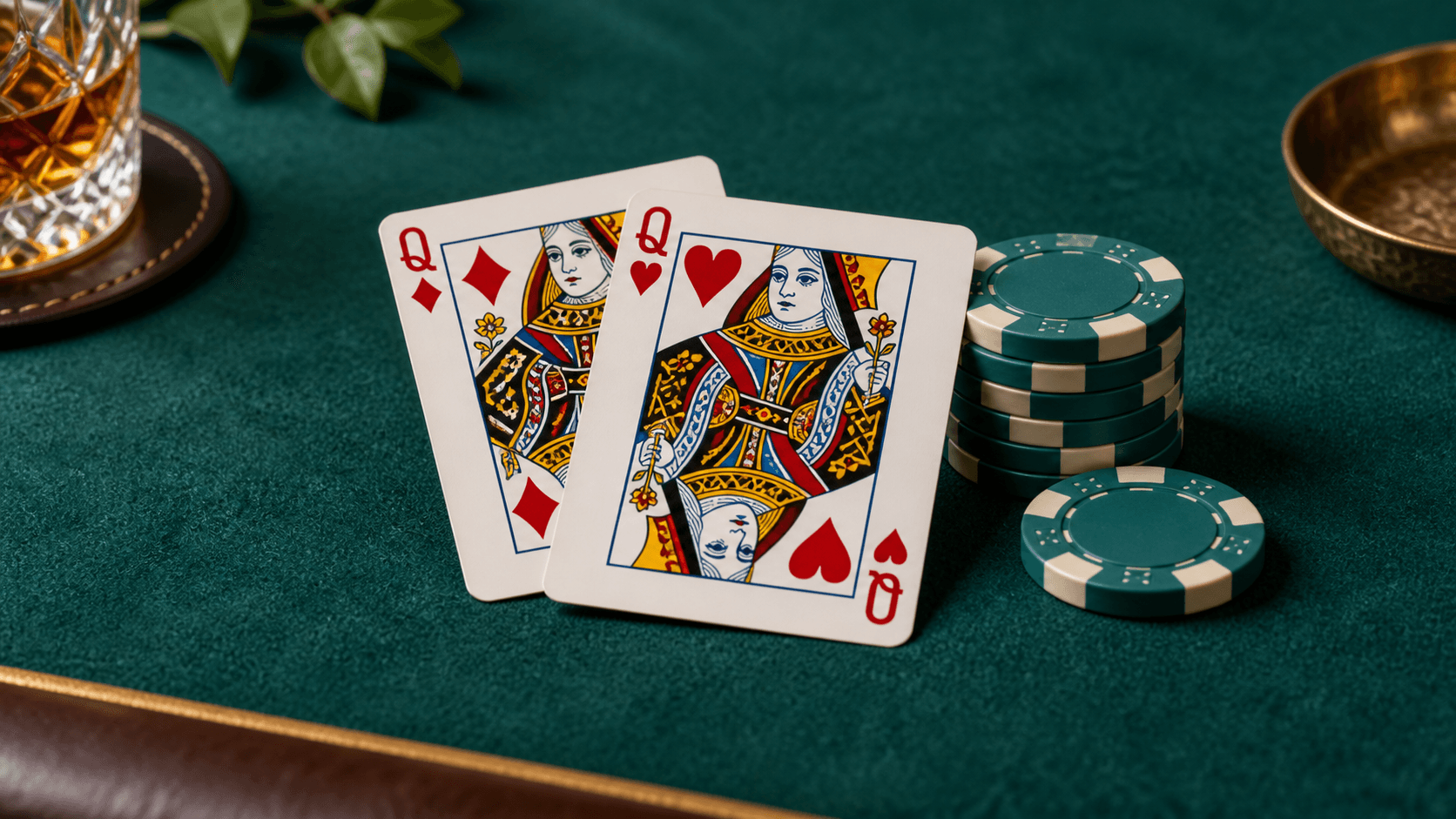
An overpair can be strong enough to bet and still too weak to call a large raise. That is not inconsistency. A bet asks what worse hands can continue; a call against a raise asks what hands take that much stronger action.
This hand lab examines that difference in a three-bet pot. It is a constructed teaching example, not a solver output or a report of a real player's hand. All amounts are in big blinds (BB), so the decision can be studied without attaching it to a particular cash stake.
The hand: queens on the button
Assume a six-handed no-limit hold'em cash game, no ante, and 100BB effective stacks at the start. We ignore rake to keep the arithmetic transparent. This is not a tournament ICM example.
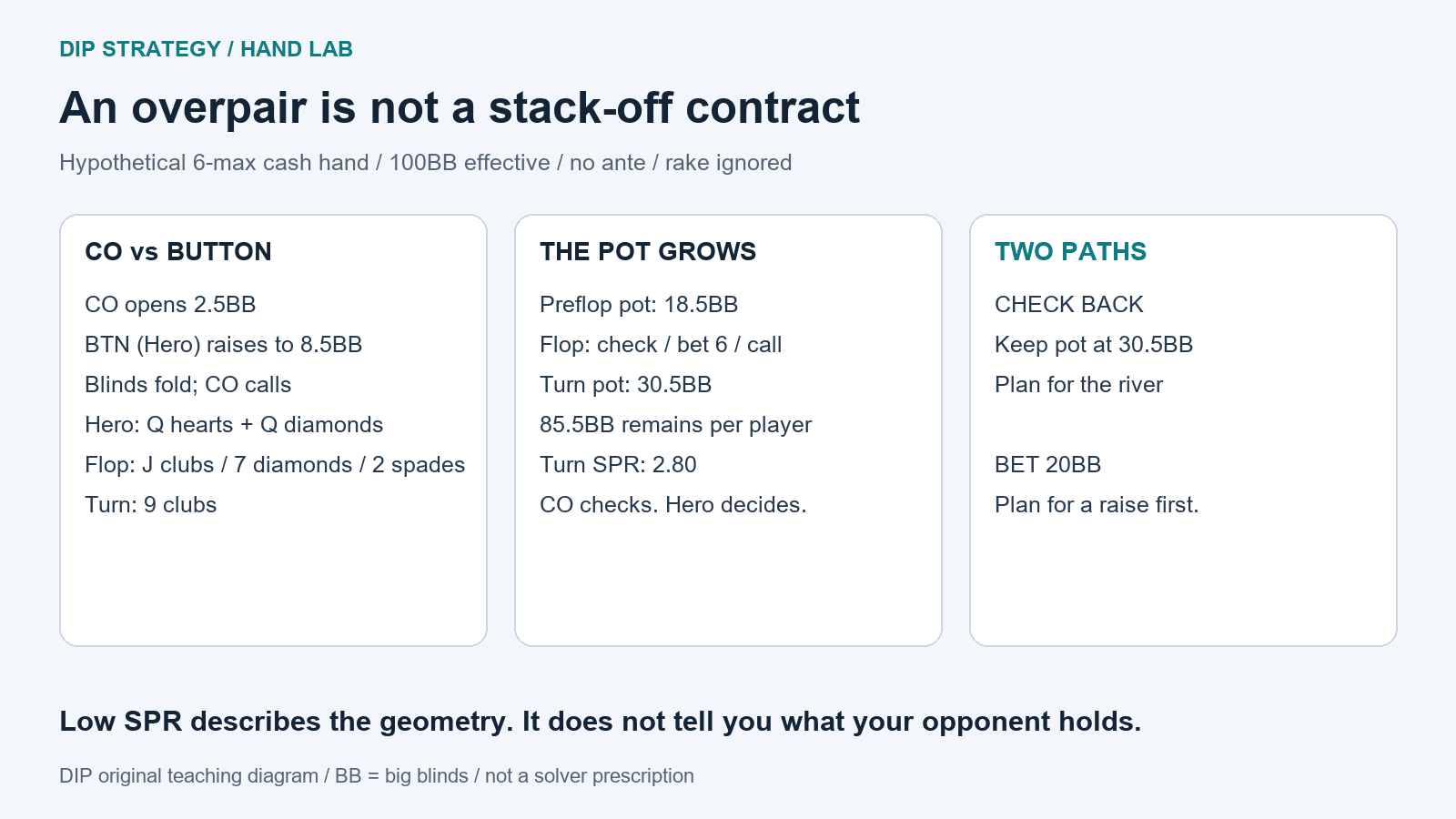
- Cutoff opens to 2.5BB. Hero on the button holds Q♥ Q♦ and three-bets to 8.5BB.
- Both blinds fold. Cutoff calls. The pot is 18.5BB: 8.5 + 8.5 + the 1.5BB dead blinds.
- Flop: J♣ 7♦ 2♠. Cutoff checks; Hero bets 6BB; cutoff calls.
- Turn: 9♣. The pot is now 30.5BB, with 85.5BB behind each player. Cutoff checks again.
Hero must decide whether to check back or bet. The important missing information is not a magic bet size: it is the opponent's range and how that range responds.
First calculate the geometry, not the verdict
Stack-to-pot ratio, or SPR, is the effective remaining stack divided by the current pot. Here it is 85.5 / 30.5 = approximately 2.80 on the turn. The pot can become all-in relatively quickly. That does not mean queens must call every shove.
The 9♣ changes the board. Some hands pick up club draws, Q-T has an open-ended straight draw, and J-9 can make two pair. Pocket nines can improve to a set. These hands matter only to the extent that this opponent actually calls the preflop three-bet and continues on the flop with them. Listing a possible hand is not the same as assigning it a realistic frequency.
A useful working range might include some A-J, K-J, Q-J, medium pairs, sets and suited combinations that reach the turn. Treat that as a starting hypothesis, not a population fact. A tight cutoff and a loose caller need different models.
Checking back: protect the decision, not just the stack
Checking retains showdown value and avoids turning a medium-strength value hand into an enormous pot automatically. It can also leave weaker hands in the opponent's range. In position, Hero sees the river before making the next decision.
The cost is real: draws get a free card, and some worse made hands that would have called another bet escape paying. Checking is therefore not a universal solution to discomfort. It is attractive when worse hands will not pay much, or when a turn raise is likely to represent a range against which queens perform poorly.
Plan the river before checking. An ace, king, club, eight or ten can change the comparison of ranges, but none creates an automatic fold rule. A small river bet and an overbet ask very different questions. Evaluate the actual card, size and opponent rather than mechanically calling every blank or folding every scare card.
Betting 20BB: name the customer
A 20BB turn bet into 30.5BB is about 66% pot. It is an illustrative size, not an asserted optimum. It may earn value from worse jacks and charge draws if those hands really continue.
Before betting, answer two questions:
- Which worse hands call this size, rather than a smaller size?
- Which hands raise, and what will Hero do against that raise?
Against a player who calls too widely and rarely raises without a very strong hand, bet-folding can be coherent. Against a player who check-raises a balanced mix of strong hands and draws, folding too freely can be costly. Neither tendency should be invented because it makes the preferred action easier to justify.
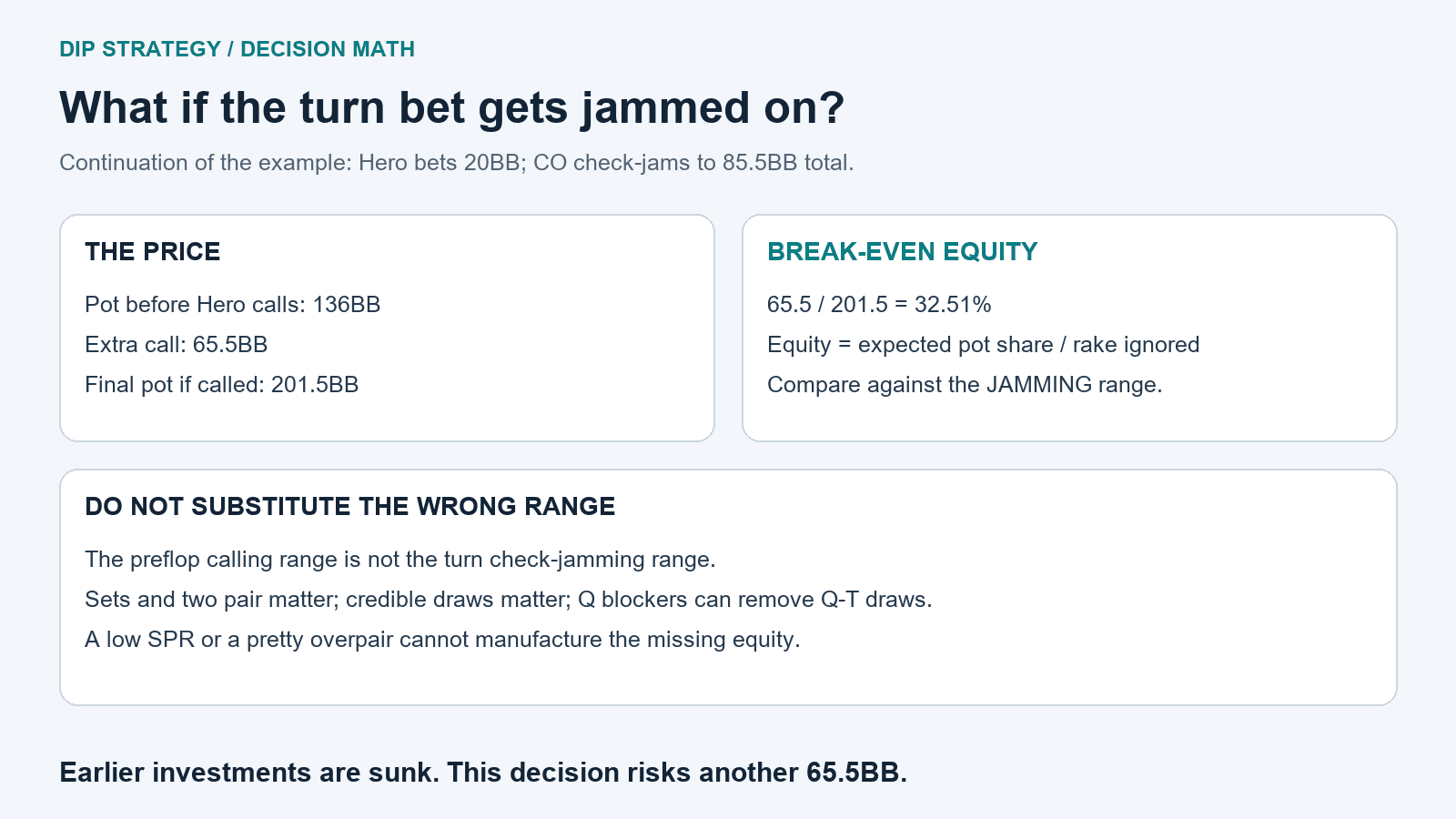
The check-jam test: the call needs 32.5%
Suppose Hero bets 20BB and cutoff check-jams the remaining 85.5BB. The raise is to 85.5BB total on the turn, not another 85.5BB on top of a call. Hero has 65.5BB left to call.
- Pot before the call: 30.5 + 20 + 85.5 = 136BB.
- Final pot after calling: 136 + 65.5 = 201.5BB.
- Break-even equity: 65.5 / 201.5 = 32.51%.
Equity means expected share of the final pot, including split-pot outcomes. In this rake-free model, call EV is equity × 201.5 minus 65.5. At an assumed 25% equity, the call loses 15.125BB relative to folding; at an assumed 40%, it gains 15.1BB. Those are sensitivity examples, not calculated equities for queens against a verified range.
The difficult part: count the range that jams
Do not compare queens with the opponent's entire preflop calling range. Many hands that call preflop never check-jam this turn. Sets and two pair can dominate the strong part of that range; credible club draws or straight draws may supply semi-bluffs.
Queens also remove some Q-T combinations. A blocker is not automatically good: blocking a draw the opponent might jam can reduce the number of semi-bluffs you hoped to find. The exact suits matter too. Hero has no club, so Hero does not directly remove club combinations with either hole card.
For an off-table review, write down value hands and semi-bluffs separately. Remove card conflicts, then assign realistic action frequencies. Run the same hand against a conservative range and a more aggressive range. If the decision flips, the important lesson is the opponent assumption—not a universal instruction to stack off with an overpair.
Common mistakes
- Calling because too much has already been invested. Earlier chips are sunk; the new decision risks 65.5BB.
- Treating SPR as a command instead of a description.
- Counting every conceivable draw at full frequency while discounting value hands.
- Using the initial 100BB stack in the turn SPR calculation.
- Applying this cash-game calculation unchanged to a payout-sensitive tournament situation.
The DIP take
The discipline is to plan for the raise before placing the bet. With queens, checking can preserve a useful showdown hand; betting can extract value. What cannot be justified is an automatic call based only on having an overpair in a three-bet pot. The pot gives you a price. Your range assessment must supply the equity.
Calculation check: September 10, 2026. This article uses original DIP examples and arithmetic, not a solver-derived recommendation.
Responsible play: Poker outcomes are uncertain. Study with hypothetical chips, set affordable time and spending limits, and never use money needed for living expenses.