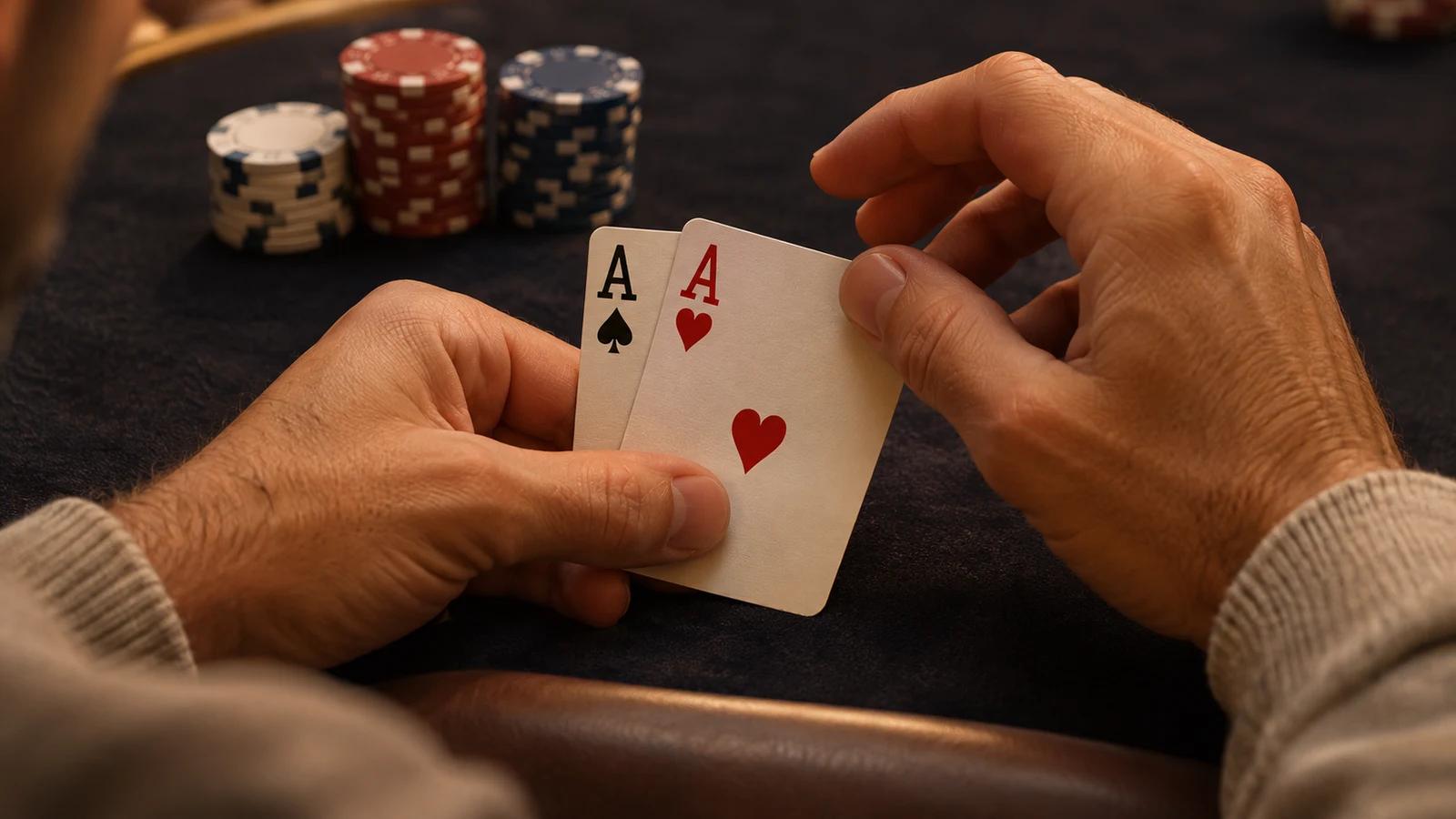
Aces are a premium starting hand. They are not a receipt for a satellite seat. When three identical prizes remain for four players, the useful question is not simply whether an all-in call wins chips. It is how much qualification value the extra chips buy, compared with what elimination destroys.
This is an original worked example of a conventional elimination satellite. It is not a target-stack qualifier where reaching a chip milestone immediately wins a seat. The distinction matters: do not apply this calculation to another format merely because both tournaments are called satellites.
Four players, three identical seats
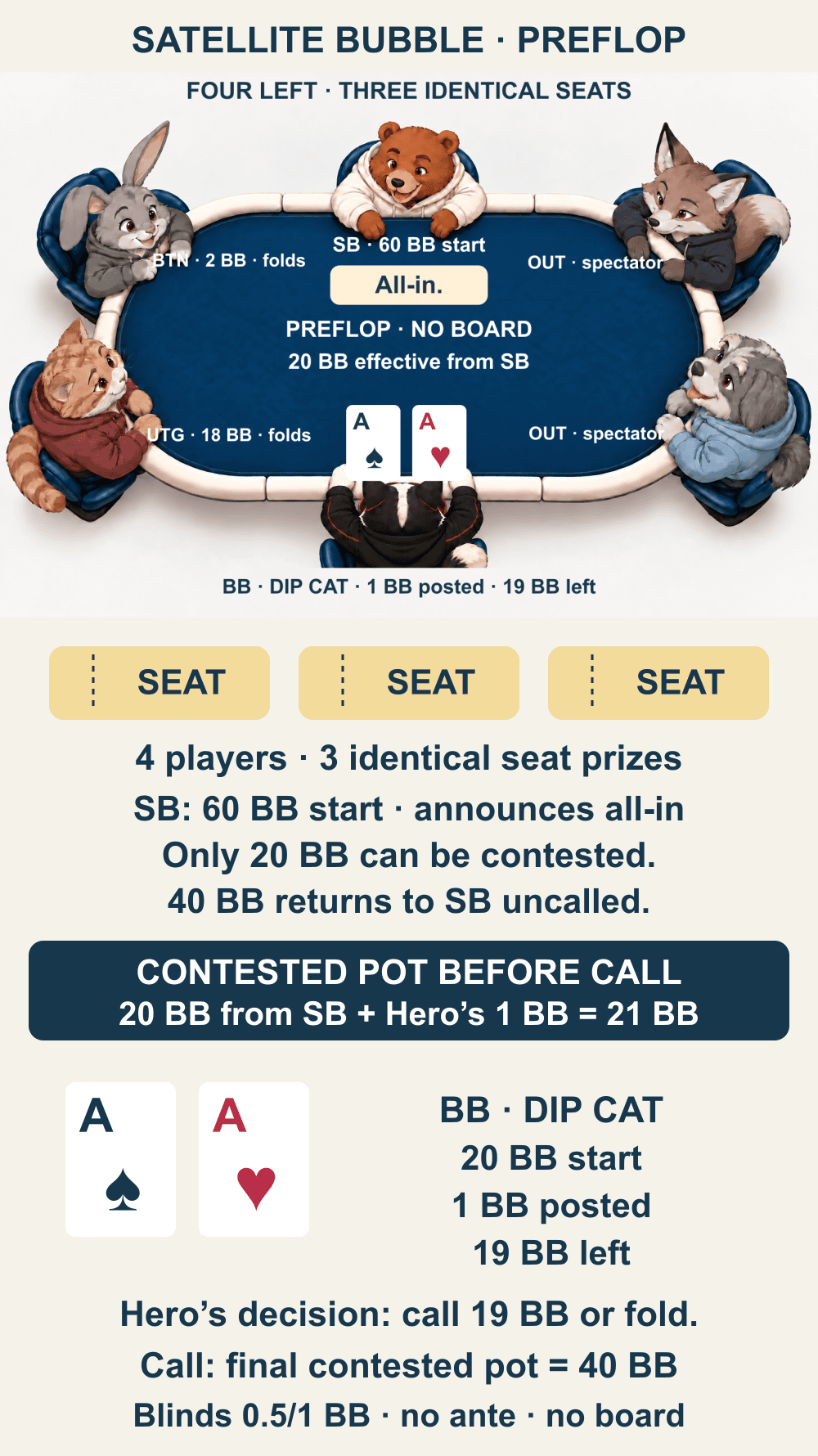
Assume the final four players are at one six-seat table, with two eliminated friends watching. The top three receive identical seats and fourth receives nothing. There are no other prizes, no deal and no ante. Blinds are 0.5BB/1BB. Before posting, stacks are:
- UTG: 18BB.
- Button: 2BB.
- Small blind: 60BB.
- Hero, DIP Cat in the big blind: 20BB, holding A♠ A♥.
There is no board: this decision is preflop. UTG and the button fold. The small blind moves all-in for 60BB total. Hero has already posted 1BB and has 19BB left. The effective stack is 20BB because the small blind cannot win more than Hero can match.
First calculate the chip price correctly
The announced shove is 60BB, but 40BB is uncallable by Hero. Exclude that excess from the contested pot. The small blind's matched 20BB plus Hero's posted 1BB gives a 21BB contested pot before Hero calls. Adding Hero's remaining 19BB makes 40BB.
The ordinary chip break-even equity is therefore 19 / 40 = 47.50%. Do not count the uncalled 40BB as money Hero can win. Also, do not treat the posted big blind as another 1BB that must be paid now.
That price is correct for chips. It does not finish a three-seat qualification calculation.
Translate each outcome into seat value
We use a deliberately static Independent Chip Model, or ICM. In each possible stack state, the model assigns first place in proportion to chips, removes that finisher, and repeats for the next place. Adding Hero's first-, second- and third-place probabilities gives the modeled share of one identical seat. We use a seat value of 1 and a fourth-place value of 0.
The total is always 100BB. UTG stays at 18BB and the button at 2BB throughout this hand's branches:
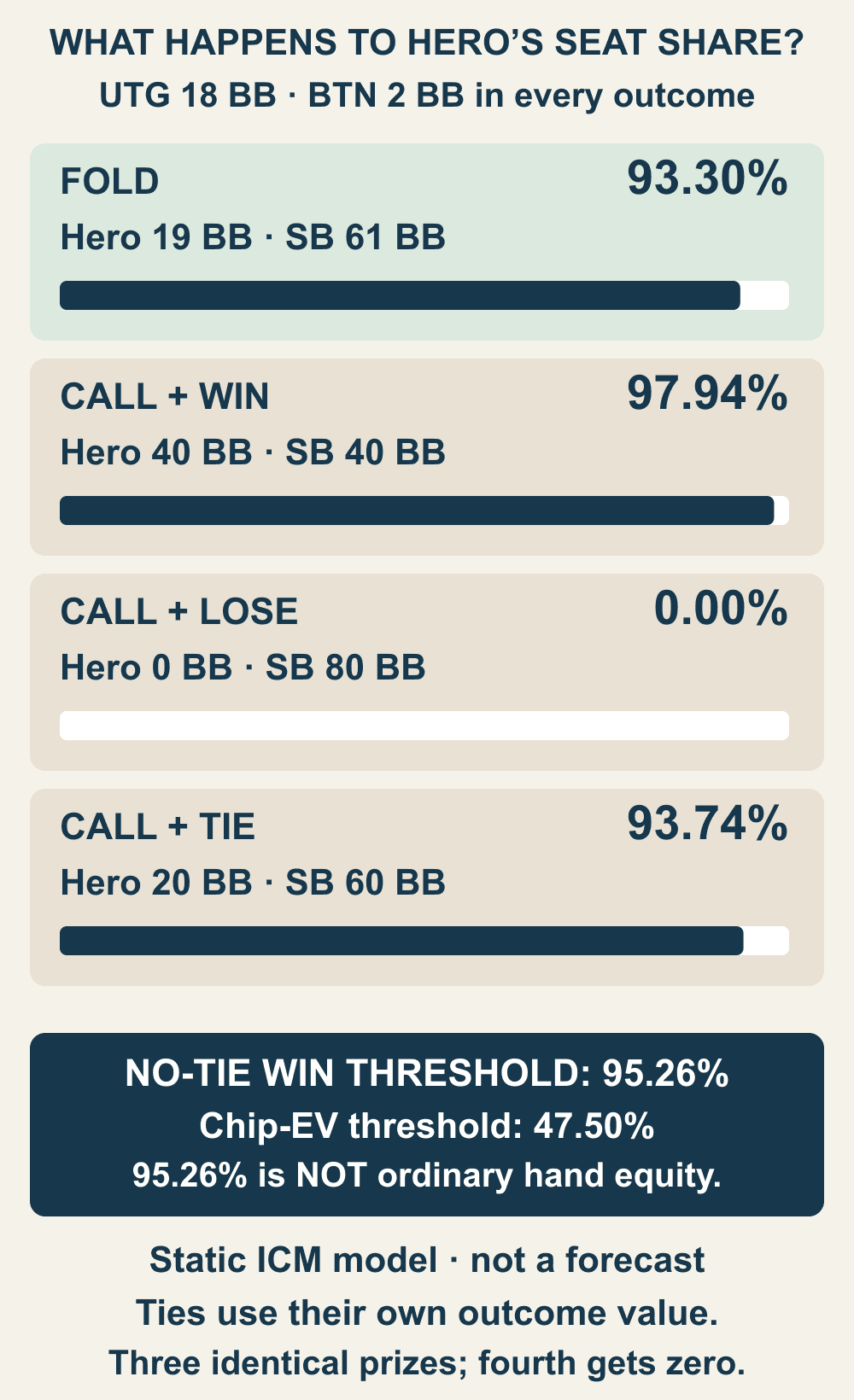
- Fold: Hero 19BB, SB 61BB. Hero's modeled seat share is 93.30%.
- Call and win outright: Hero 40BB, SB 40BB. Seat share is 97.94%.
- Call and lose: Hero 0BB, SB 80BB. Seat share is 0%.
- Call and tie: Hero 20BB, SB 60BB. Seat share is 93.74%.
For example, after folding, Hero's ICM finishing probabilities are 19.00% for first, 34.2764% for second and 40.0247% for third. Their sum is 93.3011%. Second place is calculated by summing each opponent's chance of finishing first, multiplied by Hero's fraction of the chips remaining after that opponent is removed. Third place repeats the removal for every ordered pair of opponents. These are DIP's own calculations, not a claimed solver recommendation.
Why a large chip edge can still fail
First isolate an intentionally no-tie model. Let q be the probability of winning the all-in, with every other result a loss. Calling has seat value q × 0.9794013; folding has value 0.9330111.
To break even, q must reach 0.9330111 / 0.9794013 = 95.2634%. That is far above the 47.50% chip price. Even an assumed 90% chance of winning gives 0.90 × 0.9794013 = 88.15% modeled seat value, below folding's 93.30%. The 90% number is a sensitivity test, not a calculated equity for aces against a real range.
The explanation is the uneven exchange: doubling adds relatively little modeled qualification value because Hero already covers the 2BB stack comfortably. Busting loses the entire opportunity. A low chip price and a valuable survival position can coexist.
Ties are not losses, and aces still need a range
Real preflop hands can tie. Ordinary showdown equity counts half the tied pots; that number must not be inserted blindly into the no-tie 95.26% threshold. A tie preserves a 20BB stack here, rather than eliminating Hero.
With win probability w and tie probability t, the exact comparison in this static model is:
Call seat value = w × 0.9794013 + t × 0.9374226.
Compare that with 0.9330111 for folding. For a purely illustrative distribution of 89% wins, 2% ties and 9% losses, the call has about 89.04% seat value. Again, those are hypothetical inputs, not an estimate of A♠ A♥ against the small blind.
A pressure player could shove weaker holdings than a cautious player who commits only strong pairs and high-card hands. Card removal and how often each holding is actually shoved both matter. Estimate the full win/tie/loss distribution against a defensible range in review software. We have not assigned an opponent range here, so neither “aces always call” nor “aces always fold” is a result of this example.
Compare the available choices
- Folding preserves the modeled qualification advantage. Its cost is surrendering the blind and declining a chance to improve the stack. It does not secure a ticket immediately.
- Calling can be correct if the range-dependent outcome distribution clears the seat-value comparison. Its downside is elimination against a covering opponent, not merely losing 19BB on a graph.
- Raising is not another option: SB is already all-in and Hero is covered. There is no fold equity to rescue this call.
What the model leaves out
Static ICM does not predict the next orbit. It ignores skill differences, future blind positions and the short stack's future decisions. Hero will face more pressure if the 2BB player doubles; waiting does not guarantee that player busts first. Ante structures, changing blinds, unequal prizes, residual cash awards and target-stack qualification can all change the problem.
Common mistakes are counting the covering player's uncalled chips, comparing a hand's chip equity with the wrong payout threshold, forgetting ties, and treating 93.30% as a promise that folding every future hand works.
DIP's conclusion
On an equal-seat bubble, first list the prizes and every remaining stack, then compare the actual fold, win, loss and tie states. In this example the 2BB stack makes protecting an existing qualification advantage much more valuable than an ordinary chip calculation suggests. Use the model to identify the decision's sensitivity, not to invent certainty about the opponent or to turn a premium hand into an automatic action.
Play responsibly. Set a total satellite-attempt budget before entering. A discounted route to a seat can still become expensive through repeated attempts; never chase a missed qualification with money needed for living expenses.