You suspect the river bettor is bluffing. Then another player calls. That call gives you a better price, but it also gives you another hand to beat. A river overcall means calling after someone has already called the bet. It is not the same decision as catching one player's bluff heads-up.
The hand and the price
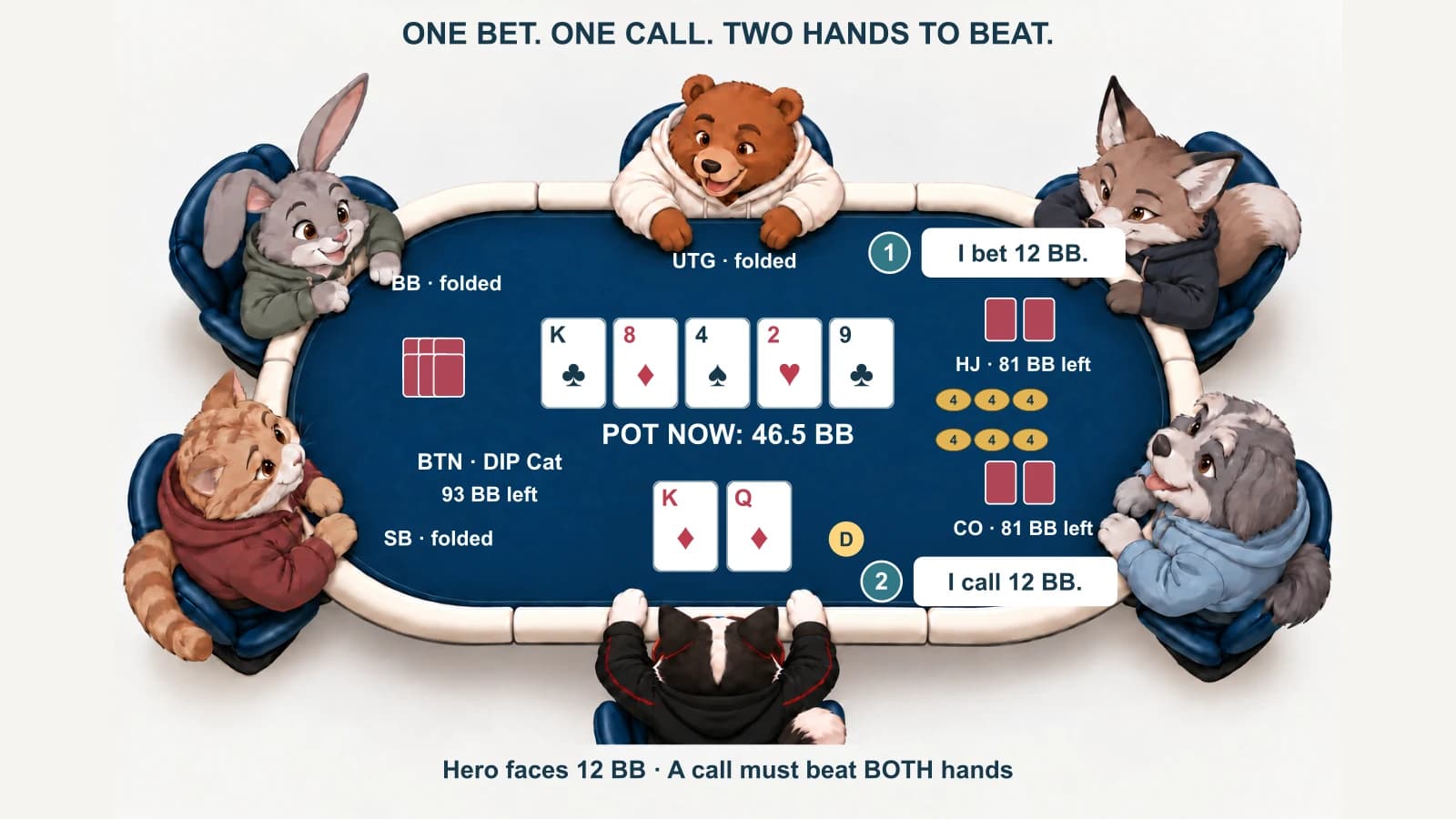
This original hypothetical six-seat cash-game hand uses 100 BB effective stacks, no ante, and no rake. UTG folds. Fox in the hijack raises to 3 BB, Dog in the cutoff calls, and DIP Cat calls on the button with K♦ Q♦. Both blinds fold. The pot is 10.5 BB and the three active players each have 97 BB left.
The flop is K♣ 8♦ 4♠. The hijack bets 4, the cutoff calls 4, and Hero calls 4. The pot becomes 22.5 BB, with 93 BB left for each player. The turn is 2♥ and everyone checks. The river is 9♣. There is no possible flush on this board.
The hijack bets 12 BB. The cutoff calls 12. Hero now faces a 12 BB decision with 46.5 BB in the middle. The opponents each have 81 BB left, while Hero still has 93. Calling would close the action, make a 58.5 BB pot, and leave all three with 81 BB.
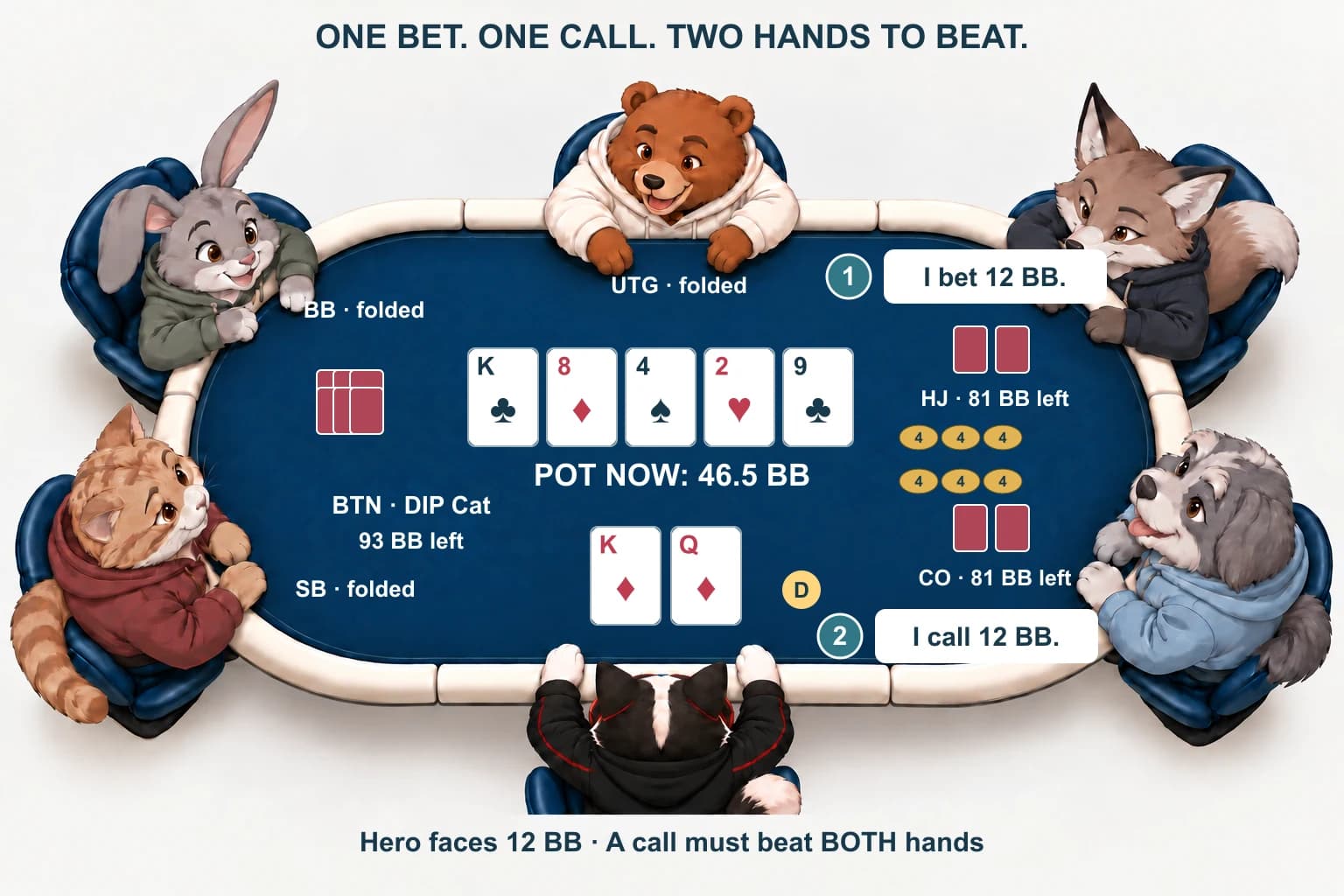
The break-even share of the final pot is 12 ÷ 58.5 = 20.5%. If you either win the entire pot or lose, you need to win more than 20.5% of the time. Ties require counting your fractional share instead. Because this is the river and your call closes the action, no future card or bet remains to complicate that price. Actual rake would make a marginal call less attractive.
If the cutoff had folded instead, the same 12 BB call would contest only 46.5 BB, requiring 25.8%. Yes, the overcall has a cheaper threshold. No, that does not establish that your hand reaches it.
Beating the bettor is only the first test
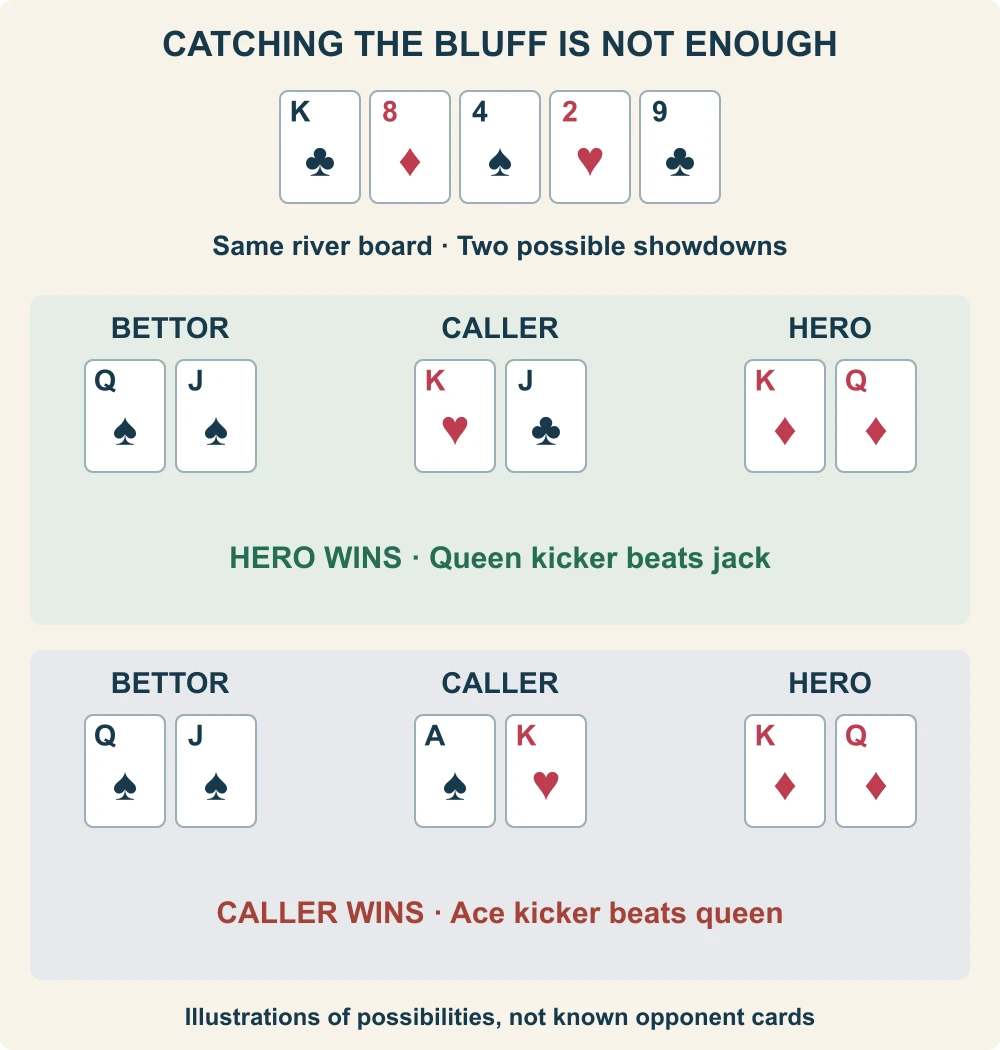
Here are two possible showdowns on the exact board. These illustrate the decision; they are not information Hero has during the hand.
- Hijack Q♠ J♠, cutoff K♥ J♣: Hero's kings with a queen kicker beat both opponents.
- Hijack Q♠ J♠, cutoff A♠ K♥: Hero catches the bettor's bluff but still loses to the caller's ace kicker.
The cutoff's call is not necessarily weak merely because it was not a raise. AK can call rather than raise when worse hands might fold to a raise. A cautious player might also call two pair. Conversely, someone who believes the bettor bluffs too often might call KJ or KT. You need a read on that caller, not just on the player who put out the bet.
A small model exposes the overcall trap
For this teaching model only, assume the bettor's value hands always beat KQ, all their bluffs lose to KQ, and there are no ties. Real opponents may value-bet worse kings, so this deliberately restricted model is not a complete range estimate.
First suppose the bettor is bluffing 30% of the time after this exact sequence of actions. In those bluff cases, suppose the caller is worse than Hero 40% of the time. Hero wins both contests in 30% × 40% = 12% of cases, not 30% and certainly not 70%.
The second percentage is conditional on the first event. We are not assuming the opponents' holdings are independent: shared cards, preflop selection and the caller's response connect their ranges. Both percentages are illustrative inputs, not population statistics or solver output.
Relative to folding now, the expected value of calling in that model is:
12% × 46.5 BB − 88% × 12 BB = −4.98 BB.
Winning earns the 46.5 BB already in the middle; losing costs the additional 12. The chips Hero invested on earlier streets are sunk costs, not new losses to add again.
Change the assumptions to 40% bluffs and a 60% chance that the caller is worse within those bluff cases. Hero wins 24%, and the same calculation gives +2.04 BB. The pot odds did not change. The assumed joint range did.
With a 30% bluff rate in the restricted model, the caller must be worse in more than 20.5% ÷ 30%, approximately 68.4%, of those bluff cases to justify an overcall. That is the read you would need to defend, rather than saying “the bettor bluffs a lot.”
Read the whole line without inventing certainty
The original raiser can still hold AK, two pair or sets after checking the turn. A turn check does not delete strong hands. The cutoff's flop call can include kings and pocket pairs; a hand such as 99 improves sharply on the river. Some missed draws can reach this river too, but the board and prior action do not prove that they all bluff.
Card removal offers a useful check, not an answer. With K♣ on the board and K♦ in Hero's hand, only two kings remain. Before action-based weighting, AK has 2 × 4 = 8 possible combinations, KJ has 8, and KQ has 2 × 3 = 6. KQ would tie Hero if it were best; it is not a worse hand. These are available counts for one opponent at a time, not frequencies and not two independent menus of cards.
Before paying, ask:
- Does the hijack bet worse kings for value, or mostly stronger hands and bluffs?
- Does the cutoff actually call with worse kings after a three-way flop, or usually require AK or better?
- Is your confidence based on repeated behavior, or on one remembered bluff?
Compare the options
**Fold:** A sensible default with KQ when the bettor is value-heavy and the caller is selective. The pleasant price is irrelevant if your expected share stays below it.
**Call:** More defensible when you have credible evidence of enough worse betting hands and loose calls. It keeps the decision to 12 BB and closes the action. Account for ties and rake before treating a tiny theoretical edge as meaningful.
**Raise:** Not a routine value play here. Ask which worse hands would call a raise. Turning KQ into a bluff instead requires better hands to fold from two different ranges. Do not replace a doubtful call with a larger, unexamined wager.
DIP takeaway
The extra caller gives you money and information at the same time. Use both. With one pair, “I beat the bluff” is insufficient when somebody else has already paid to see it. Start from the 20.5% price, then test whether your hand earns that share against both ranges together.
Keep poker within an affordable entertainment budget. Do not chase earlier contributions or losses by forcing a marginal call.