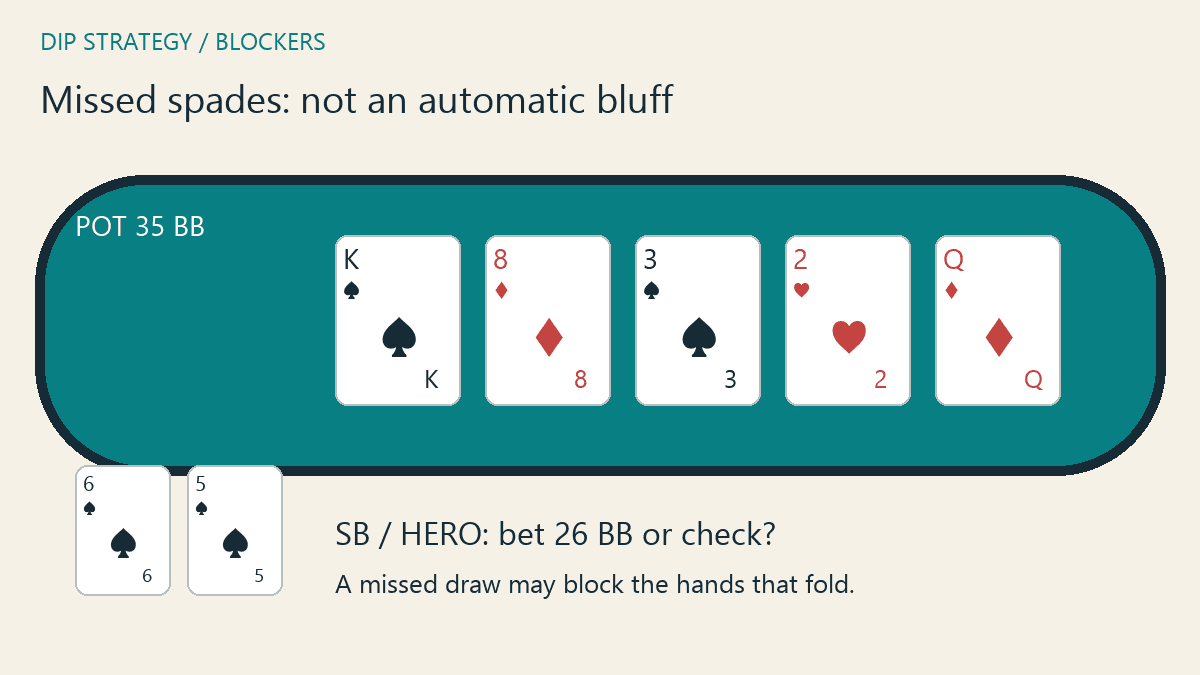
A flush draw missed. You hold top pair and a spade. That can make a river call less attractive, not more: your spade may remove hands the opponent would otherwise bluff.
The useful question is not simply whether you have a blocker. It is which part of the opponent's betting range disappears. This worked example compares two alternative versions of KQ. It is about catching a bluff, not selecting a hand with which to bluff.
One river decision, with every chip accounted for
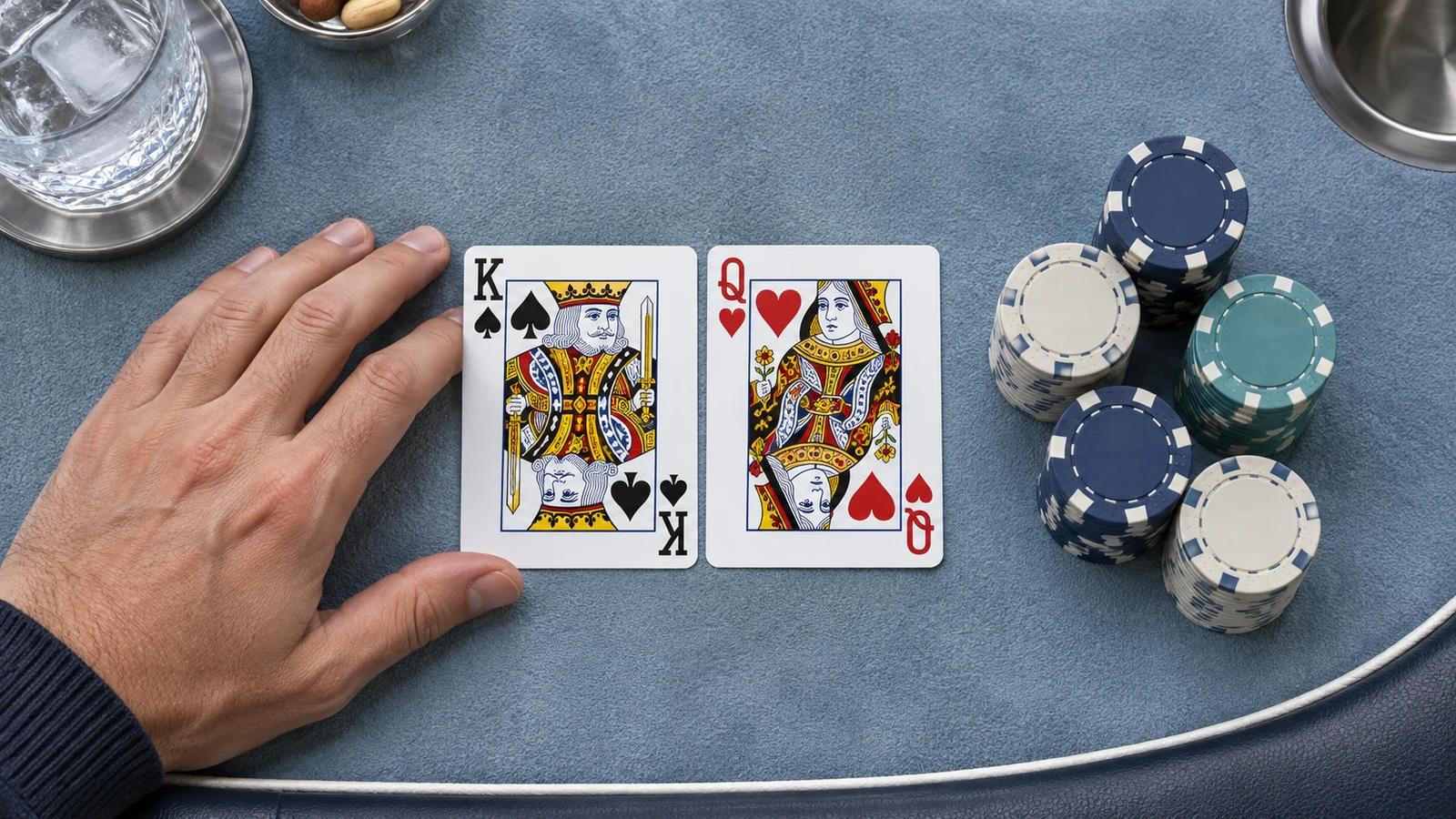
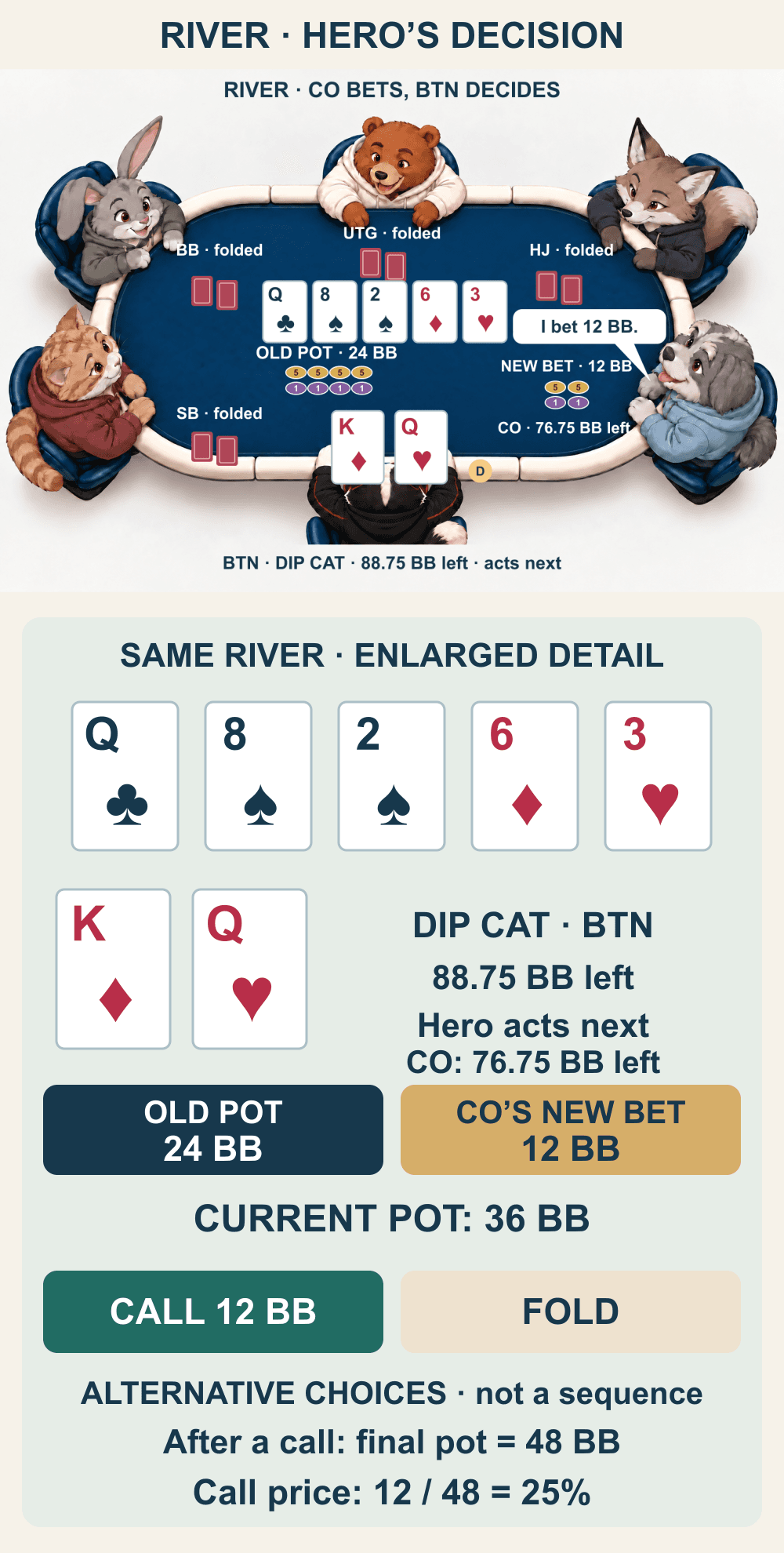
Consider a hypothetical six-handed cash game with 100BB effective starting stacks, blinds of 0.5BB/1BB, no ante and no rake. UTG and HJ fold. CO opens to 2.5BB. Hero, DIP Cat on the button, calls with K♦ Q♥. Both blinds fold.
- Preflop pot: 2.5 + 2.5 + 0.5 + 1 = 6.5BB.
- Flop Q♣ 8♠ 2♠: CO bets 2.5BB and Hero calls. Pot: 11.5BB.
- Turn 6♦: CO bets 6.25BB and Hero calls. Pot: 24BB.
- River 3♥: CO bets 12BB. There is now 36BB in the middle and Hero must decide whether to call another 12BB.
Two players remain in the pot. Hero has 88.75BB behind; CO has 76.75BB after the river bet. The earlier calls are scenario assumptions, not a recommendation to take this line against every opener.
First find the price: 25%, not 33%
Calling makes the final pot 36 + 12 = 48BB. The break-even winning share is:
Call / final pot = 12 / 48 = 25%.
Dividing 12 by the current 36BB gives 33.33%, but that omits the chips Hero would add. It is not the correct call threshold. Previous contributions are already in the pot; they are not another charge to pay now.
For the range we will construct, Hero beats every bluff and loses to every value hand, with no ties. Under those specific conditions, the winning share equals the proportion of bluffs. In a messier range, calculate actual showdown equity instead of assuming every hand fits one of those two buckets.
Build a conditional betting range, not a list of all possible hands
Suppose our review model assigns equal weight to every available combination in the following river betting range. A combination means one specific pair of cards, not an entire hand name such as AQ.
The value side is:
- AA: 6 combinations.
- KK: 3 combinations, because Hero holds a king.
- QQ: 1 combination, because one queen is on the board and Hero holds another.
- 88, 22 and 66: 3 combinations each.
- AQ: 8 combinations, from four available aces and two available queens.
That is 6 + 3 + 1 + 3 + 3 + 3 + 8 = 27 value combinations. Every one beats Hero's pair of queens with a king kicker on this board.
The ten assumed bluffs are A♠K♠, A♠J♠, A♠T♠, A♠9♠, A♠5♠, K♠J♠, K♠T♠, J♠T♠, T♠9♠ and 9♠7♠. Each had a spade flush draw on the flop. None makes a flush, straight or better hand than Hero on this river.
This is a deliberately constructed betting range after the entire line. We are not claiming that CO always bets these hands, that every missed draw bluffs, or that other holdings cannot exist. Hands that check are not automatically included just because they reach the river. Real two-pair holdings and different betting frequencies would change the model.
Now change only the king's suit
With K♦ Q♥, all ten listed bluffs remain available. Hero wins against 10 of 37 equally weighted combinations:
10 / (27 + 10) = 27.03%.
That clears the 25% price. Measured from this decision, folding has EV of zero. A winning call gains the current 36BB; a losing call costs 12BB:
Call EV = 36 × 10/37 − 12 × 27/37 = +0.97BB.
Now consider a separate, counterfactual version of the same hand: Hero holds K♠ Q♥ instead. The board, bet sizes, pair and kicker are unchanged. But CO can no longer hold A♠K♠, K♠J♠ or K♠T♠: Hero owns the K♠.
Seven listed bluffs remain. The value total is still 27. The particular three KK combinations change with the king's suit, but their number does not; no other listed value count changes.
7 / (27 + 7) = 20.59%.
Call EV = 36 × 7/34 − 12 × 27/34 = −2.12BB.
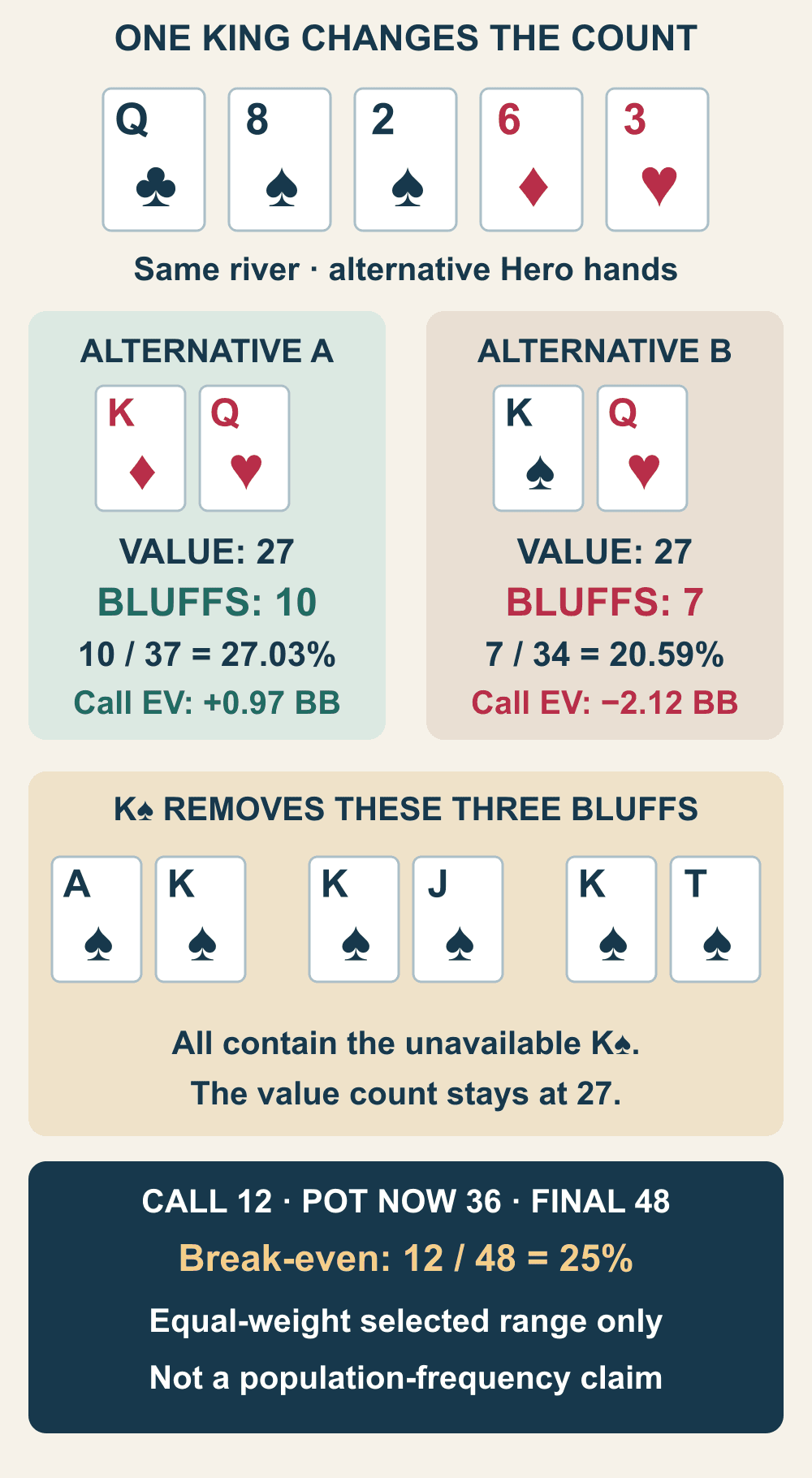
The spade blocks bluffs Hero wants the opponent to have, without reducing the value count. Calling is profitable in one version of this model and unprofitable in the other. This is not a rule to fold every hand containing a spade.
A small edge needs a frequency check
With 27 value combinations, Hero needs nine equally weighted bluffs to break even: 9 / 36 = 25%. Ten is only one combination above that boundary. If just one of those ten never bluffs, the K♦Q♥ call becomes exactly break-even; if two never bluff, it falls below the price.
Counting possible hands is therefore only the start. If all ten bluffs bet at half the frequency of the value hands, they contribute five effective bluff combinations. Hero's winning share becomes 5 / 32 = 15.625%, and the call EV becomes −4.50BB, even without K♠.
Do not invent equal frequencies because they make the arithmetic convenient. Use observed lines and defensible assumptions, then test how sensitive the answer is to them. These figures are DIP's independent calculations for a toy range, not solver output or a measured live-player tendency.
Compare Hero's choices
- Call: earns value when enough worse hands actually bet. In the K♦ example, the modeled edge is thin and depends on the ten-bluff assumption.
- Fold: gives up the chance to win the current pot but avoids a negative call when the betting range contains too little bluff weight. Earlier calls do not oblige Hero to continue.
- Raise: turns the decision into a different problem. Hero would need a credible reason that better hands fold or worse hands continue. Our model supplies neither; calling being bad does not make a bluff-raise good.
Common mistakes are treating any flush blocker as helpful, counting hand classes instead of combinations, forgetting cards already visible, including hands that would check, and mistaking raw availability for betting frequency. An opponent who bluffs too rarely can make both KQ versions folds.
DIP's conclusion
Price the call first, describe the opponent's betting range second, then remove the combinations your exact cards make impossible. A blocker is useful only through the hands it removes. Here, K♠ removes three bluffs you needed to justify calling; the same pair and kicker do not mean the same decision.
Play responsibly. Work through uncertain hands away from the table, set a loss limit in advance, and never increase stakes or chase losses to prove that a close call was right.