
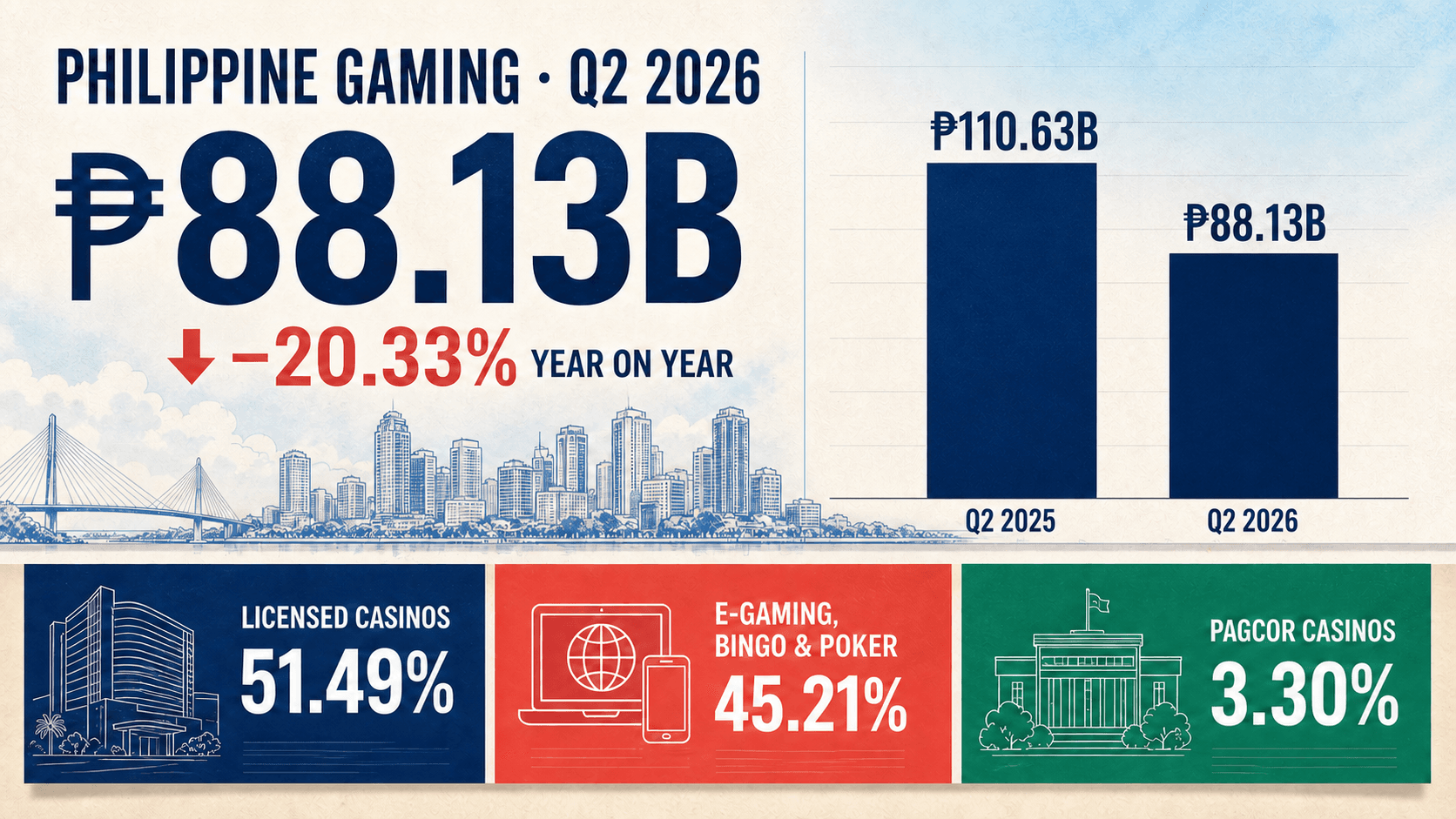
The Philippine gaming industry's second-quarter headline is a large decline: gross gaming revenue reached ₱88.13 billion in Q2 2026, down 20.33% from ₱110.63 billion in the same quarter of 2025, according to PAGCOR.
The number matters. But it does not mean that every casino, poker room or gaming product fell by exactly one-fifth.
Here is what the official release actually separates—and where a careful reader should stop making assumptions.
Three segments made up the quarter
PAGCOR reported the Q2 2026 industry total in three broad groups:
- Licensed casinos: ₱45.37 billion, or 51.49% of total GGR.
- Electronic gaming, E-Bingo, bingo and poker: ₱39.85 billion, or 45.21%.
- PAGCOR-operated casinos: ₱2.90 billion, or 3.30%.
Together, those figures account for the reported ₱88.13 billion total.
Licensed casinos remained the largest category, but the combined electronic grouping was close behind. That is important context for anyone who still pictures Philippine gaming revenue as almost entirely coming from physical casino floors.
GGR is not the same as profit
Gross gaming revenue is generally the amount wagered minus winnings returned to players before operating costs, taxes and other expenses. It is not the same as money deposited, total bets handled, company revenue after every adjustment, or profit.
PAGCOR's separate first-half report concerns the regulator-operator's own total revenue, not the whole industry's quarterly GGR. It said PAGCOR total revenue fell 26.64% in the first half of 2026 to ₱43.32 billion.
Those two measures can move together, but they answer different questions. Mixing them creates a dramatic headline and a poor explanation.
What PAGCOR says drove the decline
PAGCOR attributed the Q2 drop primarily to weaker electronic gaming revenue and also cited inflation and renewed Middle East tensions as pressures on discretionary spending.
That is the regulator's explanation. The release does not provide enough detail to calculate how much of the decline came from each cause.
The first-half PAGCOR report adds a useful comparison: revenue from E-Games, E-Bingo and bingo grantees fell 41.85% to ₱18.60 billion from ₱32 billion a year earlier, while revenue connected with licensed casinos and PAGCOR-operated casinos fell by smaller percentages.
Again, these are PAGCOR revenue figures for the half-year, not a direct subdivision of the Q2 industry GGR chart.
What the figures do not tell us about poker
Poker appears inside a broad combined Q2 category alongside E-Games, E-Bingo and bingo. The release does not isolate live poker, online poker, tournament entries or individual room performance.
Therefore, it would be inaccurate to say that Philippine poker revenue fell 20.33%.
A busy tournament series can coexist with an industry-wide decline. A poker room can gain traffic while another gaming segment contracts. To judge live poker properly, DIP would need room-level schedules, field sizes, entries and verified operating information—not just the national GGR total.
Why poker players should still care
Industry numbers influence the environment around the game even when they do not measure a particular tournament.
They can affect how operators budget for events, marketing and player services. They can shape regulatory debate. They can also reveal whether the market is becoming more dependent on electronic products or maintaining a balance with physical venues.
For players, the sensible response is not to predict closures or promotions from one quarter. It is to watch whether the direction continues and whether operators change schedules, guarantees or services.
Five questions for the next release
When the next official figures arrive, we will look for:
- Whether total GGR stabilizes after two year-on-year declines.
- Whether licensed casinos remain the largest segment.
- Whether the broad electronic grouping gains or loses share.
- Whether PAGCOR provides more detailed product-level data.
- Whether visible poker-room activity matches or diverges from the national trend.
The DIP view
The most interesting fact is not simply that Q2 fell. It is that licensed casinos and the combined electronic group each represented a very large part of the market, while PAGCOR-operated casinos were a much smaller share.
For poker readers, the limitation is equally important: national gaming data is context, not a room report. DIP will not turn a combined category into a claim about live poker that the official numbers cannot support.
Information verified: September 1, 2026. Primary sources: PAGCOR's August 10 Q2 industry GGR release and July 30 first-half revenue release. The hero graphic uses only figures reported by PAGCOR; its Manila skyline is an editorial illustration.
Responsible play notice: Gambling involves financial risk. Revenue growth or decline does not improve an individual's chance of winning. Set strict time and spending limits, and never chase losses.