You're facing a pot-sized river bet. Someone says, defend half your range. Don't turn that into an automatic call. It doesn't mean you should call half the time with this hand, or that it needs to win 50% of showdowns.
Minimum defense frequency, or MDF, looks at how often your whole range continues in a simplified bluffing game. Pot odds tell you how often this hand has to win. Start by keeping those two questions separate.
The hand before the theory
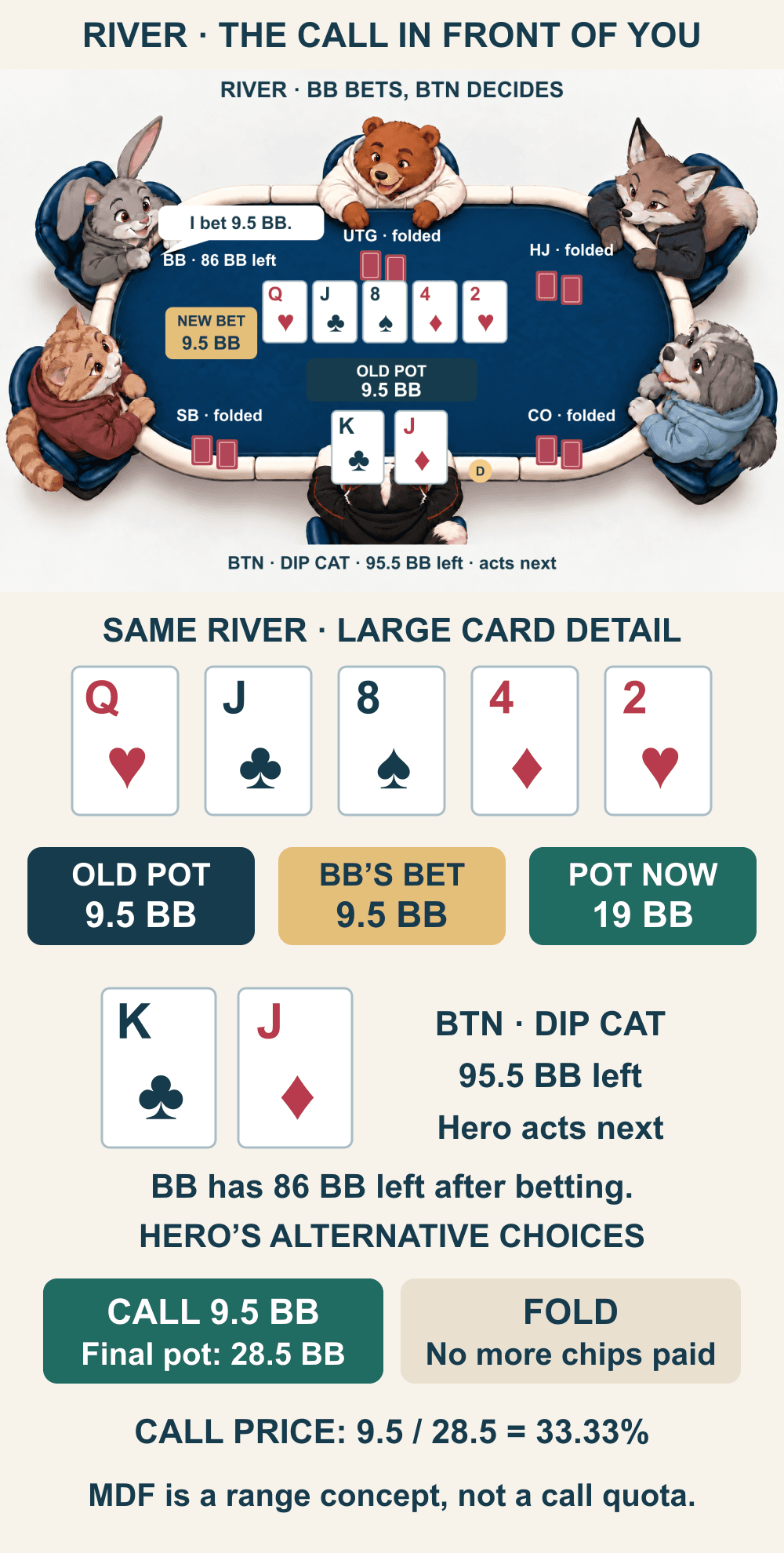
This is a hypothetical six-handed cash game with 100BB effective starting stacks, 0.5BB/1BB blinds, no ante and no rake. UTG, HJ and CO fold. Hero, DIP Cat on the button, opens to 2.5BB with K♣ J♦. SB folds and BB calls. Two players see a 5.5BB pot: 2.5BB each, plus the folded small blind's 0.5BB.
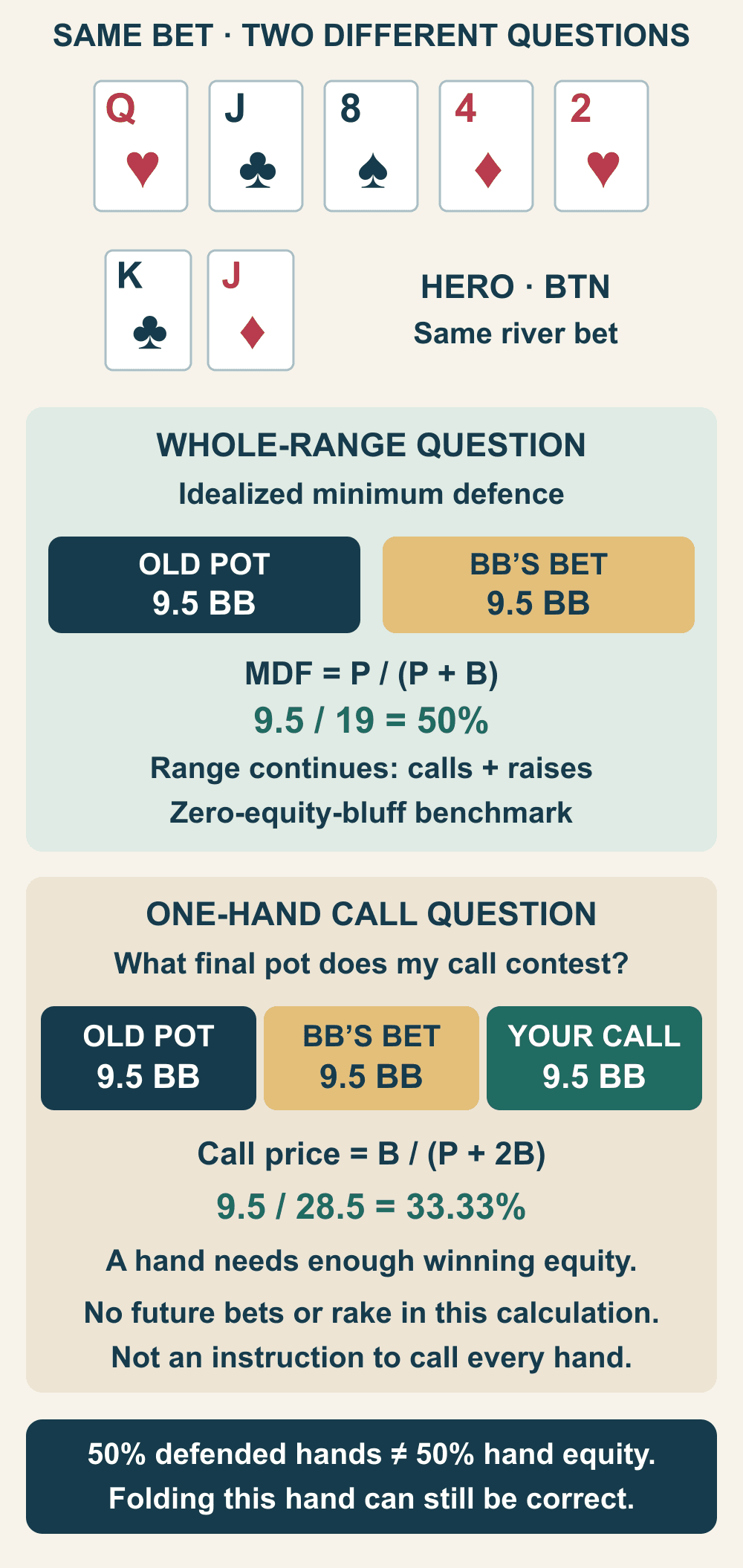
On Q♥ J♣ 8♠, BB checks. Hero bets 2BB and BB calls, making 9.5BB. The turn is 4♦ and both players check. The river is 2♥. BB now leads for 9.5BB, exactly the size of the old pot.
There is 19BB in the middle before Hero acts. Calling costs another 9.5BB and makes a 28.5BB final pot. Hero has 95.5BB behind; BB has 86BB after betting. The earlier actions establish this example, not a universal recommendation to bet second pair on every flop.
Question one: how often must this call win?
K-J needs to win one time in three to break even on a call. Here's the calculation:
9.5 / 28.5 = 1/3, or about 33.33%.
A winning call gains the current 19BB. A losing call costs 9.5BB. If w is the chance of winning and there are no ties, call EV is 19w − 9.5(1 − w). Setting it to zero gives w = 1/3.
Don't divide the call by the current 19BB and stop there. Count Hero's call in the final pot too. Chips put in earlier are already in the middle; you don't pay them again now.
For the constructed ranges below, every value hand beats KJ and every bluff loses to it. That makes the winning share equal to the bluff share. If a real range contains ties or weaker hands betting for value, use actual showdown outcomes rather than forcing everything into those two buckets.
Question two: what does defend half actually mean?
Now take BB's seat. A pure bluff risks BB's 9.5BB bet to win the old 9.5BB pot. If Hero folds at frequency f, that bluff's simplified EV is:
f × 9.5 − (1 − f) × 9.5.
It breaks even at f = 50%. The corresponding MDF is 1 − 50% = 50%, or old pot / (old pot + bet) = 9.5 / 19.
That 50% is about Hero's whole range in this simplified model, with calls AND raises counted together. It is not an instruction to call K♣J♦ 50% of the time, or to play every hand that way. Also count how often each combination gets to this river, not just how many hand names appear on a chart.
The derivation assumes a bluff that wins nothing when called and treats checking as worth zero. It is a benchmark for this river's first bet, not a complete equilibrium solution, a multiway rule or a minimum-raise formula. A hand with showdown value when checked creates a different comparison between betting and checking.
Put K-J to the test
For this example, give BB these value hands, with each combination betting equally often: QQ (3), JJ (1), 88 (3), QJ (6), Q8 suited (2) and J8 suited (1). That is 16 combinations, all beating Hero.
The two Q8 suited combinations are Q♣8♣ and Q♦8♦. J♥8♥ is the only available J8 suited combination. Visible cards and Hero's J♦ remove the others. We assume these hands took the stated line; real players may raise some earlier, and QQ may sometimes three-bet preflop.
For one test, add all four AT suited combinations and all four 97 suited combinations as bluffs. AT misses both straight draws: a king or a nine would complete a straight. 97 misses its ten gutshot. None pairs or makes a straight on this runout. All eight combinations are available against K♣J♦.
Do not count T9 as another missed draw: on Q-J-8, T9 already has a straight. A convenient bluff total is worthless if the cards are misread.
With 16 value combinations and eight bluffs, Hero wins 8/24 = 1/3. Calling is exactly break-even: 28.5 × 1/3 − 9.5 = 0BB.
Now let all four 97 suited hands check instead of bluffing. That leaves the four AT suited bluffs and the same 16 value combinations. Hero wins 4/20 = 20%. Call EV becomes 28.5 × 0.20 − 9.5 = −3.80BB. Folding has EV of zero from this decision and is better in that model.
These are sensitivity tests, not an estimate of how often an unknown live opponent bluffs. No solver or player database has supplied these frequencies. Availability, reaching the river and actually betting are separate requirements.
With eight bluff combos, calling with K-J breaks even. Cut that to four and K-J is a fold.
But could folding too much invite bluffs?
Yes. If Hero folds 60% of the whole responding range, the assumed zero-equity pot-sized bluff earns 0.60 × 9.5 − 0.40 × 9.5 = +1.90BB.
This gives you something to check when you review the hand: which hands can Hero continue with, how do they get to this river, and does BB actually fire enough bluffs? Do not assume that a theoretical opportunity is always taken.
A quick table-side check
- Before calling, separate the hands you beat from the hands you lose to. Include how often your opponent actually bets each one.
- Fold without trying to win back earlier calls. That money is already in the pot.
- Raise only if you expect better hands to fold or worse hands to call. Counting raises in MDF does not tell you which hand to raise or how much.
Watch for four traps: mixing up how often a range continues with how often one hand wins; using the pot after BB bets as the old pot in the MDF formula; treating every missed draw as a bluff; and forgetting that an opponent may win by checking.
Cash-game rake, tournament payouts and future betting on earlier streets need their own adjustments; this no-rake river calculation does not settle them.
Play responsibly. Review close hands away from the table, keep stakes within a predetermined loss limit and never call or raise simply to prove that a formula was right.