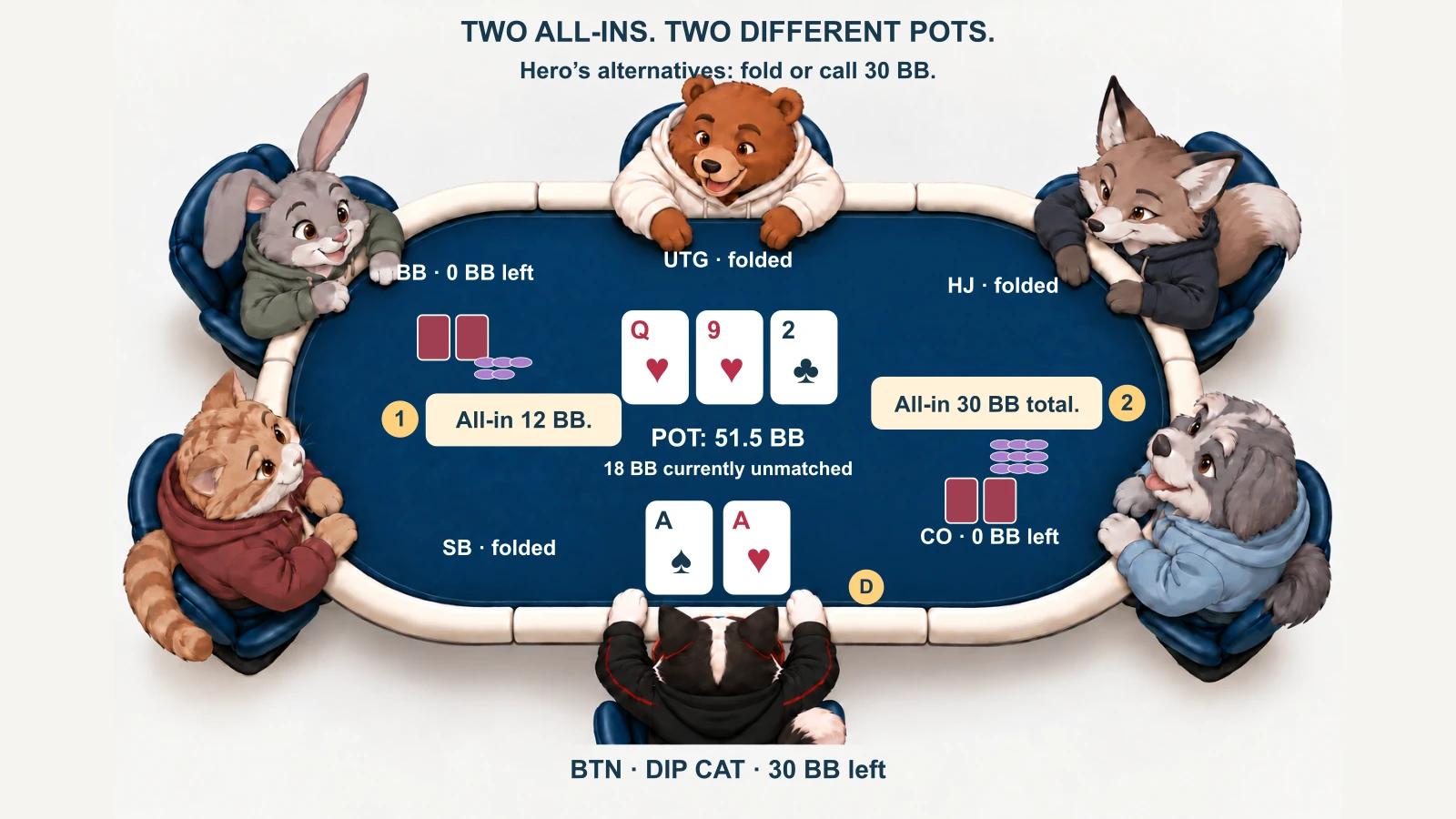
One player is all-in for less. Another puts in more. Your call now buys a share of two different pots—not one contest against one range.
The useful habit is to separate who can win each pot before you calculate whether a call pays.
The hand: aces face two all-ins
This is a six-handed cash-game example, with 0.5/1 BB blinds, no ante and no rake. All amounts below are in big blinds. DIP Cat is Hero on the button with A♠ A♥ and a 33 BB starting stack. The cutoff also starts with 33 BB; the big blind starts with 15 BB. Hero is effectively 33 BB deep against the cutoff and 15 BB deep against the big blind.
- UTG and HJ fold. The cutoff opens to 3 BB.
- Hero calls 3 BB. The small blind folds, leaving 0.5 BB dead.
- The big blind calls, making a three-way pot of 9.5 BB.
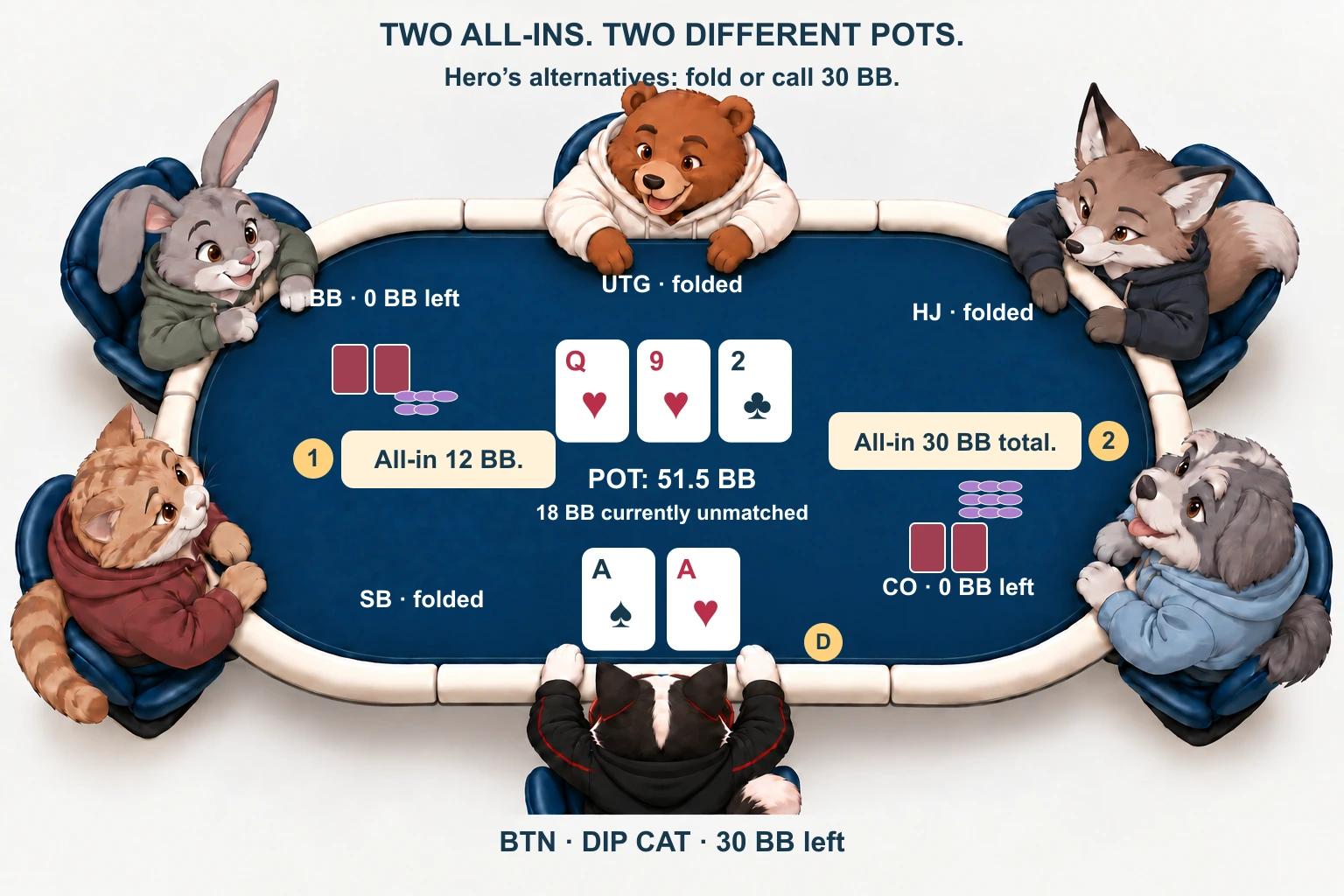
- The flop is Q♥ 9♥ 2♣. The big blind has 12 BB left; Hero and the cutoff each have 30 BB left.
- The big blind moves all-in for 12 BB. The cutoff moves all-in for 30 BB total—not 30 BB on top.
- Hero faces a 30 BB call with the entire remaining stack. The pot before Hero responds is 51.5 BB, including the cutoff’s currently unmatched extra 18 BB.
The button flat-call with aces is a setup for this lesson, not a default preflop recommendation. A three-bet often deserves consideration. Here, the decision we are studying is already on the flop.
Build the pots before judging the hand
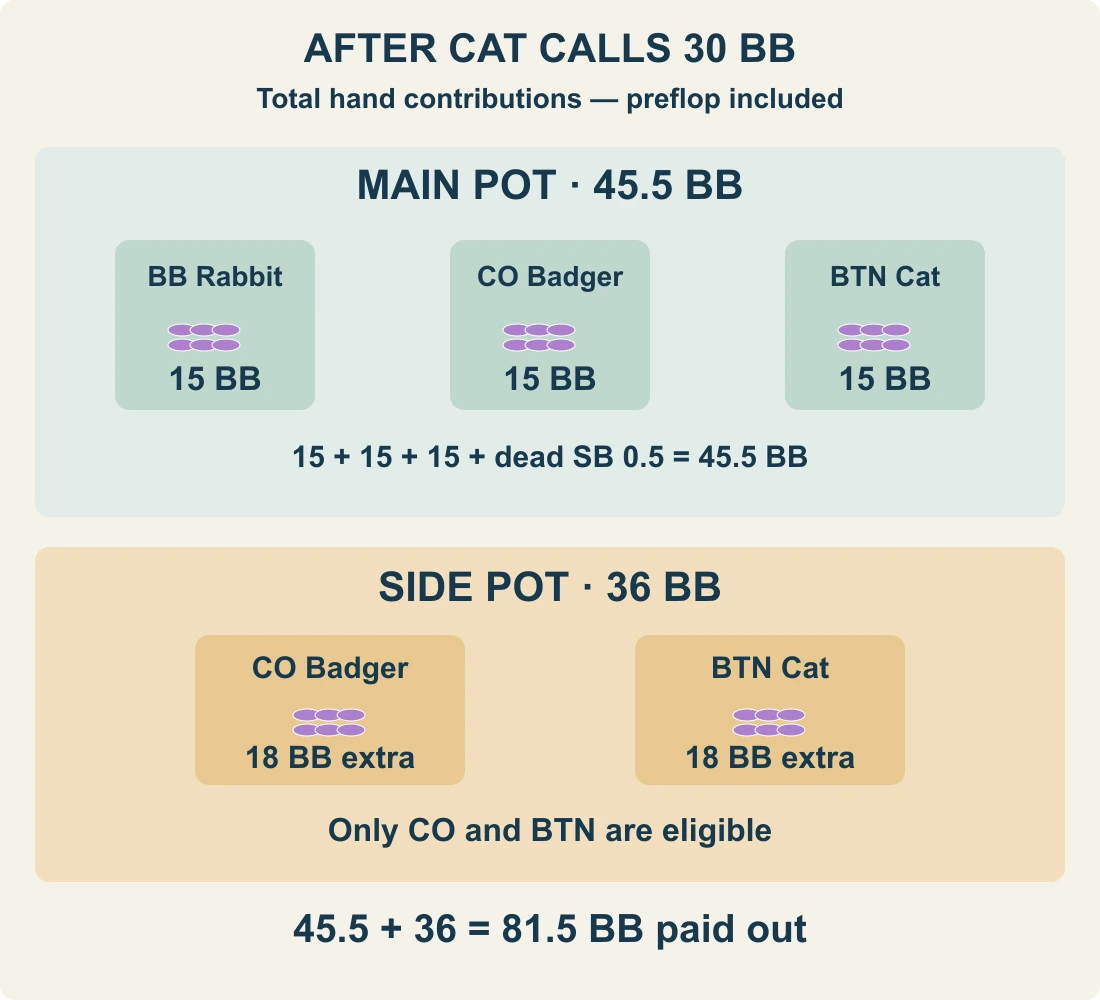
If Hero calls, each active player contributes 15 BB to the main pot across the whole hand: 3 BB preflop plus 12 BB on the flop.
- Main pot: 15 × 3 + 0.5 dead small blind = 45.5 BB. All three players are eligible.
- Side pot: Hero’s additional 18 BB plus the cutoff’s additional 18 BB = 36 BB. Only Hero and the cutoff are eligible.
- Total payout pool: 45.5 + 36 = 81.5 BB. This also equals the 51.5 BB currently visible plus Hero’s 30 BB call.
The short stack can win the main pot but cannot take the side pot. Hero can lose to the big blind and still recover chips by beating the cutoff.
If Hero folds instead, the cutoff’s unmatched 18 BB is returned. The remaining 33.5 BB pot includes Hero’s already-invested 3 BB, but Hero is no longer eligible to win it. Folding keeps Hero’s remaining 30 BB. Do not count returned chips as an opponent’s winnings.
Why one pot-odds percentage is not enough
Dividing 30 by 81.5 gives 36.81%. That would be a simple break-even threshold if the same equity applied to the entire payout pool. Here it generally does not: beating two hands is different from beating only the cutoff.
Use two equity shares, including ties:
EV of calling versus folding = (main-pot equity × 45.5) + (side-pot equity × 36) − 30.
All remaining players will be all-in after the call. There is no future betting and no extra cost to see both remaining cards. The 3 BB Hero already invested is sunk at this decision and is not subtracted again.
For an illustrative model, assume 20% main-pot equity and 60% side-pot equity:
- Main-pot expected return: 0.20 × 45.5 = 9.10 BB.
- Side-pot expected return: 0.60 × 36 = 21.60 BB.
- Combined return less the call: 9.10 + 21.60 − 30 = +0.70 BB.
Keep side-pot equity at 60%, but lower main-pot equity to 10%, and the result becomes 4.55 + 21.60 − 30 = −3.85 BB.
These percentages are teaching assumptions, not calculated equities for A♠ A♥ or a solver verdict. A real estimate needs joint, card-compatible opponent ranges. For example, assign the big blind possible sets, two pair, strong queens and draws; then ask how often the cutoff reshoves sets, overpairs, strong draws or weaker hands. The frequencies matter more than the list of possible hands. Do not estimate each opponent independently while ignoring shared card removal.
A showdown that makes the distinction visible
Suppose Hero calls and the board runs out 7♦ 3♠. The big blind reveals Q♦ Q♣, winning the 45.5 BB main pot with three queens. The cutoff reveals K♥ J♥ and misses the flush. Hero’s aces beat the cutoff and win the 36 BB side pot.
Hero loses the main pot but does not lose the whole stack. This single runout demonstrates eligibility; it does not establish that the original call was profitable against unknown ranges.
Call or fold—and the mistakes to avoid
Calling preserves access to both pots and can be correct despite weak main-pot equity when the side-pot matchup compensates. Its downside is committing the full remaining 30 BB on uncertain range estimates. Folding limits further exposure, but gives up a side pot that may be favorable. Raising is not an additional option in this exact hand: the 30 BB call already puts Hero all-in.
Common mistakes are treating the big blind as eligible for every chip, applying three-way equity to the side pot, calling the side pot “free,” and confusing the cutoff’s 30 BB total bet with a 30 BB raise over the first shove. In a raked game, account for the actual deduction before relying on a thin positive margin.
DIP’s view: ask “Which opponents can win this pot?” before “What are my pot odds?” Separate eligibility, estimate each equity share, and only then compare expected returns with the call price. Aces alone are not a calculation.
Play responsibly. Keep poker money separate from living expenses, set limits before playing, and never chase losses.