
A short stack pushes its chips forward. You reach for a raise, hoping to isolate. Before choosing a size, there is a more basic question: are you allowed to raise at all?
The important number is not simply the all-in total. It is the increase over the previous wager, compared with the last full bet or raise. Our two versions of the same hand show why this matters.
The hand before the decision
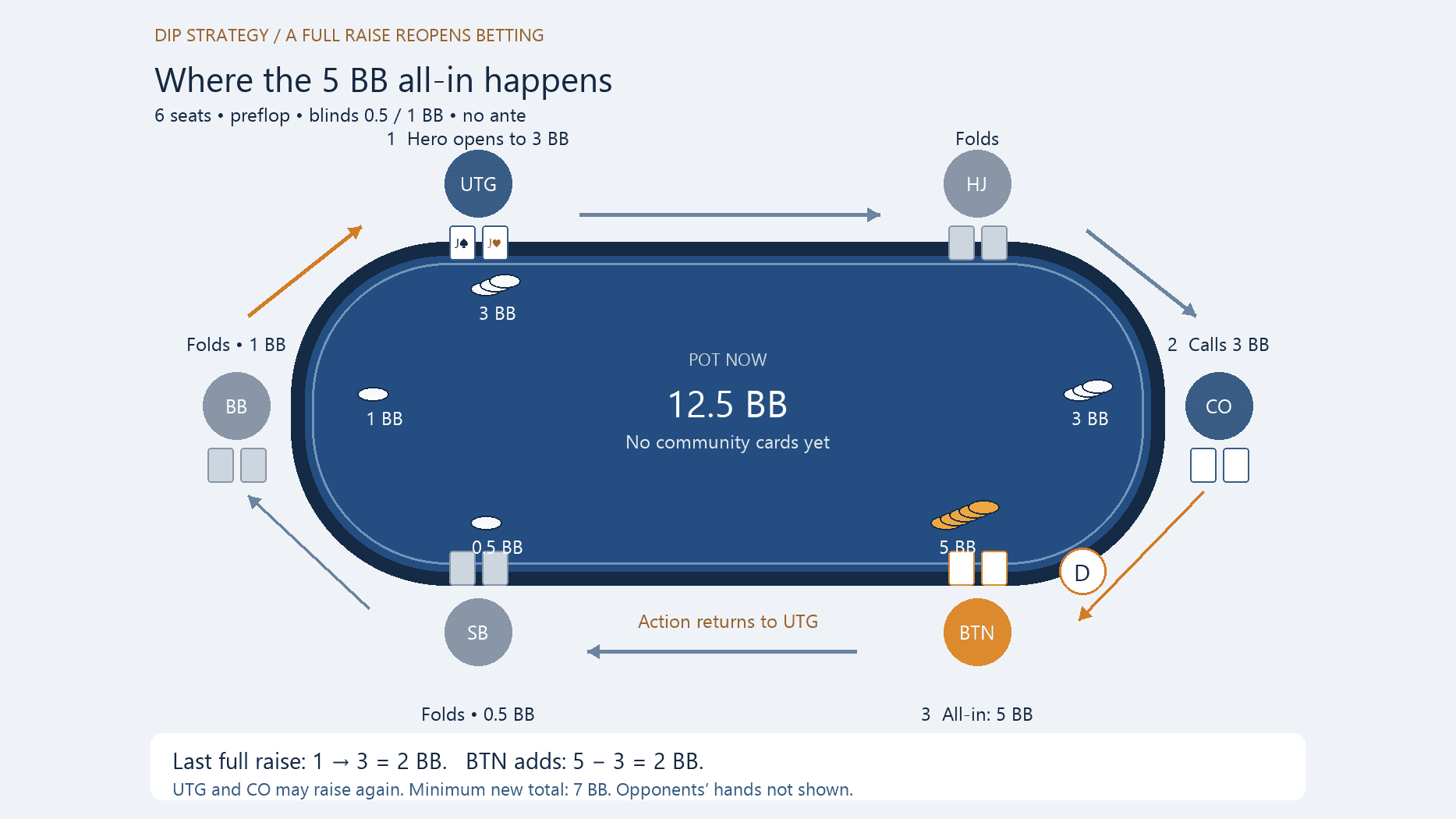
This is an original no-limit tournament example using big blinds (BB). There is no ante or rake. The small blind is 0.5BB and the big blind is 1BB. Hero is under the gun (UTG), holds J♠ J♥ and starts with 40BB. The cutoff (CO) also starts with 40BB. The button (BTN) has either 4BB or 5BB, depending on the version. The diagram uses six seats, clockwise: UTG, HJ, CO, BTN, SB and BB. HJ folds before CO acts; both blinds fold after the button acts. No community cards have been dealt: the board is empty because this is preflop.
Hero opens to 3BB. CO calls 3BB. The raise increment is 3 − 1 = 2BB. Keep that 2BB number separate from the 3BB total.
Hero and CO can potentially contest 40BB each. Against the button, however, Hero can win only the button's shorter starting stack. One table can therefore contain more than one relevant effective stack.
Version A: button has 4BB
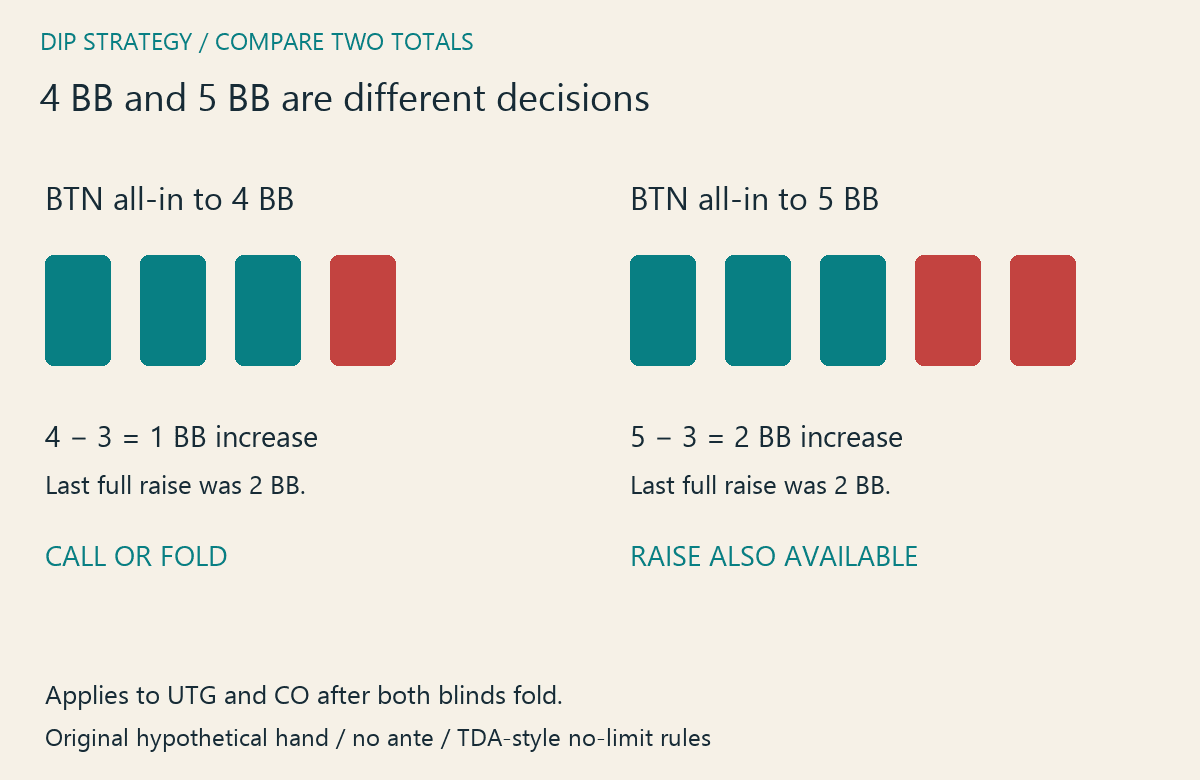
BTN moves all-in to 4BB. The increase above 3BB is only 1BB, short of the previous 2BB full raise. Under the TDA no-limit reopening rule, Hero and CO, who have already acted, do not gain a new raising option from this short all-in alone. With the blinds now out, Hero can call the extra 1BB or fold. A raise to isolate is unavailable here.
The pot before Hero responds is 3 + 3 + 4 + 0.5 + 1 = 11.5BB. If Hero adds 1BB and CO adds 1BB, the pot becomes 13.5BB. Hero and CO each have 36BB left. BTN has zero.
That leaves a stack-to-pot ratio of 36 ÷ 13.5 = 2.67 between the two players who still have chips. Calling a tiny amount has not ended their decisions: they can still bet against one another on later streets.
The number 1 ÷ 13.5 = 7.41% describes an immediate price only if CO calls and no further money goes in. It is not a guaranteed profitability threshold for playing the entire hand. Future bets, three-way equity and who can win which pot still matter.
Version B: button has 5BB
Change only BTN's stack to 5BB. The increase is now 5 − 3 = 2BB: a full raise. Hero's raising option returns. The minimum new total is 7BB, because another full increase is 2BB above 5BB. A larger legal raise is possible, but legality alone does not make it good.
The pot before Hero responds is 12.5BB. If both Hero and CO merely call the extra 2BB, the pot finishes preflop at 16.5BB. Each retains 35BB, giving an SPR of 35 ÷ 16.5 = 2.12. These are alternative hands, not consecutive stages.
Raising versus calling with the jacks
Do not assign CO a precise range because of a single call. Consider two explicit hypotheses instead:
- If CO calls the open with many weaker pairs and suited broadways, a raise may deny those hands inexpensive access to the board. But the button cannot fold: you are not winning the whole existing pot uncontested.
- If CO sometimes traps with queens, kings or aces, reopening a large pot can expose Hero to a strong response. A flat call retains those hands alongside the weaker ones and preserves more stack flexibility, at the cost of going multiway.
We have no observed frequencies for either hypothesis, so there is no justified exact equity or preferred raise size. Calling, raising and folding must be judged using the opponent information and tournament payout situation actually available. This article identifies the legal fork and its consequences, not a universal jacks strategy.
Common mistakes at the table
- Comparing the all-in total with the original open instead of comparing the two increments.
- Assuming a tiny all-in closes action for everyone. A player who has not yet acted has a different position under the rules.
- Forgetting that several short all-ins can cumulatively reopen action. That is outside this single-all-in example; ask the dealer to confirm.
- Treating the short stack's all-in as the end of betting between the deeper players.
DIP's take
Before announcing an isolation raise, identify the last full raise, the current total and whether you have already acted. Ask the dealer, “Is the betting reopened to me?” if anything is unclear. Asking before moving chips is much easier than trying to undo a mistaken action.
Rules verification: Poker TDA, 2024 rules displayed on its official site, checked September 13, 2026. The event's posted rules and floor ruling govern. All hands and arithmetic above are original DIP examples.
Play only where legally permitted and within a budget you can afford to lose. Learning a rule does not remove the risk of losing money.