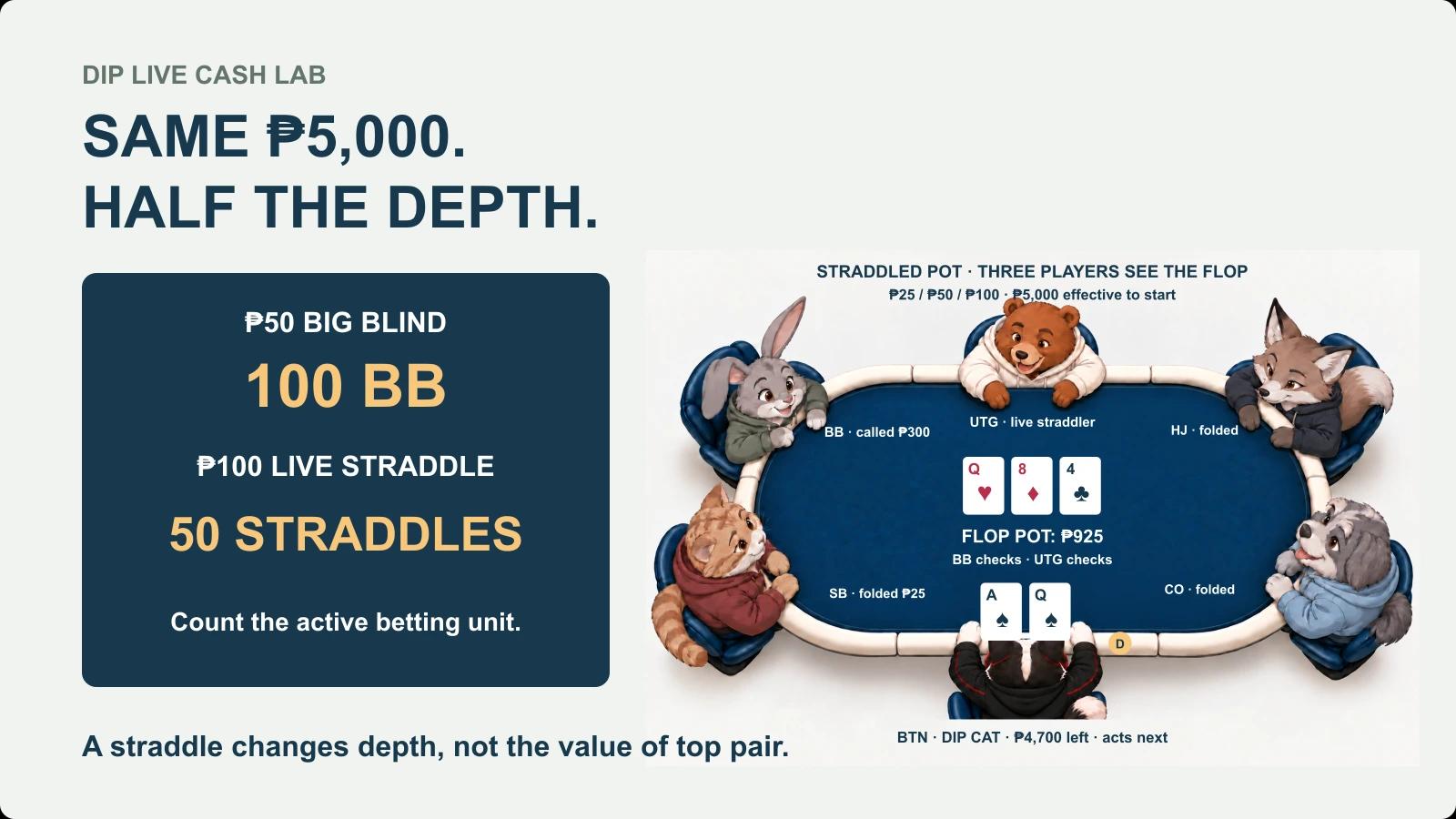
You buy in for ₱5,000 at a ₱25/₱50 cash table and think you are 100 big blinds deep. Then a live ₱100 under-the-gun straddle goes on. Your money has not disappeared, but the opening unit has doubled: you now have only 50 straddles.
That distinction changes how quickly a raised pot reaches your entire stack. It does not turn top pair into an automatic all-in.
The setup before anyone raises
This is a hypothetical six-handed game, not a description of a particular Philippine room. Assume the room permits a live UTG straddle to ₱100: it sets the current preflop amount to call, and the straddler acts last before the flop when action reaches them without further raises. Room-specific straddle rules vary; ask the dealer before playing. No ante, rake, jackpot drop or promotional deduction is included in this teaching example.
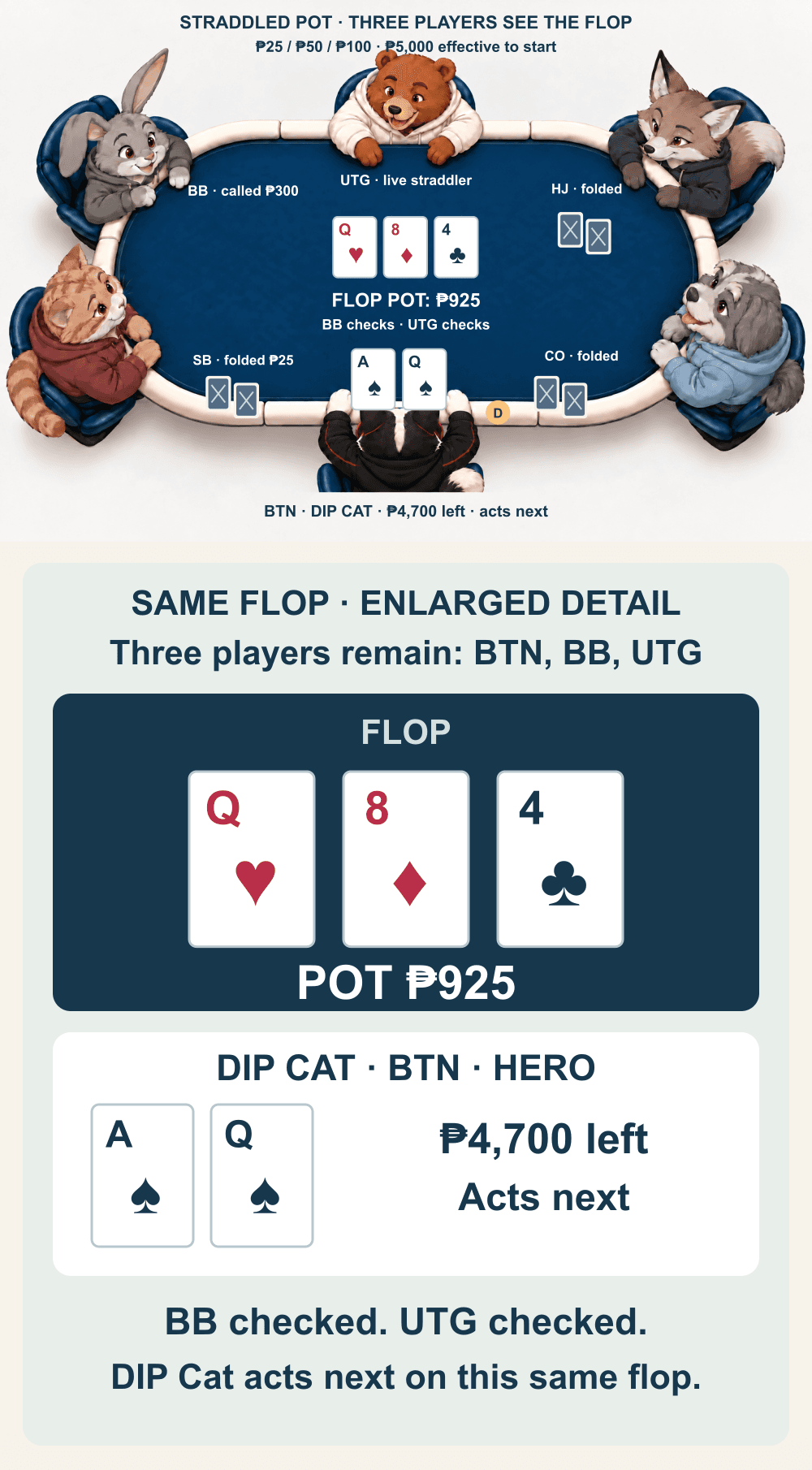
Hero is DIP Cat on the button with A♠ Q♠. Hero, BB and UTG each start the hand with ₱5,000. SB posts ₱25, BB posts ₱50 and UTG posts ₱100. HJ and CO fold. Hero raises to ₱300 total, SB folds, BB calls to ₱300 and UTG calls to ₱300. It is a three-way pot.
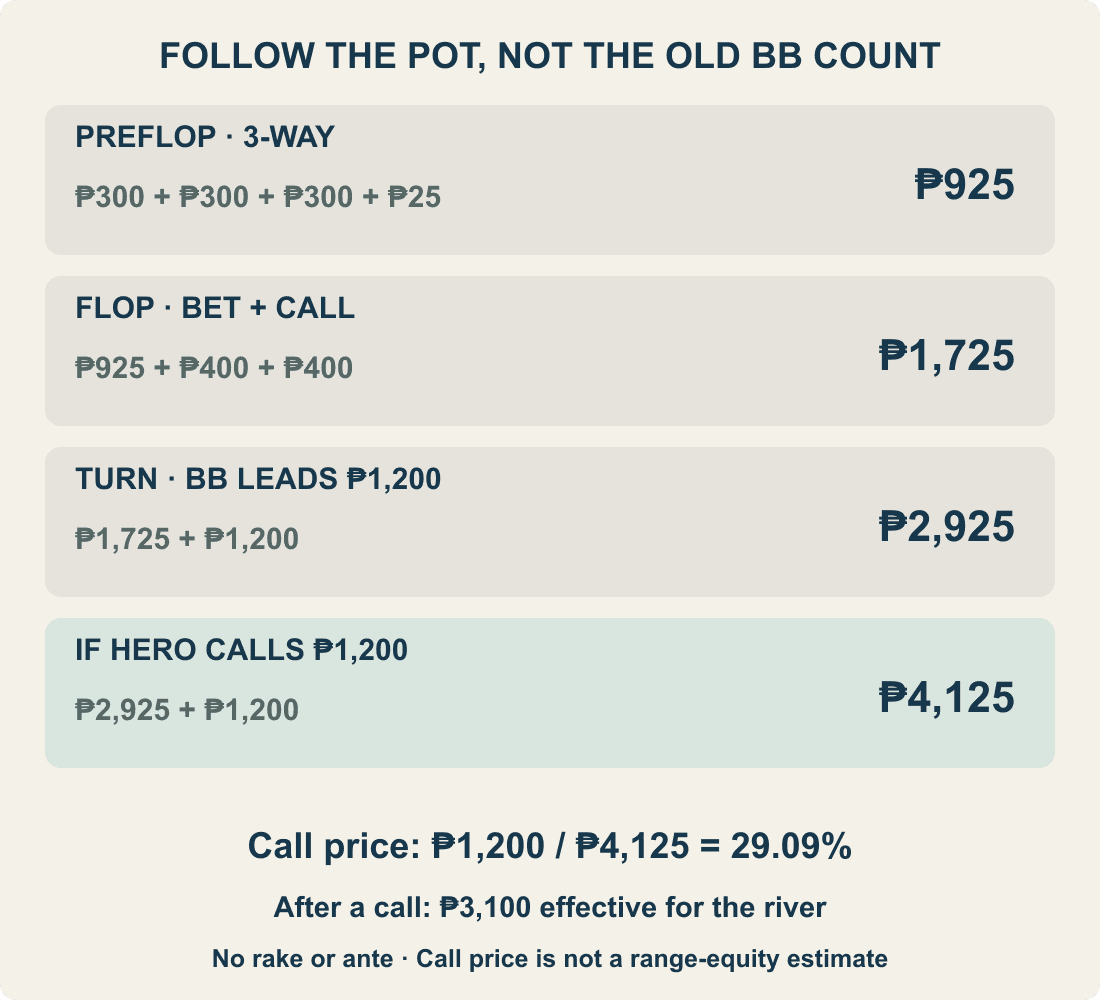
The pot is ₱300 × 3 + ₱25 = ₱925. Do not add the BB and straddle again: they are already inside those players' ₱300 totals. Each active player has ₱4,700 left.
Count the units and the SPR separately
The original buy-in was ₱5,000 / ₱50 = 100 conventional BB, but ₱5,000 / ₱100 = 50 live straddles. Hero's raise to ₱300 is six conventional BB or three straddles. Calling it a huge six-BB open without mentioning the straddle misdescribes the price opponents faced.
Stack-to-pot ratio, or SPR, uses actual money: effective remaining stack divided by the pot at that point. On this flop it is ₱4,700 / ₱925 = 5.08. Converting both amounts into another unit leaves the ratio unchanged. A straddle reduces depth relative to the live betting unit; it does not independently change the arithmetic of SPR after a pot already exists.
Follow the money to the turn
The flop is Q♥ 8♦ 4♣. BB checks, UTG checks, and Hero bets ₱400 into ₱925. BB calls; UTG folds. The ₱400 size is a worked example, not a universal multiway c-bet prescription. Hero has top pair, top kicker, but two opponents originally saw the flop; checking back is also a reasonable option against ranges or players that make betting unattractive.
After the bet and call, the pot is ₱925 + ₱400 + ₱400 = ₱1,725. Hero and BB each have ₱4,300 left. The turn is 9♦. BB leads ₱1,200. The pot in front of Hero is now ₱2,925, and Hero must decide whether to fold, call ₱1,200, or raise. BB has ₱3,100 behind; Hero still has ₱4,300 before deciding.
Before that turn bet, SPR was ₱4,300 / ₱1,725 = 2.49. This is why remembering only “I started with 100BB” can be expensive: two ordinary streets have produced a pot that can absorb the rest of the effective stack on the river.
The call price is not proof that you have the equity
A call creates a ₱4,125 pot: ₱1,725 + ₱1,200 + ₱1,200. The immediate price is ₱1,200 / ₱4,125 = 29.09%. That is the break-even showdown-equity threshold if no more money enters and the hand reaches showdown. A live turn decision also has river bets, folds and incomplete equity realization; 29.09% alone is not a recommendation to call.
The 9♦ strengthens possible Q9 and 98 two-pair holdings and JT straights, alongside sets such as 88, 44 and 99. It also creates diamond draws for hands that called the flop with backdoor diamonds. Whether those hands reached this spot, and whether BB leads them now, depends on preflop selection, flop calling and turn behavior. Do not count every theoretically possible combination at full frequency.
Hero's A♠ Q♠ has no diamond. It does not remove BB's diamond semi-bluffs, which can favor a bluff-catch compared with holding a diamond, but that observation is useful only if BB actually bets those draws. Hero also removes some AQ and Qx combinations. There is no single “blocker bonus” that replaces estimating the betting range.
Fold, call or raise
- Fold: sensible against a player whose large turn leads are predominantly two pair or better and who rarely leads draws or worse queens. Giving up top pair can be correct even after a large share of the starting stack has entered the pot.
- Call: preserves potential bluffs and avoids making worse hands fold immediately. It needs a credible range and a river plan, not a claim that every ace or queen is a clean rescue card. If called, the remaining effective ₱3,100 is about 75% of the ₱4,125 river pot. A river shove would offer a new price of ₱3,100 / ₱10,325 = 30.02%, but that price must be judged against the new river betting range.
- Raise all-in to ₱4,300 total: risks all Hero's remaining money. If BB calls the additional ₱3,100, the final pot is ₱10,325. With zero fold equity the shove needs ₱4,300 / ₱10,325 = 41.65% equity against the calling range. That is a different test from the 29.09% turn-call price. Do not justify a shove using the cheaper call's threshold.
Raising may collect value against unusually loose calls or deny equity, but it can also fold the semi-bluffs you wanted to keep and be called mainly by hands beating AQ. We have not assigned a solver range or a population frequency, so we are not presenting a fabricated exact equity for Hero.
Mistakes that the straddle exposes
- Treating the forced blind or straddle as a reason to defend regardless of price.
- Adding a blind twice when the player has already called to the full raise amount.
- Applying a 100BB chart without checking the chart's blind, ante and straddle assumptions.
- Equating low SPR with permission to stack off against every opponent.
- Calling the turn without deciding how different river cards and bet sizes change the range.
DIP's takeaway
Write the game as ₱25/₱50/₱100, count ₱5,000 as 50 live straddles, and then follow the actual pot and effective stack street by street. In this hand the straddle explains how the pot became large; it does not tell you whether BB is bluffing. Against a strongly value-heavy turn leader, folding can be the disciplined choice. Calling requires evidence of enough worse hands or draws and a river plan; shoving needs a substantially stronger justification.
Play responsibly. Decide your cash-game loss limit before sitting down. If a straddle makes the stakes too large for that limit, decline the game or leave rather than buying more chips to restore a familiar depth.