“I will get paid if I hit” is not yet an implied-odds calculation. A cheap-looking gutshot call can need a surprisingly large river payment just to break even.
Here is a turn decision where the missing number is not the number of outs. It is how much extra money the opponent must actually put in when the draw arrives.
The hand: four tens, one card to come
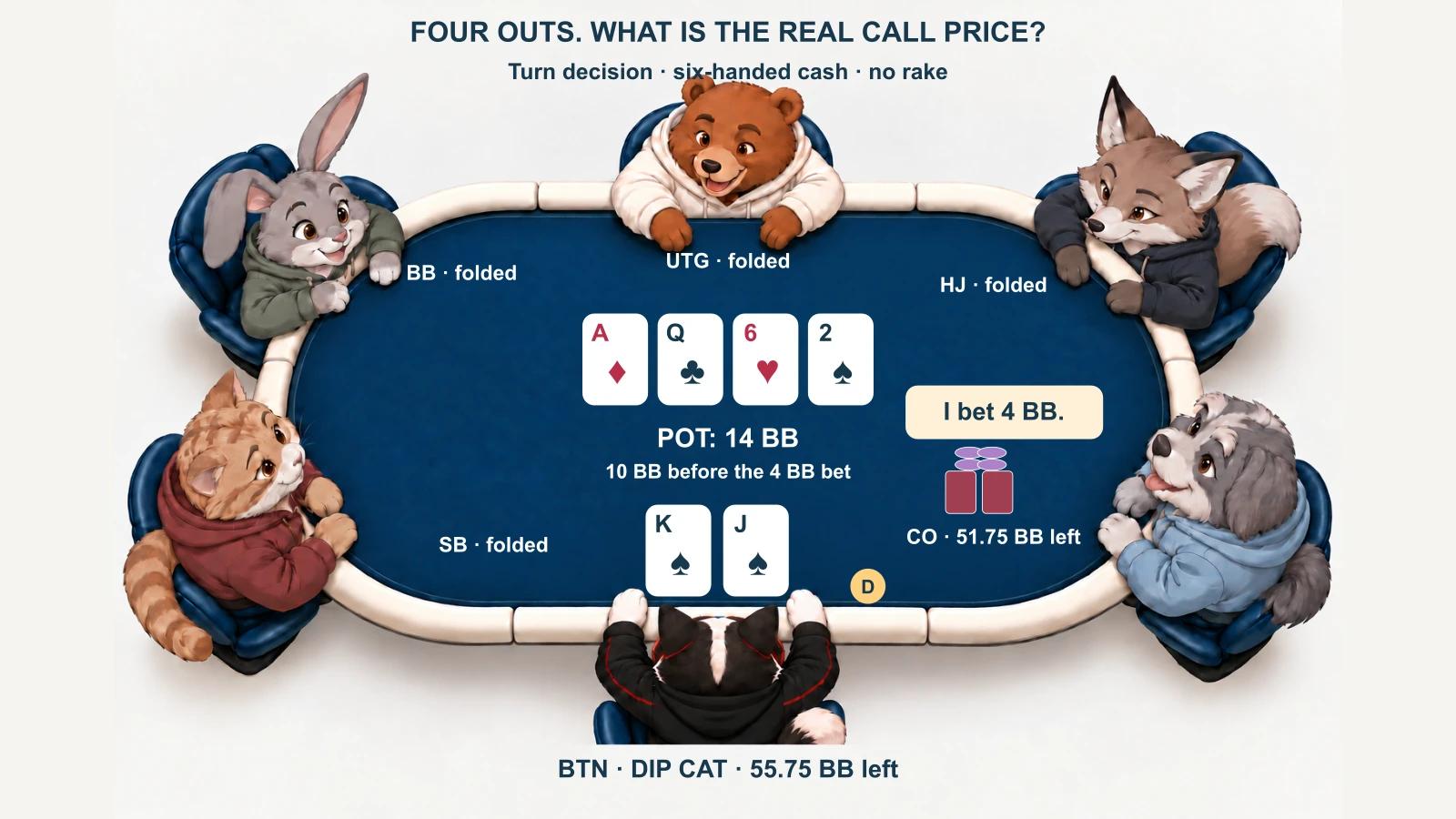
Six-handed cash game, 0.5/1 BB blinds, no ante and no rake. Everyone relevant starts with 60 BB. DIP Cat is on the button with K♠ J♠. UTG and HJ fold; the cutoff opens to 2.5 BB; Cat calls; both blinds fold. The heads-up flop pot is 6.5 BB, including the dead 1.5 BB blinds.
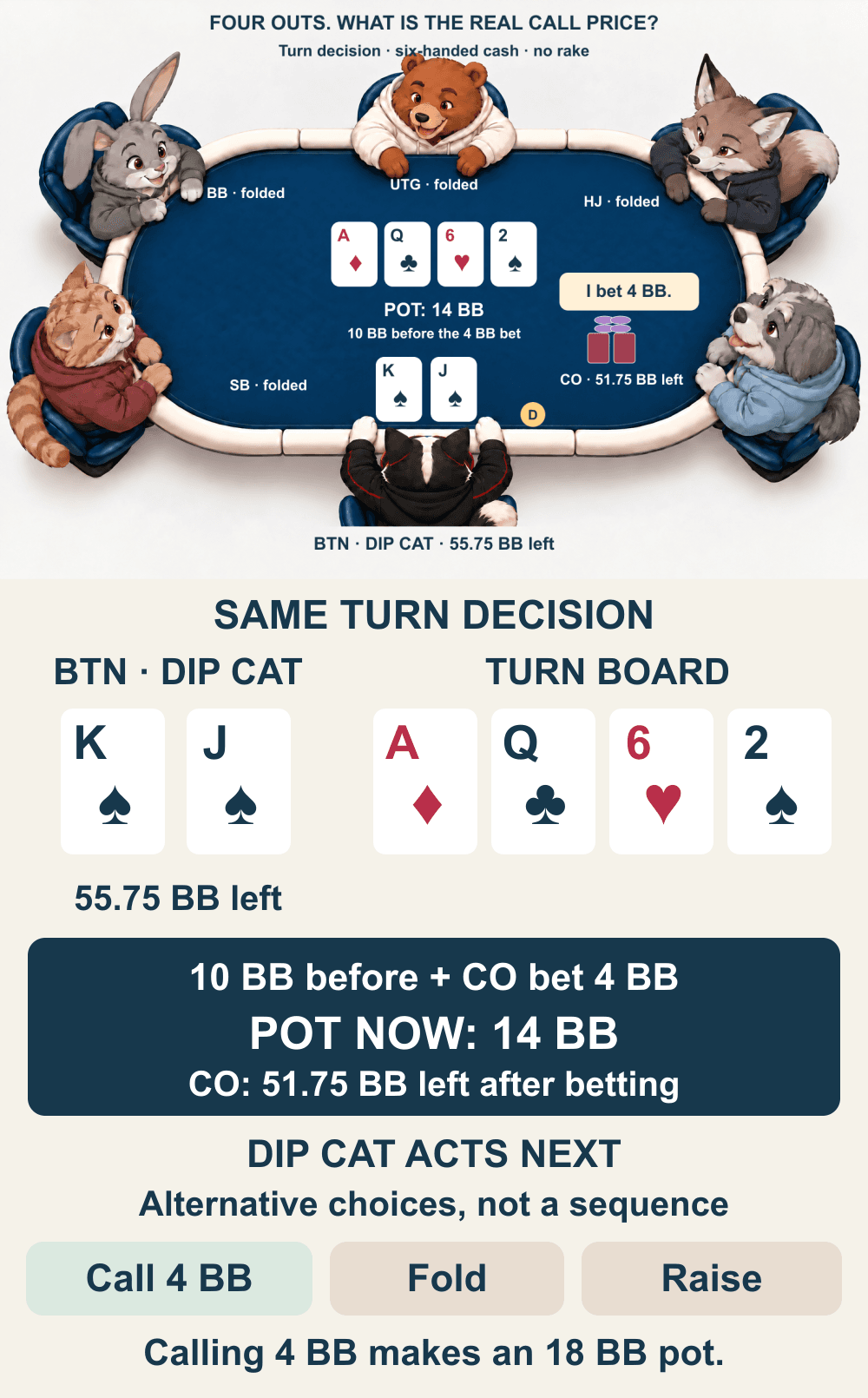
The flop is A♦ Q♣ 6♥. The cutoff bets 1.75 BB and Cat calls, making the turn pot 10 BB. On the 2♠ turn, the cutoff bets 4 BB. There are now 14 BB in the middle. Cat has 55.75 BB behind and must decide whether to fold, call 4 BB, or raise. The cutoff has 51.75 BB behind after betting.
This analysis begins at that turn decision. The preflop and flop calls are scenario assumptions, not automatic recommendations.
State the range assumption before counting outs
For the narrow model, assume the cutoff has only value hands that beat Cat now: Ax two pair, sets, or one-pair aces. A river king or jack does not beat those hands. Assume Cat never wins unimproved, does not bluff later, and folds to a river bet after missing. These are deliberately conservative assumptions, not a claim about every live opponent.
Any ten gives Cat Broadway: A-K-Q-J-T. The board then remains unpaired and cannot make a flush, so these four tens are clean winning outs against this assumed range. There are no additional flush outs: K♠ J♠ plus the lone 2♠ on board cannot become five spades with only one river card.
For a transparent first estimate, treat the four unseen tens as equally available among the 46 unseen cards. Then the hit rate is 4/46 = 8.70%. Exact range-conditioned equity can differ because the opponent’s unknown cards are not necessarily distributed uniformly. This is an educational four-out approximation, not an equity-engine output.
The direct price already says no
The call costs 4 BB and would make the pot 18 BB. Without further river money, the required equity is 4/18 = 22.22%, far above 8.70%.
- Expected final-pot return: (4/46) × 18 = 1.57 BB.
- Less the call: 1.57 − 4 = −2.43 BB.
Earlier investments are sunk at this decision. Do not subtract the preflop and flop calls again. There is only one card to come; a flop-to-river hit rate would price the wrong purchase.
How much extra river money repairs the call?
Let X be the opponent’s additional river contribution when Cat hits. Do not include Cat’s own river bet in X: when Cat wins, that bet merely comes back. In this simplified model, the turn call’s incremental EV is:
EV(call) = (4/46) × (18 + X) − 4.
Set this to zero:
- (4/46) × (18 + X) = 4.
- 18 + X = 46.
- X = 28 BB.
Cat needs to collect an extra 28 BB from the cutoff on every hit to break even. That is more than one and a half times the 18 BB river pot. The cutoff can afford it from the remaining 51.75 BB, but having chips available does not mean paying them off.
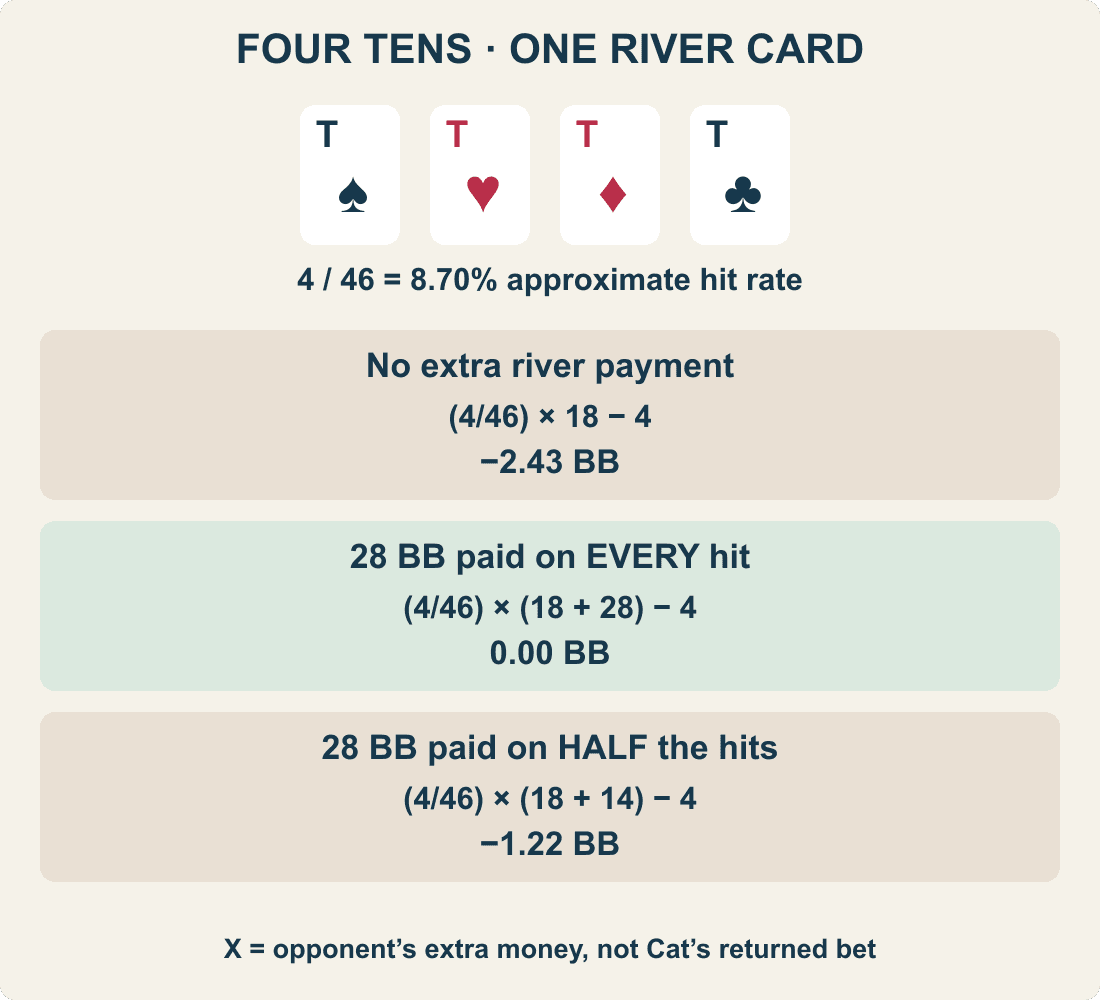
If the cutoff pays 28 BB only half the times a ten arrives and pays nothing on the other hits, the average extra payment is 14 BB. EV becomes (4/46) × (18 + 14) − 4 = −1.22 BB. “They sometimes pay big” is not enough.
Compare the options
Folding preserves 55.75 BB and avoids paying for an optimistic future story. Under the stated four-out, value-only model, it is the sound default unless unusually strong evidence supports the necessary river payout.
Calling keeps the draw available, and position lets Cat respond to the cutoff’s river action. Its weakness is dependence on a large, frequent payoff. A ten also makes the straight possibility visible; do not assume a player with one pair will call a large bet simply because they bet the turn.
Raising is a different proposal: a semi-bluff requiring fold equity, a legal size, and a plan against a shove. It cannot be justified by reusing the call’s 8.70% hit rate. K♠ J♠ removes some AK and AJ combinations, but blockers do not establish that the opponent will fold. Against a value-heavy player who continues often, raising may only enlarge the loss.
DIP’s conclusion
The practical question is not “Can I win a big pot?” It is “How much will this range pay, and how often, when my exact card arrives?” Separate the opponent’s additional payment from your own returned chips. Count only genuinely winning outs, and adjust for rake, range-conditioned card removal and any chance of winning without improving before applying the model to a real hand.
Play responsibly. Use a fixed poker budget, protect essential funds and never chase a missed draw with money you cannot afford to lose.