You flop two pair and feel comfortable. Then the board pairs a different rank, and your hand's name stops telling the whole story. Before paying another bet, rebuild your best five cards.
This hypothetical cash hand explains how bottom two pair can be counterfeited, then uses a river decision to count the bluffs needed for a call. The proposed ranges are assumptions for teaching, not measured player tendencies or solver output.
Start with a real hand and a real pot
Six players start with 100 BB. There is no ante and rake is excluded. UTG, HJ and CO fold. BTN raises to 2.5 BB, SB folds and DIP Cat in BB calls 1.5 more with K♦ 2♦.
The pot is 5.5 BB and each active player has 97.5 BB behind. Calling this particular starting hand is a scenario setup, not a universal big-blind defence recommendation.
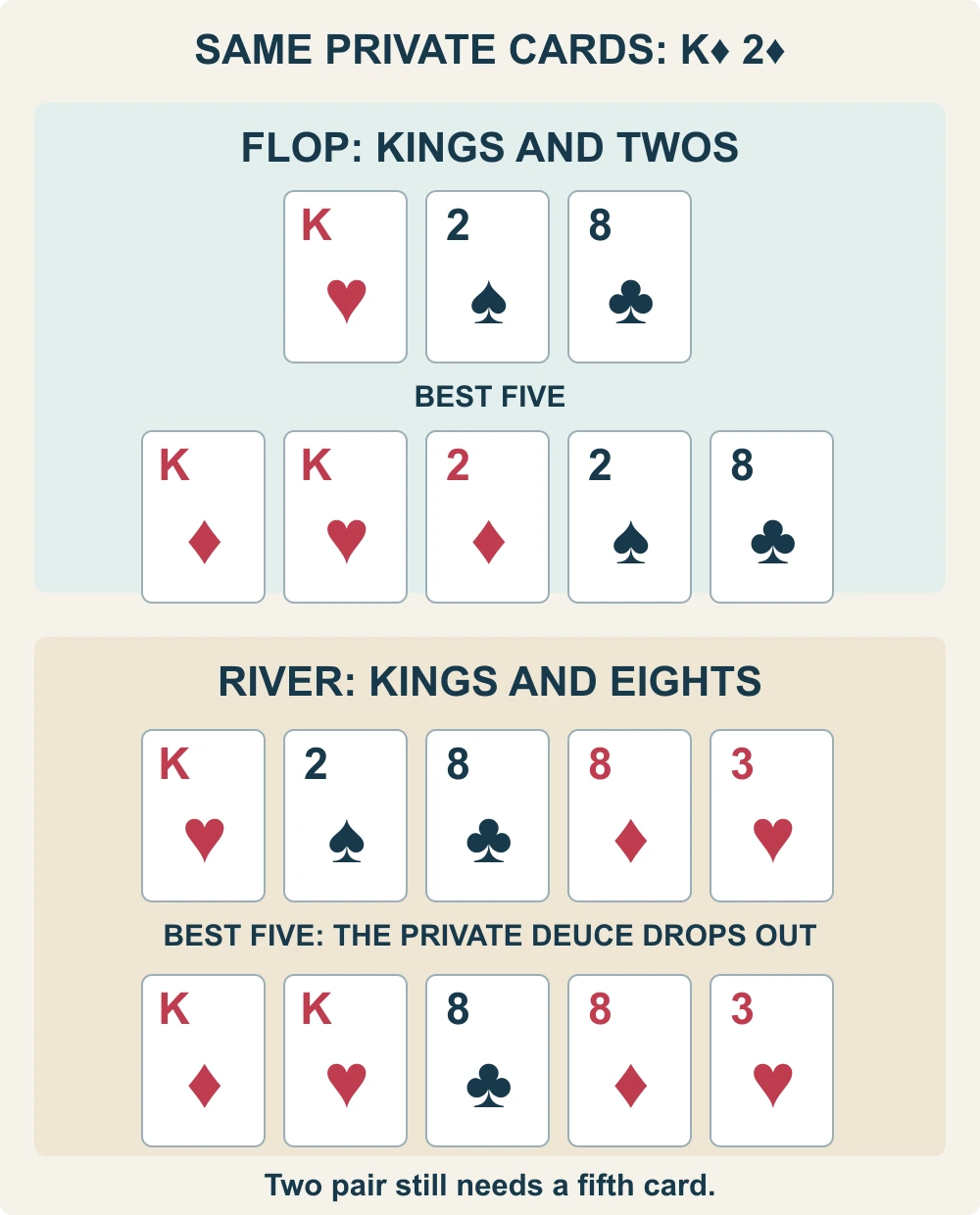
The flop is K♥ 2♠ 8♣. Cat checks, BTN bets 3 BB and Cat calls. The pot becomes 11.5 BB, with 94.5 BB left each. Cat has kings and twos; we use a call to follow one branch rather than declaring it better than a raise.
The eight changes what your deuce contributes
The turn is 8♦. Cat checks and BTN checks behind. Pot and stacks stay unchanged.
Cat now uses K♦ K♥ 8♣ 8♦ 2♦: kings and eights, with a deuce kicker. The private deuce is no longer needed to supply a second pair, because the two shared eights already supply a higher pair.
An opponent with A♣ K♠ makes kings and eights with an ace kicker and is ahead. An opponent with A♠ A♥ has aces and eights and is also ahead. Either opponent was behind Cat on the flop.
Counterfeiting describes this loss of useful contribution from part of your original hand. It does not mean the hand has no value or that every opponent improved. Pocket queens still lose to Cat's kings and eights here.
On the river, compare five cards again
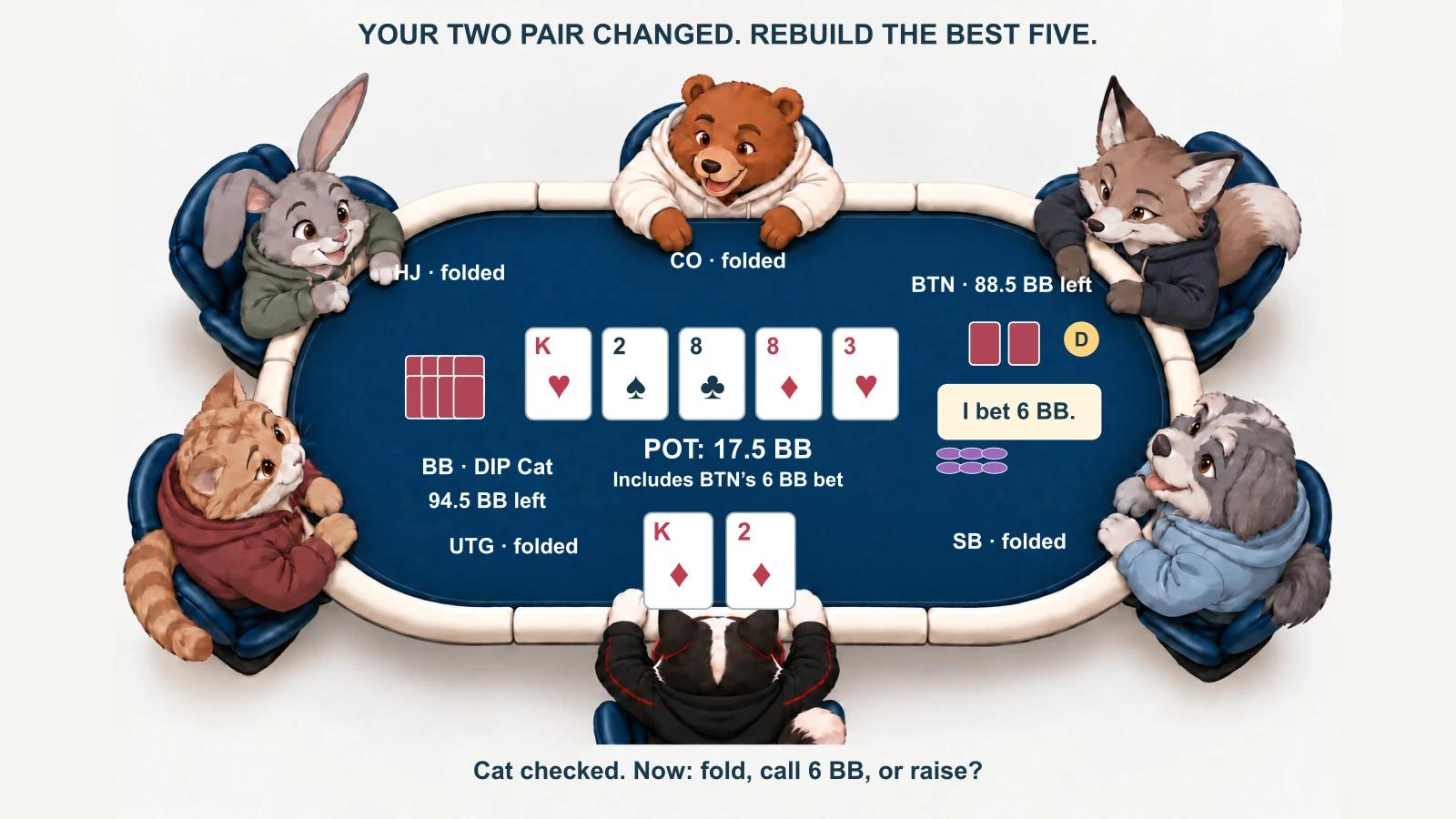
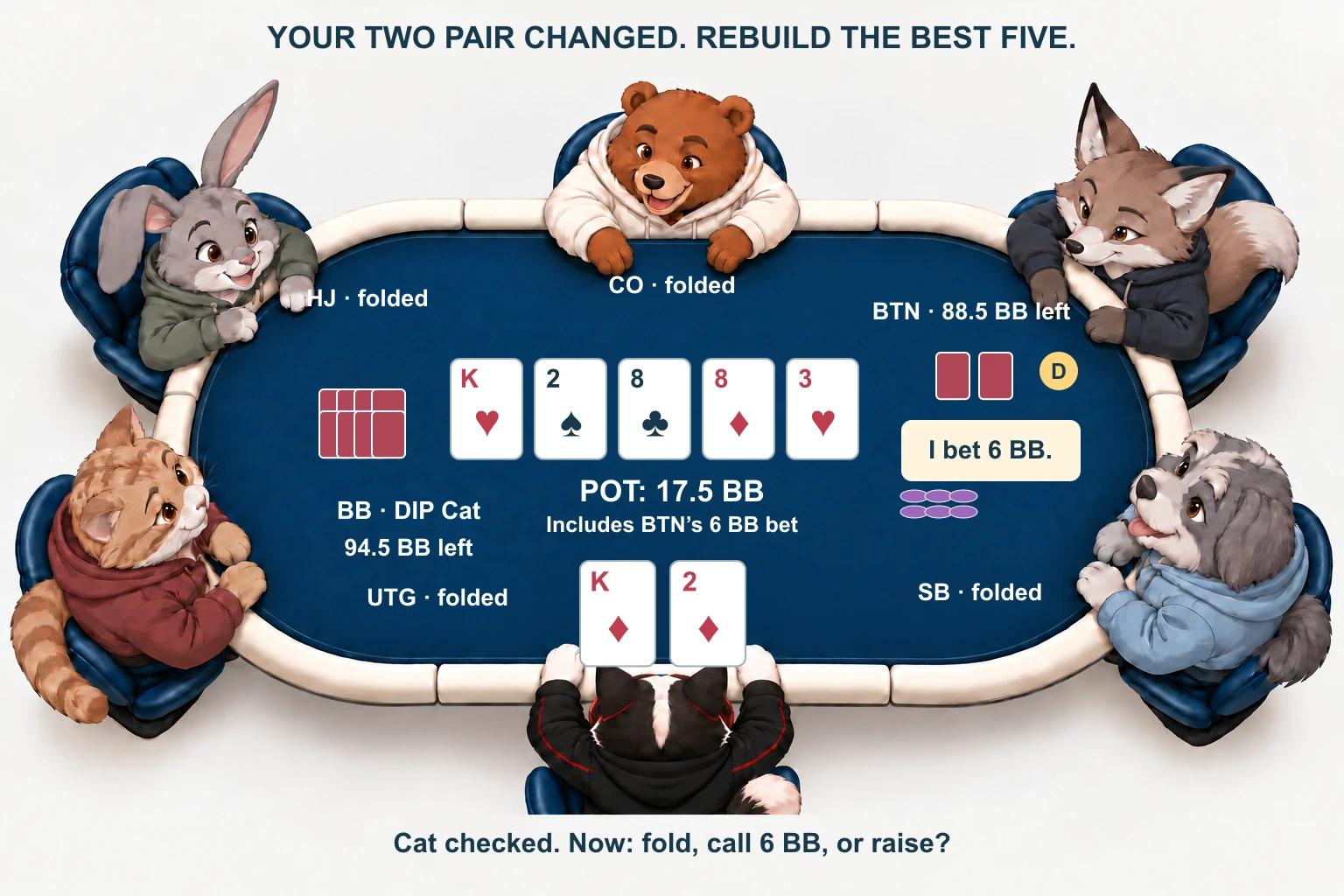
The river is 3♥. The complete board is K♥ 2♠ 8♣ 8♦ 3♥. Cat's best five are now K♦ K♥ 8♣ 8♦ 3♥. Neither player's sixth card can settle a tie between otherwise equal best-five hands.
Cat checks. BTN bets 6 BB. Cat faces a 6 BB call into 17.5 BB; calling makes the final pot 23.5 BB. Each player would have 88.5 BB left after that call. There is no later street on which to recover a mistaken call.
The immediate break-even share is 6 / 23.5 = 25.53%. This number does not estimate BTN's bluffs. It tells us what a range estimate must deliver.
Build an explicit, deliberately narrow model
Suppose BTN bets the following hands for value on this river, and bets every available combination at full weight:
- AK: eight combinations, with two kings and four aces available.
- KQ: eight combinations, with two kings and four queens available.
- AA: six combinations, choosing two of the four aces.
- A8 suited: two combinations, A♠8♠ and A♥8♥.
- 87 suited: two combinations, 8♠7♠ and 8♥7♥.
That gives 26 value combinations. Every listed hand beats Cat. The list intentionally excludes other possible value hands, so it is a model rather than a complete claim about BTN's range. A real range must account for preflop choice and every subsequent action, including the turn check.
Now suppose every bluff in the betting range loses to Cat, with no ties and no worse hands betting for value. Unpaired AQ is an example of a hand that could lose at showdown if used as a bluff; merely reaching the river with AQ does not mean it will bet.
With eight bluff combinations, Cat wins 8 / 34 = 23.53% of the time. The call's expected chip result is (8 × 17.5 − 26 × 6) / 34 = −0.47 BB.
With nine bluff combinations, Cat wins 9 / 35 = 25.71%. The expected result is (9 × 17.5 − 26 × 6) / 35 = +0.04 BB, rounded.
The exact boundary is 26 × 6 / 17.5 = 8.91 bluff combinations. Nine equally weighted combinations barely cross it. That tiny margin is sensitive to omitted value hands, action frequencies and actual fees. It is not evidence that a real opponent bluffs enough.
Fold, call or raise?
Folding costs no additional chips. Earlier calls are already part of the pot and are not a reason to pay another 6. Folding is attractive when this line rarely contains bluffs or bets from worse hands.
Calling keeps the bluffs in. It needs a credible betting range, not the memory of having two pair on the flop. If weaker pairs also bet, they may count among hands Cat beats; rebuild the model instead of calling every such hand a bluff.
Raising commits more chips with a hand that no longer has its original relative strength. A value raise needs worse hands that call. A bluff raise needs better hands that fold. Neither result follows from the words two pair.
Common mistakes
- Comparing only the hand category and overlooking the fifth card.
- Assuming a checked turn removes all strong hands.
- Counting all missed hands as river bluffs, regardless of how often they bet.
- Treating a model that barely beats zero as a robust practical edge.
DIP takeaway
When the board pairs, rebuild the best five before choosing an action. Flopped two pair can become a bluff catcher, and a bluff catcher needs enough worse bets to justify its price. The earlier strength of your hand is not a discount on the river call.
Practise with play chips. If you play for money, set an affordable limit beforehand and never increase stakes to recover a loss.