A strong draw is a candidate for a flop check-raise, not a command to build the biggest pot possible. The useful question is what the raise achieves against the bettor's range, and what happens when it does not win immediately.
The hand before the decision
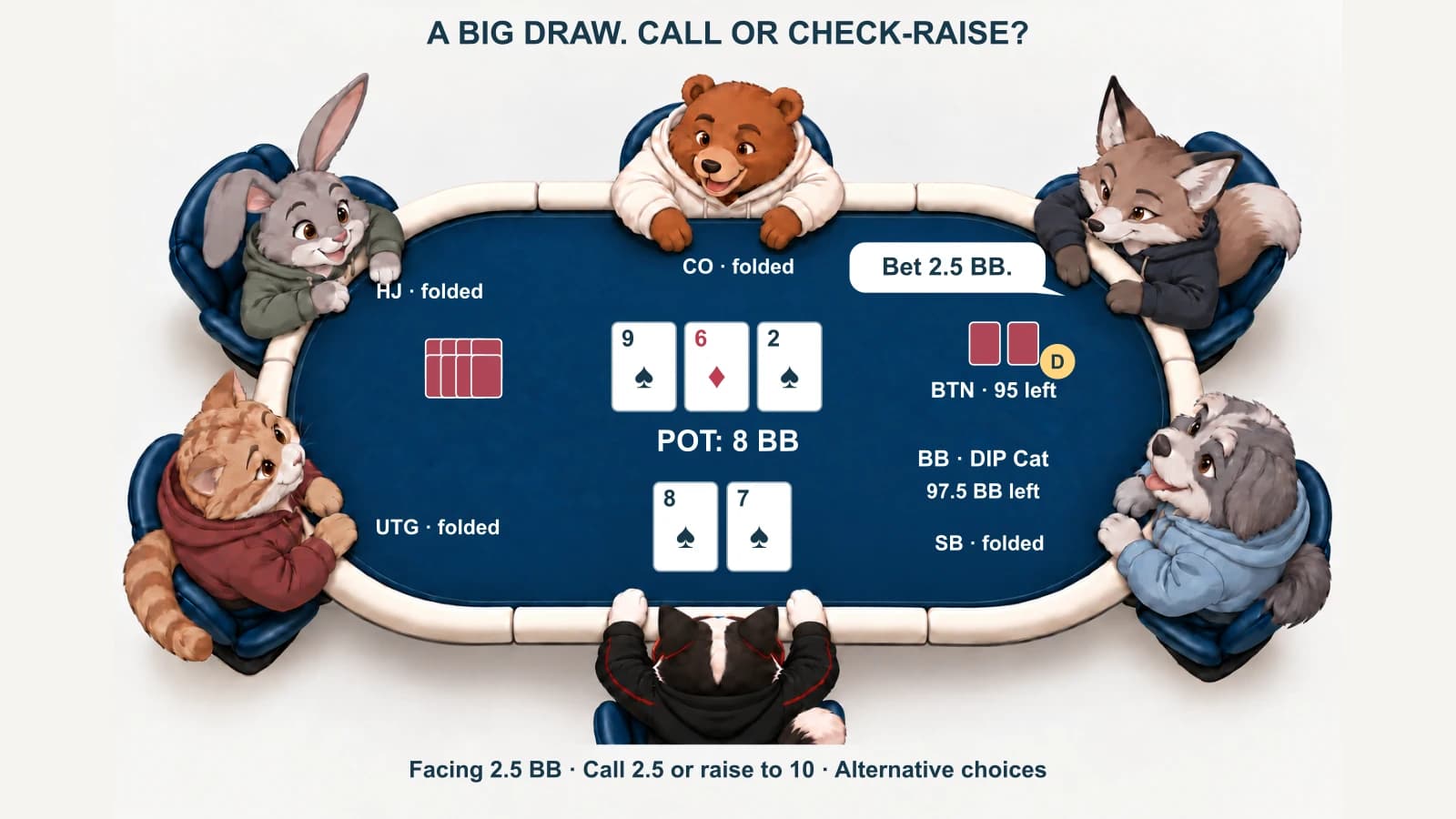
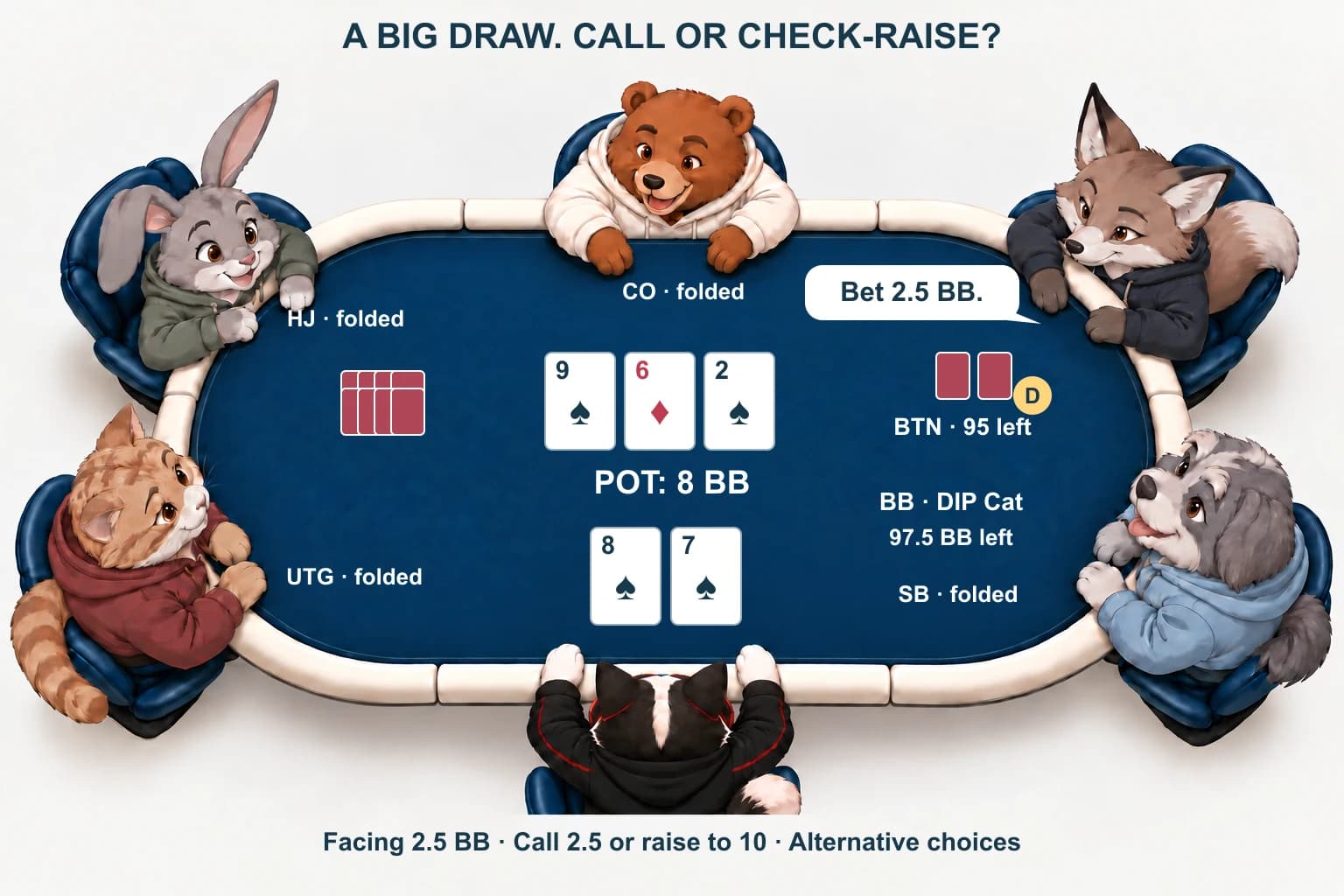
Consider a hypothetical six-handed cash practice game, 100 BB effective, with no ante or rake. UTG, HJ and CO fold. BTN opens to 2.5 BB, SB folds its 0.5 BB, and Hero calls in BB with 8♠ 7♠. The pot is 5.5 BB; both active players have 97.5 BB behind.
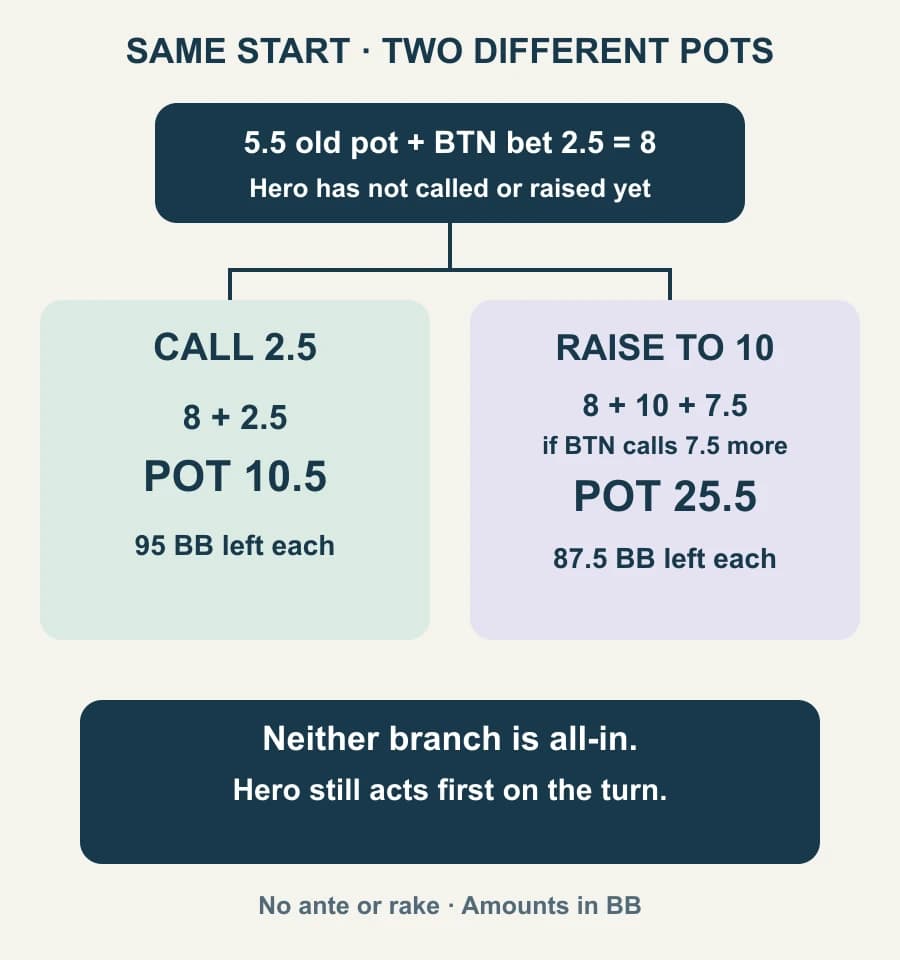
The flop is 9♠ 6♦ 2♠. Hero checks. BTN bets 2.5 BB, making the pot 8 BB. Hero can fold, call 2.5, or raise. We examine a raise to 10 BB total, not ten more on top of a call.
Count the draw without counting cards twice
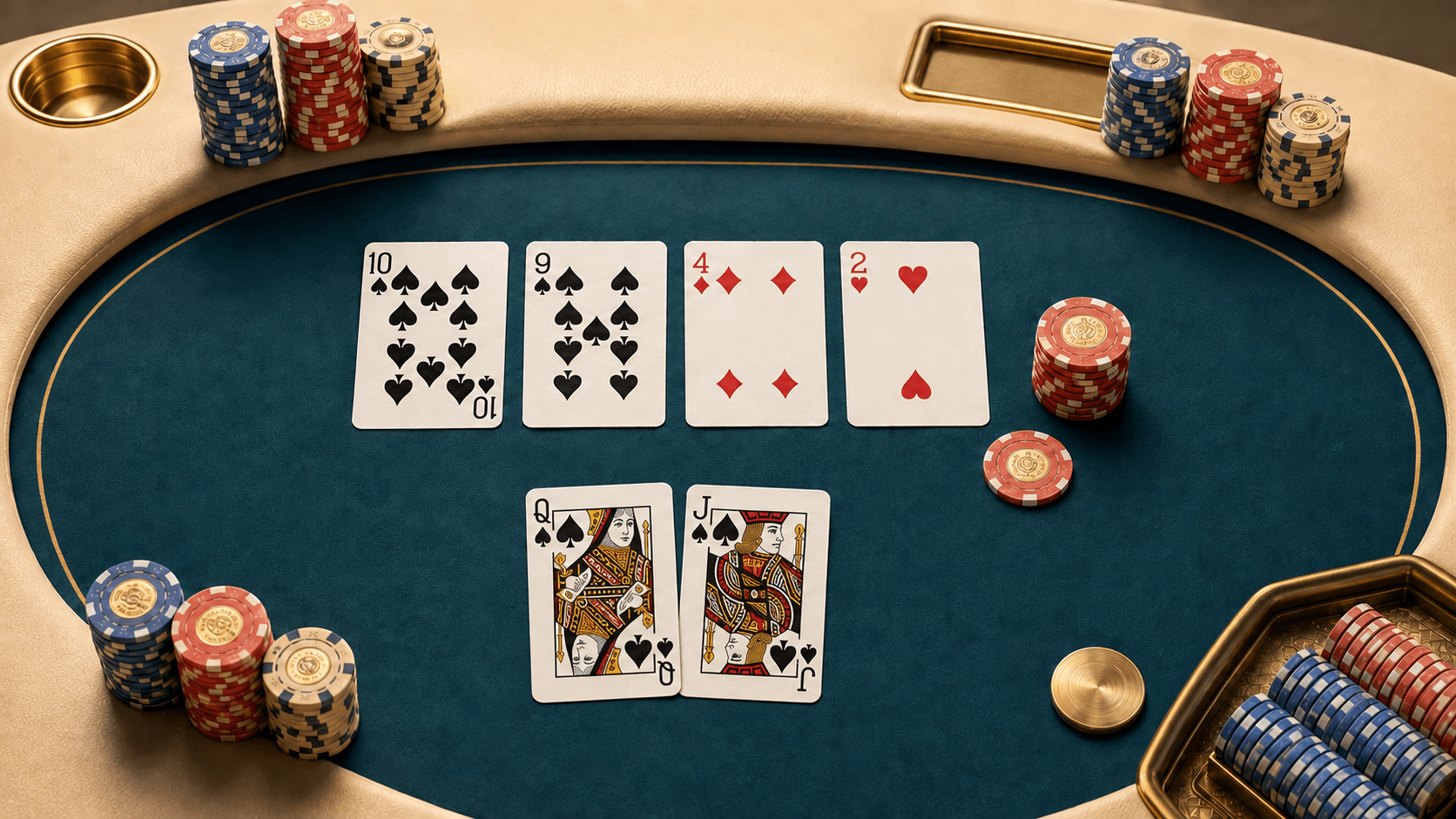
Hero has a flush draw and an open-ended straight draw. Nine remaining spades make a flush. Four fives and four tens make a straight. The 5♠ and T♠ appear in both groups, so the union is 9 + 8 − 2 = 15 cards, not 17.
With only Hero's cards and the flop known, 47 cards are unseen. The chance that the next card belongs to that 15-card group is 15/47, or 31.9%. If both remaining board cards were dealt without another decision, the chance of seeing at least one is 1 − (32/47 × 31/46), or 54.1%.
Neither number is automatically Hero's winning equity. An opponent can hold some of those cards, a higher flush draw can make a spade dangerous, and a set can fill up after Hero improves. Range-conditioned equity needs those possibilities. The two-card calculation is especially not permission to call a flop bet while ignoring the price of the turn.
What changes when you raise to ten?
Calling costs 2.5 BB and creates a 10.5 BB pot, leaving both players with 95 BB. Its immediate price is 2.5/10.5 = 23.8%. That is the break-even equity for a hypothetical call that goes directly to showdown, not a complete forecast of a hand with two betting rounds left.
Raising instead commits 10 BB now. There are 18 BB in the middle before BTN responds. BTN has already bet 2.5 and needs 7.5 more to call. A call produces a 25.5 BB pot with 87.5 BB behind each player: a stack-to-pot ratio of about 3.43.
If BTN folds, Hero gains the existing 8 BB from the decision point. Receiving one's own raise back is not additional profit. If BTN calls, the pot is larger and Hero still acts first on the turn. A check-raise does not buy position or guarantee a free river.
Fold equity is about the hands that actually fold
Against a player who continuation-bets many unpaired overcards, a raise can win now from hands that currently beat eight-high. Against someone who bets only strong pairs, sets and premium draws, fewer hands may disappear. Start by naming the folds, not by assuming that a large bet looks scary.
For a deliberately simplified benchmark, suppose the raise has zero winning chance whenever it gets called, and BTN either folds or calls. Risking 10 to win 8 requires folds more than 10/(10 + 8) = 55.6% of the time. Our actual drawing hand can win after a call, so this is a pure-bluff benchmark, not its true required fold rate.
Now consider a second toy model: after a call, all remaining cards run out for free, and Hero has an assumed 35% equity against the calling range. The called branch is worth 0.35 × 25.5 − 10 = −1.075 BB. If F is the fold frequency, the raise's value is F × 8 + (1 − F) × (−1.075). It breaks even at about 11.8% folds.
Do not read that as a recommendation to raise whenever an opponent folds twelve percent. The 35% is an assumption, not a solver result. The free-runout model excludes reraises, future bets, rake and imperfect equity realisation. A profitable raise in that model can also be worse than calling; beating zero is not the same as being the best available action.
Make a turn plan before making the pot bigger
- On a non-spade five or ten, Hero makes a straight. Consider which worse hands can pay, while remembering the board can change again.
- On a spade, Hero makes a flush but not necessarily the best flush. The opponent's higher spade holdings still matter.
- On a blank such as K♦, Hero has not completed either draw. Do not automatically fire again because ten chips already went in. Reassess the caller's range and the new price.
- If BTN reraises the flop, stop using the call-only model. Recalculate the amount required and likely continuing range before deciding whether to continue.
DIP's conclusion
Calling keeps the pot smaller and preserves more weaker hands in BTN's range, but leaves Hero out of position with no immediate fold equity. Check-raising can deny equity and win the pot now, but concentrates the opponent's continuing range and exposes Hero to a reraise. Folding relinquishes the draw without further cost; it becomes more plausible when the apparent outs are unreliable and the opponent's range is unusually strong.
Use this hand to practise three habits: remove overlapping outs, separate a raise's total from the extra amount to call, and plan the next street. A draw's appearance alone does not choose the action.
Practise with play chips. If you choose real-money play, follow local eligibility rules, set limits and never treat an illustrative calculation as guaranteed income.