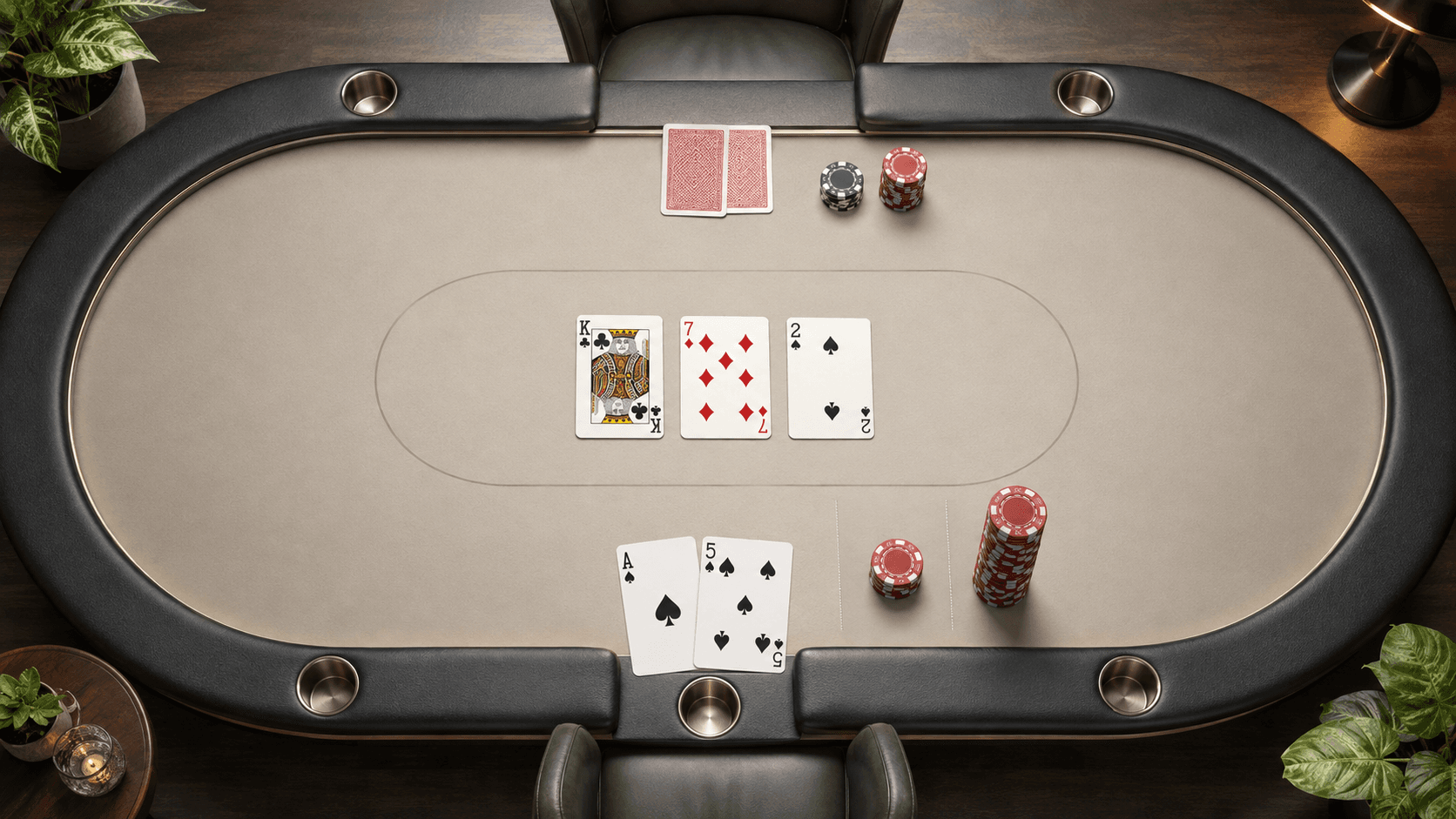
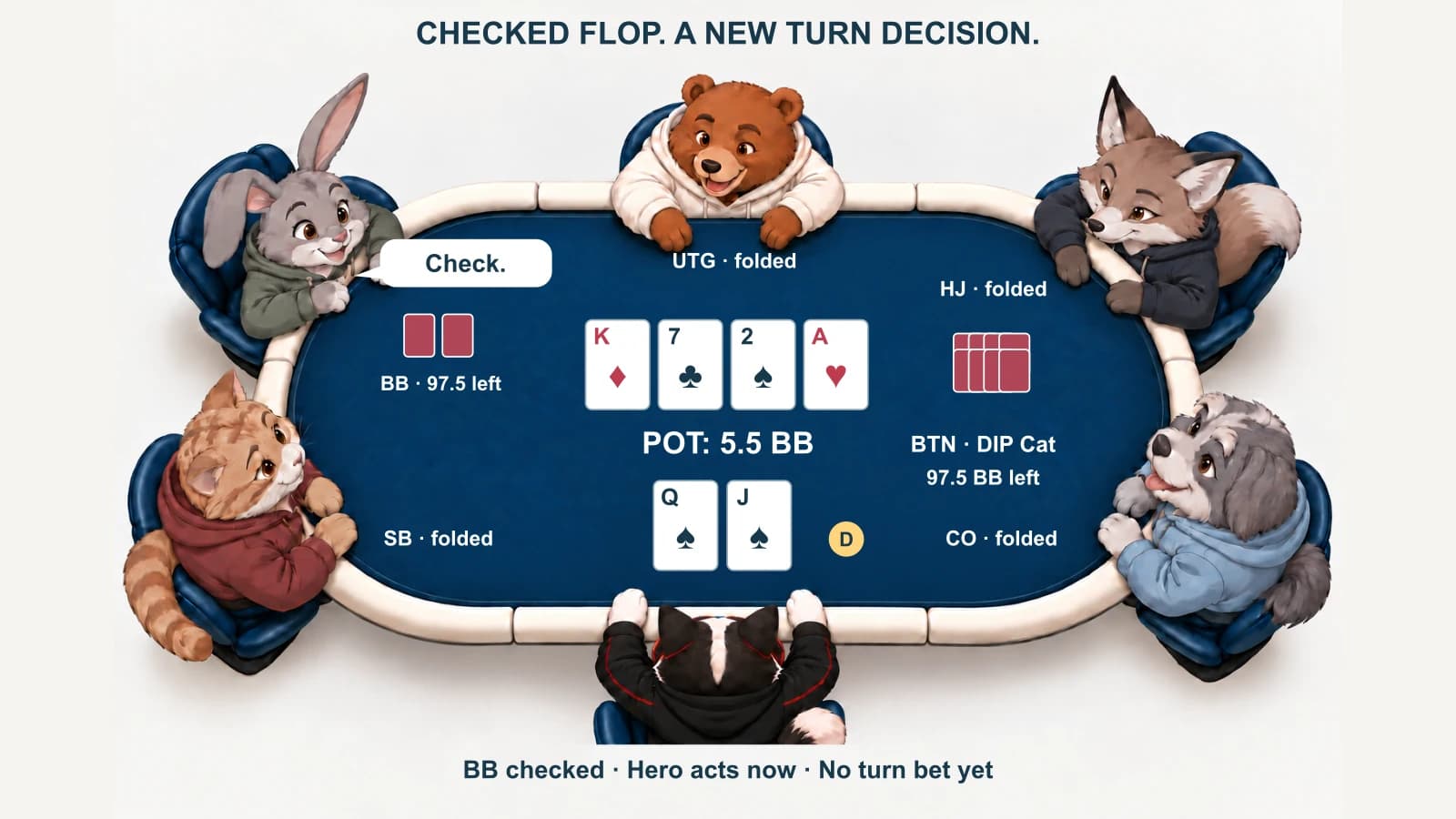
A checked flop does not end your chance to bet. It does, however, change the story. Before making a delayed continuation bet on the turn, ask what the new card changes, which worse hands can fold, and what you will do if called.
The hand: a second chance, not a free pot
This is a hypothetical six-handed cash-game example, with 100 BB effective stacks and no ante or rake. UTG, HJ and CO fold. Hero on BTN opens Q♠ J♠ to 2.5 BB. SB folds its 0.5 BB and BB calls. Two players see the flop with 5.5 BB in the pot and 97.5 BB behind each.
The flop is K♦ 7♣ 2♠. BB checks and Hero checks back. Hero has queen-high, two overcards to the seven and a backdoor spade possibility, not a made flush draw. Checking avoids immediately building a pot with a weak hand and keeps the option to respond to the turn. It is an illustrative choice, not a solver prescription for every QJs combination.
The turn is A♥. BB checks again. The pot is still 5.5 BB, the stacks are still 97.5 BB, and Hero can check or bet. A bet now would be a delayed continuation bet: the preflop raiser bets after declining to bet the flop.
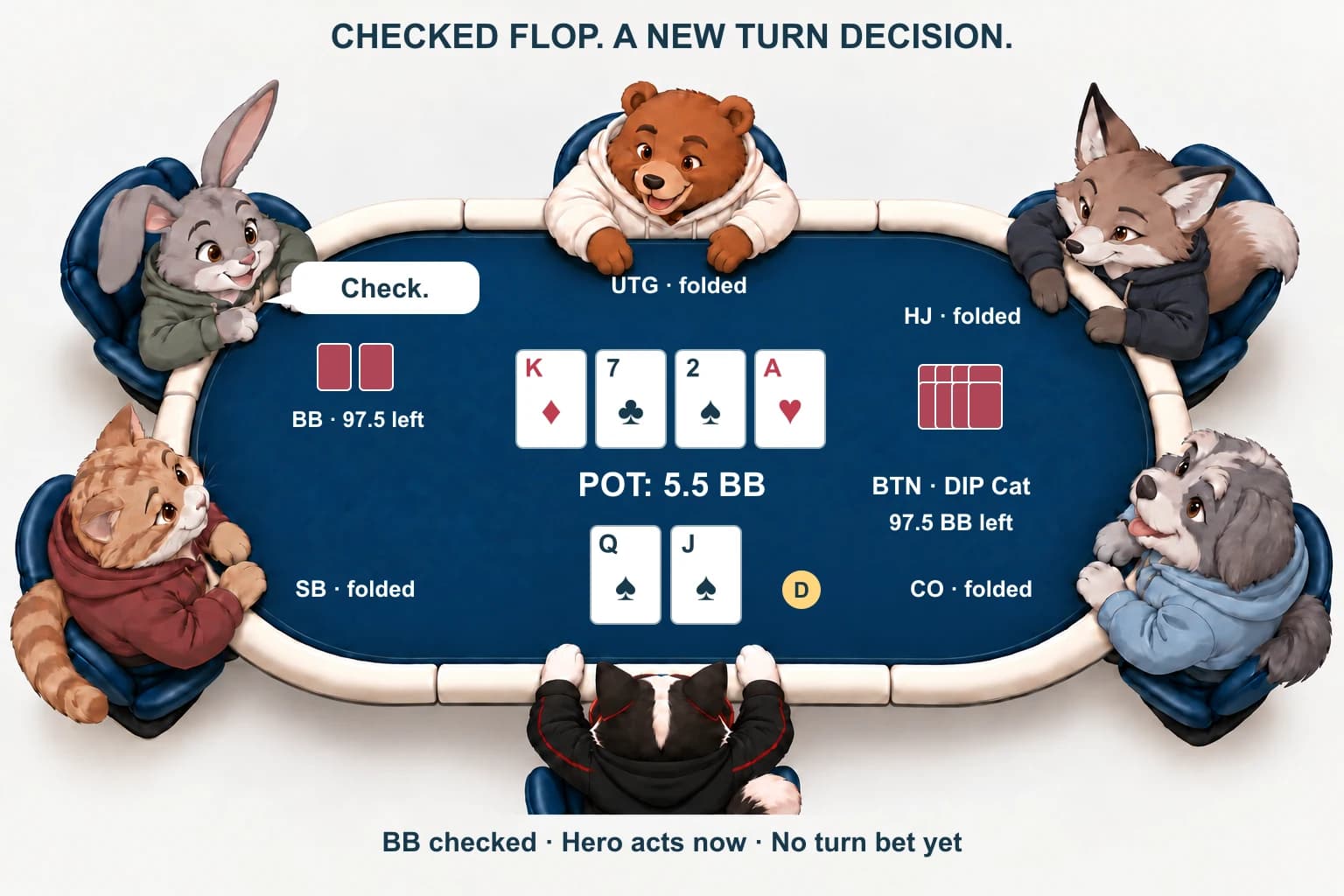
Why the ace helps the story, but does not prove a bluff will work
Hero can have aces that checked the flop, including hands such as AQ or AJ. Hero can also have strong hands that chose not to bet earlier. That makes an ace-turn bet plausible. But BB can have Ax too: checking twice is not proof of weakness, and a flop check does not remove strong hands from either player.
Separate the opponent's possible responses:
- Some unpaired hands and lower pairs may fold. These are the hands the bluff needs to move.
- Kx may call once; do not assume the ace automatically makes every king fold.
- Ax, two pair and sets are not the hands to target with a routine bluff. Some may check-raise.
Those are candidate hand classes, not a measured range or a population frequency. Against a player who calls nearly every pair, the case for bluffing weakens. Against someone who routinely releases lower pairs on overcards, it improves. Use observed behaviour, not the animal character in the picture, to assign a read.
Price the bet before choosing it
Consider betting 4 BB into 5.5 BB. As a pure bluff that always loses after a call, it needs folds more than 4 ÷ (5.5 + 4), or 42.1% of the time, to show a positive immediate expectation. At exactly that rate it breaks even. This threshold is not a claim that BB folds that often.
If BB calls 4, the pot becomes 13.5 BB and both players have 93.5 BB left. The remaining stack-to-pot ratio is 93.5 ÷ 13.5, about 6.93. A small turn bluff has not committed the whole stack.
A 2 BB bet would require only 26.7% immediate folds in the same pure-bluff model. But the cheaper price can also encourage more calls. A lower mathematical threshold does not make a smaller size automatically better. Choose a size for the hands you expect to fold, not just the most attractive percentage.
QJ has a route to improvement, not a licence to fire
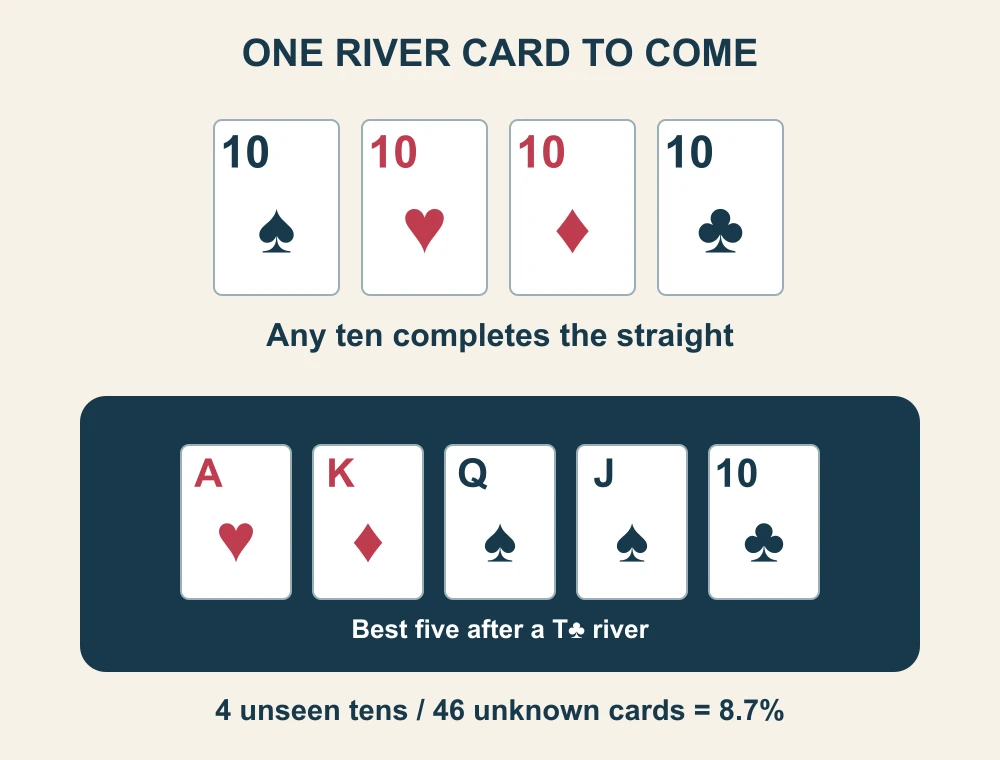
On K♦ 7♣ 2♠ A♥, any ten completes Hero's ace-high straight. There are four unseen tens among 46 cards unknown to Hero, giving a simple 4/46, or 8.7%, chance of a ten on the river before conditioning on the opponent's holding. This is not Hero's exact equity against a calling range: QJ can sometimes already be ahead, a queen or jack may or may not help, and another QJ can share a straight.
The spade backdoor possibility is now gone: with only one community spade and one river card to come, Hero cannot make a five-card spade flush. Do not keep counting a draw that the turn removed.
Q♠ J♠ also removes some AQ and AJ combinations from the deck, but removes some Q-high and J-high hands that might fold as well. Saying 'I have blockers' is not enough; ask which part of the opponent's range you block. We have not run a solver or assigned a precise range, so there is no justified exact bluffing frequency here.
Have the next decision ready
If BB folds, the hand ends. If BB calls and the river is T♣, Hero has the nut straight, possibly shared with QJ, and can consider value betting when checked to. The right size still depends on what worse hands will pay.
If BB calls and the river is 3♦, Hero still has queen-high. Another bluff requires a fresh reason: which turn calls now fold, and why? Against a sticky opponent, checking back and accepting the failed attempt is a valid plan. Do not escalate merely to recover the turn bet.
If BB check-raises the turn, reassess the price and likely strength. The ten draw is small, stacks remain deep, and folding can be sensible. The initial 4 BB bet does not oblige Hero to continue.
DIP's conclusion
The ace makes this a reasonable candidate to examine for a delayed bluff, not an automatic bet. Betting can fold out hands that beat queen-high and gives a clear improvement route when called. Checking costs nothing now and avoids a large pot against a calling-heavy opponent, but gives up immediate fold equity. Our practical default is to require a believable folding target and a river plan before choosing the bet. Two checks alone are not enough.
Study with play chips first. If you play for money, follow local eligibility rules, set limits and never increase stakes to chase losses.