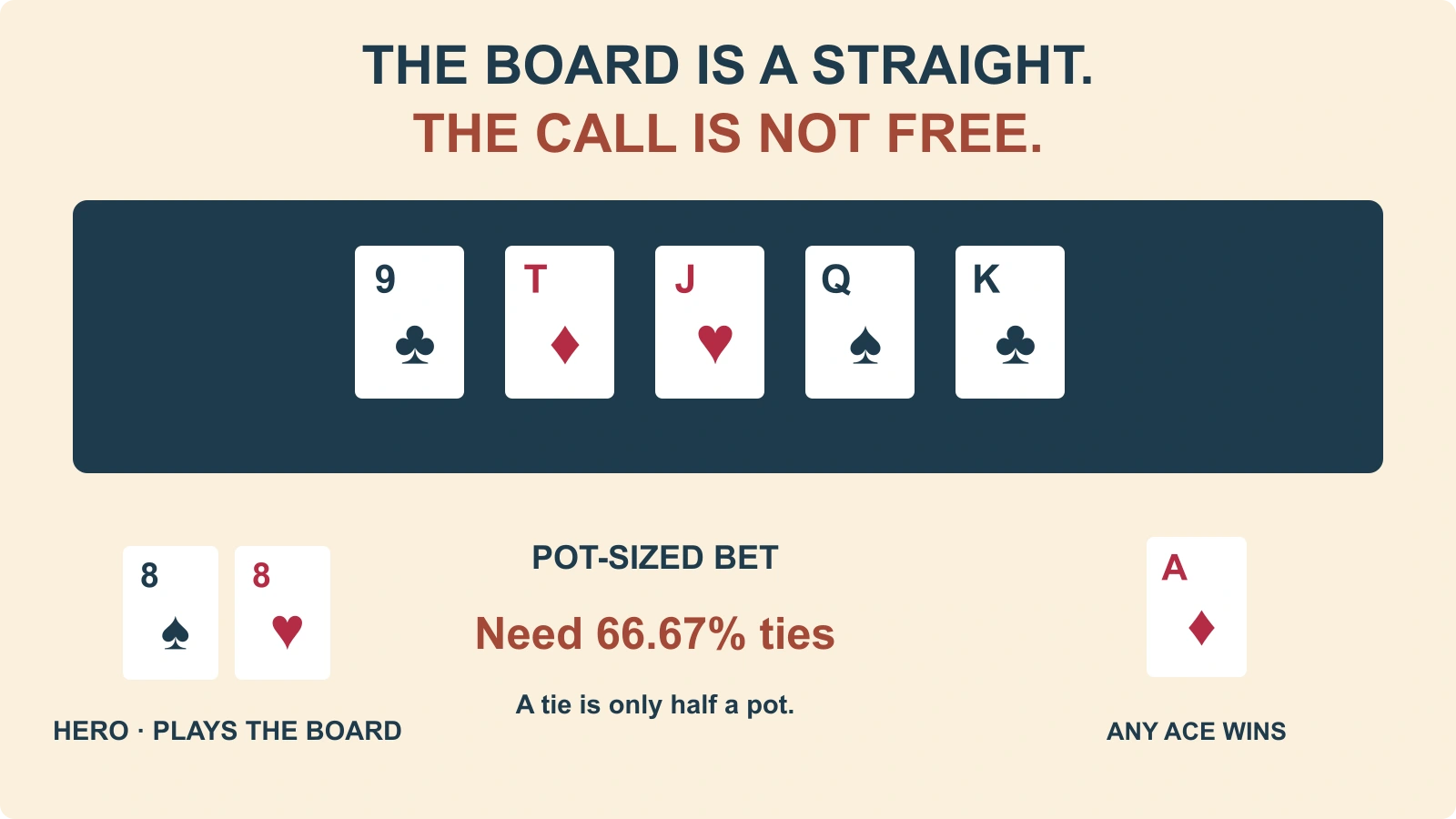
The river puts a straight on the board. You have the same five-card hand as almost everyone, so calling looks harmless. But a call that can only tie is not priced like a call that can win outright. Against an opponent who sometimes holds the higher straight, you may be paying a full bet to recover only half the pot.
A straight everyone can use
Consider a six-handed cash game with 0.5BB/1BB blinds, no ante or rake, and 100BB effective stacks. Hero is in the cutoff with 8♠ 8♥. UTG and HJ fold. Hero opens to 3BB, the button calls, and both blinds fold. The pot is 7.5BB, and two players remain with 97BB each.
The flop is T♦ J♥ Q♠. Hero checks and the button checks. The turn is K♣; both check again. The river is 9♣, completing 9♣ T♦ J♥ Q♠ K♣. Hero checks. The button bets 7.5BB into 7.5BB. There is now 15BB in the middle, and Hero must decide whether to fold, call 7.5BB or raise.
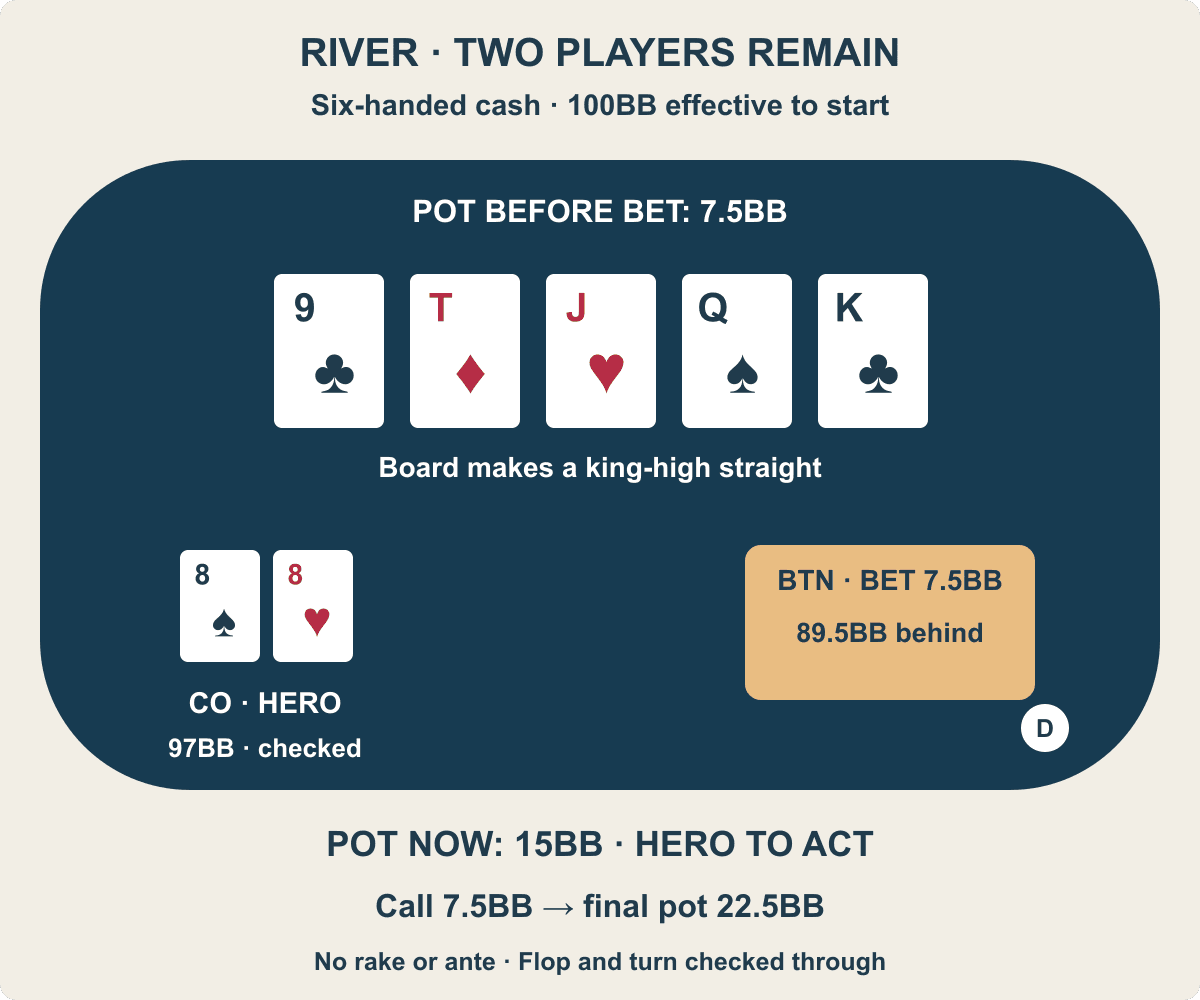
Hero's best five cards are the entire board: a king-high straight. The eights do not improve it. A player with any ace makes T-J-Q-K-A, a higher straight. With no ace, the button also uses the board and ties Hero. There is no flush on this board, and neither a pair nor two pair beats a straight.
So, against a call, there are only two outcomes: Hero loses to an ace or splits with a non-ace. Hero never wins the entire pot at showdown.
Why the usual percentage can mislead
The familiar pot-odds formula still works. Calling 7.5BB makes the final pot 22.5BB, so required equity is 7.5 ÷ 22.5 = 33.33%. The mistake is treating a 33.33% chance to tie as 33.33% equity. A tie gives Hero only half a pot, so a 66.67% tie frequency is needed to supply 33.33% equity here.
Count the actual money from the decision point:
- Fold: invest nothing more; incremental result is 0BB.
- Call and split: receive 11.25BB from the final pot after paying 7.5BB; incremental gain is 3.75BB.
- Call and lose: receive nothing after paying 7.5BB; incremental loss is 7.5BB.
Money Hero put in earlier is sunk. It belongs in the pot calculation, but it is not a reason to call now.
Let q be the fraction of the button's bets that contain no ace. Call EV is q × 3.75 − (1 − q) × 7.5. Setting that to zero gives q = 2/3. At a pot-sized bet, at least two-thirds of the betting range must be hands Hero ties just to break even. Equivalently, ace-containing hands must make up no more than one-third.
Count the betting range, not all possible hands
Here is a deliberately restricted test range, not a claim about a typical live opponent. Suppose the button takes this line and bets every surviving suited combination of AJs, AQs, ATs, KQs, QJs and JTs, all with equal weight.
- AJs: A♠ J♠, A♣ J♣, A♦ J♦. Three combinations beat Hero.
- AQs: A♥ Q♥, A♣ Q♣, A♦ Q♦. Three combinations beat Hero.
- ATs: A♠ T♠, A♥ T♥, A♣ T♣. Three combinations beat Hero.
- KQs: K♥ Q♥ and K♦ Q♦. Two combinations tie.
- QJs: Q♣ J♣ and Q♦ J♦. Two combinations tie.
- JTs: J♠ T♠ and J♣ T♣. Two combinations tie.
Board cards remove the other suited combinations; Hero's two eights remove none of these. This model contains nine winning ace combinations and six ties, for a 40% tie frequency. Call EV is 0.40 × 3.75 − 0.60 × 7.5 = −3BB. Folding is better under those assumptions.
The important uncertainty is behavioral. Would the button check back AQ twice? Would KQ bet this river, or simply take the split? Would a missed small pair bluff? These questions change the weights. Do not pad the tie side with every non-ace holding the button could have reached the river with: only hands that actually bet belong in the betting range.
The price changes with the bet size
Let P be the pot before the bet and B the amount to call. A split returns half of P + 2B. After subtracting the call, the incremental gain is always P/2. A loss costs B. The break-even tie frequency is therefore B ÷ (B + P/2).
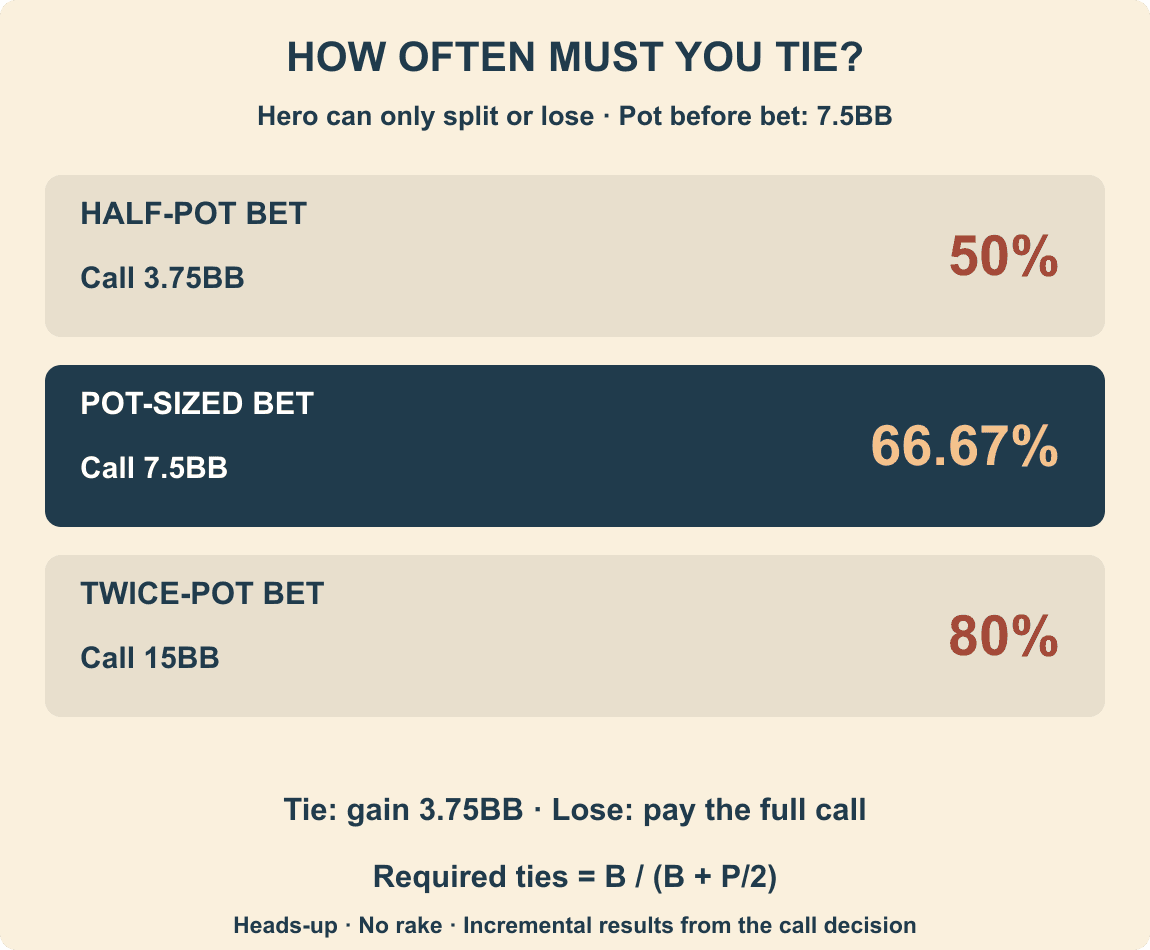
With our 7.5BB pot, a half-pot bet of 3.75BB requires 50% ties; a 7.5BB pot-sized bet requires 66.67%; and a 15BB twice-pot bet requires 80%. More money in the middle does not automatically make the call attractive: the opponent's bet also increases what Hero can lose.
What about raising
Calling tries to recover a share of the existing pot. Raising with eights is a bluff, because no worse hand can call and lose at showdown. It may push a non-ace off its share, but an ace can continue with the nuts. Hero holds no ace to remove those value combinations.
Do not turn a questionable call into a bigger bluff just because the board looks scary. A raise needs its own credible story, sizing and fold-frequency estimate. Against a player who mostly bets aces and checks non-aces, both the call and the bluff-raise are unattractive.
DIP conclusion
Read your best five cards before reading the bet. Then separate outright wins, ties and losses. On this exact board with eights, the pot-sized call needs two ties for every loss. If the opponent is not betting non-aces often enough, fold and keep the remaining stack. Sharing the board is not a promise that you will share the money.
Play responsibly. Keep the stakes within a fixed budget, avoid calling out of frustration, and take a break when losses affect your decisions.