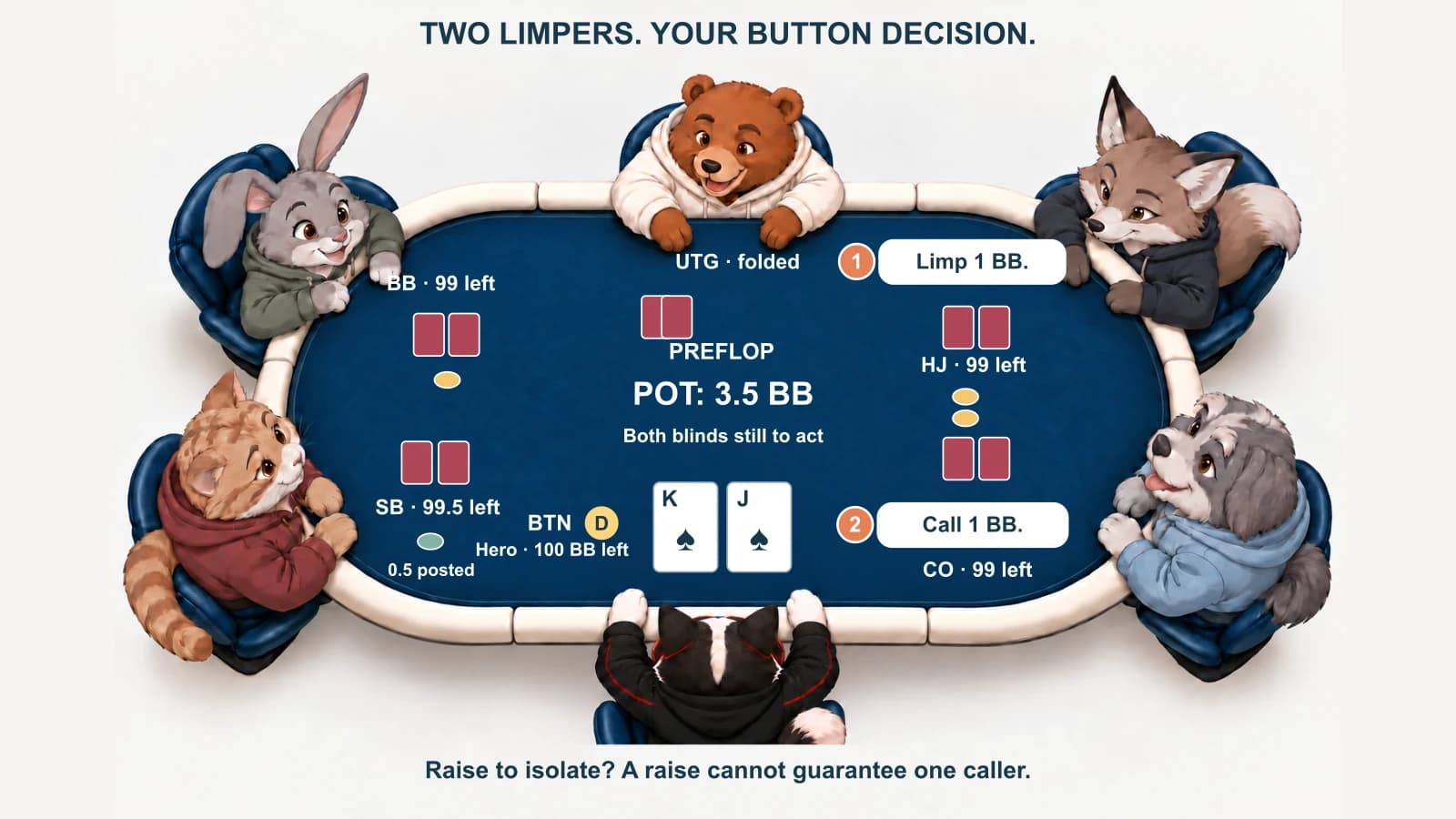
Two players limp, and you find K♠ J♠ on the button. Raising can buy a better situation, but it does not buy a guaranteed heads-up pot. The useful question is not simply whether your cards look playable. It is which opponents will continue, at what price, and how your hand performs against them.
The decision before the flop
This is a hypothetical six-handed cash hand with 100 BB effective stacks, no ante and no rake. UTG folds. HJ limps for 1 BB and CO calls 1 BB. You are on the button with K♠ J♠. SB has posted 0.5 BB and BB has posted 1 BB; both still have a decision. The pot is 3.5 BB. You have all 100 BB available, while each limper has 99 BB behind.
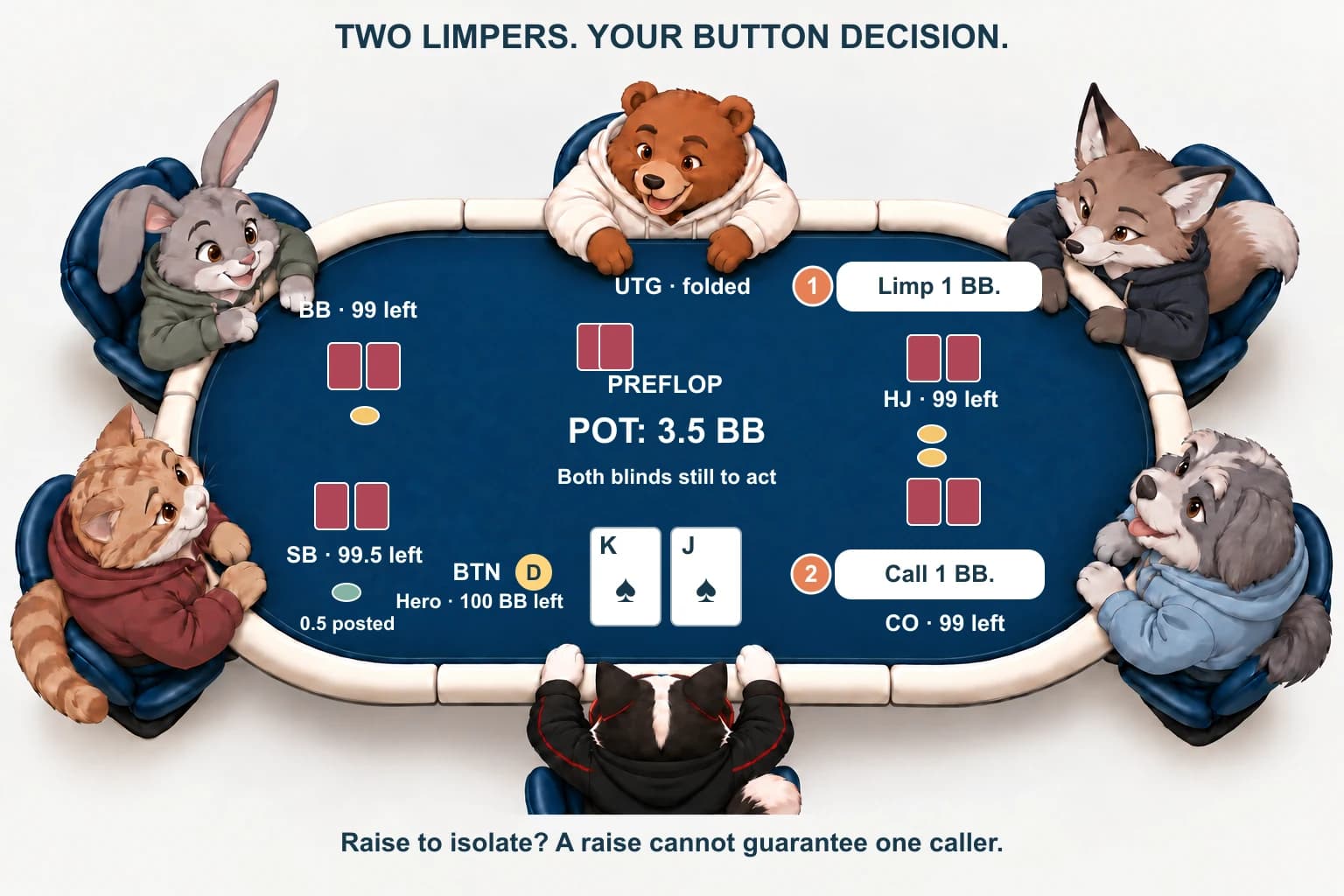
An isolation raise is a raise over one or more limpers, intended to thin the field and play a larger pot against a favourable opponent. It is an intention, not a promise.
Compare the pots you might create
Consider a raise to 6 BB, not a raise by 6. This is an illustrative size for this table, not a universal chart recommendation.
- If everyone folds, your unmatched 6 BB comes back and you win the old 3.5 BB.
- If both blinds and HJ fold but CO calls another 5 BB, the flop pot is 14.5 BB: your 6, CO's 6, HJ's folded 1 and the blinds' 1.5. You and CO each have 94 BB behind.
- If both limpers call and the blinds fold, the pot is 19.5 BB with three players, each holding 94 BB behind.
- If you only call 1 BB, SB folds and BB checks, four players see a 4.5 BB pot. Each active player has 99 BB behind.
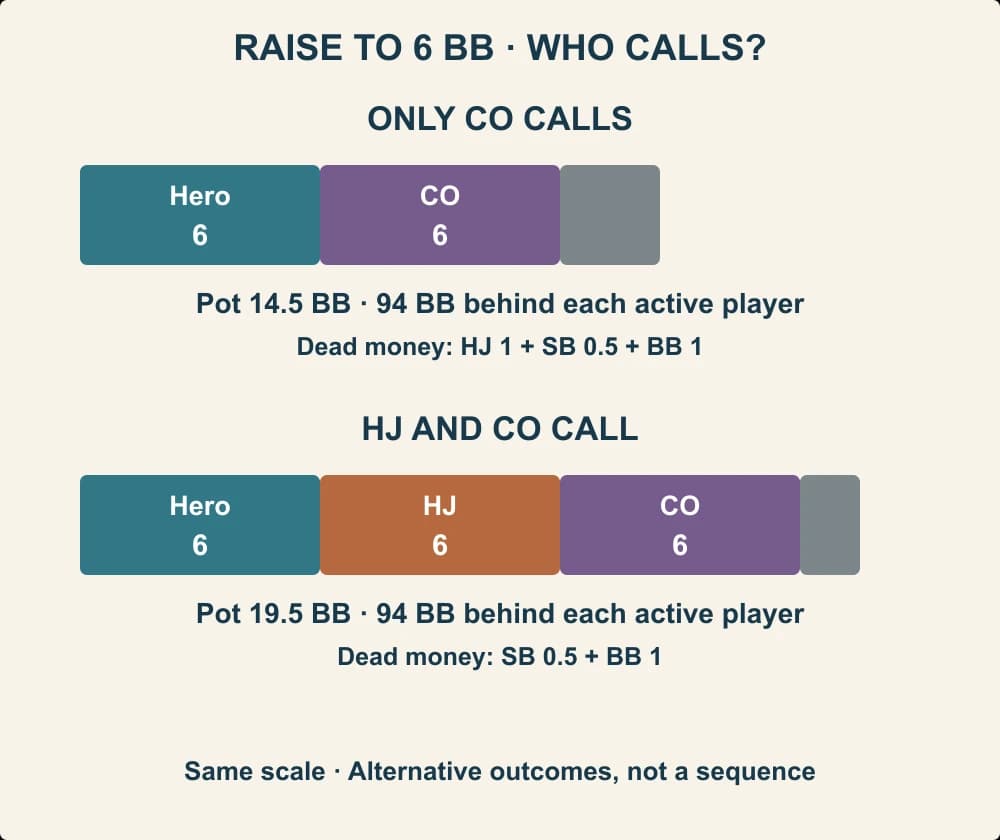
Against one caller, stack-to-pot ratio is 94 / 14.5 = 6.48. Against two callers it is 94 / 19.5 = 4.82. A lower ratio does not make one pair automatically worth your stack; the extra opponent changes the hands you need to beat.
The opponents matter more than the label
A useful raise target might limp and continue with weaker kings, weaker suited jacks, suited connectors and small pairs, then play straightforwardly after the flop. That is a hypothetical description to test against observation, not a measured population range.
KJs benefits from position, suitedness and the chance to make stronger pairs than some of those hands. But KQ, AJ and trapped premiums can still dominate it. A limp does not prove weakness. A player who limp-reraises frequently, or blinds who attack wide button raises, can make this spot less attractive.
Overlimping keeps your initial expense small and retains suited multiway possibilities, but allows more opponents to realise equity and can leave a weak kicker facing several ranges. Folding gives up a playable opportunity at a soft table, yet can be sensible if the players behind and the limpers' ranges are unusually strong. Avoid treating any of these choices as mandatory without table information.
Do not justify the raise with imaginary fold equity
If you were making a pure bluff that lost the entire 6 BB whenever anyone continued, the break-even all-fold rate would be 6 / (6 + 3.5) = 63.2%.
That is a deliberately simplified benchmark, not the required fold rate for KJs. Your hand retains equity when called, and later betting, rake and equity realisation change the result. It is also everyone folding that matters. One limper folding 70% of the time does not mean the table folds 70% of the time.
To illustrate only, suppose the conditional fold probabilities, in action order, were SB 80%, BB 70%, HJ 40% and CO 50%, each given that all earlier players folded. The all-fold probability would be 0.8 × 0.7 × 0.4 × 0.5 = 11.2%. Those invented inputs are not advice or a forecast. They show why the raise needs a credible plan when called, rather than a story about collecting dead money every time.
Follow the one-caller branch
You raise to 6 BB and only CO calls. The flop is K♦ 8♣ 3♠. CO checks into the 14.5 BB pot. With top pair and a jack kicker, a small value bet such as 4 BB can target worse kings and some pairs, if that opponent actually calls them. A check can protect your checking range and avoid inflating the pot against a tighter caller.
If you bet 4 and CO calls, the turn pot is 22.5 BB and both players have 90 BB left. On a blank 2♥, reassess which worse hands pay again. Do not convert “I raised preflop” into three automatic bets. On Q♥, KQ and some queen-containing hands improve; on a spade you gain a flush draw, not a made flush. Your next decision needs the actual card and opponent's action.
If a limper instead reraises before the flop, discard the one-caller plan. The new price and reraising range matter; having invested 6 BB is not a reason to defend KJs against every size.
DIP takeaway
Raise over limpers when the likely continuing ranges and your positional advantage justify the bigger pot. Size for the table you observe, then check how many players actually called. The most expensive mistake is paying for an isolation raise and continuing as though isolation succeeded when it did not.
Practice with play chips first. If playing for money, use a fixed affordable budget and never chase losses.