When the preflop raiser checks behind, the big blind gets a new opportunity on the turn. It is an opportunity to assess a range, not permission to bet every hand.
Our worked example explores a turn probe: a bet by the out-of-position player after the previous street checked through. All ranges and equity inputs below are illustrative assumptions, not solver output or claims about typical players.
Start with the actual pot
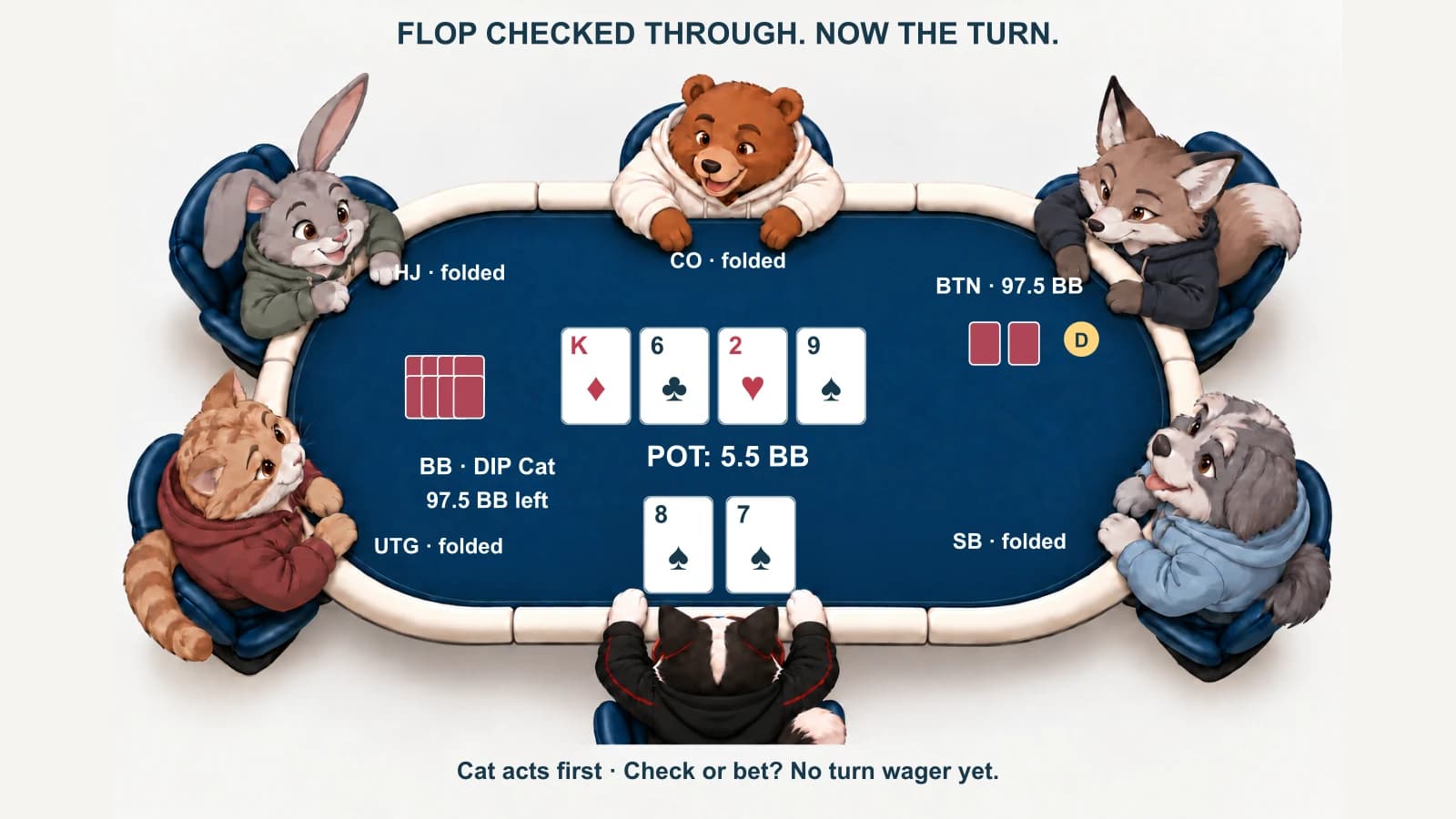
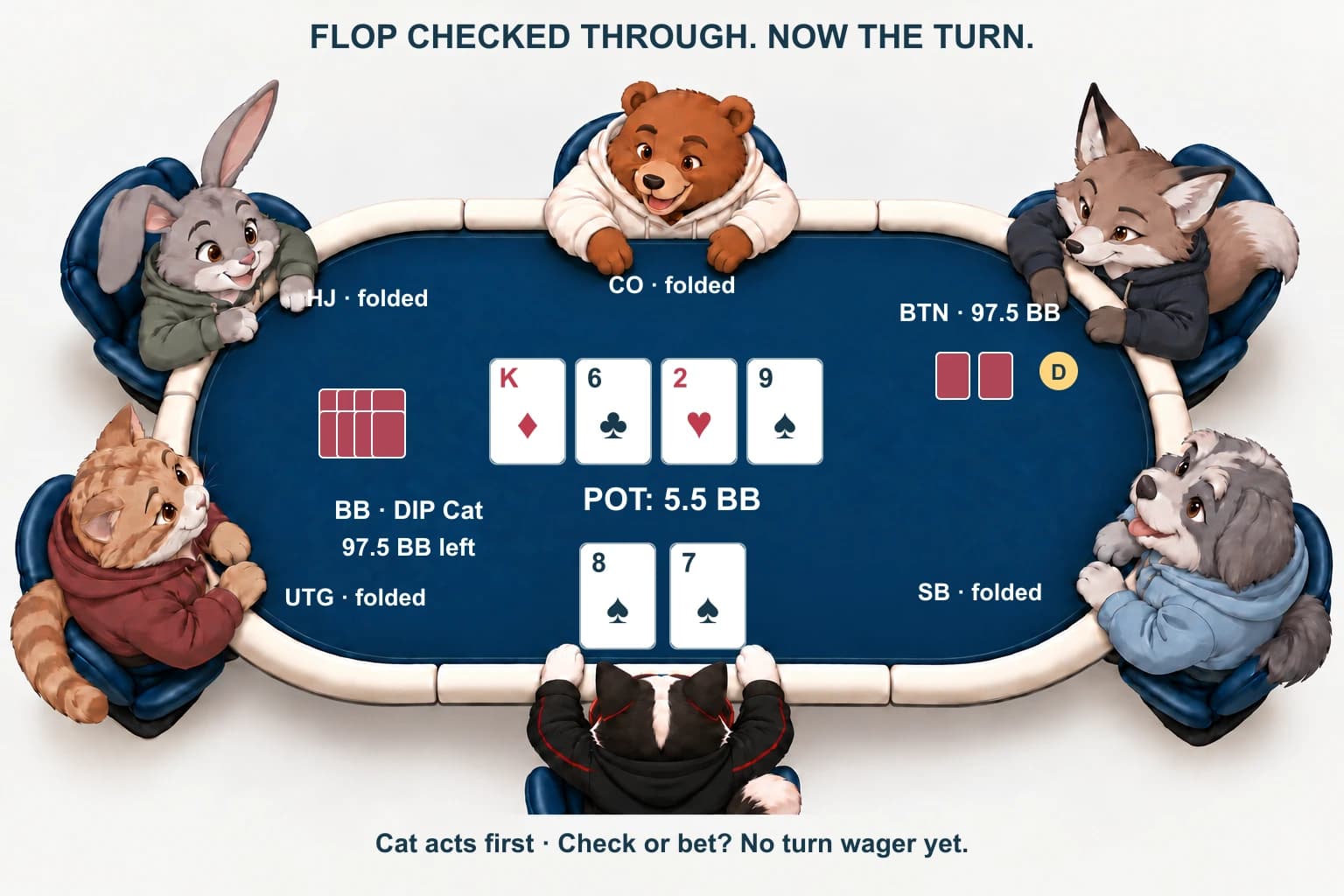
Six players begin a cash hand with 100 BB each. No antes; rake is excluded. UTG, HJ and CO fold. The button opens to 2.5 BB, the small blind folds, and DIP Cat in the big blind calls 1.5 more with 8♠ 7♠.
The pot is 5.5 BB, including the folded small blind's 0.5 BB. Both remaining players have 97.5 BB. The flop is K♦ 6♣ 2♥. Cat checks and the button checks behind. No chips move.
The turn is 9♠. Cat has an open-ended straight draw: a five or ten would complete a straight. Cat acts first and considers betting 4 BB into 5.5 BB. The button has not acted on the turn.
What did the flop check actually remove?
Nothing with certainty. A button might check ace-high, underpairs, some kings, slow-played strong hands or unpaired hands that gave up on betting. A check does not prove the absence of top pair or a set.
The nine gives Cat a draw and can improve other big-blind holdings. But the button can also hold 99, K9 or a nine. Use the new card to update possible hands, not to declare that the whole board belongs to the big blind.
A useful read would be a player who often checks back unpaired hands and folds them to a substantial turn bet. A less attractive target would be someone who checks strong hands or calls once very widely. Those are different response patterns; the flop check alone cannot distinguish them.
Separate the immediate bluff from the draw
If a 4 BB bet could never win after being called, its immediate break-even fold frequency would be:
4 ÷ (5.5 + 4) = 42.11%.
Cat risks 4 to win the existing 5.5. Winning back Cat's own bet is not extra profit. This is a zero-equity benchmark, not the exact requirement for eight-seven.
If the button calls, the pot becomes 13.5 BB and both players have 93.5 BB behind. There is plenty left to bet: the river SPR is about 6.93. This is not an all-in situation where raw equity must be realised automatically.
The button's immediate call price is 4 ÷ 13.5 = 29.63%, but the same warning applies: there may be river betting, and equity against a range matters more than a list of possible draws.
An intentionally simplified equity model
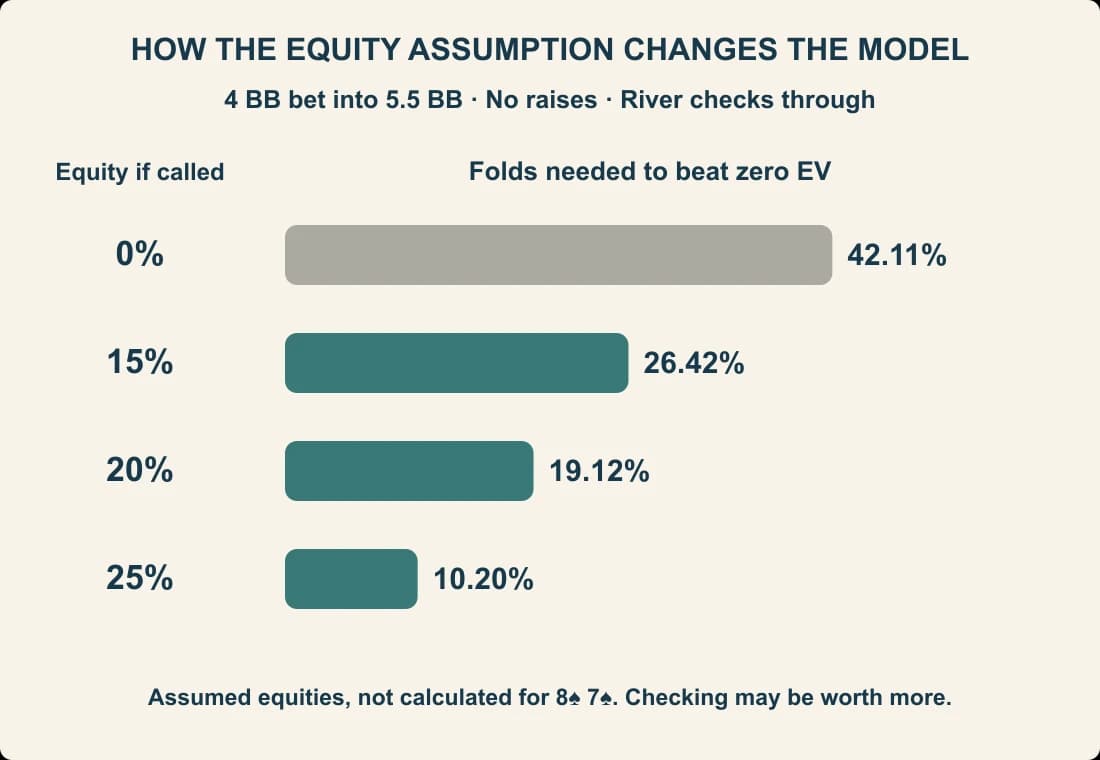
For illustration only, suppose Cat has 20% equity against the calling range and the river always checks through. This is an assumed input, not a calculated equity result for the hand.
The called branch is then worth 0.20 × 13.5 − 4 = −1.3 BB relative to the turn decision. If F is the button's fold frequency:
EV(bet) = F × 5.5 + (1 − F) × (−1.3).
Setting that expression to zero gives F = 1.3 ÷ 6.8 = 19.12%. If the assumed equity is 15%, the threshold rises to 26.42%; at 25%, it falls to 10.20%.
These are sensitivity checks, not recommendations. Real opponents can raise the turn, and both players can bet the river. More importantly, beating zero does not prove betting beats checking: checking the draw may have positive value too.
Eight straight cards are not a complete range analysis
There are four fives and four tens unaccounted for among the visible cards. Eight out of 46 unseen cards is 17.39%, a simple one-card completion count before conditioning on an opponent's particular cards or range.
Do not quietly substitute that number for showdown equity. Some river outcomes can win without a straight; some combinations in the opponent's range affect which cards remain available. A range calculation needs actual hands and weights. A completed straight can also be shared or lose to a higher straight in some matchups.
With the actual 8♠ 7♠ on this board, one river spade cannot make a flush: Cat currently has only three spades across the two hole cards and four board cards. Do not add imaginary flush outs.
Check or bet with a river plan
Checking avoids paying 4 BB immediately and may earn a free river if the button checks again. The cost is allowing hands that would have folded to retain their equity, and facing a possible bet without initiative.
Betting can fold out better unpaired hands and puts money into a pot that Cat may win after improving. The costs are the immediate investment, a potential raise and the need to play a river out of position.
If the 4 BB probe is called and the river is T♣, Cat makes a ten-high straight. A value bet can be considered against hands that will pay. If Cat bets 9 BB and gets called, the pot is 31.5 BB and each player has 84.5 BB left. That is an example size, not a compulsory bet.
On a Q♥ river instead, Cat still has eight-high. Do not automatically fire again simply because the turn bet was a bluff. The button's turn call has filtered the range. A further bluff needs its own target hands and fold expectation; checking and giving up is an available outcome.
If the button raises the turn from 4 to 14 BB total, Cat faces another 10. The pot is 23.5 before Cat responds and would become 33.5 after a call, a 29.85% immediate price. Do not compare that price mechanically with eight outs and invent guaranteed implied odds. Both players would still have 83.5 BB, but those chips are not promised future winnings.
DIP takeaway
A checked flop creates an opening, not a mandatory bluff. Probe with a reason for expecting folds or useful calls, compare the bet with checking, and decide how the river changes your plan. Avoid assuming the opponent is capped, confusing completion chance with equity, or treating a profitable-looking toy model as a solved strategy.
Play within limits you can afford. Practising these decisions with play chips is enough; do not increase stakes to test a new idea.