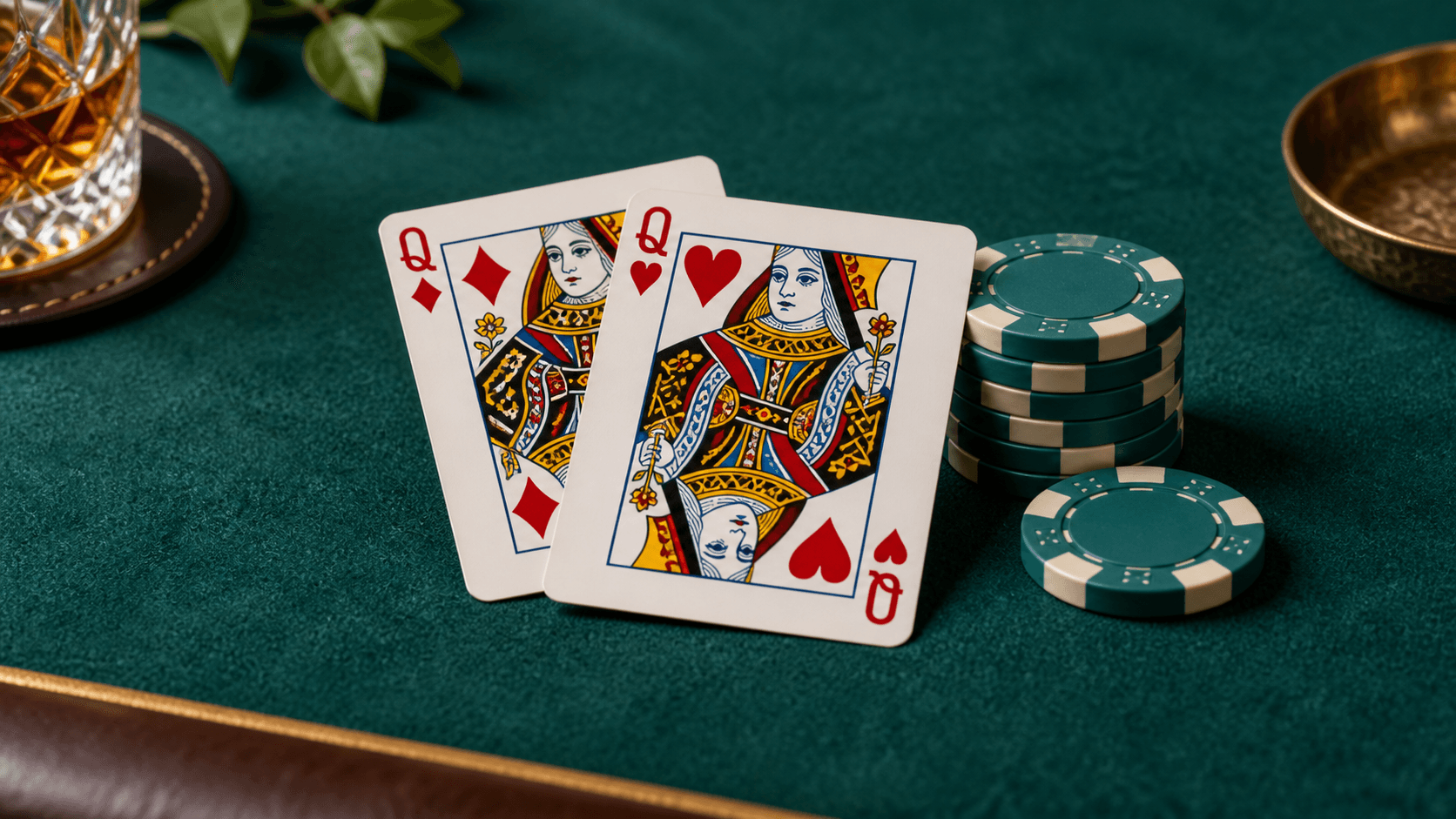
Ace-king was strong enough to three-bet before the flop. That does not make it a made hand afterward. On a connected, two-heart board, the question is not whether AK deserves to win. It is what your exact cards can do against the hands that continue.
The hand before your decision
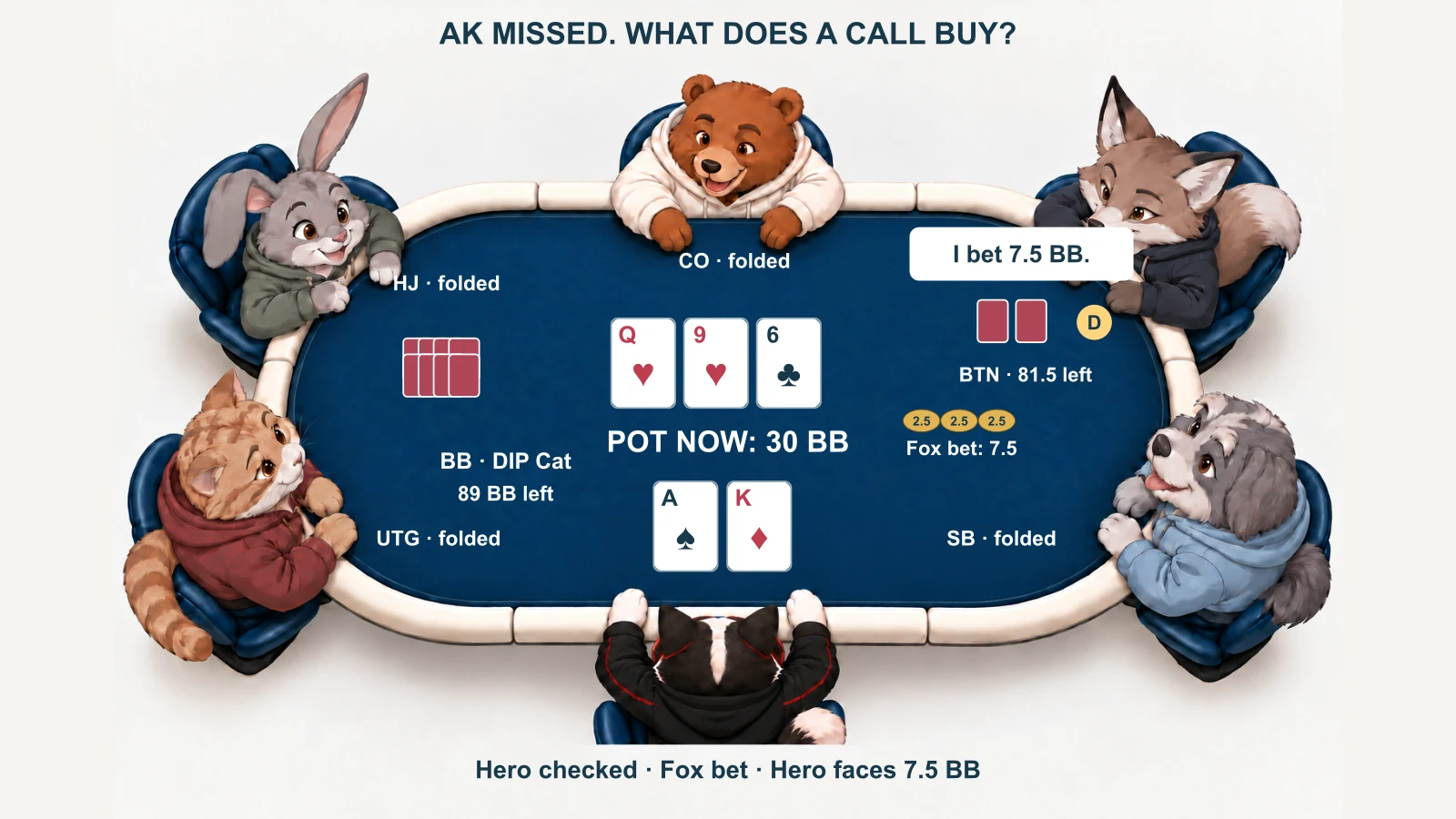
This is a hypothetical six-seat cash-game hand with 100 BB effective stacks, no ante, and rake excluded to isolate the decision. DIP Cat is the big blind. Fox is the button. Everyone folds to the button, who opens to 2.5 BB. The small blind folds. Hero holds A♠ K♦ and raises to 11 BB total. The button calls another 8.5 BB.
The pot is 22.5 BB: 11 from each active player plus the folded small blind's 0.5. Both players have 89 BB left. The flop is Q♥ 9♥ 6♣. Hero checks. The button bets 7.5 BB. There is now 30 BB in the middle, Hero has 89 BB behind, and the button has 81.5 BB. Hero must fold, call 7.5, or raise.
A small bet is a price not a permission slip
Calling would make the pot 37.5 BB and leave each player 81.5 BB. The simple showdown break-even price is 7.5 ÷ 37.5 = 20%. That is not the probability of catching a pair, nor proof that the call profits. With two streets still to play, later bets affect how much of your equity you actually realize.
The stack-to-pot ratio before any flop bet was 89 ÷ 22.5 = 3.96. After a bet and call it becomes 81.5 ÷ 37.5 = 2.17. A casual-looking call therefore moves you into a pot where one large turn bet can consume a substantial part of your stack.
Suppose the turn is 2♣ and the button bets 25 after you check. Calling again would cost 25 to contest 87.5 BB, a simple price of 28.6%. Neither the flop call nor the original three-bet obliges you to continue. This is a new decision against a narrower betting range.
Six cards that make a pair are not six clean outs
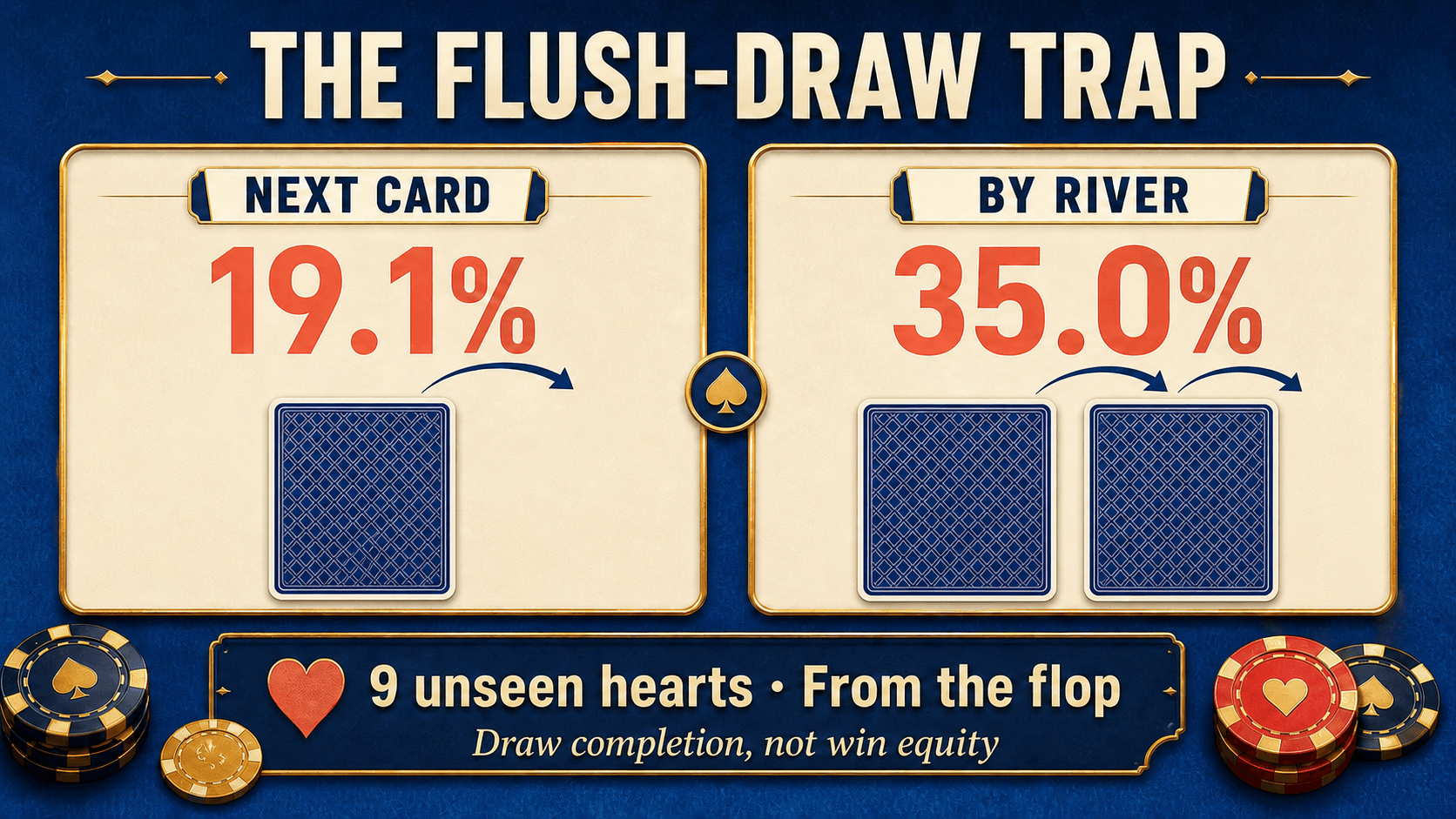
From Hero's five known cards, 47 cards are unseen. Three aces and three kings remain. With no assumptions about the opponent's cards, a turn ace or king appears 6 ÷ 47 = 12.8% of the time. If both remaining cards were dealt without another decision, the chance of at least one ace or king would be 1 − (41 ÷ 47 × 40 ÷ 46) = 24.1%.
Those are card-arrival calculations, not equity against a betting range. You cannot justify today's call using the two-card number when tomorrow's card may cost more chips. Conditioning on a particular opponent hand also changes the available deck.
More importantly, making a pair can still leave you behind:
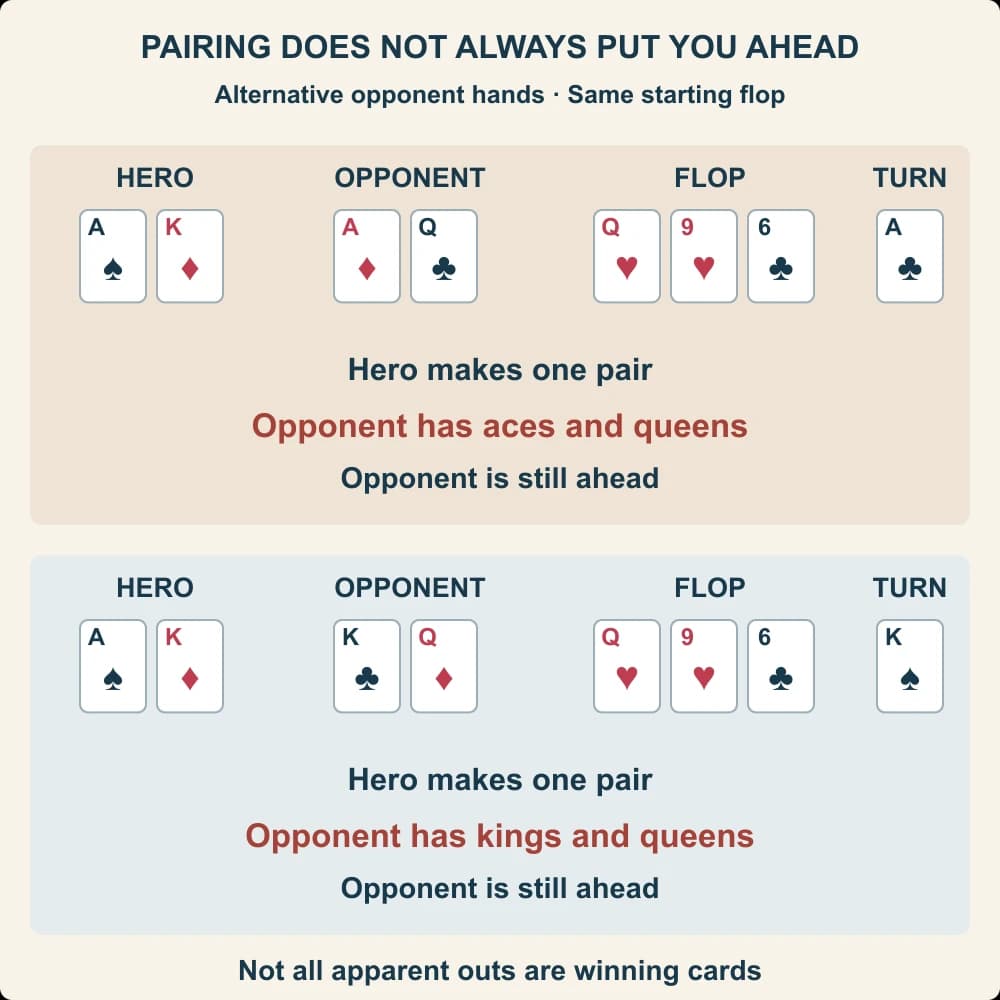
- Against A♦ Q♣, a turn A♣ gives Hero one pair but gives the button two pair, aces and queens.
- Against K♣ Q♦, a turn K♠ gives Hero one pair but gives the button kings and queens.
- Against Q♠ Q♦, neither a single ace nor a single king on the turn beats the opponent's set.
- Against J♥ T♥, A♥ or K♥ completes the opponent's flush. A non-heart king also completes JT's straight on this board.
Hero also has no backdoor flush draw: even two more spades or diamonds would not provide five of that suit. A running jack and ten could make Broadway, but that requires both streets and is not a one-card escape route.
Build the betting range before choosing an action
Start with hands the button plausibly calls preflop and then bets: some AQ and KQ, sets, heart draws, JT, and selected weaker hands using position. Not every preflop call bets; some queens or medium pairs may check behind. Do not assign every available combination to the betting range.
Your ace and king remove some strong queen combinations. Ignoring preflop and betting frequencies, AQ has 3 × 3 = 9 available combinations and KQ also has 9; QQ has 3. These counts show card removal, not the opponent's actual mix. Blocking value does not automatically make a call good, especially when you hold no heart and cannot rely on a flush redraw.
Against a player who bets mostly queens or better and strong draws, folding this exact AK is a reasonable disciplined choice. Against a player who repeatedly attacks checks with weak hands and slows down later, a call becomes more defensible: ace-high can already lead some bluffs, and your future decisions need not rely only on pairing. That adjustment requires an observed tendency, not the hope that the opponent is bluffing.
What each option commits you to
**Fold:** You surrender the current pot but invest nothing more. The 11 BB already contributed is a sunk cost; it is not a reason to defend an unprofitable spot.
**Call:** You preserve bluffs and avoid inflating the pot yourself, but remain out of position. Decide which turn cards and bet sizes you can continue against. A heart, jack, or ten can improve important parts of the button's range; even an ace or king deserves a fresh reading of the board.
**Raise:** You may fold out some weak hands, but risk pushing chips into queens, sets and strong draws. With this exact no-heart AK, do not invent a check-raise merely to represent your preflop strength. If you raise to 25 BB and are called, the pot becomes 72.5 BB and both players have 64 left. That is a much larger commitment than calling.
Checking was also a legitimate initial action. Betting 7.5 into 22.5 instead would need 25% immediate folds in a deliberately simplified zero-equity, no-future-action bluff model. Real AK has equity, but real opponents can call or raise and create later decisions. That toy threshold is not a recommendation to bet automatically or a solver frequency.
DIP takeaway
Our default against an unknown opponent is to avoid automatic continuation with this exact hand on this texture. Check first; facing a bet, assess the opponent's likely betting range and your future playability. Do not call solely because AK began as a premium hand or because someone counted six outs. A sound preflop raise and a sound flop fold can belong to the same hand.
Play within a fixed entertainment budget, take breaks, and never use a difficult hand as a reason to chase losses.