An ace blocker can help a preflop bluff. It does not pay for the bluff by itself. Before four-betting A5s, count both the hands your ace removes from the opponent's value range and the hands it removes from the range that would have folded.
The button faces a three-bet
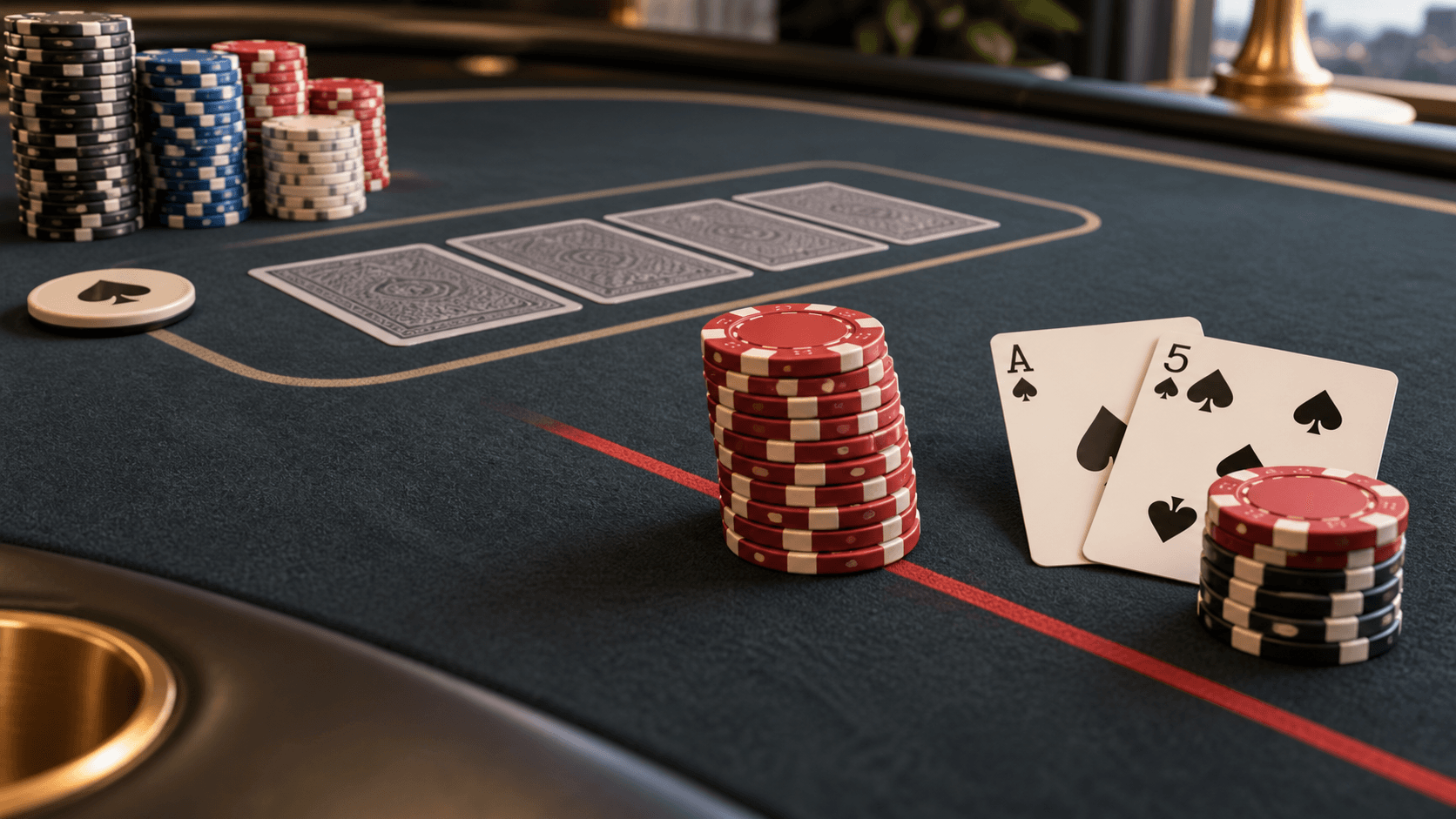
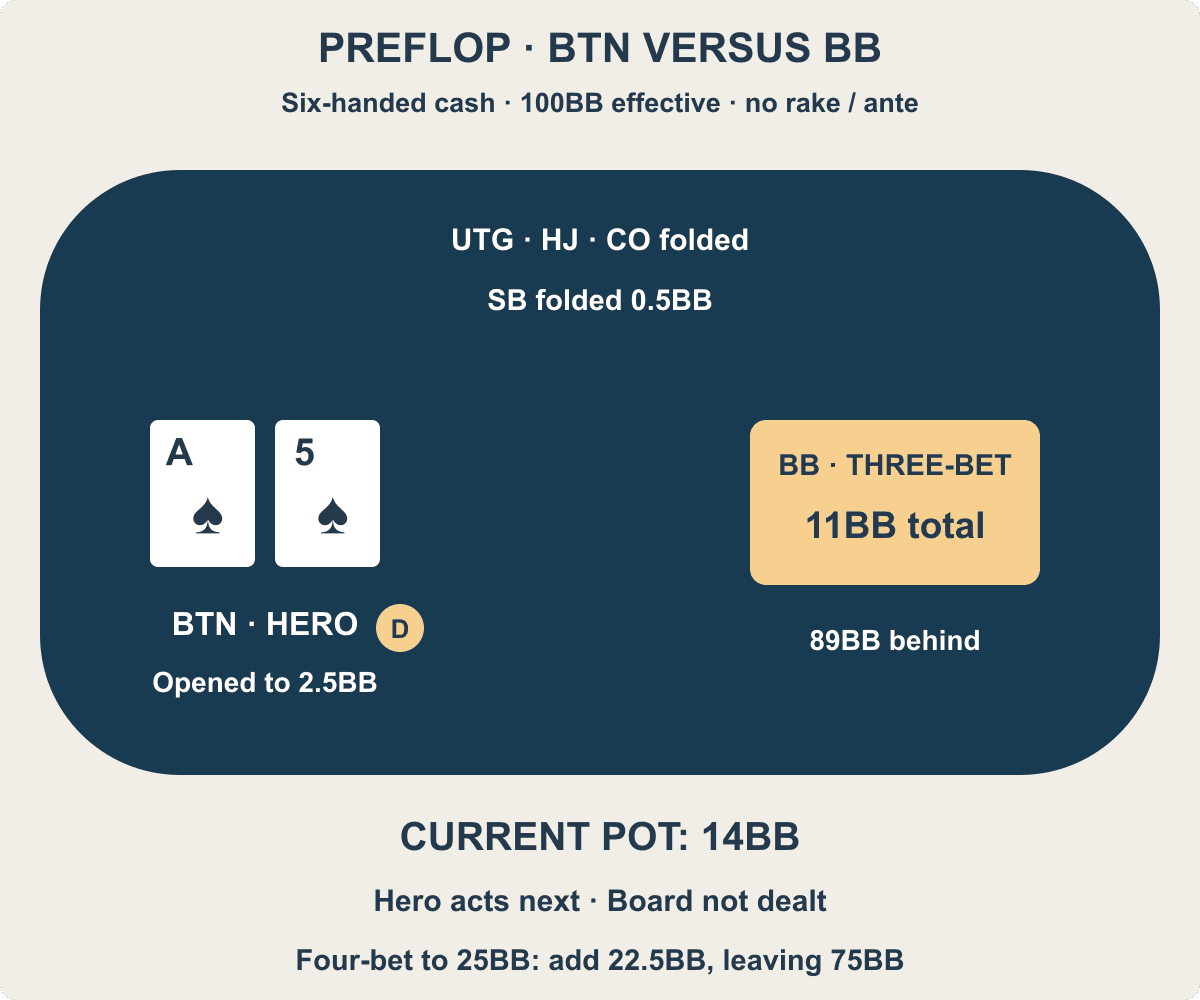
Six-handed cash, 0.5BB/1BB blinds, no ante or rake, and 100BB effective stacks. UTG, HJ and CO fold. Hero opens A♠ 5♠ on the button to 2.5BB. The small blind folds. The big blind three-bets to 11BB total. Two players remain, with no community cards dealt yet.
The current pot is 14BB: Hero's 2.5BB, BB's 11BB and the folded 0.5BB small blind. Hero can fold, call another 8.5BB, or raise. Consider a four-bet to 25BB total, adding 22.5BB now. Hero is not risking only the 14BB increase from the opponent's 11BB sizing; the full additional 22.5BB leaves Hero's stack.
Price a simple four-bet and fold model
Start with a deliberately limited response model. BB either folds to the four-bet or shoves, and Hero folds to every shove. There are no calls in this model. This is a sensitivity test, not a solver solution or a claim about typical live behavior.
- If BB folds, Hero gains the current 14BB from this decision point.
- If BB shoves and Hero folds, Hero loses the additional 22.5BB.
- Hero's earlier 2.5BB is sunk; folding now has incremental EV of zero.
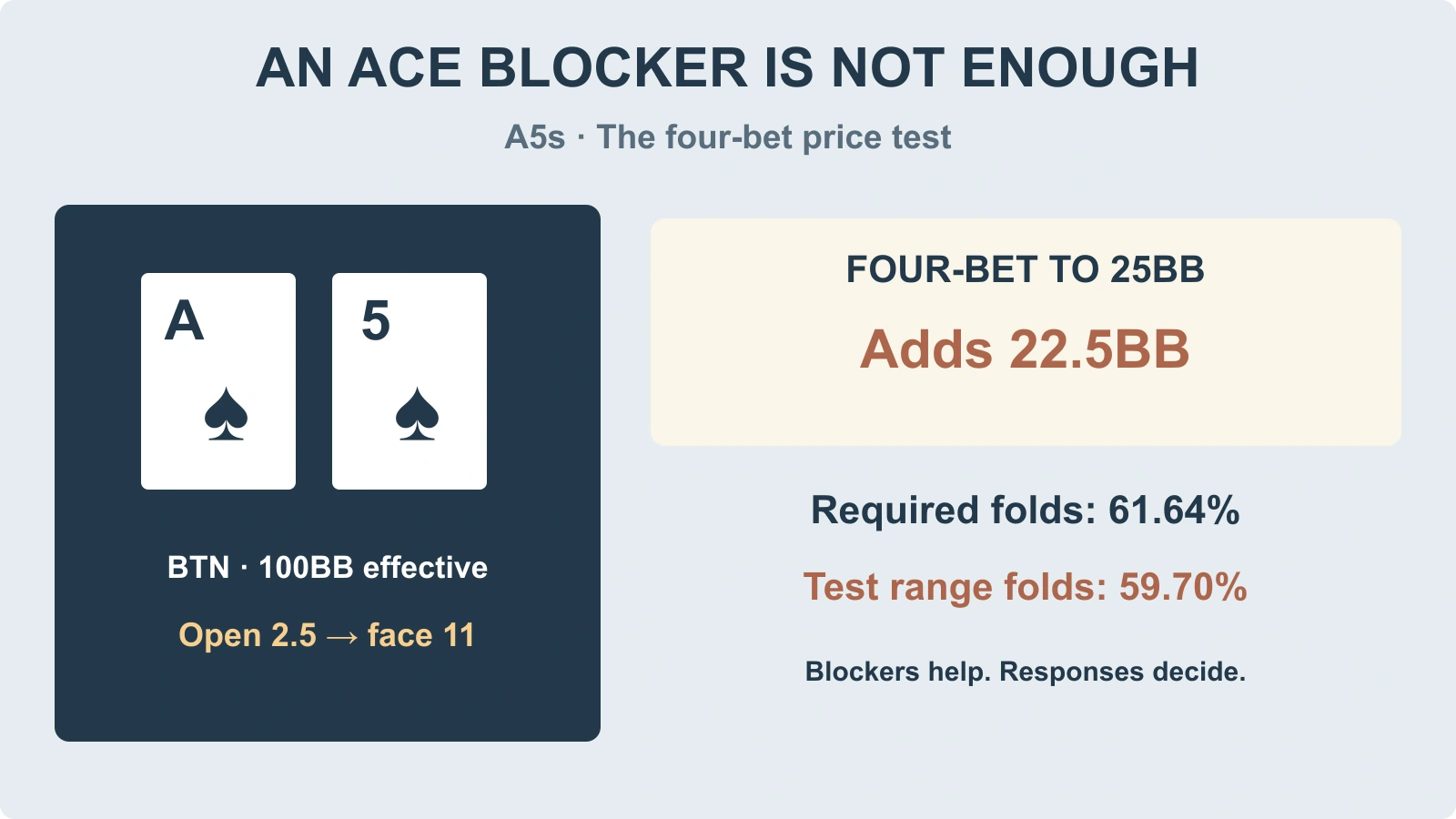
Let F be BB's fold frequency. Four-bet EV is F × 14 − (1 − F) × 22.5. The break-even fold frequency is 22.5 ÷ (14 + 22.5) = 61.64%. Hero needs more folds than that for a positive result under these exact assumptions.
That calculation does not include the equity A5s could realize after a call or after calling a shove. If either happens, the full model must include that branch rather than attaching a vague equity bonus to this number.
Count a transparent test range
Suppose BB three-bets every combination of TT+, AQ, AK, A5s–A2s and KQs. AQ and AK include both suited and offsuit hands. Suppose BB shoves QQ+ and AK, folding everything else. Every available combination has equal weight. These are chosen assumptions to make the arithmetic inspectable.
With Hero holding A♠ 5♠, the available three-bet combinations are:
- TT, JJ, QQ and KK: six each, or 24 total.
- AA: three, because the ace of spades is unavailable.
- AQ and AK: twelve each, or 24 total.
- A5s, A4s, A3s and A2s: three each, or twelve total.
- KQs: four.
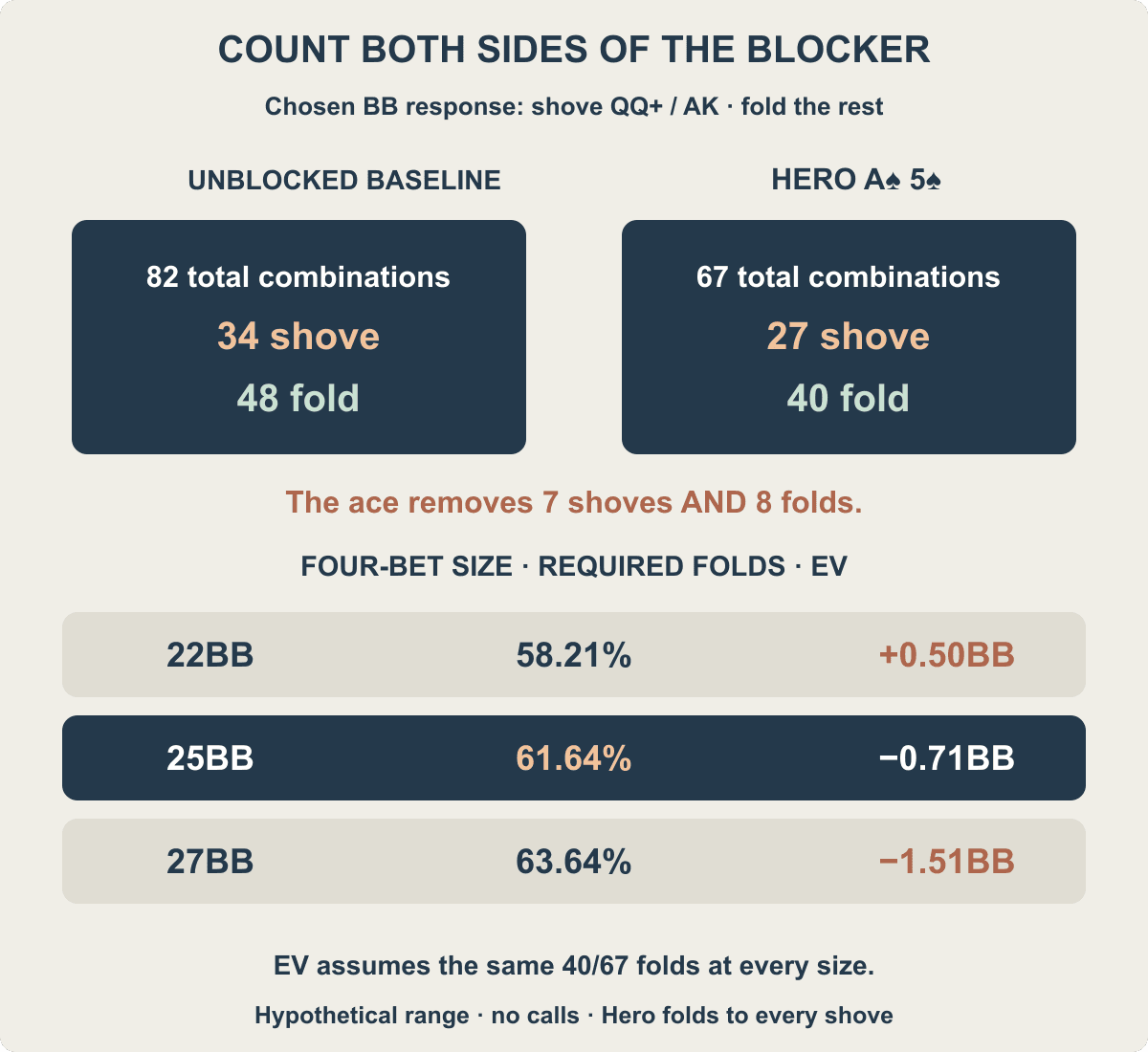
Total: 67 combinations. The shove range has QQ six, KK six, AA three and AK twelve, or 27 combinations. The other 40 fold. BB's modeled fold frequency is 40/67 = 59.70%, below the 61.64% required.
At that frequency, EV = (40/67 × 14) − (27/67 × 22.5) = −0.71BB. The ace helps, but the four-bet is still losing relative to folding in this model.
What the blocker actually changes
For a card-removal comparison only, replace Hero's hand with 7♠ 6♠ while holding the same range rules fixed. Those cards block none of the listed hands. BB then has 82 three-bet combinations: 34 shove and 48 fold. That produces 58.54% folds and a modeled four-bet EV of −1.13BB.
A♠ 5♠ removes seven shove combinations compared with that baseline: three AA and four AK. But it also removes eight folding combinations: four AQ and one each of A5s, A4s, A3s and A2s. The fold percentage improves by only about 1.16 percentage points, not by the percentage reduction in value combinations alone.
This is why counting only blocked AA and AK is incomplete. A blocker affects the denominator and both sides of the response range. The comparison is not a recommendation to four-bet 76s; it isolates card removal, not overall hand quality.
Smaller sizing changes the price but also the response
With the same 14BB pot, a four-bet to 22BB adds 19.5BB and requires 58.21% folds. To 27BB, it adds 24.5BB and requires 63.64%. At the same assumed 40/67 fold frequency, their modeled EVs are +0.50BB and −1.51BB respectively, compared with −0.71BB for 25BB.
Do not conclude that 22BB must be best. A smaller raise can cause the opponent to call or continue more often, invalidating the fixed-response assumption. The useful lesson is to price the chosen size before assuming a blocker makes every size profitable.
Compare the actual alternatives
Folding costs no more chips and is reasonable when the three-bet range is strong or the response estimate is uncertain. Calling costs 8.5BB, makes a 22.5BB pot and leaves 89BB effective, for an SPR of 3.96. Hero keeps position but can make dominated top pairs with a weak ace. Calling is not proved profitable by the four-bet calculation.
If BB calls the 25BB four-bet, the pot is 50.5BB and both have 75BB left: SPR 1.49. On a hypothetical K♦ 8♣ 2♥ flop after BB checks, Hero has only ace-high and no immediate flush draw. The larger pot has not created an automatic continuation bet. Board coverage, BB's calling range and the new bet size need a separate decision.
DIP conclusion
Use A5s as a candidate for analysis, not a command to bluff. Specify the three-bet range, the fold/call/shove responses and the amount you actually add. A useful blocker can improve a bluff without making it profitable. If the fold estimate does not clear the price, keep the extra chips.
Play responsibly. Keep cash-game stakes within a fixed budget, do not escalate a preflop fight out of frustration, and stop when losses affect your judgment.