Running a pot twice can make an all-in less brutal. It cannot turn a bad call into a good one. The useful distinction is between your expected share of the money and how violently individual results swing around that expectation.
Here is a cash-game example that separates the betting decision from the river-dealing agreement. All amounts are in big blinds, with no rake or ante. The room rules below are assumptions for this example, not a claim about every Philippine poker room.
First price the call
Six players are seated with blinds of 0.5BB and 1BB. Hero, DIP Cat on the button, and the cutoff start with 100BB effective. UTG and HJ fold. CO opens to 3BB, Hero three-bets A♠ A♥ to 10BB total, both blinds fold, and CO calls. Two players see the flop. The pot is 21.5BB: 10BB from each player plus 1.5BB in folded blinds.
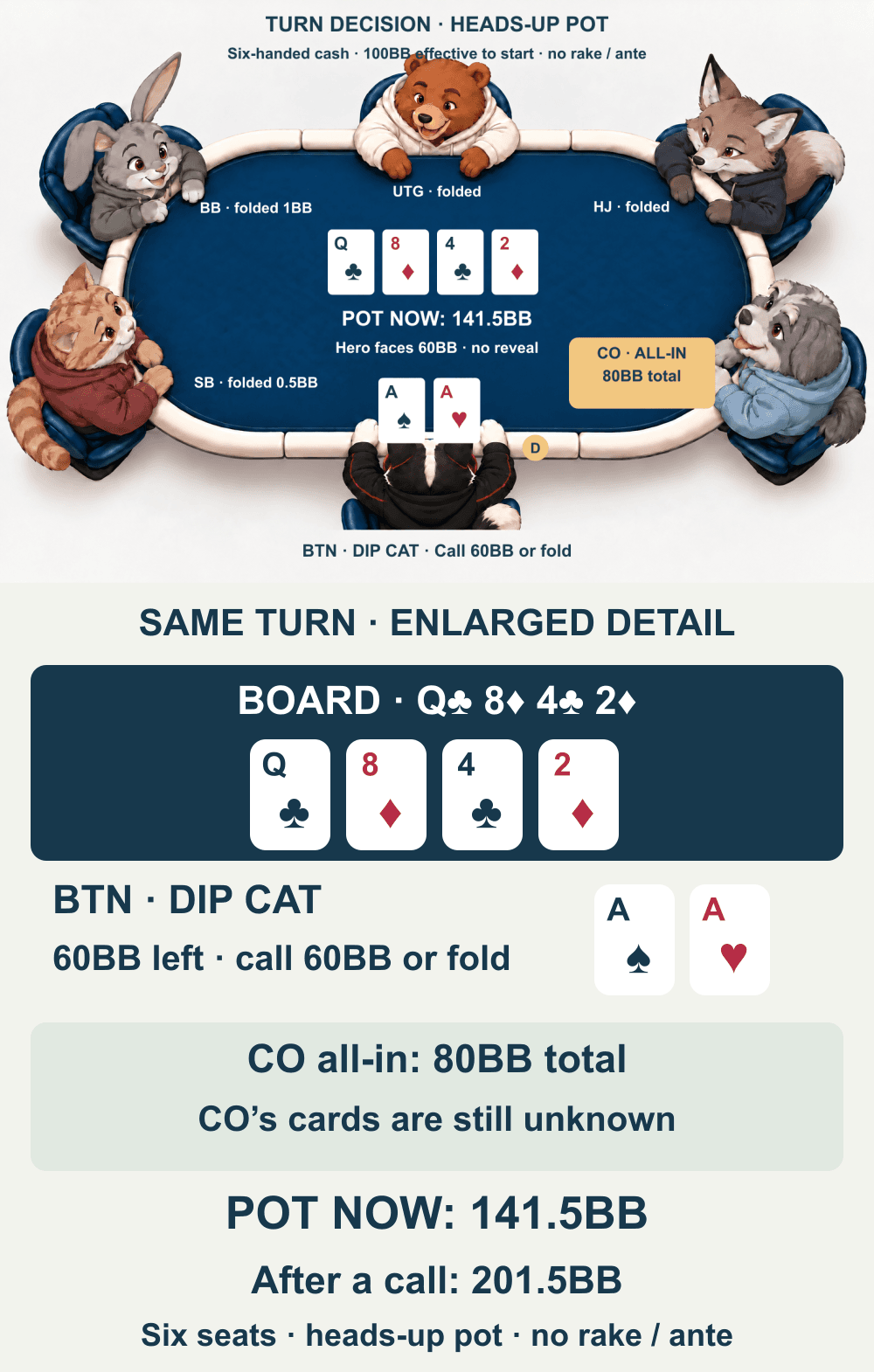
On Q♣ 8♦ 4♣, CO checks. Hero bets 10BB and CO calls. The pot becomes 41.5BB; each player has 80BB left. The turn is 2♦. CO checks, Hero bets 20BB, and CO moves all-in for 80BB total. Hero has 60BB left and must decide whether to call it.
The accounting matters:
- Pot before the turn action: 41.5BB.
- Hero's bet plus CO's entire shove: 20BB + 80BB.
- Pot now in the middle: 141.5BB.
- Hero calls 60BB to contest a final pot of 201.5BB.
- Break-even equity: 60 ÷ 201.5 = 29.78%.
That last number is a price, not an estimate of Hero's equity. To estimate equity, ask what this opponent check-shoves. Sets such as QQ, 88, 44 and 22 crush one pair. KK is behind Hero. Hands such as A♦ K♦ can have drawing equity. Do not give every possible hand equal weight merely because it fits the board; preflop and flop action, plus the player's tendencies, determine how plausible each holding is.
For an intentionally narrow sensitivity test, suppose every shove is either a set or KK. Against any of those sets, Hero wins only on either remaining ace: 2/44, or 4.55%. Against KK, Hero wins on 42/44 rivers, or 95.45%. If p is the fraction of the shove range that is KK, Hero's equity is approximately 4.55% + 90.91% × p. Using the unrounded inputs, reaching the call price requires p of about 27.75%. This is a weighted-range illustration, not a population read or a recommended cutoff for a wider range.
Folding protects the remaining 60BB when the range is too strong. Calling is justified only by enough equity against the actual range. Raising is not an available third option: CO is already all-in and Hero is covered. A promise to run twice changes none of this price calculation under equal splitting and no extra fee.
Now reveal the hands
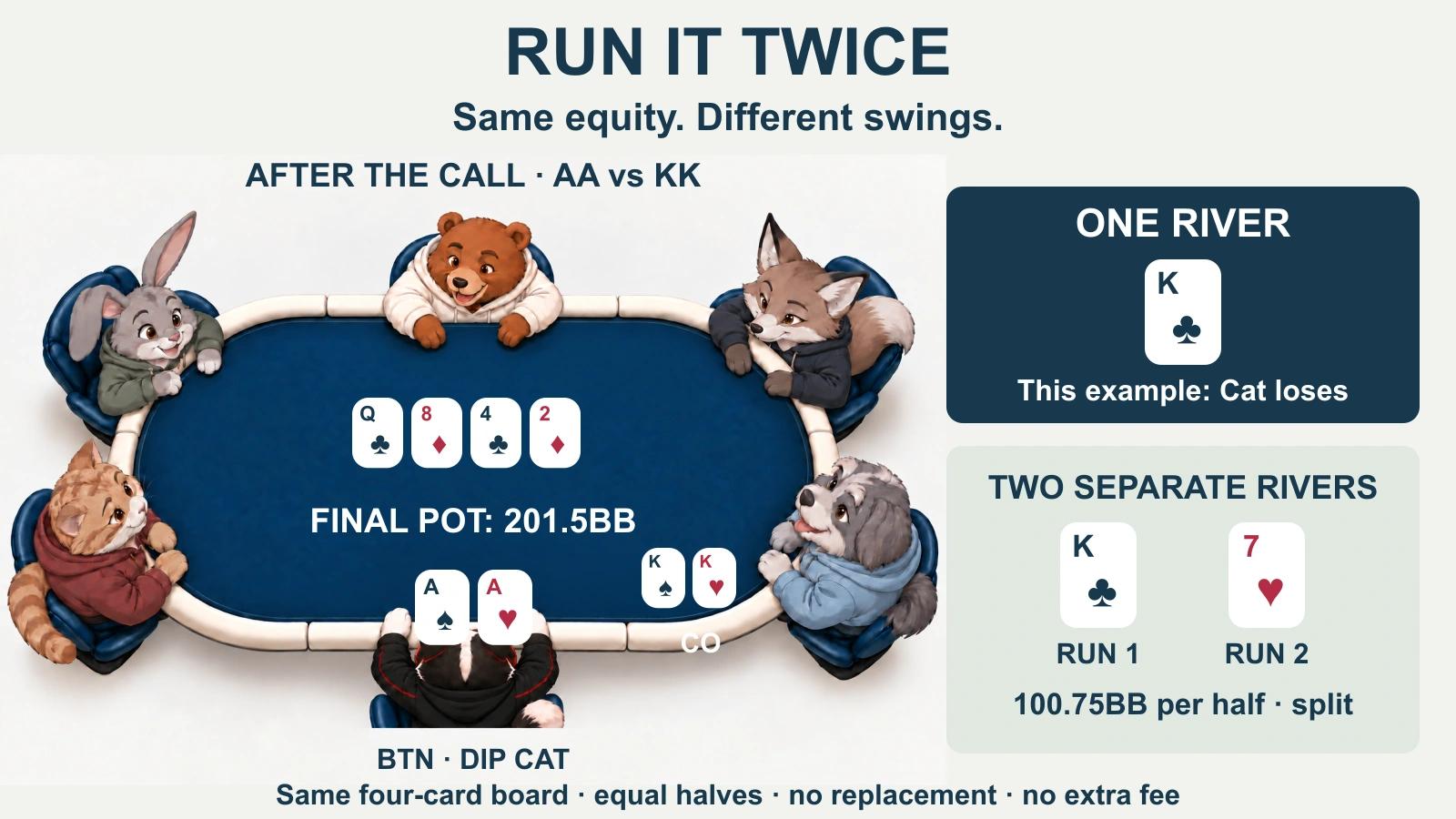
For the rest of the example, Hero calls and CO exposes K♠ K♥. This new information lets us calculate an exact river model; Hero did not know it while making the call.
The board remains Q♣ 8♦ 4♣ 2♦. Eight cards are known: four hole cards and four board cards. Of 44 unseen cards, K♣ and K♦ make CO a winning set. The other 42 leave Hero ahead. Neither player can complete a flush with one river, and there are no ties.
Assume the room permits both players to agree, before any river is dealt, to split the final 201.5BB into two equal 100.75BB shares and deal two separate river cards without replacement from the same unseen deck. Each river completes the same four-card board for its own half. There is no reshuffle, additional charge or side pot in this model. Unknown burn cards do not change the marginal probabilities when their identities provide no information.
One river versus two rivers
With one river, Hero wins the entire pot 42/44 of the time, or 95.45%, and loses it 2/44 of the time, or 4.55%.
With two rivers, the second card depends on what came first. The two runs are not independent:
- Win both halves: (42/44) × (41/43) = 91.01%.
- Win exactly one half: 2 × (42/44) × (2/43) = 8.88%.
- Lose both halves: (2/44) × (1/43) = 0.106%.
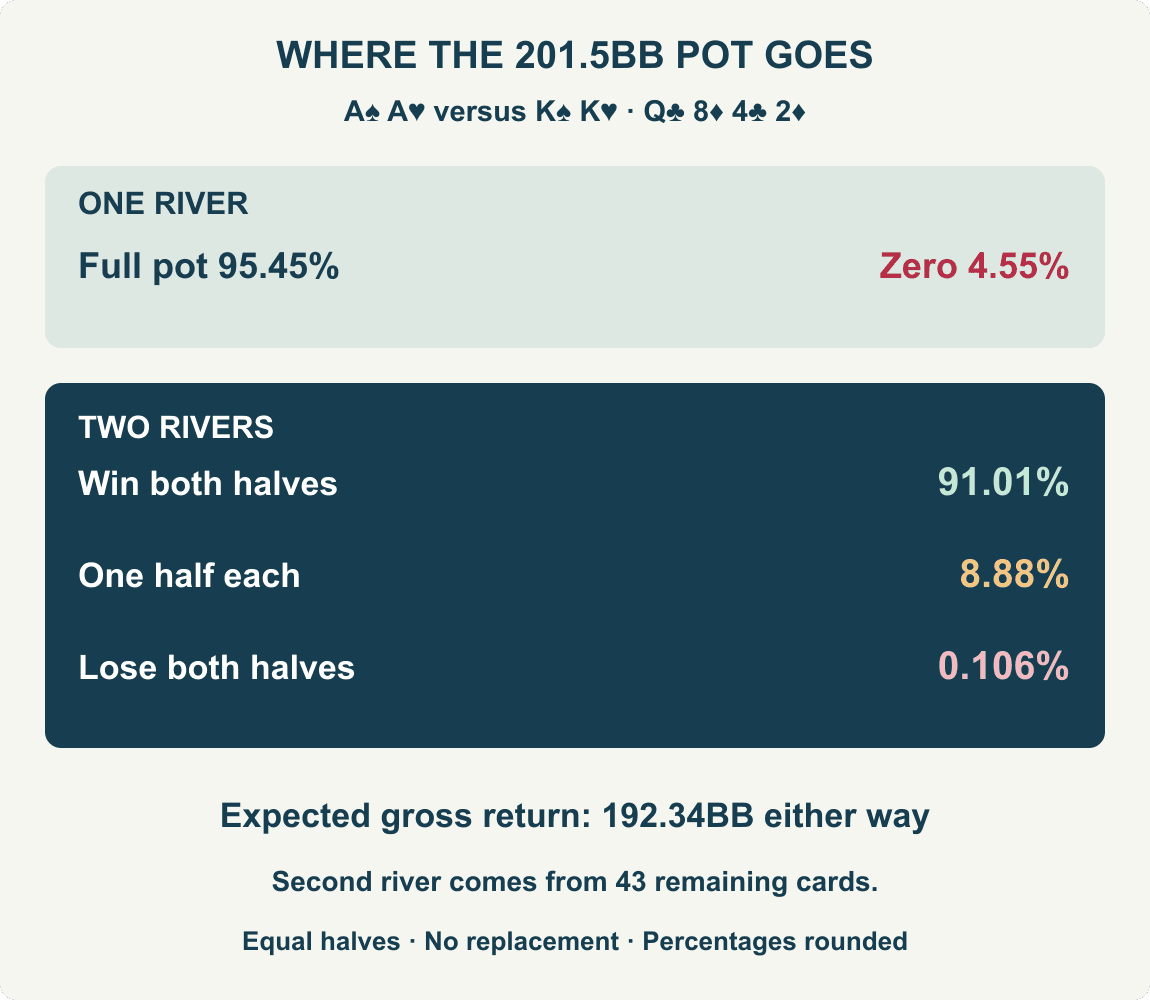
Running twice sharply reduces the chance of losing everything in this particular hand. It also reduces the chance of collecting everything: some outcomes become a split. Do not describe the 91.01% sweep probability as a lower underlying equity, or the 99.894% chance of winning at least half as a new hand-equity figure. They answer different questions.
The expected money stays the same
With one river, expected gross return is 201.5BB × 42/44 = 192.34BB. With two rivers, it is 201.5BB × P(win both) + 100.75BB × P(split), which also equals 192.34BB. This is an average amount returned from the final pot, not net profit on the hand.
Why no improvement? Each river has the same 42/44 marginal chance of favoring Hero, but each awards only half as much money. More opportunities to collect a smaller share do not create extra expected value.
Running twice may suit a player who prefers fewer all-or-nothing results. Running once keeps settlement simpler and avoids extra dealing time. Neither choice proves that someone is braver or more skilled. Ask the dealer what the room allows before making an agreement; do not assume an online feature or another venue's procedure applies.
Common mistakes and the DIP conclusion
- Calling too widely because there will be two chances to win. Price the call against a range first.
- Squaring 2/44 to calculate two losing rivers. After one king is used, only one remains among 43 unseen cards.
- Treating half the pot as a full win, or expected gross return as profit.
- Ignoring extra fees or unequal pot divisions. Those change the money model and must be calculated separately.
DIP's view: use running twice as an agreed way to smooth results, not as a reason to take a losing gamble. Make the poker decision first. Then choose the permitted settlement procedure you are comfortable with.
Play responsibly. Set a loss limit before sitting down, use only money you can afford to lose, and stop if the stakes or swings affect your judgment.