
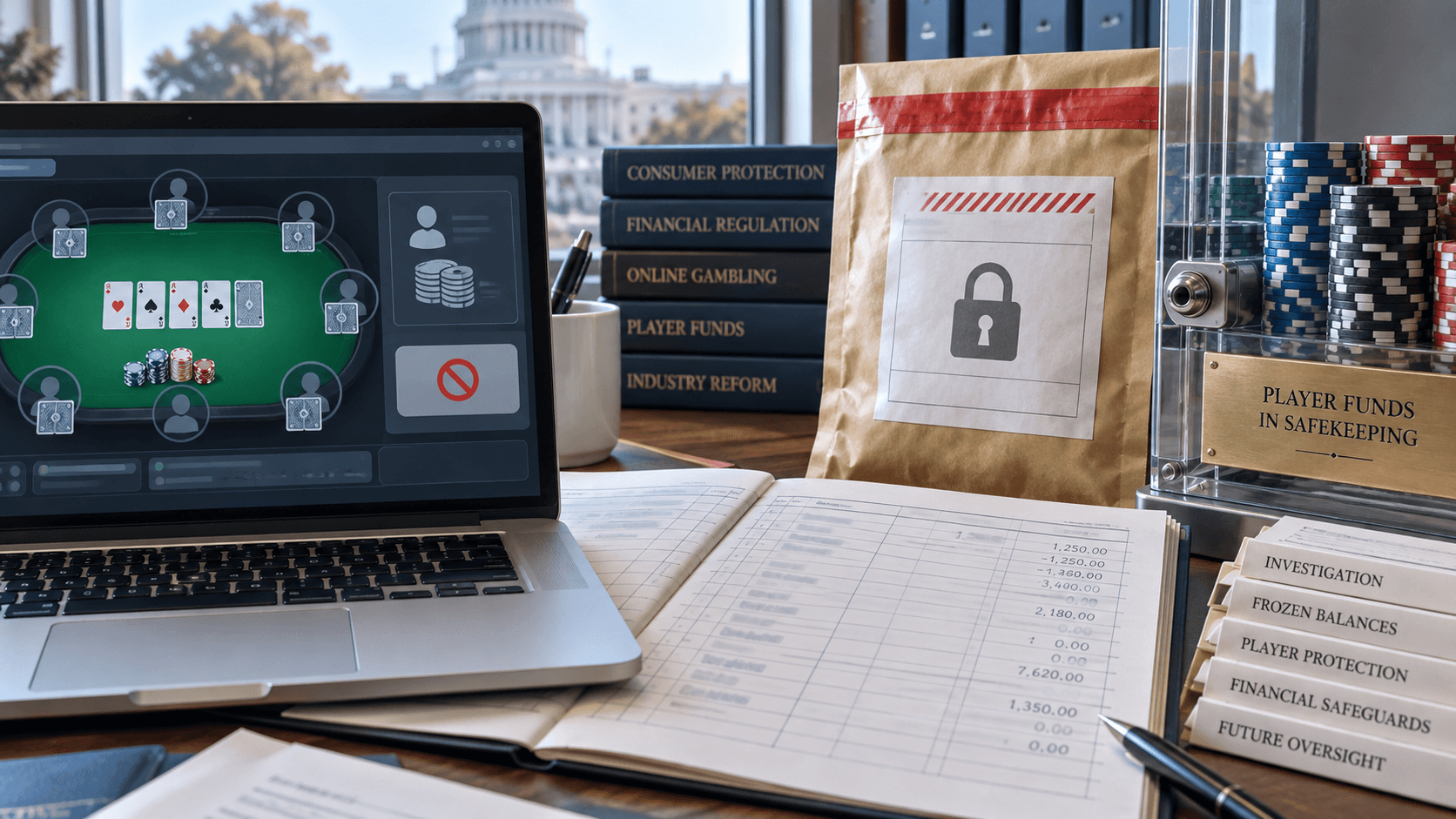
On April 15, 2011, a U.S. enforcement action abruptly turned an online-poker account balance into a question: was the number on the screen backed by money that could actually be withdrawn?
The Full Tilt Poker case is often remembered as part of poker's “Black Friday.” Its lasting value is not the drama. It is the distinction between game risk and operator risk. A player can make a correct decision at the table and still face a separate loss if the platform holding the balance cannot return it.
This case study relies on U.S. Department of Justice records and labels allegations as allegations. It does not treat every operator or every regulated market as equivalent.
What the official record says
The U.S. Attorney's Office said it entered a domain-name use agreement with Full Tilt Poker in April 2011 that expressly allowed the company to return player money. A later amended civil complaint alleged that the company did not have enough player funds on hand, had transferred substantial amounts to company principals and continued showing account credits that were not backed by collected deposits.
A July 2012 federal announcement describing a superseding indictment alleged that, only weeks before the April 2011 action, internal statements showed about $390 million owed to players but only about $60 million in bank accounts. Those are allegations from the government's case, not numbers DIP independently audited.
The practical point is simple: a displayed balance and a safeguarded balance are not automatically the same thing.
The timeline
- April 15, 2011: U.S. authorities unsealed enforcement actions involving major online-poker operators and seized or restricted domain names.
- April 20, 2011: the government announced agreements allowing PokerStars and Full Tilt Poker to use their domains to facilitate withdrawals outside the United States and return U.S. player funds.
- September 2011: an amended civil complaint alleged that Full Tilt lacked sufficient cash to repay players and had used deposits in ways inconsistent with representations about fund safety.
- July 2012: Full Tilt agreed to forfeit virtually all of its assets to resolve the civil action. A separate PokerStars settlement included a $547 million forfeiture and assumption of approximately $184 million owed by Full Tilt to foreign players.
- March 2013 onward: a claims process was established for eligible U.S. Full Tilt players.
- April 2017: the Department of Justice reported 53,220 submitted Full Tilt claims, 44,320 approved claims and approximately $118.1 million paid to U.S. victims at that point.
The resolution took years, involved different processes for U.S. and non-U.S. players, and depended on litigation, forfeiture and a later settlement. That is a far more complicated recovery path than an ordinary withdrawal.
The hidden second bankroll
Poker players usually think about bankroll management as the number of buy-ins reserved for variance. The case shows that a complete bankroll has two layers:
- Playing risk: the chance of losing through normal poker variance and imperfect decisions.
- Custody risk: the chance that money held by an operator becomes delayed, restricted or unavailable.
If a player keeps every poker peso on one platform, the second risk becomes concentrated. The fact that the balance is used for poker does not stop it from being an unsecured operational exposure unless the legal and regulatory structure actually protects it.
What “segregated player funds” should mean
The phrase sounds reassuring, but players should ask what sits behind it. Is segregation required by a regulator? Are player liabilities reconciled against dedicated accounts? Is there an independent audit? What happens if the operator stops trading? Which legal entity owes the player money?
A marketing sentence is not the same as a rule, an audited control or an enforceable claim. The Full Tilt record matters because the government alleged a gap between what players were told and what the company's finances could support.
Modern regulation varies by jurisdiction. A licence in one market does not automatically extend its safeguards to a player in another. Players should check the regulator and operating entity that apply to their own account, not only the global brand name.
A practical custody-risk checklist
Before leaving a meaningful balance online, ask:
- Can I identify the licensed operating company and the regulator for my location?
- Does the regulator require player money to be separated from operating funds?
- Are withdrawal rules, identity checks and processing times written clearly?
- Have I tested a normal withdrawal before the balance becomes large?
- Am I keeping only the amount needed for near-term play rather than my full poker bankroll?
- Do I retain deposit, withdrawal and account-history records outside the platform?
- Would a delayed withdrawal threaten rent, bills or other essential money?
None of these steps can eliminate operator risk. They can reduce concentration and make a problem easier to document.
Small withdrawals are operational checks
A withdrawal should not be used as a rumour test after social media panic begins. It can be a normal part of bankroll operations. Periodically moving excess funds back to a bank account shows whether identity records are current, whether the chosen payment rail works and whether the operator's published process matches actual experience.
One slow withdrawal does not prove insolvency. Compliance reviews, payment-provider delays and incomplete documents can all cause friction. Look for patterns: unexplained changes, repeated broken promises, inconsistent account records or official regulatory action. Separate evidence from gossip.
What this history does not prove
The Full Tilt case does not prove that online poker itself is fraudulent, and it does not show that every current operator has the same controls. It demonstrates a narrower lesson: players need evidence about custody, not confidence in a familiar interface.
It also does not turn forum speculation into fact. DIP uses the language of the official record—alleged, agreed, reported and paid—because enforcement allegations, settlements and final findings are different things.
DIP's take
Bankroll advice that discusses only buy-ins is incomplete. The safest practical habit is to separate your total poker bankroll from the amount temporarily parked with any one operator. Keep enough online for the games you plan to play, understand the withdrawal route and move excess funds out on a schedule.
The strongest takeaway from Black Friday is not “never play online.” It is “never confuse access to a game with proof of custody.” Table skill manages poker decisions. Good records, sensible balance limits and regulatory checks manage the institution holding the money.
Information verified: September 9, 2026. Key historical figures and procedural details were checked against U.S. Department of Justice records. Allegations are described as allegations; settlement and repayment figures are attributed to the official releases.
Responsible play notice: Poker involves financial risk. Use only licensed services available in your jurisdiction, keep essential money outside gambling accounts, set deposit and loss limits, and seek help if play stops being controlled or enjoyable.